Case study · Technical benchmarking
A technical benchmark study of a client’s new range: proving it against the market, without animal testing
A cosmetic brand in Canada had developed three new products and asked CSL to show how they measure up. CSL benchmarked each one against several commercially available reference products, covering toxicology, safety, mode of action, efficacy and product attributes such as design and colour.
The brief
Three new products to prove against the market
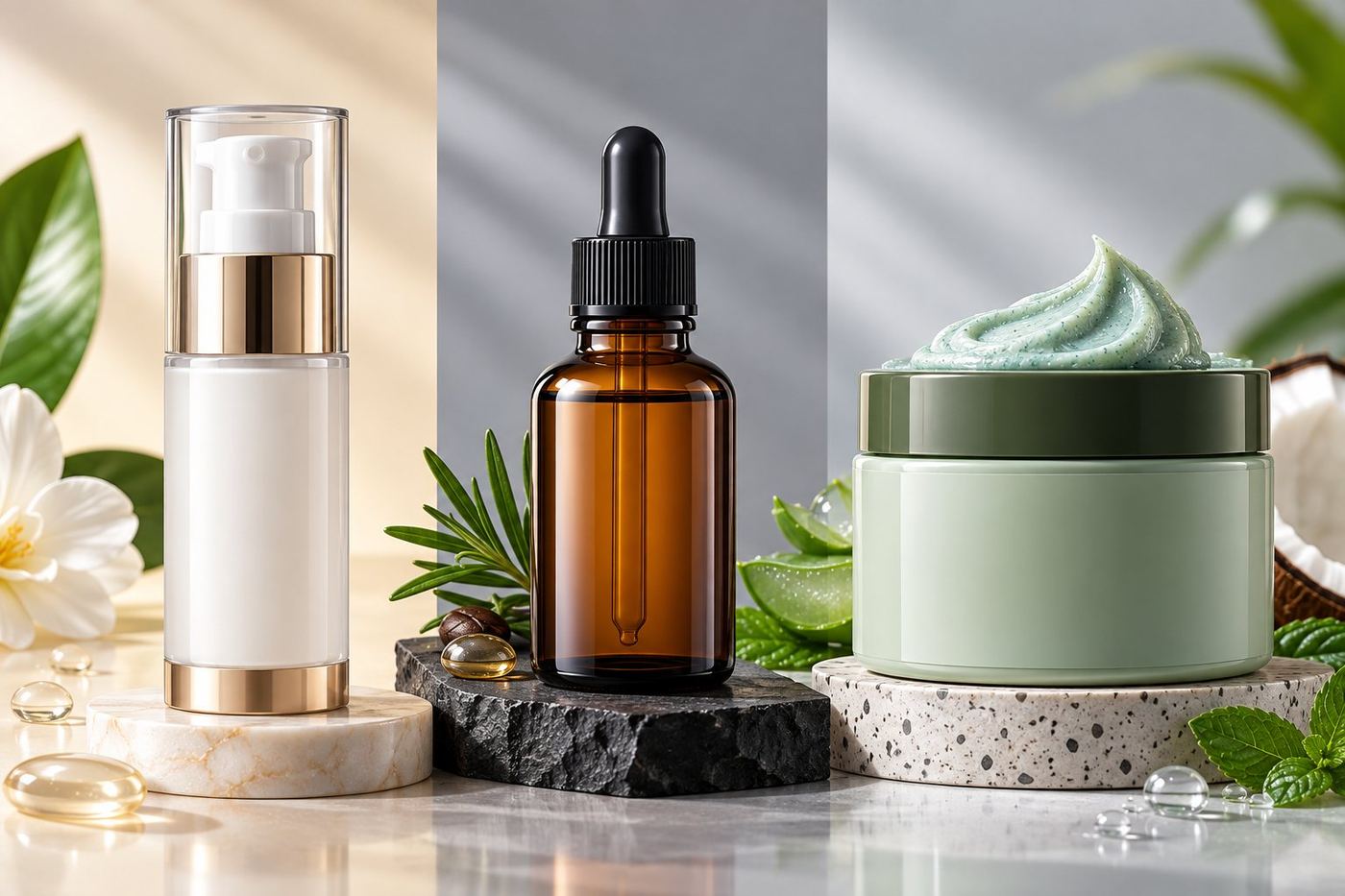
The client had already developed three products for the Canadian market: a skin brightening and anti-ageing product, a men’s hair care product and a concentrated shampoo paste. Before launch, the team wanted independent proof of how each one compared with what shoppers already buy.
The client’s rule was simple: each product had to at least match the quality of the best products on the market. CSL was asked to run a technical benchmark study of all three, choosing the right reference products for each and comparing them parameter by parameter.
- Client product 1Skin brightening & anti-ageing
- Client product 2Men’s hair care
- Client product 3Concentrated shampoo paste
The challenge
Safety benchmarks without animal data
Benchmarking safety used to lean on animal data. That route is now closed. The EU bans testing cosmetic ingredients and finished products on animals, and since March 2013 it also bans the sale of cosmetics developed with new animal tests. Canada brought in its own ban on cosmetic animal testing in December 2023.
What the team had to work with
- No animal testingSafety had to be shown with in vitro methods, existing data and expert assessment.
- Limited public dataThe full composition, ingredient levels and safety data of the market reference products are rarely in the public domain.
- Many parametersEach client product had to be compared on toxicology, safety, mode of action and efficacy, and on attributes such as design and colour, and no single reference product covers all of them.
The task was to build benchmarks robust enough for real safety and launch decisions, using only animal-free evidence and incomplete information about the reference products.
Bracketing a prototype on the safety spectrum
- Non-irritant reference
- Acceptable benchmark
- Borderline benchmark
- Irritant reference
Our approach
Benchmarks built the way toxicologists work
CSL’s deformulation and safety team designed the study around the way toxicologists use established products as reference points, and selected several reference products for each client product, depending on what each parameter needed.
- Step 1
Select the references
For each client product, the team chose several commercially available reference products, picking different references for toxicology, safety, mode of action, efficacy and product attributes such as design and colour. Where the composition, ingredient levels or safety data of a reference were not public, assumptions were based on its manufacturer’s own safety and efficacy claims.
- Step 2
Bracket with more than one benchmark
Each client product was set against an acceptable benchmark, and against borderline references where useful, to narrow down where it sits on the safety spectrum. Using several reference points is common practice, depending on the existing data and the purpose of the study.
- Step 3
Bring in analogues
Where an ingredient under review was a chemical such as a surfactant, a structurally similar analogue, or one from the same chemical or functional class with known toxicology data, was used as a reference.
- Step 4
Calibrate with reference standards
In vitro skin irritation reference standards, whose irritation classification is already established, covered both ends of the profile, irritant and non-irritant. This calibrated the study and gave a measure of confidence in each classification.
3client products, each benchmarked against several references
04 · The result
Clear evidence of where each product stands
The client received one detailed report for all three products: toxicology, safety and mode of action against the benchmarks, the efficacy evidence for each product’s intended use, product attributes such as design and colour, and the calibration against reference standards. The client was pleased with the depth of the report, which gave the team clear evidence of where each product stands against the market.
What the client received
Why it matters
Benchmarking that drives decisions
Reference products and standards with known profiles make it possible to judge whether a new formula is acceptable, which helps brands make launch decisions and keep innovating without animal testing.
A measurable bar
Each product is judged against defined benchmarks for every parameter, not a general impression of the market leader.
Animal-free confidence
Calibrated in vitro data supports safety decisions that meet EU and Canadian animal testing bans.
Launch with evidence
Gaps against the market are found before launch, so the team knows exactly where a product leads and where to improve it.
Related
Benchmark your own products
Start a project
Create your next product with CSL.
Our formulation chemists, testing scientists and regulatory specialists work alongside your team, from the first brief to a market-ready product. Bring a brief, a benchmark or just an idea: a scientist will reply within one working day with next steps and an indicative scope.