Randomised controlled trialMelanoma · daily sunscreen
Daily SPF 15+ sunscreen vs discretionary use
Randomised trial · 1,621 adults · 4.5 years + 10-year follow-up
Invasive melanomas were fewer with daily use (3 vs 11; HR 0.27, 95% CI 0.08–0.97); all new primary melanomas halved (11 vs 22), borderline significant.
Green AC et al. J Clin Oncol 2011;29(3):257–263 · PMID 21135266 ↗
Randomised controlled trialSkin cancer · daily sunscreen
Daily SPF 15+ sunscreen vs discretionary use
Community randomised factorial trial · 1,621 adults · 4.5 years
Squamous cell carcinoma tumours were 39% lower with daily sunscreen (RR 0.61, 95% CI 0.46–0.81); no effect on basal cell carcinoma.
Green A et al. Lancet 1999;354(9180):723–729 · PMID 10475183 ↗
Randomised controlled trialPhotoageing · daily sunscreen
Daily broad-spectrum SPF 15+ vs discretionary use
Randomised community trial, blinded assessment · 903 adults · 4.5 years
Daily users showed 24% less skin ageing (relative odds 0.76) than discretionary users.
Hughes MC et al. Ann Intern Med 2013;158(11):781–790 · PMID 23732711 ↗
Randomised controlled trialSun damage · actinic keratoses
SPF 17 sunscreen vs base cream
Randomised, placebo-controlled · 588 adults aged 40+ · one summer
Fewer new solar keratoses with sunscreen (1.6 vs 2.3 per person), and more existing lesions went into remission.
Thompson SC et al. N Engl J Med 1993;329(16):1147–1151 · PMID 8377777 ↗
Randomised controlled trialHow people use SPF
SPF 30 vs SPF 10 on holiday
Randomised, double-blind · 87 young adults · summer holiday
People used the same amount of sunscreen but stayed in the sun longer with SPF 30 (72.6 vs 58.2 hours), a reason to design for real use.
Autier P et al. J Natl Cancer Inst 1999;91(15):1304–1309 · PMID 10433619 ↗
Controlled trialApplication amount vs SPF
Sunscreen at 0.5, 1, 2 and 4 mg/cm² on the same volunteers
In-vivo SPF study · 20 volunteers
Protection fell steeply below the 2 mg/cm² test dose, so texture that encourages generous use matters as much as the SPF number.
Faurschou A, Wulf HC. Br J Dermatol 2007;156(4):716–719 · PMID 17493070 ↗
Randomised controlled trialMelasma · visible-light protection
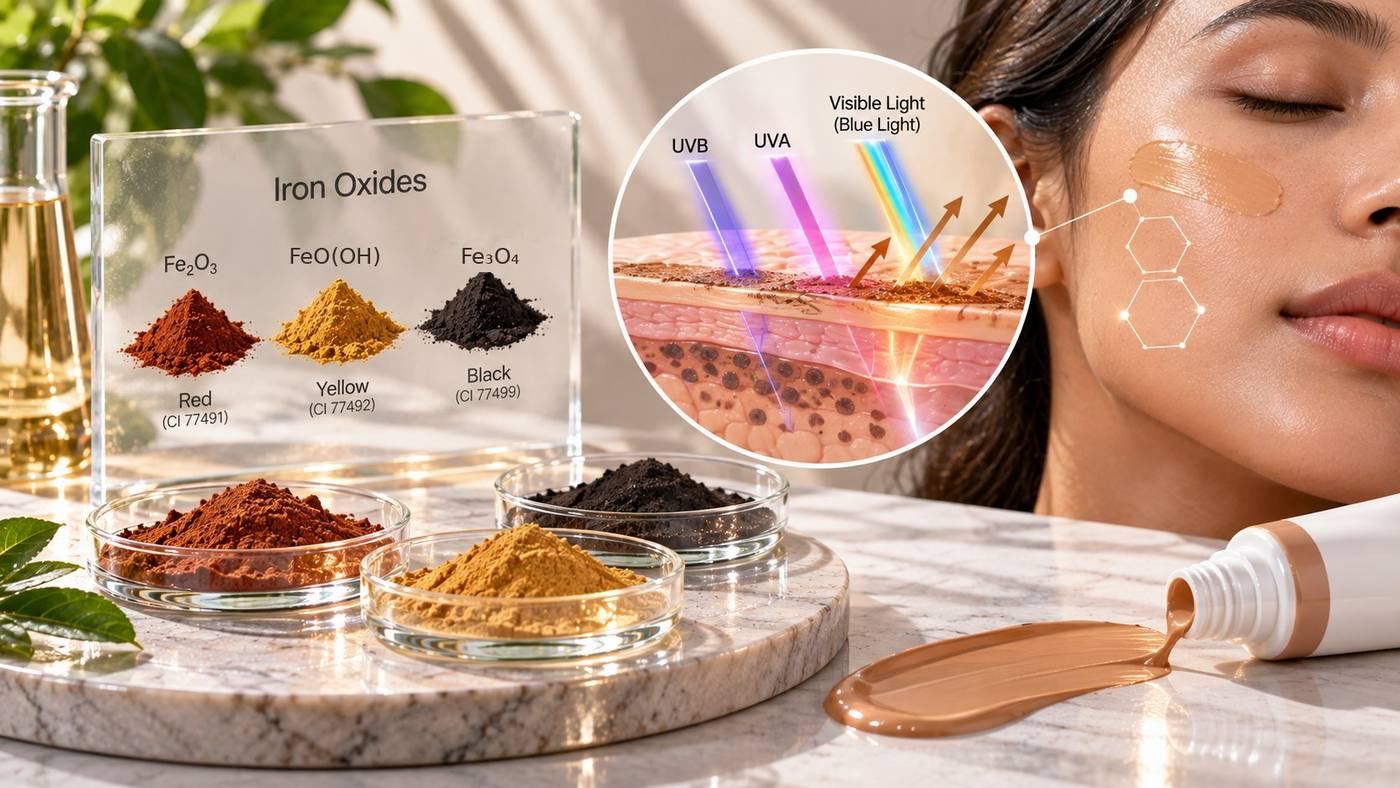
UV + visible-light sunscreen with iron oxides vs UV-only sunscreen
Randomised, double-blind · 68 patients with melasma · 8 weeks
The iron-oxide formula improved melasma severity by 15% more than the UV-only sunscreen (MASI), with lower melanin on biopsy.
Castanedo-Cazares JP et al. Photodermatol Photoimmunol Photomed 2014;30(1):35–42 · PMID 24313385 ↗
Randomised controlled trialMelasma relapse · tinted SPF
Tinted UV + visible-light sunscreen vs UV-only sunscreen
Randomised comparative trial · 40 patients · 6 months
Melasma relapsed far less with the tinted, visible-light formula (median MASI rise 0.45 vs 2.43, P=.027).
Boukari F et al. J Am Acad Dermatol 2015;72(1):189–190 · PMID 25443629 ↗
Randomised controlled trialLip SPF
Lip sunscreen vs placebo before UV exposure
Double-blind crossover · 38 people prone to cold sores
UV-triggered cold sores appeared in 71% after placebo and in none after sunscreen.
Rooney JF et al. Lancet 1991;338(8780):1419–1422 · PMID 1683420 ↗
These are published studies on ingredients, methods and routines, not on products we have made. A finished product needs its own testing before a claim goes on pack, and we design that study with you. See the full evidence library