Randomised controlled trialMild cleansing · infants
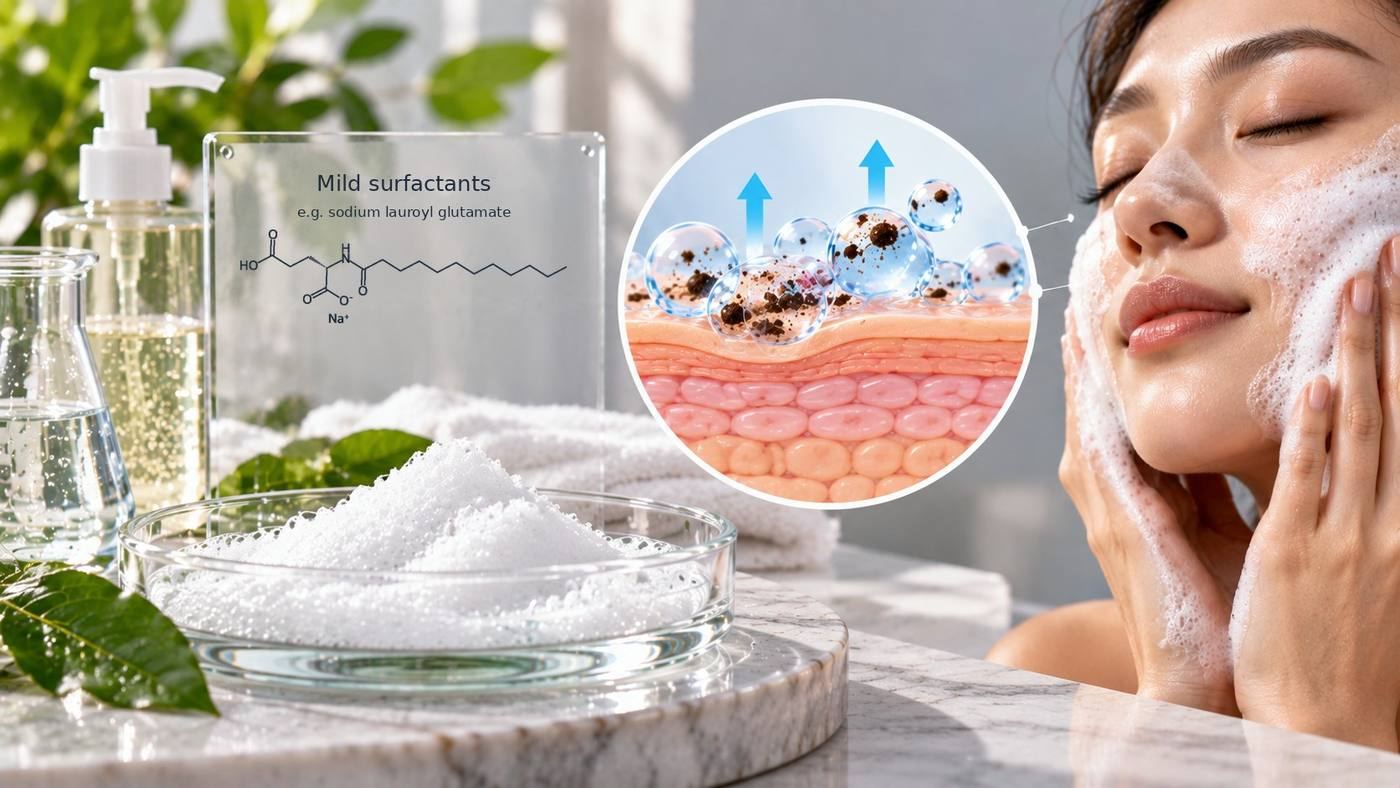
Alkaline soap vs syndets vs water
Open, randomised, controlled · 40 infants
Alkaline soap raised skin pH most (+0.45 vs +0.19 for water) and removed the most surface lipid; syndets were gentler.
Gfatter R et al. Dermatology 1997;195(3):258–262 · PMID 9407174 ↗
Randomised controlled trialGentle wash · newborn barrier
Baby wash vs water only
Assessor-blinded, randomised non-inferiority · 307 newborns · 14–28 days
The wash was non-inferior to water on TEWL (12.8 vs 12.5 g/m²/h) and gave higher skin hydration (p=0.022).
Lavender T et al. J Obstet Gynecol Neonatal Nurs 2013;42(2):203–214 · PMID 23421327 ↗
Randomised controlled trialBaby wipes vs water
Alcohol-free baby wipe vs cotton wool and water
Assessor-blinded equivalence trial · 280 newborns · 4 weeks
Wipes were equivalent to water on skin hydration, and mother-reported nappy rash was lower with wipes (p=0.025).
Industry-funded.
Lavender T et al. BMC Pediatr 2012;12:59 · PMID 22656391 ↗
Randomised controlled trialEmollient from birth
Daily full-body emollient from birth vs none
Randomised, assessor-blinded · 124 high-risk newborns · 6 months
Eczema at 6 months was 22% vs 43% (RR 0.50).
Small trial; larger trials below did not confirm prevention.
Simpson EL et al. J Allergy Clin Immunol 2014;134(4):818–823 · PMID 25282563 ↗
Randomised controlled trialEmollient from birth
Daily moisturiser for 32 weeks vs control
Randomised · 118 high-risk newborns · 32 weeks
About 32% fewer moisturised infants developed eczema by week 32 (P=.012).
Horimukai K et al. J Allergy Clin Immunol 2014;134(4):824–830 · PMID 25282564 ↗
Randomised controlled trialEmollient from birth · large trial
Daily emollient for the first year vs advice only
Multicentre, pragmatic · 1,394 newborns · 2 years
No reduction in eczema at age 2 (23% vs 25%), and more skin infections in the emollient group.
Negative trial: we do not claim emollients prevent eczema.
Chalmers JR et al. Lancet 2020;395(10228):962–972 · PMID 32087126 ↗
Randomised controlled trialEmollient from birth · large trial
Emollient oil baths and face cream vs no intervention
Cluster-randomised factorial · 2,397 newborns · 12 months
Skin care did not reduce atopic dermatitis (11% vs 8%).
Negative trial.
Skjerven HO et al. Lancet 2020;395(10228):951–961 · PMID 32087121 ↗
Randomised controlled trialDry, eczema-prone skin · coconut oil
Virgin coconut oil vs mineral oil
Randomised, double-blind · 117 children · 8 weeks
Eczema severity fell 68% with coconut oil vs 38% with mineral oil (P<0.05).
Evangelista MT et al. Int J Dermatol 2014;53(1):100–108 · PMID 24320105 ↗
Randomised controlled trialEczema-prone skin · colloidal oatmeal
1% colloidal oatmeal cream vs prescription barrier cream
Randomised, double-blind, active-controlled · children with eczema · 3 weeks
The oatmeal cream matched the prescription barrier cream on eczema improvement, with similar tolerability.
Manufacturer-sponsored.
Lisante TA et al. J Dermatolog Treat 2017;28(7):659–667 · PMID 28366039 ↗
Randomised controlled trialBaby oils on newborn skin
Olive oil vs sunflower oil vs no oil
Randomised, assessor-blinded pilot · 115 newborns · 4 weeks
Both oils raised hydration but gave less improvement in skin lipid structure than no oil, a reason to test oils carefully on newborn skin.
Cooke A et al. Acta Derm Venereol 2016;96(3):323–330 ↗
Controlled trialNappy care · dexpanthenol + zinc oxide
Dexpanthenol and zinc oxide ointment vs base
Split-side comparison · 46 children with nappy rash · 7 days
Barrier function (TEWL) was better on the treated side by day 3 (p=0.002); severity scores did not differ.
Wananukul S et al. J Med Assoc Thai 2006;89(10):1654–1658 · PMID 17128840 ↗
These are published studies on ingredients, methods and routines, not on products we have made. A finished product needs its own testing before a claim goes on pack, and we design that study with you. See the full evidence library