EU CPSR: Cosmetic Product Safety Report Under Regulation (EC) No 1223/2009
What the EU CPSR must contain under Annex I, how the Margin of Safety is calculated, which tests support it and why reports get challenged at inspection.
By CSL Regulatory team · Technical pillar page · Checked against EUR-Lex and SCCS sources
Quick answer
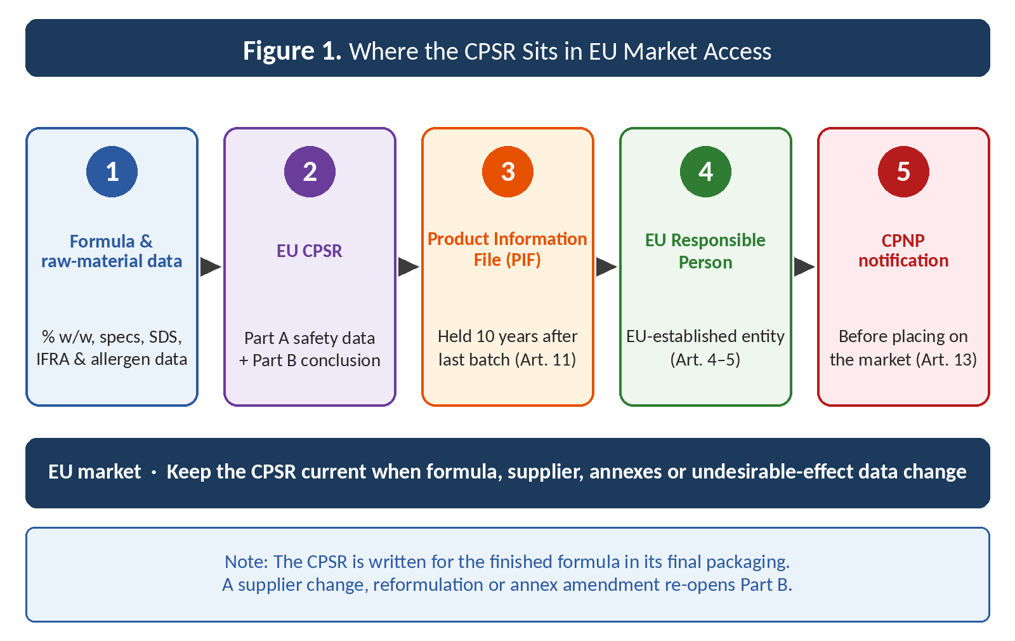
An EU CPSR (Cosmetic Product Safety Report) is the safety assessment that Article 10 and Annex I of Regulation (EC) No 1223/2009 require before any cosmetic is placed on the EU market. [1] Part A compiles composition, stability, microbiology, impurity, exposure and toxicological data. Part B is the qualified safety assessor’s signed conclusion. The CPSR sits inside the Product Information File (PIF), held by the EU Responsible Person, and is in place before the product is notified on CPNP and placed on the market.
Take-home messages
- If you already sell in the EU
- Re-open every CPSR affected by the 31 July 2026 fragrance allergen deadline. [4] Treat a supplier change as a formula change: new impurity and allergen data mean a new Part B.
- If you are entering the EU
- Start stability and challenge testing on the final pack early; they sit on the critical path to launch. Appoint an EU Responsible Person, because only an EU-established Responsible Person can notify on CPNP. [1]
Products placed on the market from this date must individually declare the expanded allergen list when an allergen exceeds 0.001% in leave-on or 0.01% in rinse-off products. Products already on the market may remain available until 31 July 2028. [4]
Newly classified CMR substances moved to Annex II with no sell-through period. Re-screen any CPSR signed before this date. [5]
01What is an EU CPSR?
The Cosmetic Product Safety Report is the scientific evidence that a finished product is safe for human health under normal and reasonably foreseeable conditions of use (Article 3). [1]
- It covers the finished formula in its final packaging, not individual ingredients.
- It must follow the structure in Annex I of the EU Cosmetics Regulation.
- Commission Implementing Decision 2013/674/EU explains how to complete each section. [2]
02CPSR Part A and Part B: Annex I requirements
Table 1. CPSR Annex I sections and required technical data
| Annex I section | Technical data required |
|---|---|
| A1 Composition | Quantitative and qualitative formula: INCI, chemical and CAS names, function of each substance |
| A2 Physico-chemistry and stability | pH, viscosity, specifications, stability and packaging compatibility |
| A3 Microbiological quality | Microbiological specifications and the preservation challenge test result |
| A4 Impurities, traces and packaging | Traces of prohibited substances (Article 17), relevant packaging characteristics and migration |
| A5–A7 Use and exposure | Normal and reasonably foreseeable use, application site, amount, frequency, target population, exposure to each substance |
| A8 Toxicological profile | Point of departure (e.g. NOAEL), dermal absorption, sensitisation, Margin of Safety |
| A9–A10 Effects and other data | Undesirable and serious undesirable effects, human tolerance and in-use data |
| Part B Assessment | Conclusion, label warnings and instructions, reasoning, assessor credentials and approval |
Structure as set out in Annex I of Regulation (EC) No 1223/2009 and Implementing Decision 2013/674/EU. [1] [2]
03Margin of Safety calculation in a cosmetic safety assessment
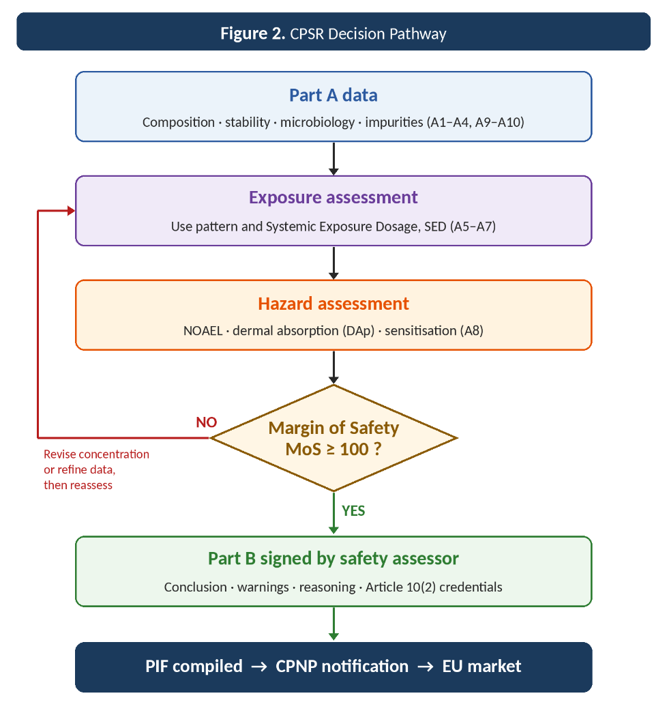
For ingredients that can reach the systemic circulation, the cosmetic safety assessment compares a toxicological point of departure with the Systemic Exposure Dosage (SED). Exposure values and default assumptions come from the SCCS Notes of Guidance, 12th revision (SCCS/1647/22). [3]
Core equations
SED = A × C/100 × DAp/100 (mg/kg bw/day)
where A is the daily exposure to the product, C is the ingredient concentration (%) and DAp is dermal absorption (%).
MoS = PoDsys / SED → generally acceptable when MoS ≥ 100
where PoDsys is the systemic point of departure: the oral NOAEL adjusted for oral bioavailability.
Worked example (illustrative)
- An ingredient is used at 1% in a face cream, where A = 24.14 mg/kg bw/day (SCCS default for face cream).
- With the default 50% dermal absorption, SED = 24.14 × 0.01 × 0.5 = 0.121 mg/kg bw/day.
- The oral NOAEL is 100 mg/kg bw/day. With the default 50% oral bioavailability, PoDsys = 50 mg/kg bw/day.
- MoS = 50 ÷ 0.121 = 414.
The ingredient passes. If the MoS fell below 100, the assessor would lower the concentration or refine the data, for example with a measured dermal absorption value.
04Testing required to support a CPSR
Table 2. Tests required to support a CPSR
| Test | Standard or method | Feeds section |
|---|---|---|
| Stability testing | Accelerated and real-time, ISO/TR 18811 guidance | A2 |
| ISO 11930 challenge test | ISO 11930 preservation efficacy [6] | A3 |
| Microbial limits | ISO 17516 [7] | A3 |
| Packaging compatibility | Final pack, migration and interaction | A2, A4 |
| Dermatological tolerance | Supervised HRIPT or in-use study | A9–A10 |
All tests use non-animal methods, in line with the Article 18 animal-testing ban. See the CSL safety and stability testing service and the ISO 11930 challenge test guide.
05How CSL prepares your EU CPSR
- Formula and annex screen: CSL regulatory specialists check every substance against Annexes II–VI and current CMR entries.
- Raw-material dossier: specifications, impurity profiles, toxicological data and IFRA and allergen declarations are collected.
- Product testing: stability, compatibility and challenge testing run on the final formula in the final pack.
- Exposure and MoS: the SED and Margin of Safety are calculated for each relevant ingredient.
- Part B assessment: a safety assessor qualified under Article 10(2) signs the conclusion.
- PIF and CPNP: the PIF is compiled and kept for ten years after the last batch is placed on the market, and the product is notified on CPNP. [1]
Why CPSRs get challenged at inspection
- Default dermal absorption is used where supplier data existed, or the reverse, without justification.
- Fragrance allergens are not reconciled against the current Annex III list.
- Stability is run in a different pack from the one sold.
- Part B conclusions cannot be traced back to Part A data.
Technical CPSR review
Send your quantitative formula and raw-material data. A CSL safety assessor will screen the formula against Annexes II–VI, flag missing Part A data and pre-calculate the MoS for your highest-risk ingredients, with a reply within one working day.
Request a CPSR gap assessment06EU CPSR FAQs
Is a CPSR mandatory for cosmetics sold in the EU?
Yes. Article 10 requires a safety assessment and a CPSR for every cosmetic before it is placed on the market. The Responsible Person keeps it in the Product Information File.
Who can sign an EU CPSR?
A safety assessor holding a diploma or other evidence of formal qualifications from a university course in pharmacy, toxicology, medicine or a similar discipline, or a course recognised as equivalent by a Member State (Article 10(2)).
What Margin of Safety is acceptable?
Under the SCCS Notes of Guidance, a MoS of at least 100 is generally considered to indicate safe use for an ingredient that reaches the systemic circulation.
Does a CPSR need updating?
Yes. Update it whenever the formula, a supplier, the annexes or undesirable-effect data change. A CSL compliance retainer covers this file maintenance.
07Conclusion
An EU CPSR is the scientific foundation of every cosmetic placed on the EU market, not a one-off document to file and forget. A defensible report links Part A data to a signed Part B conclusion, uses current SCCS Notes of Guidance exposure values, justifies its Margin of Safety and rests on testing of the final formula in its final pack.
With the fragrance allergen deadline now in force and Omnibus VII adding new CMR bans, a CPSR is only as reliable as the annex version it was assessed against. Brands that review their safety reports whenever a formula, supplier or regulation changes keep their Product Information File audit-ready and their CPNP notification secure.
08Get an Annex I-compliant CPSR your Responsible Person can defend
CSL delivers the formula screen, exposure modelling, Margin of Safety calculations and a signed Part B, built on non-animal data and ready for your PIF and CPNP notification. See also EU Responsible Person and market entry and regulatory services.
09References
- Regulation (EC) No 1223/2009 of the European Parliament and of the Council of 30 November 2009 on cosmetic products. Link
- Commission Implementing Decision 2013/674/EU of 25 November 2013 on Guidelines on Annex I to Regulation (EC) No 1223/2009 on cosmetic products. Link
- Scientific Committee on Consumer Safety. The SCCS Notes of Guidance for the testing of cosmetic ingredients and their safety evaluation, 12th revision (SCCS/1647/22), adopted 15 May 2023, with corrigenda. Link
- Commission Regulation (EU) 2023/1545 of 26 July 2023 amending Regulation (EC) No 1223/2009 as regards labelling of fragrance allergens in cosmetic products. Link
- Commission Regulation (EU) 2025/877 amending Regulation (EC) No 1223/2009 as regards the use in cosmetic products of certain substances classified as carcinogenic, mutagenic or toxic for reproduction (Omnibus VII). Link
- International Organization for Standardization. ISO 11930:2019 Cosmetics — Microbiology — Evaluation of the antimicrobial protection of a cosmetic product. Link
- International Organization for Standardization. ISO 17516:2014 Cosmetics — Microbiology — Microbiological limits. Link
Update log
- Published; content checked against EUR-Lex, SCCS and ISO sources by CSL regulatory specialists