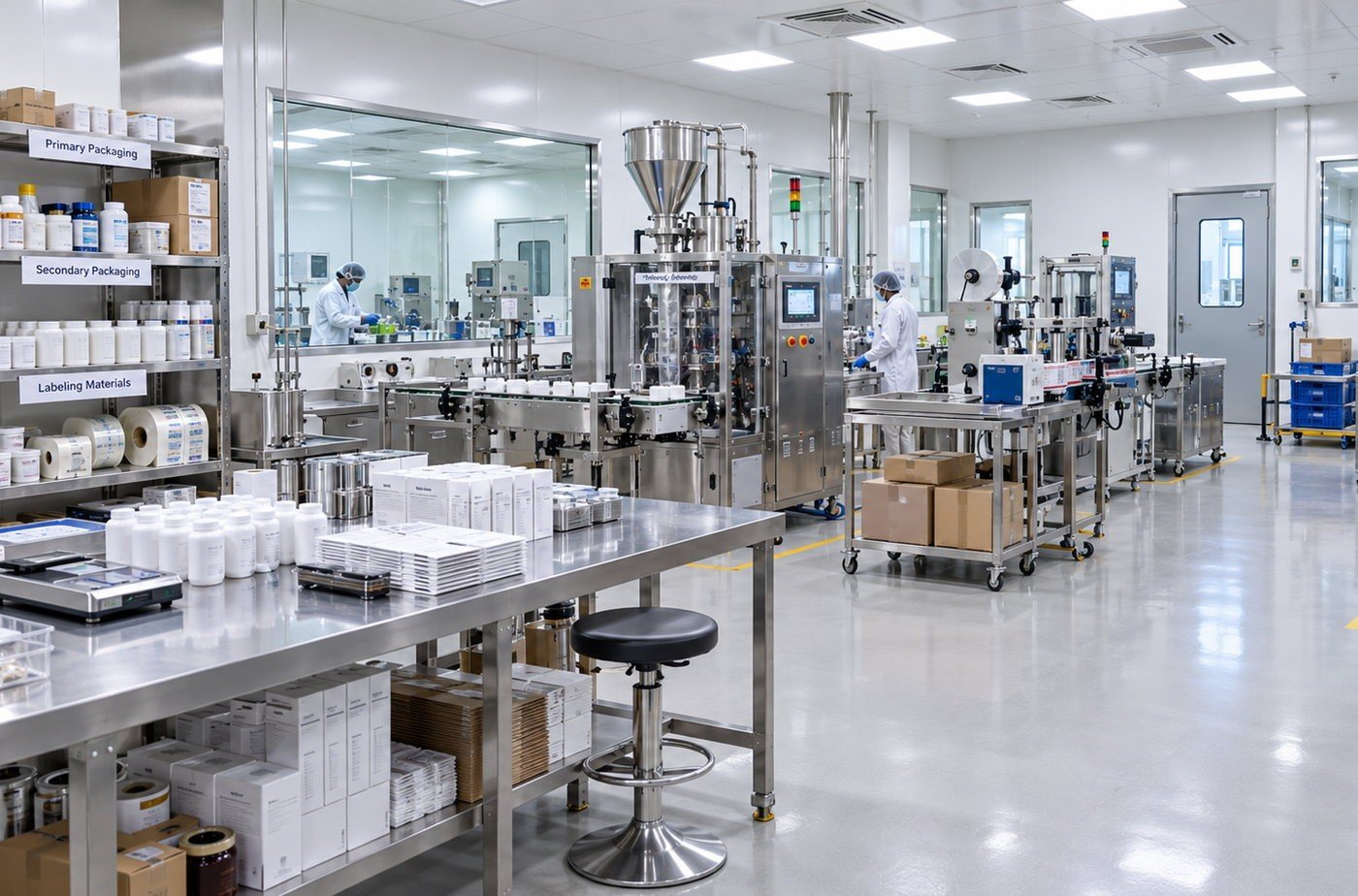
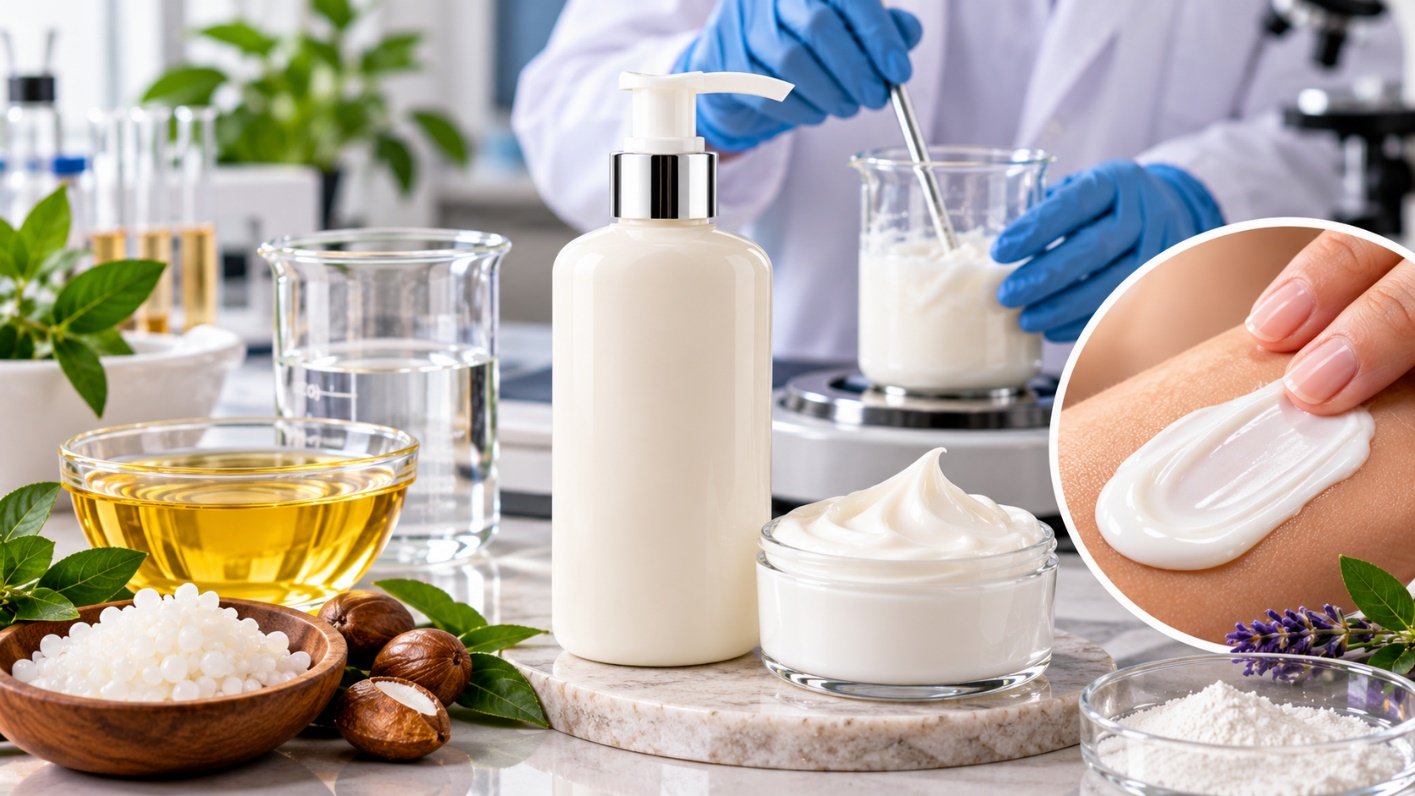
From bench to pilot: cosmetic tech transfer and scale-up
What changes between a 1 kg lab batch and a 500 kg tank, the process parameters that break, and the checklist to complete before you hand your formula to a manufacturer.
By Dr. Premalatha, Ph.D., Life Science, Regulatory Consultant, Cosmetic Science Lab
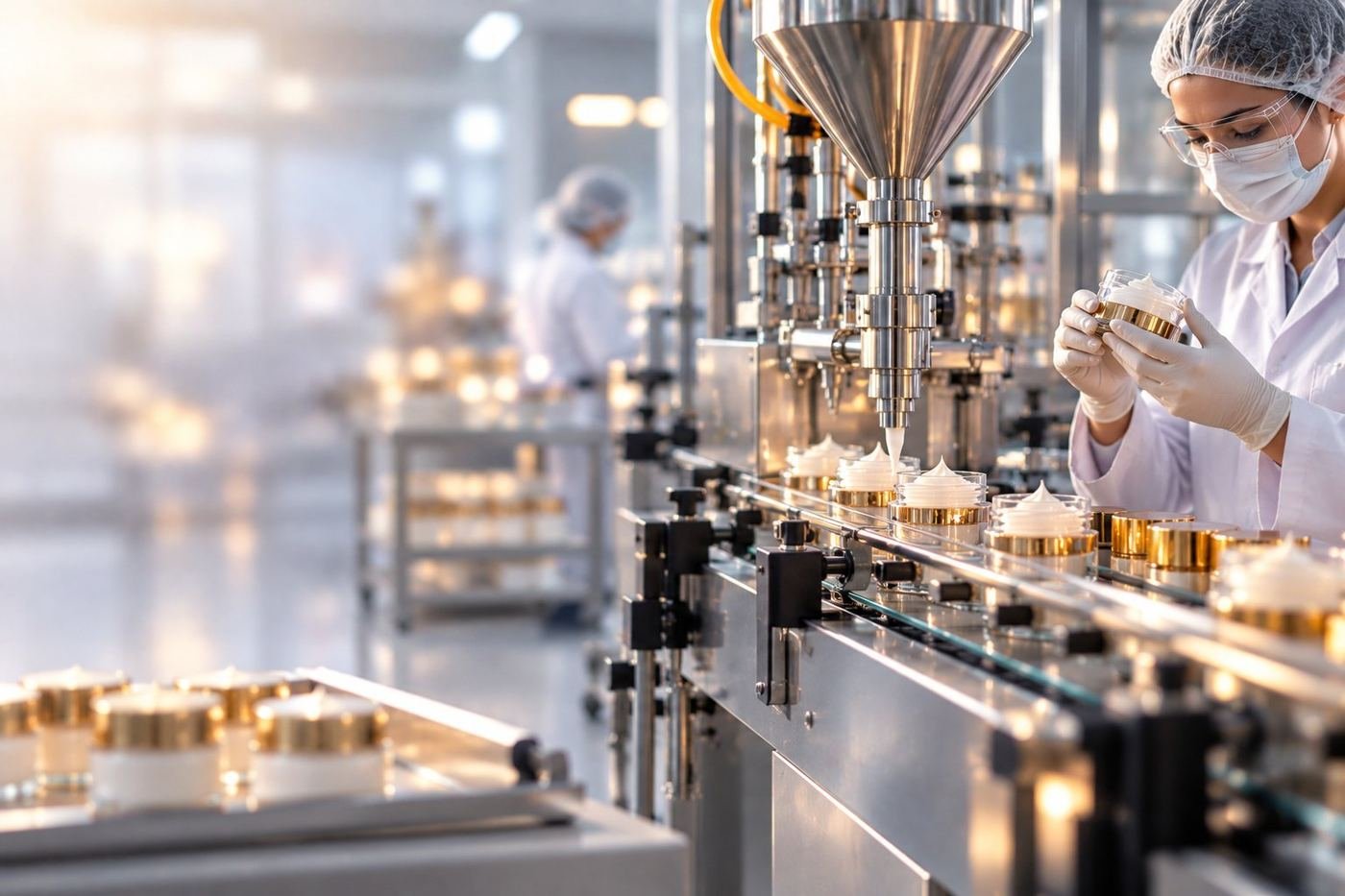
Quick answer
- What is cosmetic scale-up? The controlled move from a lab batch to a pilot batch and then the first production batch, without changing how the product looks, feels or performs.
- The formula stays the same; the physics change. Big vessels heat and cool more slowly and mix differently.
- Match homogeniser tip speed, not rpm, and write down every process parameter at the bench.
- Hand the manufacturer a full tech transfer pack, so they do not fill the gaps with their own assumptions.
Take-home message for formulators
- Record shear, tip speed, heating and cooling rates and order of addition as numbers
- Avoid lab shortcuts no production tank can copy
Take-home message for brand owners
- Budget for at least one pilot batch
- Agree who owns the formula and the batch record before tech transfer starts
01What is cosmetic scale-up?
A cream that is perfect in a 1 kg beaker can split, thin out or turn grainy in a 500 kg tank. Cosmetic scale-up is the controlled move from that lab batch to a pilot batch and then to the first production batch, without changing how the product looks, feels or performs.
The formula stays the same. The physics do not. Mixing can behave very differently between 250 ml and 2,000 litres, and lab mixing speeds usually cannot be copied in a large vessel [1]. Larger batches need longer mixing times, especially when the batch is heated or cooled [4], because a vessel's surface area grows more slowly than its volume, so heat moves in and out more slowly [6]. Tech transfer is the documentation and testing that carries your lab know-how into the factory, so the manufacturer can repeat your result every time [2].
New to creams and lotions? Start with what an emulsion is and why creams separate.
02Lab batch vs pilot batch vs first production batch
Each stage answers a different question, and skipping the pilot batch moves every surprise onto the full tank. The scale-up factor (production size ÷ lab size) shows how far the process has to stretch: 1 kg to 500 kg is a factor of 500. That is why teams step through an intermediate pilot size, such as a pilot of about 50 kg after a lab batch of 500–1,000 g [3].
| Stage | Typical size | Question it answers | Output |
|---|---|---|---|
| Lab batch | 0.5–2 kg | Does the formula work, feel right and stay stable? | Final formula, specification, stability start |
| Pilot batch | 10–50 kg, on equipment that behaves like the plant | Can the process be repeated on bigger kit? | Process window, draft batch manufacturing record |
| First production batch | Full tank, e.g. 200–2,000 kg | Does the plant hit the spec first time? | Approved batch manufacturing record, release data |
Run mixing trials on a mixer no smaller than about 10% of the final batch capacity, so the data reflects real plant conditions [4].
03Process parameters that break on scale-up
Most scale-up failures trace back to six parameters. Writing them down at the lab bench, with numbers, is the cheapest fix.
| Parameter | 1 kg lab batch | 500 kg tank | What goes wrong | What to record |
|---|---|---|---|---|
| Shear rate | High, close to the whole batch | Lower on average, uneven away from the rotor | Larger droplets, lower viscosity, separation | Mixer type, rotor–stator gap, time at each speed |
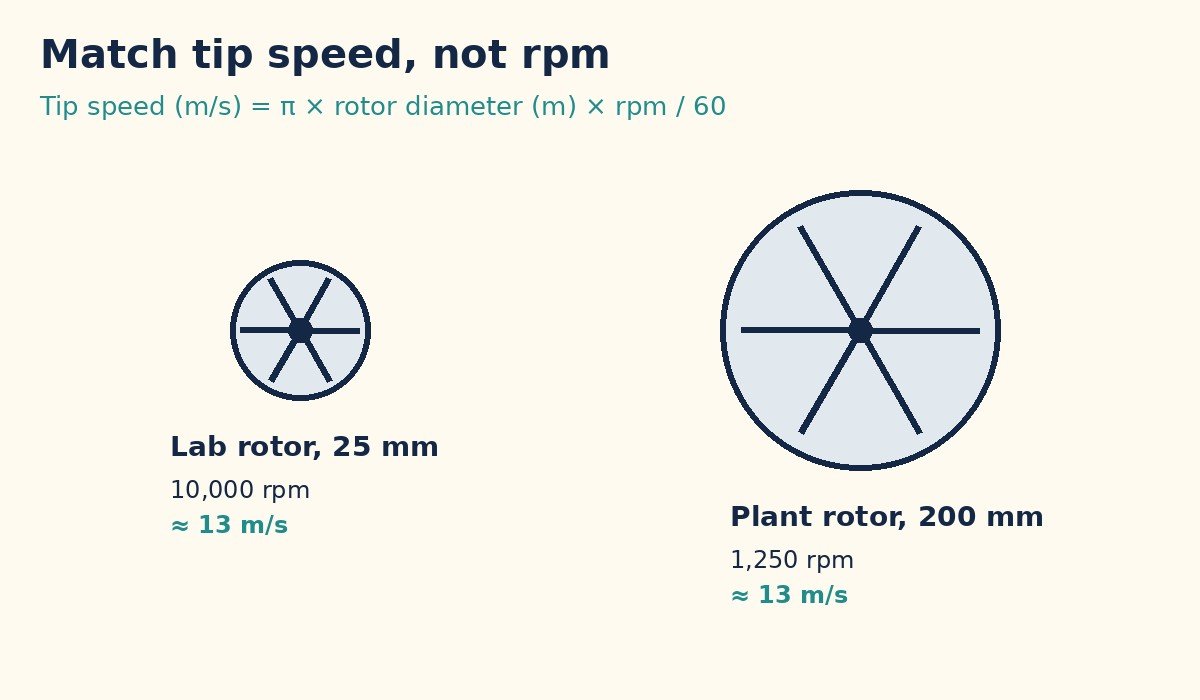
| Homogeniser tip speed | Small rotor at high rpm | Large rotor at lower rpm | Copying rpm gives the wrong shear | Tip speed in m/s, not rpm |
| Heating and cooling rate | Fast | Much slower [4], [6] | Waxes crystallise, grainy texture, thickener over-hydrates | °C per minute and hold times |
| Order of addition | Hand-added in seconds | Pumped or poured over minutes | Lumps, gel fish-eyes, emulsion inverts | Exact sequence, temperature and rate per phase [3] |
| Phase transfer | Beaker poured at once | Pumped through lines | Heat loss, premature set-up | Transfer temperature and line length |
| Air and vacuum | Little trapped air | Vortex pulls in air | Foam, low density, fill-weight errors | Vacuum level and deaeration step |
Tip speed matters most for rotor–stator homogenisers. In trials on geometrically similar mixers from lab to factory scale, droplet size tracked tip speed more closely than energy input [7].
04How to run a cosmetic tech transfer
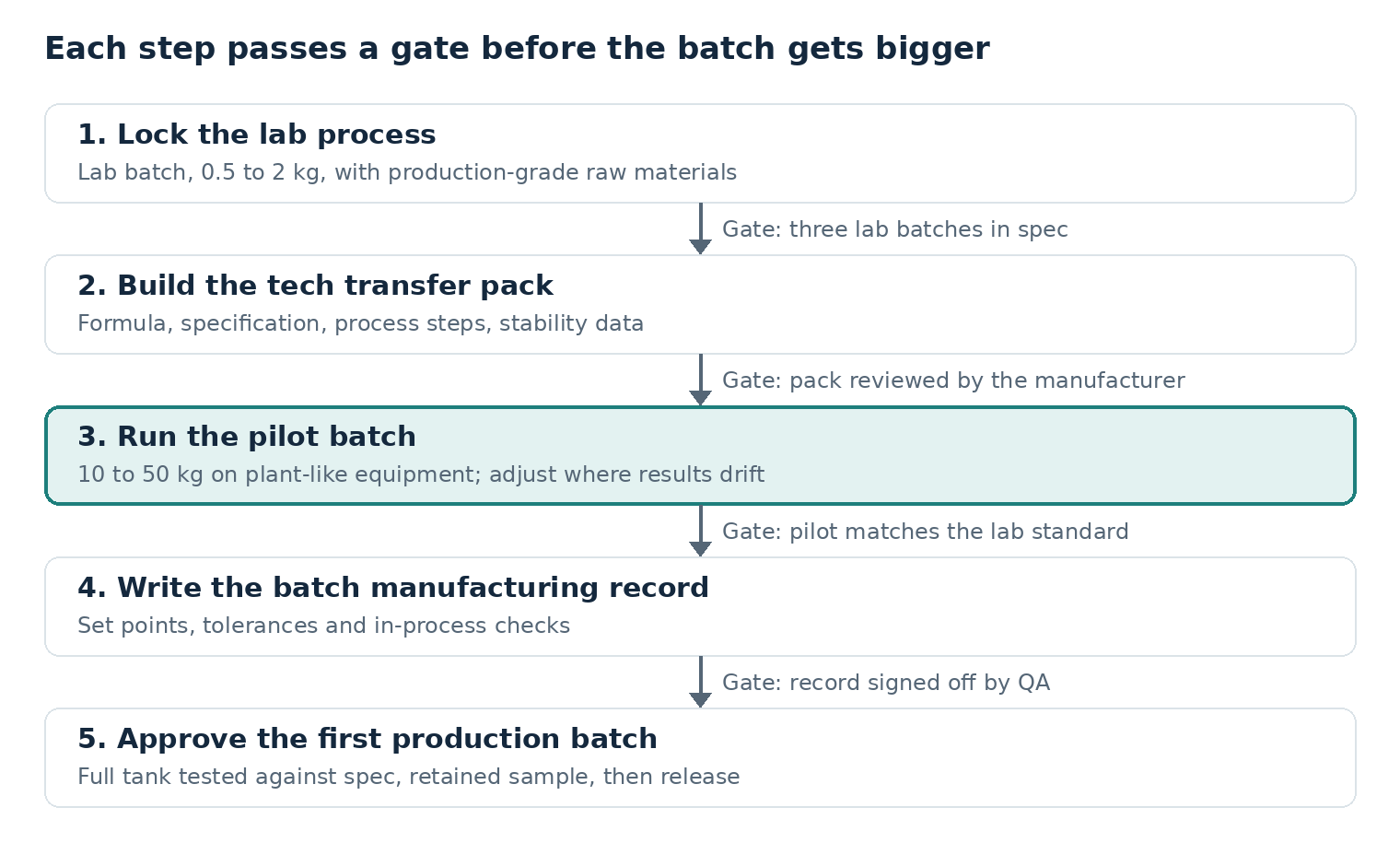
Tech transfer works best as five gated steps, where nothing moves forward until the previous step meets its acceptance criteria.
- Lock the lab process
Make three lab batches with the same raw material grades, from the same suppliers, that the factory will buy [3]. Record every parameter in Table 2, not just the formula.
- Build the tech transfer pack
Formula with INCI names and supplier codes, specification (appearance, pH, viscosity, density, micro limits), process instructions, critical control points and stability data to date [2]. Our product development team can prepare this pack with you.
- Run the pilot batch
Make it on equipment that behaves like the production line [2]. Compare pH, viscosity, droplet size and feel against the lab standard, and adjust tip speed, timing or cooling rate where results drift.
- Write the batch manufacturing record
Turn the pilot results into a step-by-step record with set points, tolerances and in-process checks the plant operator signs off, in line with the production and documentation clauses of ISO 22716 [5].
- Approve the first production batch
Test it against the full specification, keep a retained sample, start stability and compatibility testing in final packaging, then release.
05Cut waste before it starts
A failed production batch is a significant waste of time, resources and materials [1]. Four habits prevent most of it:
- Formulate for the plant, not the bench. Avoid speeding up mixing, heating or cooling in the lab in ways no production tank can copy [1].
- Use production raw materials early. A new grade or supplier can shift viscosity; test it at lab scale before it reaches the tank [3].
- Add colour and fragrance where you can still correct. Check against a standard mid-batch so a small adjustment saves the whole run.
- Plan stepped batch sizes. A failed 50 kg pilot uses a tenth of the materials of a failed 500 kg batch, and gives you the data to fix it.
Treat every off-spec result as data: log the deviation, the cause and the fix in the batch manufacturing record so the next batch does not repeat it.
06Checklist for brands before handing over to a manufacturer
If you cannot tick every box, the manufacturer will fill the gaps with their own assumptions, and your product may change.
- Final formula with INCI names, percentages, supplier and grade for every raw material
- Written order of addition with phase temperatures
- Mixing and homogeniser settings as tip speed and time, not just rpm
- Heating and cooling profile with hold points
- Finished product specification with tolerances (pH, viscosity method and spindle, appearance, odour, micro limits)
- Lab standard sample for side-by-side comparison
- Stability and packaging compatibility data to date
- Agreed pilot batch size, acceptance criteria and who signs off
- Ownership of the formula and batch manufacturing record defined in the contract
- Batch coding, retained samples and deviation reporting agreed [5]
07Questions readers ask
What is a pilot batch in cosmetics?
A pilot batch is an intermediate run, usually 10–50 kg, made on equipment similar to the production line. It proves the process can be repeated before you commit a full tank.
Why does my cream get thinner after scale-up?
Usually lower or uneven shear and slower cooling. Match homogeniser tip speed rather than rpm, and copy the lab cooling profile with set hold points.
How many pilot batches do I need?
One is the minimum; two or three give you a process window. Add more if the formula contains shear-sensitive thickeners or waxes, as many skin care creams do.
Who owns the batch manufacturing record?
Agree it in the manufacturing contract before tech transfer starts. A brand that keeps the master record can move production to another manufacturer later.
Ready to scale your formula?
Our product development team builds tech transfer packs, supports pilot batches and stays with you through the first production batch, so the product your customers buy matches the one you approved.
08References
- Happi. Coperion makes scale-up not-so scary (interview with Corinne Delpy, Coperion). happi.com
- Kothari C. From formula to face: how skincare is developed at scale. The Ordinary (DECIEM) blog; 20 April 2026. theordinary.com
- Jain S. Key challenges in scaling up production process. Cosmetech. cosmetech.co.in
- Dillon E. Gearing up for personal care production success: dynamics and equipment. Cosmetics & Toiletries. February 2024. cosmeticsandtoiletries.com
- ISO 22716:2007. Cosmetics. Good manufacturing practices (GMP). Guidelines on good manufacturing practices; clause 7 (Production) and clause 17 (Documentation). International Organization for Standardization. iso.org
- Paul EL, Atiemo-Obeng VA, Kresta SM, eds. Handbook of Industrial Mixing: Science and Practice. Hoboken (NJ): Wiley-Interscience; 2004. Chapter 14, Heat transfer. ISBN 978-0-471-26919-9.
- Hall S, Pacek AW, Kowalski AJ, Cooke M, Rothman D. The effect of scale and interfacial tension on liquid–liquid dispersion in in-line Silverson rotor–stator mixers. Chem Eng Res Des. 2013;91(11):2156–2168. DOI
Update log
- Published by Cosmetic Science Lab
This article is general technical information, not legal, regulatory or medical advice. Confirm requirements for your product and market before launch.