What is an emulsion? Oil-in-water vs water-in-oil, and why creams separate
How an emulsion holds oil and water together, how oil-in-water and water-in-oil types differ, the four ways creams separate, and the stability tests that catch each one.
By CSL Formulation science team, Cosmetic Science Lab · Reviewed by Dr. Premalatha, Ph.D., Life Science, Regulatory Consultant
Quick answer
- What is an emulsion? A mixture of two liquids that do not normally blend, usually oil and water, where one is broken into fine droplets and held inside the other by an emulsifier.
- In an oil-in-water (O/W) emulsion, oil droplets sit in water: light lotions and most creams. In a water-in-oil (W/O) emulsion, water droplets sit in oil: rich, occlusive barrier creams.
- No emulsion is permanently stable. Good formulation slows separation until it falls outside the product's shelf life.
Take-home message for formulators
- Match the emulsifier blend to the oil phase's required HLB first
- Pick stability tests by the failure mode you need to rule out
Take-home message for brand owners
- A cream that separates once is usually two or three variables failing together
- Adding an acid active late can collapse a stable formula
01What is an emulsion?
Most creams, lotions and conditioners are emulsions. When one separates on the shelf, the brand pays in returns and reformulation. Every emulsion has two parts:
- Dispersed phase: the liquid broken into droplets.
- Continuous phase: the liquid that surrounds those droplets.
Oil and water resist mixing because of interfacial tension. Water molecules bond strongly to each other and push oil away, so the system always drifts back towards two separate layers. An emulsifier sits at the boundary between the phases, lowers that tension and wraps every droplet in a protective film. Flocculation and coalescence both begin at that film, which is why emulsifier choice matters so much [1].
02Oil-in-water vs water-in-oil emulsion
The two main types are named by which phase surrounds the other.
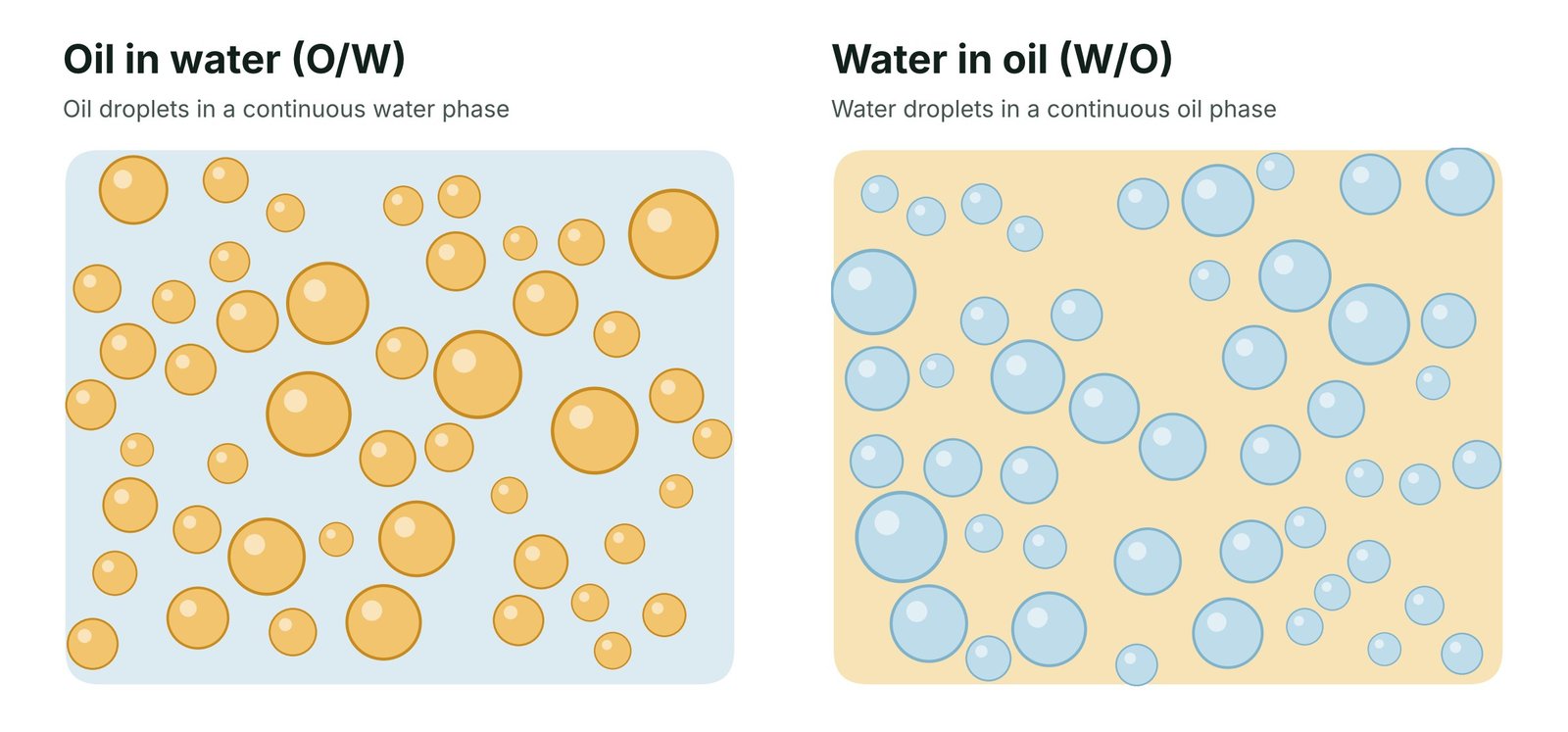
| Feature | Oil-in-water (O/W) | Water-in-oil (W/O) |
|---|---|---|
| Continuous phase | Water (an aqueous solution) | Oil |
| Dispersed phase | Oil droplets | Water droplets |
| Skin feel | Light, fast-absorbing | Rich, occlusive, water-resistant |
| Typical products | Daily moisturisers, body lotions, milky serums | Barrier creams, night creams, some sun care |
| Emulsifier HLB | High, about 9–18 [4] | Low, about 3–6 [4] |
| Quick test | Dilutes in water; conducts electricity | Dilutes in oil; does not conduct |
The HLB (hydrophile-lipophile balance) scale, introduced by Griffin in 1949, shows which type an emulsifier favours [3]. High-HLB emulsifiers build an oil-in-water emulsion; low-HLB emulsifiers build a water-in-oil emulsion. Most skin care launches use oil-in-water because consumers prefer the lighter feel. Matching the emulsifier blend to the oil phase's required HLB is the first stability decision a formulator makes.
03Formulation variables that decide emulsion stability
Four variables decide whether a formula holds for its full shelf life. They interact, so changing one often shifts another:
- Use level
Too little emulsifier leaves bare droplet surface and invites coalescence. Too much can thin the product or irritate skin. Totals of 2–5% of the formula are common.
- pH
Many emulsifiers and thickeners only work within a set pH window. In one carbomer gel study, viscosity was far lower at pH 4.7 than at pH 6 [5]. Adding an acid active such as lactic acid late in development can do the same to a carbomer-thickened cream, collapsing viscosity and starting creaming within days.
- Compatibility
Electrolytes, alcohol, botanical extracts and charged actives can strip the droplet film or break the thickener network.
- Process
Phase temperatures, order of addition, shear rate, homogenisation time and cooling speed set the final droplet size. The same formula made two ways can give two different shelf lives.
04Why creams separate: four failure modes
An emulsion fails in four main ways [1], [2]. Some can be reversed by shaking; others mean the droplets have merged for good.
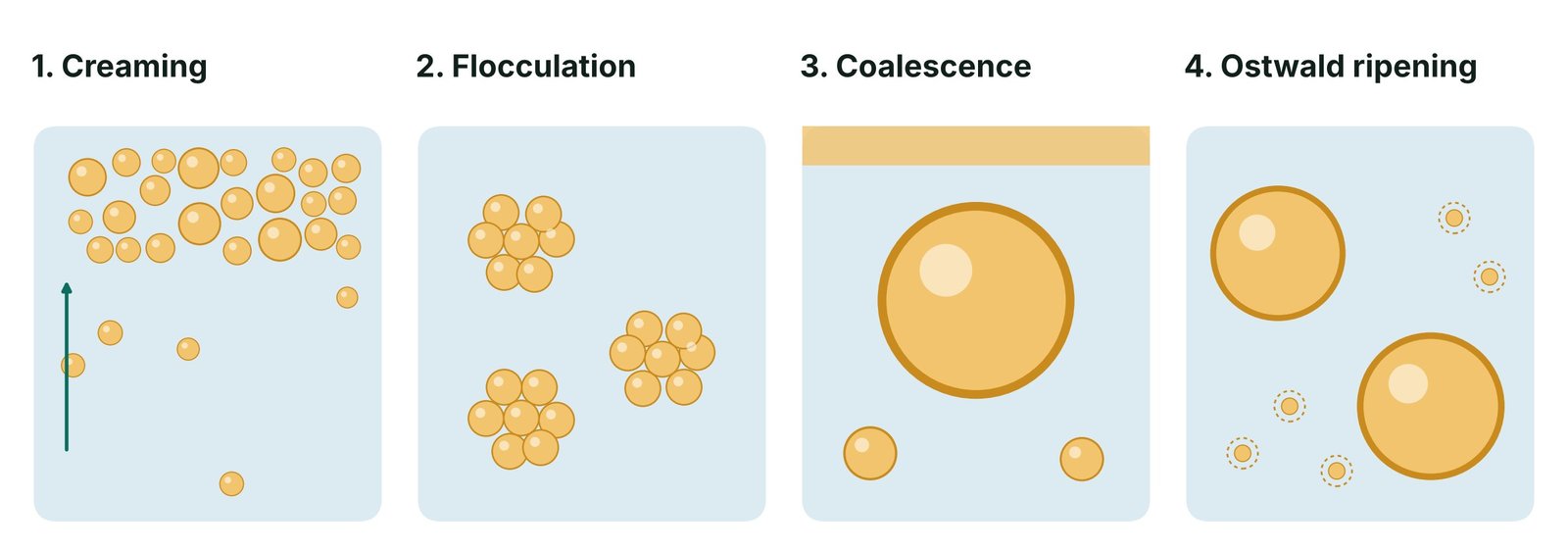
| Failure mode | What you see | Main cause | Fix |
|---|---|---|---|
| Creaming | A paler layer at the top that remixes on shaking | Density gap, large droplets, thin continuous phase | Smaller droplets; add a rheology modifier |
| Flocculation | Grainy look, uneven texture | Droplets clump but keep their film; weak charge barrier, high electrolyte | Raise droplet charge; add polymeric stabilisers |
| Coalescence | Oil pools, permanent split | Interfacial film ruptures and droplets merge | Correct HLB; raise emulsifier level; add a co-emulsifier |
| Ostwald ripening | Droplets slowly grow over weeks | Small droplets dissolve and redeposit onto large ones | Add a highly insoluble oil; narrow the droplet size range |
Creaming and flocculation are early warnings. Coalescence is the end point: once droplets merge, mixing cannot rescue the product [1]. Ostwald ripening is driven by the higher pressure inside small droplets, which makes their oil slightly more soluble. It is most common when the oil phase is partly water-soluble, as with light esters or fragrance oils [6].
Syneresis is a related failure in gelled or thickened products. The gel network contracts and squeezes liquid out, leaving a watery layer on the surface [7]. It usually points to an under-hydrated thickener, pH drift or freeze-thaw stress.
05Stokes' law: why viscosity and droplet size matter
Stokes' law gives the speed at which a droplet rises or sinks, and it explains most creaming problems in one line [1]:

- Droplet size dominates. Speed scales with radius squared, so halving droplet size cuts creaming speed by 75%. That is why homogenisation is the biggest single lever against creaming.
- Viscosity slows movement. Doubling continuous-phase viscosity halves creaming speed. That is the job of a rheology modifier such as a carbomer or xanthan gum.
- The density gap sets direction. Oil is lighter than water, so oil droplets rise in an O/W cream.
06Which stability test catches which failure
Stability tests stress a product so problems show in weeks, not months. Choose them by the failure you need to rule out:
| Test | Best at exposing |
|---|---|
| Centrifugation | Creaming, early coalescence |
| Elevated-temperature storage | Coalescence, viscosity loss, colour and odour change |
| Freeze-thaw cycling | Coalescence, syneresis, crystallised butters |
| Droplet size over time (microscopy, particle sizing) | Flocculation, Ostwald ripening |
Heat can trigger failures that never happen at room temperature and miss slow ones that do. Confirm with real-time data in the final pack. See our stability testing service.
07How CSL diagnoses a separating emulsion
When a brand sends us a separating cream, we work from symptom to root cause instead of guessing at a fix. We confirm the emulsion type and whether the split is reversible, measure droplet size by microscopy and particle sizing, and profile viscosity and yield point. Then we audit HLB, use level, pH drift and incompatible actives, and compare batch temperatures and shear with the lab method. The fix is proven with accelerated, centrifuge and freeze-thaw testing.
A separating product is rarely one problem. It is usually two or three variables pulling the same way, and a fix only holds when every one is addressed. Send us the formula, the process sheet and a photo of the failed sample. Ask for a root-cause review.
08Questions readers ask
Is lotion an emulsion?
Yes. Most lotions and creams are oil-in-water emulsions: oil droplets held in water by an emulsifier. Richer barrier creams are often water-in-oil.
Why does my cream separate after adding an active?
Usually because the active changed the pH or added electrolytes. Both can weaken the emulsifier film or the thickener network. Check pH before and after the addition, and test the final formula, not the base.
Need a cream that stays stable for its full shelf life?
We diagnose separating emulsions, rebuild the emulsifier system and prove the fix before you scale up.
09References
- Agno Pharmaceuticals. Emulsion stability and testing (technical brief). 2019. Agno Pharma
- McClements DJ. Critical review of techniques and methodologies for characterization of emulsion stability. Crit Rev Food Sci Nutr. 2007;47(7):611–649. DOI
- Griffin WC. Classification of surface-active agents by "HLB". J Soc Cosmet Chem. 1949;1(5):311. SCC library
- PCC Group. HLB: what is it? Hydrophilic-lipophilic balance. PCC Group
- Maslii Y, Ruban O, Kasparaviciene G, et al. The influence of pH values on the rheological, textural and release properties of carbomer Polacril® 40P-based dental gel formulation with plant-derived and synthetic active components. Molecules. 2020;25(21):5018. DOI
- Taylor P. Ostwald ripening in emulsions. Adv Colloid Interface Sci. 1998;75(2):107–163. DOI
- IUPAC. Syneresis. Compendium of Chemical Terminology (Gold Book), 5th ed. 2025. DOI
Update log
- Published by Cosmetic Science Lab
This article is general technical information, not legal, regulatory or medical advice. Confirm requirements for your product and market before launch.