How to make lotion: the formulator's method (not a DIY recipe)
A real oil-in-water lotion formula by phase, the four-step hot process, why homemade lotion grows mould, and what changes when you turn a recipe into a product you can sell.
By CSL Formulation science team, Cosmetic Science Lab · Reviewed by Dr. Premalatha, Ph.D., Life Science, Regulatory Consultant
Quick answer
- How to make lotion: heat a water phase and an oil phase separately to 75 °C, combine them with an emulsifier under high shear, cool while stirring, then add a preservative and adjust pH in the cool-down phase.
- Formulators write every ingredient as a percentage of the batch, so the recipe scales from 100 g to production.
- Any lotion contains water, so it needs a broad-spectrum preservative. One made without it is at real risk of growing bacteria and mould.
- To sell a lotion, you also need stability testing, a preservative challenge test and GMP manufacture.
Take-home message for formulators
- Write the formula in % w/w by phase, never in cups or spoons
- Shear and cooling rate decide droplet size, and droplet size decides stability
- Prove the preservative in the final pack with a challenge test
Take-home message for brand owners
- A kitchen recipe is a prototype, not a product
- Essential oils are not a preservative system
01How to make lotion: the formula by phase
Professional formulators write every lotion formula as batch percentages, never as cups or spoons, so the recipe scales from 100 g in the lab to 1,000 kg in production. Here is a typical oil-in-water body lotion:
| Phase | Ingredient (INCI) | % w/w | Function |
|---|---|---|---|
| A: Water phase | Aqua (distilled water) | to 100 (about 77.6) | Solvent; the continuous phase |
| Glycerin | 3.0 | Humectant; draws water into the skin | |
| Xanthan gum | 0.2 | Thickens the water phase and slows separation | |
| B: Oil phase | Glyceryl stearate (and) PEG-100 stearate | 4.0 | Primary emulsifier |
| Cetearyl alcohol | 2.0 | Co-emulsifier; adds body | |
| Stearic acid | 2.0 | Thickener; gives a soft, matte finish | |
| Butyrospermum parkii (shea) butter | 3.0 | Emollient; richer feel for dry skin | |
| Simmondsia chinensis (jojoba) seed oil | 4.0 | Emollient; a liquid wax that resists oxidation | |
| Vitis vinifera (grapeseed) oil | 3.0 | Light, fast-absorbing emollient | |
| C: Cool-down phase | Phenoxyethanol (and) ethylhexylglycerin | 1.0 | Broad-spectrum preservative |
| Tocopherol | 0.2 | Antioxidant that protects the oils | |
| Citric acid or sodium hydroxide | as needed | Adjusts pH to 5.0–5.5 |
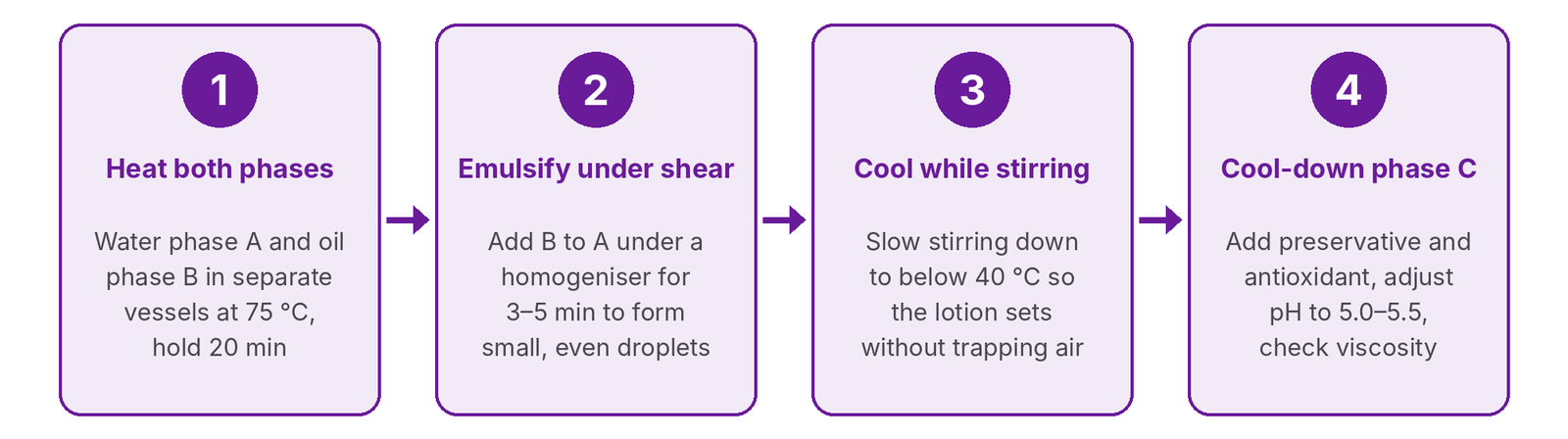
The method takes four steps:
- Heat both phases
Weigh each phase into its own vessel. Heat both to 75 °C and hold for 20 minutes; the hold helps reduce microbes in the water phase and fully melts the waxes.
- Emulsify under shear
Add the oil phase to the water phase under a homogeniser for three to five minutes. Shear creates small, even droplets, the key to a stable emulsion.
- Cool while stirring
Cool to below 40 °C with slow stirring, so the lotion sets without trapping air.
- Add cool-down ingredients and check
Add phase C, check pH and viscosity, then fill.
Kitchen guides swap the homogeniser for a hand whisk and the jacketed vessel for a double boiler. That changes droplet size, which decides how long the lotion stays mixed. Our guide what is an emulsion, and why creams separate explains why.
02Troubleshooting a homemade lotion
Most first batches fail in one of five ways. Each points back to a step in the method:
| Problem | Likely cause | Fix |
|---|---|---|
| Separates within days | Too little emulsifier, phases at different temperatures, weak shear | Raise emulsifier level; heat both phases to 75 °C; homogenise |
| Grainy texture | Shea butter or stearic acid crystallising on slow cooling | Hold at temperature until fully melted; cool with steady stirring |
| Too thin | Low fatty alcohol or gum; pH outside the thickener's range | Increase cetearyl alcohol or xanthan; check pH |
| Mould or off smell | No preservative, too little, or one that fails at the lotion's pH | Use a broad-spectrum system at its stated level; confirm with a challenge test |
| Rancid smell over time | Oxidised oils | Add tocopherol; choose stable oils; use airless packs |
03What the data show: why homemade lotion grows mould
Anyone learning how to make lotion meets the same problem: water. Any formula that contains water can feed bacteria, yeast and mould, and contamination risk rises when products are made outside a controlled facility. A Korean public health study tested 120 customised cosmetics made on the spot in shops [1]. Transferring products into new containers was a significant risk factor for contamination, and sequencing found bacteria and moulds that can cause human infections.
That is why professional formulas are proven with a challenge test. Under ISO 11930, a lab inoculates the product with five test organisms, including Escherichia coli, Staphylococcus aureus and Aspergillus brasiliensis, then measures how fast the preservative reduces them over 28 days [2]. In the EU, the safety report for most water-containing products is expected to include this preservation challenge test plus stability data [3]. See our ISO 11930 guide.
The pH target also has a basis. Healthy skin surface pH averages about 4.7 [4], which is why most leave-on lotions are adjusted to around 5.
04Myths about homemade lotion
- "Natural oils keep it fresh." Oils go rancid; they do not stop microbes growing in the water phase.
- "Essential oils are a preservative." At the low levels that are safe on skin, essential oils are not a reliable preservative system, and only a challenge test can show whether a formula is protected. Many are also fragrance allergens: under Regulation (EU) 2023/1545, the list of allergens that must be named on EU labels grows to more than 80, above 0.001% in leave-on products [5].
- "Coconut oil and cocoa butter make a lotion." Without water and an emulsifier, you have made a body butter, not a lotion. A water-free butter needs no preservative, but it feels greasier.
- "Shea butter is anti-inflammatory, so the lotion is too." Lab studies found anti-inflammatory activity in compounds isolated from shea fat [6]. A 3% use level in a lotion is not a treatment, and that claim would make the product a drug in many markets.
05For brands: what changes when you sell it
Knowing how to make lotion is a starting point; a kitchen lotion formula is not yet a product. Selling it adds three requirements:
- Stability testing
Samples are stored at heat, cold and through freeze-thaw cycles to show the lotion stays mixed, smells right and holds its pH for its shelf life.
- Preservative efficacy testing (PET)
The challenge test above, run on the final formula in its final pack.
- Good Manufacturing Practice (GMP)
In the US, MoCRA requires facility registration, product listing and safety substantiation, and directs FDA to set GMP rules; FDA had not yet proposed them as of October 2026 [7]. In the EU, ISO 22716 is the accepted GMP standard.
Production vessels heat, cool and shear at different rates from a lab beaker, so droplet size changes. Plan a pilot batch and repeat the key stability checks before the first full run. Our body lotion deformulation case study shows how we match a benchmark formula.
06Questions readers ask
How do you make lotion at home safely?
Use distilled water, a proper emulsifier and a broad-spectrum preservative at its recommended level. Weigh everything as batch percentages and keep tools sanitised. Without a challenge test, treat a homemade lotion as short-lived.
Can I make lotion without a preservative?
Not safely, if it contains water. Water-free products such as body butters and balms usually need an antioxidant rather than a preservative, as long as no water gets into the jar.
Why did my homemade lotion separate?
Usually the emulsifier level was too low, the two phases were not both at 70–75 °C when combined, or the mixing shear was too weak.
Turning a homemade lotion into a product?
We rebuild the formula, run stability and challenge tests, and prepare it for GMP manufacture for skin care and body care brands.
07References
- Kim HW, Seok YS, Cho TJ, Rhee MS. Risk factors influencing contamination of customized cosmetics made on-the-spot: evidence from the national pilot project for public health. Sci Rep. 2020;10:1561. DOI
- Intertek. ISO 11930 preservative efficacy (challenge) test for cosmetics. Intertek
- European Commission. Commission Implementing Decision 2013/674/EU on guidelines on Annex I to Regulation (EC) No 1223/2009 on cosmetic products (Part A, sections 3.2.3 and 3.3.2). 2013. EUR-Lex
- Lambers H, Piessens S, Bloem A, Pronk H, Finkel P. Natural skin surface pH is on average below 5, which is beneficial for its resident flora. Int J Cosmet Sci. 2006;28(5):359–370. DOI
- Commission Regulation (EU) 2023/1545 amending Regulation (EC) No 1223/2009 as regards labelling of fragrance allergens in cosmetic products. OJ L 188, 27.7.2023. EUR-Lex
- Akihisa T, Kojima N, Kikuchi T, et al. Anti-inflammatory and chemopreventive effects of triterpene cinnamates and acetates from shea fat. J Oleo Sci. 2010;59(6):273–280. DOI
- U.S. Food and Drug Administration. Modernization of Cosmetics Regulation Act of 2022 (MoCRA). FDA
Update log
- Published by Cosmetic Science Lab
This article is general technical information, not legal, regulatory or medical advice. Confirm requirements for your product and market before launch.