“Dermatologically tested”: what the claim needs behind it
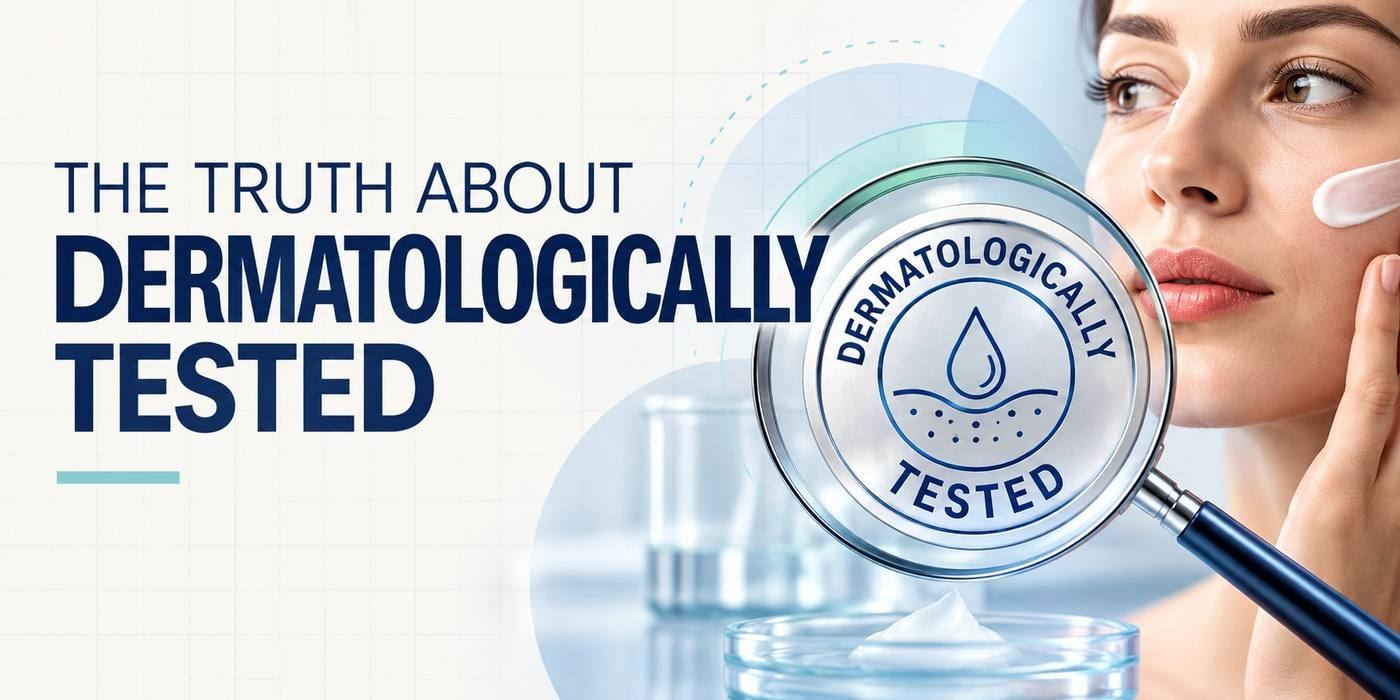
“Dermatologically tested” is one of the most common claims on a cosmetic pack, and one of the most often challenged. Here is what regulators and retailers expect to see behind it.
What a dermatologically tested claim really needs, and how to word it so it holds up in every market.
Executive summary
“Dermatologically tested” must be backed by a dermatologist-supervised test on the finished product. A patch test supports basic tolerance; daily-use products usually need an in-use study as well.
Take-home message for manufacturers
- Test the final formula, not a similar version
- Keep protocols, panel data and dermatologist reports on file
- Repeat testing when the formula changes
Take-home message for brand owners
- Keep the claim no stronger than the study
- Do not turn “tested” into “approved” or “recommended” without extra evidence
- Add a sensitive-skin panel before claiming “suitable for sensitive skin”
What the claim promises
To a shopper, “dermatologically tested” means a dermatologist has checked the product on real skin and found it well tolerated. That is the standard your evidence has to meet. A test on a raw material, or on a different version of the formula, does not support the claim for the finished product.
What the rules say
In the EU and UK, every cosmetic claim must meet the six common criteria of Regulation (EU) 655/2013: legal compliance, truthfulness, evidential support, honesty, fairness and informed decision-making. The Commission’s guidance on claims expects a “tested” claim to describe a test that was actually done, on the product sold. In the US, the FTC expects claims to be truthful and substantiated. In India, ASCI applies the same principle to advertising.
The evidence that usually supports it
- A dermatologist-supervised study on the final formula, not a similar one
- A single-application patch test (typically 48 hours under occlusion) for a basic tolerance claim
- An in-use study of two to four weeks for products used daily, graded by a dermatologist
- A sensitive-skin sub-panel if the pack also says “suitable for sensitive skin”
- HRIPT if you want to add “hypoallergenic” or “low allergy potential”
How many volunteers?
There is no single legal number. Patch tests commonly use 20 to 50 volunteers; HRIPT panels typically run from 50 to 200. What matters is that the panel suits the product and its target users, and that the method and results are documented well enough for a regulator or retailer to review.
Getting the wording right
Keep the claim exactly as strong as the study. “Dermatologically tested” is fine after a supervised patch test. “Dermatologist approved” or “recommended by dermatologists” implies an endorsement, and needs different evidence. “Clinically proven” needs an efficacy result, not just tolerance.
Questions readers ask
Is a raw-material test enough for “dermatologically tested”?
No. The claim must be supported by a test on the finished product.
How many volunteers does a patch test need?
There is no legal number; patch tests commonly use 20 to 50 volunteers.
Need help with this?
Our product, testing and regulatory teams work on this every week.
This article is general information, not legal advice. Source: Commission Regulation (EU) No 655/2013 on common criteria for cosmetic claims.