Texture claims: how sensory panels measure 'lightweight' and 'non-greasy'
How cosmetic sensory testing turns texture words into evidence: trained versus consumer panels, attribute lexicons, the role of rheology, and the pass criteria that decide which claim a result allows.
By CSL Claims and testing team, Cosmetic Science Lab · Reviewed by Dr. Premalatha, Ph.D., Life Science, Regulatory Consultant

Texture claims at a glance
- Claims covered
- "Lightweight", "non-greasy", "absorbs fast" and comparative texture claims
- Core rule (EU)
- Claims must be truthful and backed by adequate, verifiable evidence (Regulation 655/2013)
- Three evidence types
- Trained descriptive panel, consumer panel, rheology
- Method references
- ASTM E1490 (skin creams and lotions), ISO 13299 (sensory profiles)
- Decide first
- Exact claim wording and pass criteria, before any testing
Quick answer
- Cosmetic sensory testing turns texture words such as "lightweight" and "non-greasy" into measurable data.
- Trained panels score defined attributes, such as spreadability, absorbency and greasiness, on intensity scales. Consumer panels show how real users perceive the product.
- Rheology explains why a product feels the way it does, but it cannot carry a perception claim on its own.
- Fix the claim wording and the pass criteria before testing. The wording decides the panel, the attributes and the statistics [1].
Take-home message for formulators
- Screen prototypes with rheology, confirm with panels
- Use the same attribute lexicon from brief to claim
- Benchmark against a named reference product
Take-home message for brand owners
- Agree the exact pack wording before the study is designed
- "Less greasy than" and "non-greasy" need different evidence
- State the panel size next to any "% agreed" claim
01Start with the claim wording
Each texture word implies a different test. In the EU, cosmetic claims must be truthful and supported by adequate, verifiable evidence [1], so the wording has to match what the study can prove.
| Claim wording | What it implies | Evidence needed |
|---|---|---|
| "Feels lightweight" | Consumer perception | Consumer panel agreement |
| "Non-greasy finish" | Absence of greasiness | Trained panel score near the scale floor, confirmed by consumers |
| "Absorbs fast" | Speed of absorption | Trained panel absorbency scores over timed rub-outs |
| "Less greasy than [named benchmark]" | Comparative | Significant trained panel difference against that benchmark |
02Sensory evaluation in cosmetics: trained vs consumer panels
Sensory evaluation in cosmetics relies on two complementary approaches. ASTM E1490, the guide for skin creams and lotions, describes a technical-assessor approach and a consumer-behaviour approach [2].
Trained descriptive panel
Descriptive sensory analysis uses screened assessors trained to score each attribute against reference products, often through quantitative descriptive analysis (QDA) or similar methods. ISO 13299 sets out how to build such a sensory profile [3]. The output is intensity data that can be repeated and compared, but it says nothing about whether shoppers like the product.
Consumer panel
Untrained target users apply the product in a central location or at home. They rate liking on a hedonic scale and agree or disagree with statements such as "feels lightweight". This is the data behind "% of users agreed" claims.
The attribute lexicon
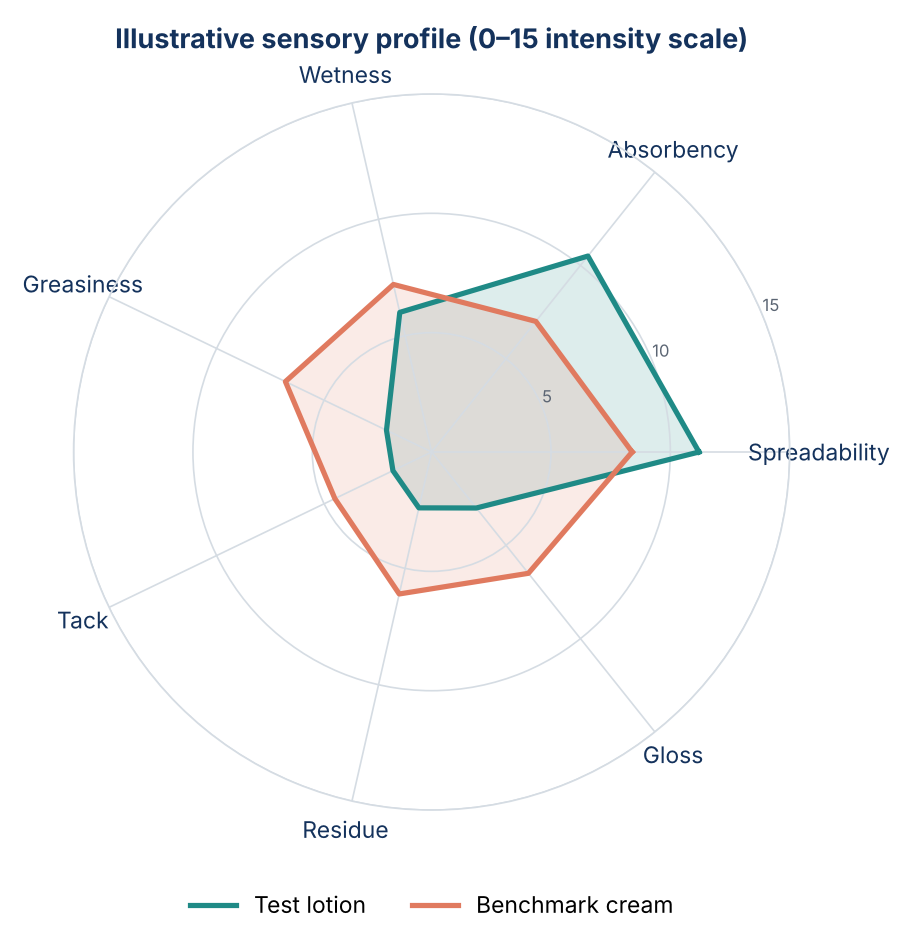
A lexicon defines each attribute, its reference anchors and when it is scored: pick-up (from the container), rub-out (during application) and after-feel (on skin afterwards). The worked example below shows how a lightweight lotion might profile against a rich benchmark cream.
| Attribute | Phase | Definition | Test lotion | Benchmark |
|---|---|---|---|---|
| Spreadability | Rub-out | Ease of moving product across skin | 11.2* | 8.4 |
| Absorbency | Rub-out | Speed at which product disappears into skin | 10.5* | 7.0 |
| Wetness | Rub-out | Amount of water perceived | 6.0 | 7.2 |
| Greasiness | After-feel | Oily film left on skin | 2.1* | 6.8 |
| Tack | After-feel | Stickiness when a fingertip touches skin | 1.8* | 4.5 |
| Residue | After-feel | Amount of product left on skin | 2.4* | 6.1 |
| Gloss | After-feel | Shine of treated skin | 3.0* | 6.5 |
Hypothetical values for illustration, not results from a CSL study. *In this example, significantly different from the benchmark (p < 0.05).
03How rheology backs a texture claim
Rheology measures how a product flows and deforms: viscosity, yield stress and elastic modulus. A lower yield stress usually means easier spreading, so instrument data help explain panel scores and screen prototypes cheaply before a panel is booked. In one study of cosmetic emulsions, rheological measurements fed into a neural network predicted sensory ratings with 60–84% accuracy [4]. Emulsion type matters too: an oil-in-water emulsion usually feels lighter than a water-in-oil one at a similar viscosity.
It cannot tell you whether consumers perceive a product as lightweight. Use it as supporting and development evidence; perception claims still need human panels.
04Panel size, duration and pass criteria
- Trained panel: typically 10–15 assessors, trained over several weeks, with replicated scoring sessions.
- Consumer panel: commonly 30–100+ target users, with either a single supervised application or one to four weeks of home use.
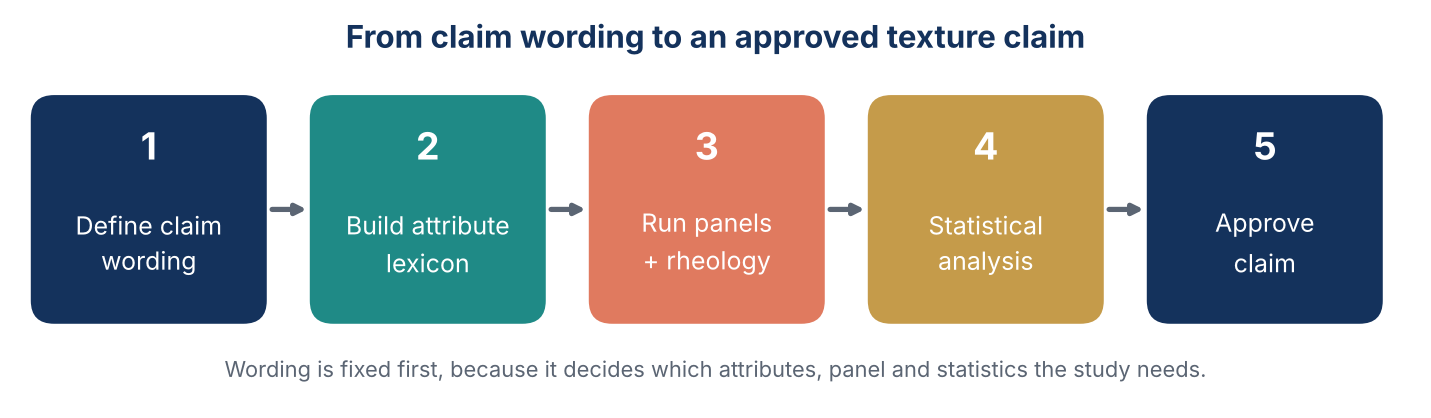
Write the pass criteria into the protocol before testing begins:
- Comparative claims: a statistically significant difference in the claimed direction, usually by ANOVA at p < 0.05.
- Absolute claims: a mean score in the lowest band of the scale, compared with a reference known to have that property.
- Consumer claims: agreement significantly above 50% is common practice, with the sample size stated alongside the claim.
"No significant difference from a non-greasy reference" is not proof that two products are equally non-greasy; a small panel can miss a real difference. For absolute or parity claims, plan an equivalence margin and enough assessors to test it.
05Which claim each result allows
| Result | Claim it can support | Claim it cannot support |
|---|---|---|
| Greasiness significantly lower than benchmark | "Less greasy than [benchmark]" | "Non-greasy" |
| Greasiness at scale floor, matching reference | "Non-greasy finish" | Claims about consumer liking |
| Majority of consumers agree it feels lightweight | "X% said it felt lightweight (n = Y)" | Absolute technical claims |
| Rheology data only | Internal and supporting evidence | Any consumer-facing perception claim |
Can you write the final pack claim, the attribute, the comparator and the pass criterion in one line? If not, the study is not ready to run. We can design it with you.
06For brands: getting a texture claim approved
The strongest texture claims combine a trained panel for precision, a consumer panel for perception and rheology for explanation, all planned around one claim wording. Texture expectations also differ by category and climate, so check our skin care sector insights. Pairing a texture claim with a safety claim? See what "dermatologically tested" needs behind it.
07Questions readers ask
What is the difference between a trained panel and a consumer panel?
A trained panel scores the intensity of defined attributes against references and works like a measuring instrument. A consumer panel records how target users perceive and like the product. Many texture claims need both.
How many people do you need for a sensory claim?
Trained panels typically use 10–15 assessors with replicated sessions. Consumer panels commonly use 30 to over 100 target users. The right number depends on the claim and the size of difference you need to detect.
Can rheology alone support a "non-greasy" claim?
No. Rheology explains flow and spreading and is useful for screening, but a perception claim such as "non-greasy" needs sensory panel evidence.
Need evidence for a texture claim?
We design and run trained-panel, consumer and instrumental studies that support claims like "lightweight" and "non-greasy", from claim wording to final report.
08References
- Commission Regulation (EU) No 655/2013 of 10 July 2013 laying down common criteria for the justification of claims used in relation to cosmetic products. OJ L 190, 11.7.2013, p. 31–34. EUR-Lex
- ASTM International. ASTM E1490-19: Standard guide for two sensory descriptive analysis approaches for skin creams and lotions. 2019. ASTM
- International Organization for Standardization. ISO 13299:2016 Sensory analysis — Methodology — General guidance for establishing a sensory profile. ISO
- Franzol A, Banin TM, Brazil TR, Rezende MC. Rheological analyses and artificial neural network as optimization tools to predict the sensory perception of cosmetic emulsions. Mater Res. 2021;24(6):e20210252. DOI
Update log
- Published by Cosmetic Science Lab
This article is general technical information, not legal, regulatory or medical advice. Confirm requirements for your product and market before launch.