Is reverse engineering a cosmetic legal? Trade secrets, patents and INCI
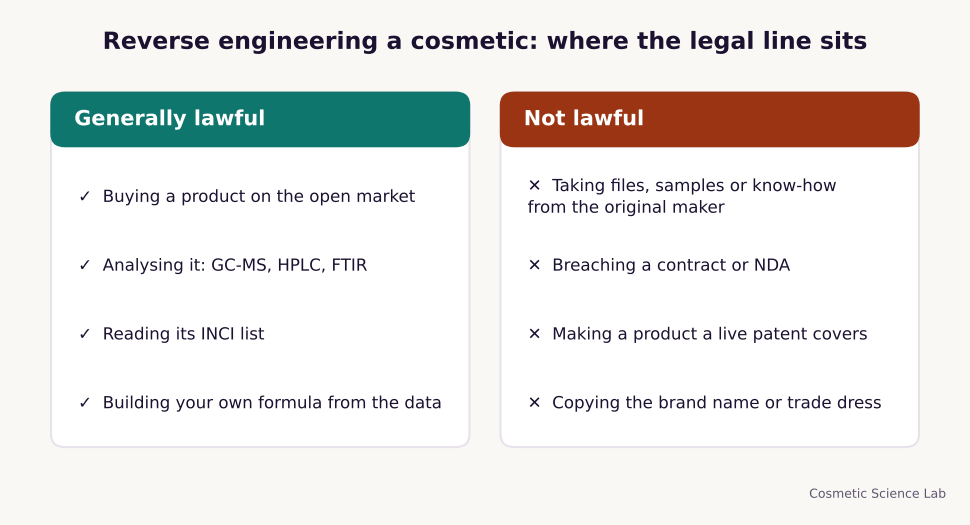
For cosmetics, analysing a product you bought on the open market is generally lawful in the EU, UK, US and UAE. What stays unlawful is taking secrets by improper means, breaching a contract, making a product a live patent covers, or copying another brand. This guide sets out the rules by market and a freedom-to-operate checklist.
By Dr. Premalatha, Ph.D., Life Science, Regulatory Consultant, Cosmetic Science Lab
Quick answer
- Is reverse engineering a cosmetic legal? Analysing a product bought on the open market is generally lawful in the EU, UK, US and UAE. What stays unlawful is taking secrets by improper means, breaching a contract, making a product a live patent covers, or copying another brand.
- EU law lists studying, taking apart or testing a publicly available product as a lawful way to acquire a trade secret [1].
- US federal law states that reverse engineering is not an improper means [3].
- A trade secret defence does not cover patents: making a patented product can still infringe [7]. Run a freedom-to-operate check in every market before launch.
01The trade secret rule, market by market
A trade secret protects a formula only against people who get it by improper means. In the EU, the Trade Secrets Directive treats "observation, study, disassembly or testing" of a product made available to the public, or lawfully held by someone free of any valid duty to limit it, as lawful acquisition [1]. Copying documents, materials, substances or files without consent is unlawful acquisition [1].
In the US, federal law states that improper means "does not include reverse engineering, independent derivation, or any other lawful means of acquisition", wording added by the Defend Trade Secrets Act of 2016 [3]. The UK implemented the Directive through 2018 regulations, which judge whether acquisition was unlawful by the principles of the law of confidence [2].
| Market | Trade secret law | Analysing a bought product |
|---|---|---|
| EU | Directive (EU) 2016/943 | Lawful acquisition (Art. 3) [1] |
| UK | Trade Secrets (Enforcement, etc.) Regulations 2018 plus the law of confidence | Judged under the law of confidence [2] |
| US | Defend Trade Secrets Act (18 U.S.C. §1839) | Reverse engineering is not an improper means [3] |
| India | No dedicated statute; contract and equity. A draft bill sits in Law Commission Report No. 289 | Listed as lawful in the draft bill, which is not yet law [4], [5] |
| GCC (UAE) | Federal Law No. 11 of 2021, Arts 61–66 | Testing and analysing products on the market is not against fair business practice (Art. 65) [6] |
02Patents: the limit reverse engineering cannot cross
Patents work differently. A patent protects an invention even against people who arrive at it independently. In the UK, making, disposing of, using or importing a patented product without consent infringes [7]. There are narrow exceptions for acts done privately and for non-commercial purposes, and for experiments on the invention itself [7], but launching a matched formula is neither.
So reverse engineering can tell you what is in a product. It cannot give you the right to make it if a live patent covers the formula or process in your market.
03INCI disclosure and fragrance trade secrets
Part of a cosmetic formula is public by law. In the EU, every product must carry a full ingredient list, with fragrance blends shown as "parfum" or "aroma" and certain fragrance allergens named separately [8]. Unlike the old Cosmetics Directive, the Regulation has no trade-secret exemption from the ingredient list [8]. See our glossary entry on INCI names.
In the US, FDA rules let a company ask for an ingredient's identity to be treated as a trade secret, weighing factors such as how easily others could duplicate it [9]. That rule was tied to the voluntary registration programme FDA stopped accepting in 2023, so check the current route with a regulatory adviser. Either way, the fragrance blend is where most cosmetic trade secrets remain: the INCI list shows "parfum", not its composition.
04What a brand must do: a freedom-to-operate checklist
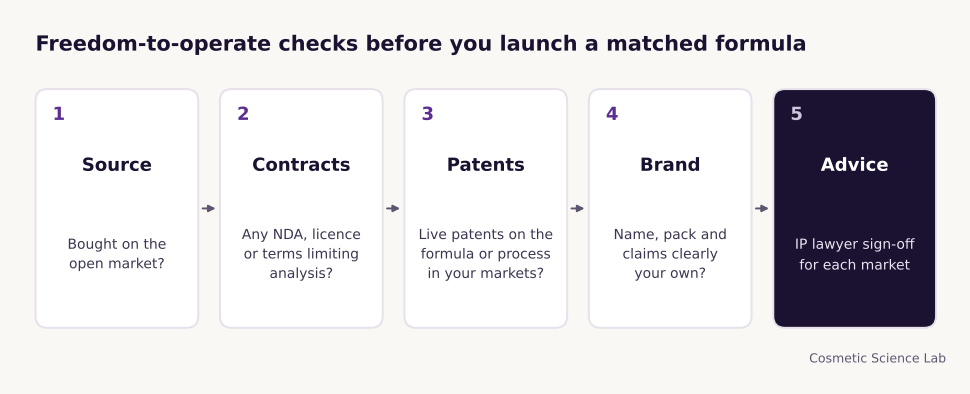
- Check the source. Buy the benchmark on the open market and keep the receipt and batch code.
- Check contracts. Make sure no NDA, licence or supply terms limit analysis [1].
- Search patents. Look for live patents on the formula, process or packaging in every launch market.
- Check the brand. Use your own name, pack design and claims, and avoid confusion with the original.
- Get legal sign-off. Ask an IP lawyer to review the plan for each market.
05Key dates
| Date | What happened |
|---|---|
| 11 May 2016 | US Defend Trade Secrets Act enacted; reverse engineering written into federal law as a lawful means [3] |
| 8 June 2016 | EU Trade Secrets Directive adopted [1] |
| 2018 | UK Trade Secrets (Enforcement, etc.) Regulations made [2] |
| 2021 | UAE Federal Law No. 11 of 2021 issued; in force six months after publication [6] |
| March 2024 | India's Law Commission recommends a trade secrets law and drafts a bill; not yet law as far as we can find [4], [5] |
Our reverse engineering service works only on products bought on the open market, and builds a formula you own; see our body lotion deformulation case study. For labelling and market entry, our regulatory team can help.
06Questions readers ask
Is reverse engineering legal for cosmetics?
Analysing a product bought on the open market is generally lawful in the EU, UK, US and UAE. Copying patented technology or a brand is not.
Can I copy a formula if I find out what is in it?
Not if a live patent covers it in your market, or if you would breach a contract. Take legal advice.
Is a fragrance a trade secret?
Often, yes. EU labels show the blend as "parfum", with certain allergens named, so the full composition usually stays confidential.
Does India protect cosmetic trade secrets?
Not through a dedicated law yet. Protection relies on contracts and equity. In March 2024 the Law Commission proposed a draft trade secrets bill, which would treat reverse engineering as lawful, but we could find no sign it has been enacted [4], [5].
Is a dupe the same as a counterfeit?
No. A dupe is a different product under its own brand; a counterfeit copies the brand itself, which is unlawful. See what lab analysis of counterfeit cosmetics finds.
Planning to benchmark or match a competitor's formula?
We analyse legally bought products and build a formula you own.
07References
- Directive (EU) 2016/943 of the European Parliament and of the Council of 8 June 2016 on the protection of undisclosed know-how and business information (trade secrets) against their unlawful acquisition, use and disclosure. OJ L 157, 15.6.2016, p. 1. EUR-Lex
- The Trade Secrets (Enforcement, etc.) Regulations 2018 (SI 2018/597). UK. legislation.gov.uk
- 18 U.S.C. §1839, Definitions, as amended by the Defend Trade Secrets Act of 2016, Pub. L. 114-153 (11 May 2016). GovInfo
- Law Commission of India. Report No. 289: Trade Secrets and Economic Espionage. March 2024. Law Commission (PDF)
- European Commission, EU IP Helpdesk. Overview of the Protection of Trade Secrets Bill, 2024. 6 June 2024. EU IP Helpdesk
- UAE Federal Law No. 11 of 2021 on the Regulation and Protection of Industrial Property Rights, Arts 61–66 and 80. WIPO Lex
- Patents Act 1977, section 60 (meaning of infringement). UK. legislation.gov.uk
- Regulation (EC) No 1223/2009 of the European Parliament and of the Council of 30 November 2009 on cosmetic products, Article 19. EUR-Lex
- 21 CFR 720.8, Confidentiality of statements. US Code of Federal Regulations. See also FDA, "FDA has stopped accepting submissions to the Voluntary Cosmetic Registration Program" (2023). Cornell LII
Update log
- Published by Cosmetic Science Lab
This article is general technical information, not legal, regulatory or medical advice. Confirm requirements for your product and market before launch.