Fake makeup: what lab analysis of counterfeit cosmetics finds
US customs seized more than half a million counterfeit personal care items in fiscal 2024, and raids on fake makeup have turned up heavy metals, bacteria and human waste. What the reports show, why fakes are contaminated, and how FTIR, GC-MS and ICP-MS tell a real product from a fake.
By Dr. Premalatha, Ph.D., Life Science, Regulatory Consultant, Cosmetic Science Lab
Quick answer
- US customs seized 500,716 counterfeit personal care items in fiscal 2024, and China and Hong Kong supplied about 90% of all seized goods by quantity [1].
- A fake can look right and still fail on chemistry: FTIR, GC-MS and ICP-MS expose it [8].
- Brands that keep a reference fingerprint of each product can prove a fake quickly.
Take-home message for brand owners
- A fake is only provable against a genuine baseline
- Hold a reference fingerprint for every hero product
Take-home message for QA and formulators
- Run ICP-MS and microbiology on every suspect
- Contamination data turn an IP case into a safety case
01What the seizure reports show
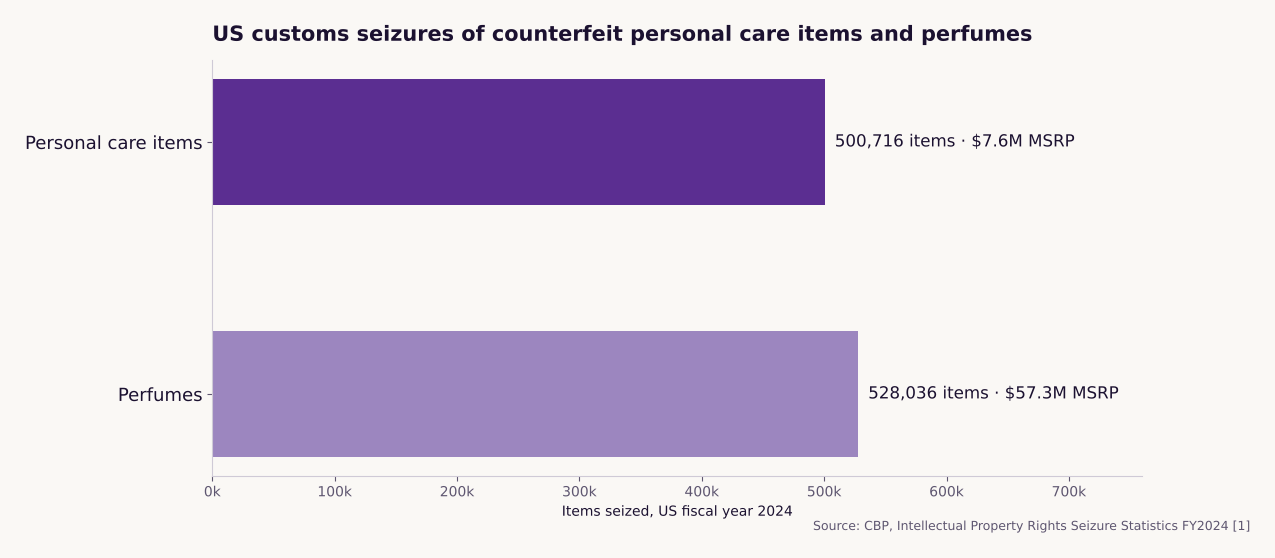
US Customs and Border Protection (CBP) logged about 32.4 million counterfeit items in fiscal year 2024, with a retail value of $5.42 billion [1]. Personal care items made up 500,716 of them, worth $7.6 million at the manufacturer's suggested retail price, alongside 528,036 counterfeit perfumes worth $57.3 million [1]. Seizures from China and Hong Kong accounted for about 90% of the total quantity seized [1].
In Europe, the EU Intellectual Property Office (EUIPO) estimates that counterfeit cosmetics cost the EU cosmetics sector about €3 billion in sales a year, 4.8% of the market, and almost 32,000 jobs, based on 2018–2021 averages [2]. Online, the risk reaches ordinary shoppers: when the US Government Accountability Office bought products from third-party sellers on popular consumer websites, 20 of 47 items were counterfeit, including all 13 cosmetics [3].
| Report | Market | Key figure |
|---|---|---|
| CBP IPR seizure statistics, FY2024 [1] | US | 500,716 personal care items seized; $7.6M retail value |
| EUIPO, counterfeiting in clothing, cosmetics and toys, 2024 [2] | EU | €3bn lost cosmetics sales a year (4.8%); almost 32,000 jobs |
| GAO-18-216, 2018 [3] | US, online | 13 of 13 cosmetics bought from third-party sellers were counterfeit |
02What lab analysis of fake makeup finds
Seizure data show scale; laboratory results show risk. In 2018, Los Angeles police seized about $700,000 of counterfeit cosmetics in the city's Fashion District, and police said testing found bacteria and human waste in the products [4]. The City of London Police reported fake beauty products containing arsenic, lead and mercury, along with rat droppings and human urine from unsanitary production [5]. New York's Department of State warns that counterfeits have contained dangerous bacteria, lead and beryllium [6].
For context, FDA draft guidance recommends a maximum of 10 ppm lead as an impurity in lip products and externally applied cosmetics [7]. A genuine brand tests its raw materials against limits like this. A counterfeiter has no reason to.
Most published findings come from enforcement agencies and news reports rather than peer-reviewed studies, so measured contaminant levels are rarely reported. That gap is why brands benefit from holding their own test data.
03Why counterfeit cosmetics are contaminated
Counterfeiters copy packaging, not formulas. They buy the cheapest pigments, waxes and fillers, skip preservation and fill products in uncontrolled premises. Each shortcut adds a hazard.
- Heavy metals. Low-grade mineral pigments and fillers can carry lead, arsenic and mercury.
- Microbial contamination. Without a tested preservative system, bacteria, yeast and mould can grow once water or skin contact gets in.
- Substituted bases. Different waxes and oils change texture and stability, so the product also fails in use.
04Who is affected
| Who | The harm |
|---|---|
| Consumers | Lip and eye products bring contaminants close to mucous membranes, and reactions are often blamed on the genuine brand. |
| Brands | Lost sales [2], complaints and reputational damage, even though the brand never made the product. |
| Retailers and marketplaces | Returns, liability and lost trust when fakes reach their listings [3]. |
05How analytical fingerprinting tells real from fake
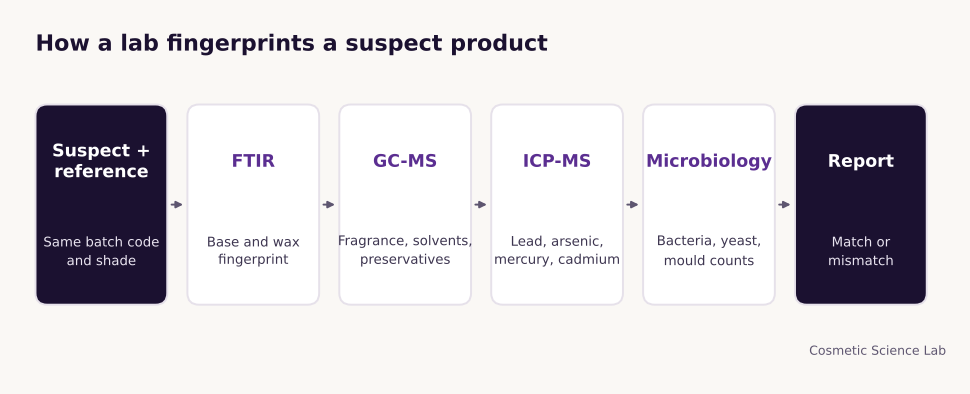
A fake can copy the box, batch code and shade name. It cannot easily copy the chemistry. Analytical fingerprinting compares a suspect product with a genuine reference of the same shade and, ideally, the same batch, using the techniques in an analytical laboratory.
| Technique | What it measures | What a mismatch signals |
|---|---|---|
| FTIR | Overall fingerprint of the base, waxes and fillers | Different raw materials or a substituted base |
| GC-MS | Volatile compounds: fragrance, solvents, some preservatives | Wrong fragrance profile, missing preservative, solvent residues |
| ICP-MS | Trace heavy metals: lead, arsenic, mercury, cadmium | Contaminated pigments or fillers; compare with limits [7] |
| Microbiology | Total viable count and specified pathogens | Poor hygiene or no working preservation |
| Physical tests | Hardness, rheology and melting behaviour | A different wax blend [8] |
Published work shows how this works in practice. A UK study of 22 lipsticks of one popular shade, bought from seven vendors, found an FTIR band near 3690 cm⁻¹ in genuine samples, linked to carnauba wax, that the counterfeits lacked. Genuine sticks were also harder (326 g vs 178 g) and had a higher yield stress (253 Pa vs 138 Pa) [8].
06Brand protection: how to prevent it
Brand protection works best when the lab work is done before a fake turns up.
- Build a reference library. Fingerprint each hero product at launch with FTIR, GC-MS and ICP-MS, and keep retained samples by batch.
- Monitor sales channels. Test-buy from marketplaces and grey-market sellers, starting with lip, eye and best-selling products.
- Test suspects quickly. Compare each one with the reference and report contaminants against regulatory limits.
- Use the data. A lab report supports customs action, takedown requests and legal claims.
- Make the formula harder to copy. Distinctive texture profiles and in-formula markers make a mismatch easier to prove.
07Questions readers ask
How can I tell if my makeup is fake?
Check the seller, print quality, batch code and smell. Only lab testing against a genuine reference can confirm a counterfeit.
What do counterfeit cosmetics contain?
Reported contaminants include lead, arsenic, mercury, beryllium, bacteria and animal waste.
Which test finds heavy metals in cosmetics?
ICP-MS measures trace metals such as lead, arsenic and mercury at very low levels. Results are compared with limits such as the 10 ppm maximum for lead in FDA's draft guidance.
Can a lab prove a product is counterfeit?
Showing that its chemistry differs from a verified genuine reference, using several techniques together, gives strong evidence.
Is a counterfeit the same as a dupe?
No. A dupe is a different product sold under its own brand; a counterfeit copies the brand itself. See are skincare dupes the same formula?
Found a suspected fake of your product?
Tell us your hero products and channels, and we will map which tests prove a fake.
08References
- US Customs and Border Protection. Intellectual Property Rights Seizure Statistics, Fiscal Year 2024. January 2025. CBP (PDF)
- European Union Intellectual Property Office. Economic impact of counterfeiting in the clothing, cosmetics and toy sectors in the EU. Alicante: EUIPO; January 2024. EUIPO (PDF)
- US Government Accountability Office. Intellectual Property: Agencies Can Improve Efforts to Address Risks Posed by Changing Counterfeits Market (GAO-18-216). January 2018. GAO
- CBS News. Human waste, bacteria found in $700K worth of counterfeit cosmetics. 14 April 2018. CBS News
- Cosmetics Business. Fake beauty products found to contain arsenic and urine. 18 May 2015. Cosmetics Business
- New York Department of State. Fake cosmetics and their health risks. Accessed 27 October 2026. NY DOS
- US Food and Drug Administration. Lead in cosmetic lip products and externally applied cosmetics: recommended maximum level. Draft guidance for industry, December 2016. FDA (PDF)
- Stevic M, Naseem S, Rogaten J, Bei R, Hoque TN, Buanz A, Tamburic S. Determination of lipstick authenticity parameters. IFSCC Congress 2022, London; full paper 353. IFSCC (PDF)
Update log
- Published by Cosmetic Science Lab
This article is general technical information, not legal, regulatory or medical advice. Confirm requirements for your product and market before launch.