Are skincare dupes the same formula? We compared the INCI lists
Usually not. A dupe can share most of its INCI list with the original and still be a different formula, because the label shows ingredient names and rough order, not concentration, pH, base or packaging. Here is what the studies show and what to check before you buy.
By Dr. Premalatha, Ph.D., Life Science, Regulatory Consultant, Cosmetic Science Lab
Quick answer
- Are skincare dupes the same formula? Usually not. A dupe can share most of its INCI list with the original and still be a different formula.
- Ingredients below 1% can be listed in any order, so a matching list can hide very different amounts [2].
- Some dupes are good products. You just cannot tell from the label alone.
Take-home message for brand owners
- Your INCI list is public; your formula is not
- Concentration, pH and process are where your advantage lives
Take-home message for formulators
- Benchmark a dupe on measured data, not the label
- Match the numbers, then improve on them
01Why skincare dupes are everywhere
Nearly a third (29%) of European consumers have bought a beauty dupe, rising to more than half (52%) of 18–34-year-olds, according to Circana research [1]. Dupe finder apps and social posts now drive product discovery, matching similar products on ingredients and price per ml, often with a match score. The trouble is what they match on: the ingredient list.
02Why an INCI list is not a formula
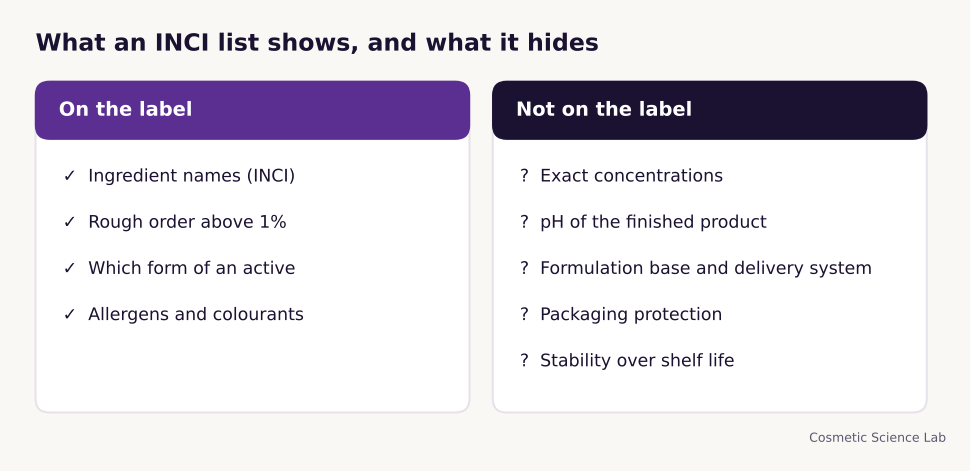
Under EU rules, ingredients are listed in descending order of weight at the time they are added, but anything below 1% may appear in any order after the rest, and colourants may be listed in any order after the other ingredients [2]. Many actives, preservatives and fragrance components sit in that sub-1% zone, so an INCI comparison can look identical while the amounts differ widely.
The list also says nothing about pH, the formulation base (gel, emulsion or oil), the delivery system that carries an active into skin, or whether the packaging protects it. Those product attributes are the formula. See our glossary entry on INCI names.
03What the data and studies show
Active concentration is not guaranteed by the name on the label. When researchers tested 36 cosmetics containing B vitamins, every labelled vitamin was present, but two of the eight products that declared an amount held only 47% and 57% of the niacinamide they claimed [3].
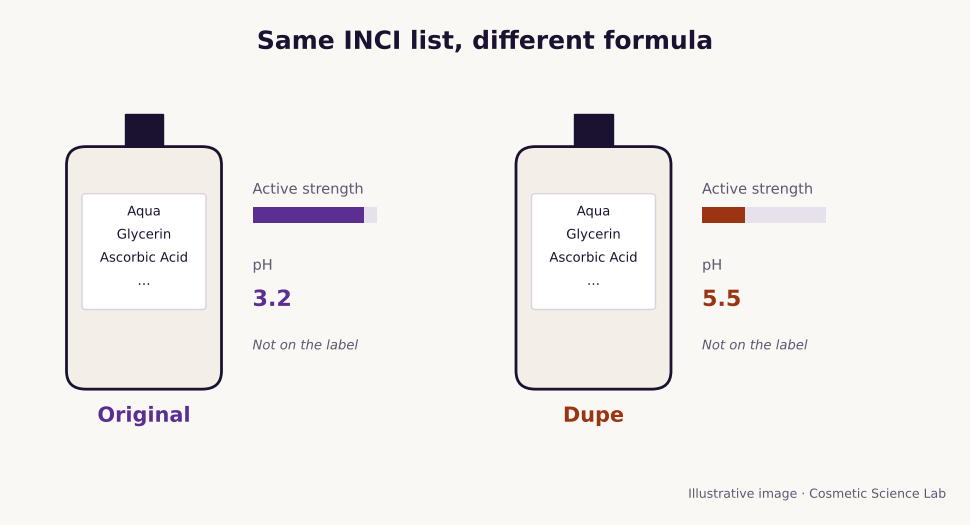
pH can matter as much as dose. In skin absorption studies on pig skin, L-ascorbic acid, the pure form of vitamin C, only entered skin when the formula was below pH 3.5; absorption peaked at 20%, and the derivatives tested (magnesium ascorbyl phosphate and ascorbyl palmitate) did not raise skin vitamin C levels [4]. Alpha hydroxy acids behave the same way: in human skin in vitro, absorption of glycolic and lactic acid was much greater at pH 3.0 than when fully ionised at pH 7.0 [5]. That is why the US Cosmetic Ingredient Review panel ties the safety of glycolic and lactic acid in consumer products to both concentration (10% or less) and pH (3.5 or above) [6].
| Variable | On the INCI list? | Why it changes results |
|---|---|---|
| Active concentration | Only as rough order | Dose drives the effect, and declared amounts can be wrong [3] |
| pH | No | Controls how acids and vitamin C enter skin [4], [5] |
| Form of the active | Yes, by name | Some vitamin C derivatives did not raise skin levels [4] |
| Formulation base and delivery system | No | Changes feel, release and stability |
| Packaging | No | Air and light can degrade sensitive actives such as vitamin C and retinol |
04Ten dupe pairings: where the match hides the difference
We took ten of the most commonly duped skincare product types and mapped what an INCI comparison catches, and what it misses. No brands are named.
| # | Product type | What an INCI comparison shows | What it misses |
|---|---|---|---|
| 1 | Vitamin C serum | Ascorbic acid present | Strength, pH below 3.5, oxidation in the pack [4] |
| 2 | Niacinamide serum | Niacinamide high on the list | Real % versus the claim [3] |
| 3 | Retinol night cream | Retinol listed | Dose, stabilisers, airless packaging |
| 4 | Glycolic acid toner | Glycolic acid listed | pH and how much acid is free to act [5], [6] |
| 5 | Hyaluronic acid serum | Sodium hyaluronate listed | Molecular weight mix |
| 6 | Ceramide moisturiser | Same ceramide names | Lipid ratio and emulsion type |
| 7 | Peptide serum | Same peptide names | Concentration, often below 1% [2] |
| 8 | Salicylic acid cleanser | Salicylic acid listed | pH and contact time |
| 9 | Mineral sunscreen | Zinc oxide listed | SPF comes from testing the finished product |
| 10 | Rich night cream | Same oils and butters | Emulsion structure, texture and stability |
For a ceramide example in depth, see barrier repair cream formulation, and for the sunscreen row, how SPF is tested.
05Three myths about dupes
- "The same first five ingredients means the same product." The first five are usually water, glycerin and solvents. The differences sit lower down, often below 1% [2].
- "Dupes are always worse." Some are well made. The point is that the label alone cannot tell you which.
06What to check on a label
- Form of the active. Ascorbic acid and a vitamin C derivative are not interchangeable [4].
- Declared percentage and pH. Brands that state both give you something to compare.
- Position on the list. An active listed after the preservative is often below 1%.
- Packaging. Opaque, airless packs protect vitamin C and retinol better than clear jars.
- Price per ml, last. Compare cost only once the points above match.
A dupe of your hero product, or a dupe you want to beat, is a reverse-engineering question. CSL's reverse engineering team measures concentrations, pH and packaging performance, then builds an equivalent or better formula you own. See our body lotion deformulation case study.
07Questions readers ask
Are skincare dupes the same as the original?
Rarely in full. They may share ingredients, but concentration, pH and base can differ.
Are skincare dupes safe?
Legally sold dupes must meet the same cosmetic safety rules as any other product. The bigger risk is that a dupe does less.
Is a dupe the same as a counterfeit?
No. A dupe is its own product under its own brand. A counterfeit copies the brand itself; see what lab analysis of counterfeit cosmetics finds.
Can a lab tell whether a dupe matches the original?
Yes. Reverse engineering measures concentrations, pH and other attributes that an INCI comparison cannot show.
Want to know what is really inside a dupe?
Send us the product and the original. We measure the differences the INCI list hides.
08References
- Barber L. How beauty dupes became a new form of social status. Cosmetics Business, 15 July 2025 (data: Circana). Cosmetics Business
- Regulation (EC) No 1223/2009 of the European Parliament and of the Council on cosmetic products, Article 19(1)(g). OJ L 342, 22.12.2009, p. 59. EUR-Lex
- Temova Rakuša Ž, Šenk A, Roškar R. Content and stability of B complex vitamins in commercial cosmetic products. J Cosmet Dermatol. 2023;22(2):628–636. DOI
- Pinnell SR, Yang H, Omar M, Monteiro-Riviere N, DeBuys HV, Walker LC, Wang Y, Levine M. Topical L-ascorbic acid: percutaneous absorption studies. Dermatol Surg. 2001;27(2):137–142. PubMed
- Kraeling MEK, Bronaugh RL. In vitro percutaneous absorption of alpha hydroxy acids in human skin. J Soc Cosmet Chem. 1997;48(4):187–197. SCC
- US Food and Drug Administration. Alpha hydroxy acids (Cosmetic Ingredient Review conclusion on glycolic and lactic acid). Accessed 27 October 2026. FDA
Update log
- Published by Cosmetic Science Lab
This article is general technical information, not legal, regulatory or medical advice. Confirm requirements for your product and market before launch.