Polysorbate 20: solubiliser monograph for formulators
INCI and CAS, function, HLB, typical use levels, pH and compatibility, limits by market, safety data and the alternatives worth testing.
By Dr. Premalatha, Ph.D., Life Science, Regulatory Consultant, Cosmetic Science Lab
Quick answer
- Polysorbate 20 is a water-soluble, non-ionic surfactant used mainly as a solubiliser. It disperses fragrance oils and essential oils clearly into water-based products such as toners, mists and gels.
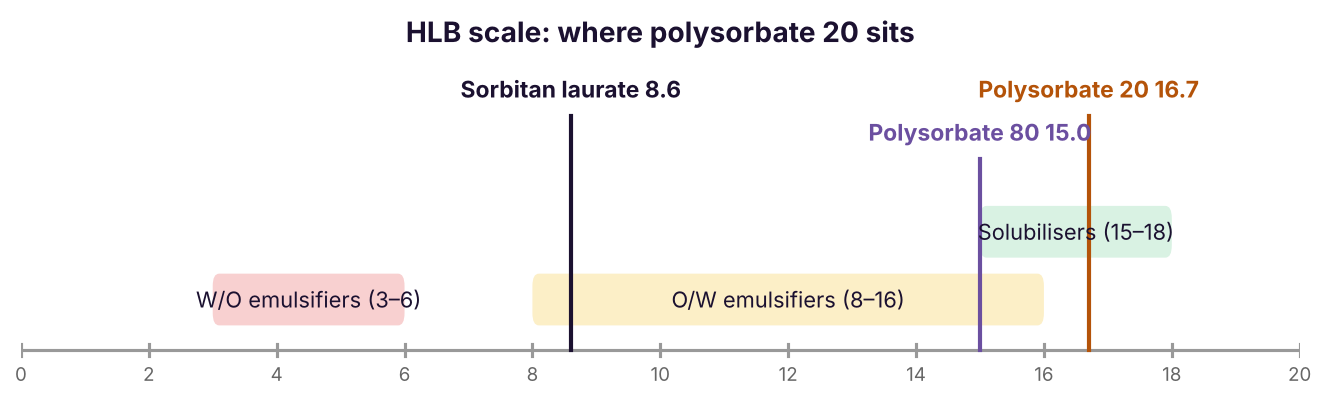
- Its HLB is about 16.7, which places it in the solubiliser range [4].
- Typical use is 0.5–5% of the formula. For fragrance, start around 1 part per part of oil and raise it until the product is clear.
- It is ethoxylated, so ask suppliers for 1,4-dioxane data.
01INCI, CAS and what polysorbate 20 is
| Property | Value |
|---|---|
| INCI name | Polysorbate 20 |
| Chemical name | Polyoxyethylene (20) sorbitan monolaurate |
| CAS number | 9005-64-5 |
| Type | Non-ionic surfactant, ethoxylated |
| HLB | About 16.7 |
| Appearance | Yellowish, viscous liquid; water soluble |
| Typical use level | 0.5–5% |
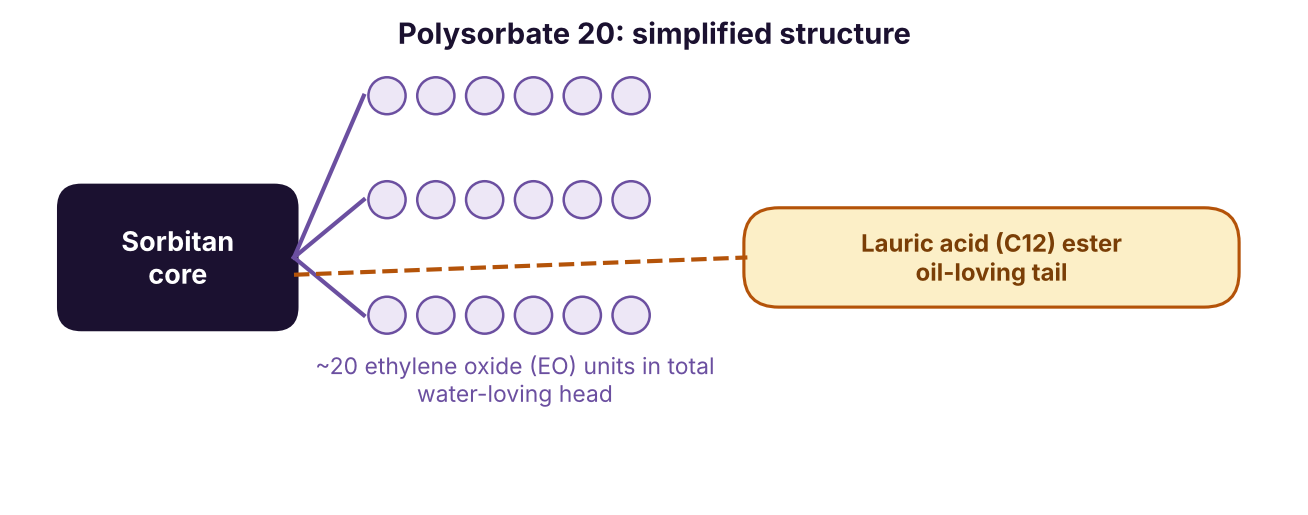
Polysorbate 20 is made by esterifying sorbitan with lauric acid, a C12 fatty acid usually from coconut or palm kernel oil, then reacting it with about 20 units of ethylene oxide [1]. The ethylene oxide chains form a water-loving head; the lauric acid forms an oil-loving tail.
02Function: solubiliser and emulsifying agent
With an HLB of about 16.7, polysorbate 20 is strongly hydrophilic. Its main job is fragrance solubilisation: wrapping small amounts of oil in micelles so a water-based product stays clear. It also acts as a secondary emulsifier in an oil-in-water emulsion, a wetting agent and a mild co-surfactant in cleansers.
03Typical use level
| Application | Typical use level | Note |
|---|---|---|
| Fragrance in toner or mist | 1:1 up to about 4:1 (solubiliser : fragrance) | Start at 1:1 and raise until clear |
| Essential oils | Up to about 5:1 (solubiliser : oil) | Citrus and terpene-rich oils need more |
| Gels and serums | 0.5–3% of formula | Pre-mix with oil before adding water |
| Cleansers (co-surfactant) | 1–5% of formula | Can soften foam |
04pH and compatibility
- Stable with weak acids and bases; strong acids or alkalis can saponify (hydrolyse) the ester.
- Compatible with anionic, cationic and other non-ionic surfactants.
- Can bind some preservatives, especially parabens, and reduce their efficacy [5]; confirm by challenge testing.
- Can autoxidise and form peroxides during storage [4], so check odour and colour across shelf life in stability testing.
05Limits by market
| Market | Position |
|---|---|
| EU | No specific Annex limit for polysorbate 20. 1,4-dioxane is prohibited as an ingredient, but technically unavoidable traces are allowed if the product is safe (Article 17) [2]. |
| US | No federal limit. New York caps 1,4-dioxane at 10 ppm in cosmetics (from 31 Dec 2022) and 1 ppm in personal care and household cleansing products (from 31 Dec 2023); all waivers ended on 30 Dec 2025 [3]. |
| India | No ingredient-specific limit known; follow the Cosmetics Rules 2020 (as amended in 2025) and the IS 4707 (Part 2) ingredient lists. |
| GCC | Largely based on EU requirements (GSO 1943:2024), but the lists are not updated in step with the EU, so check the current annexes. Confirm the fatty acid source for halal claims. |
06Safety data
The Cosmetic Ingredient Review panel first found polysorbates safe for use in cosmetics in 1984 [1]. In a 2015 amended assessment covering 80 polysorbates, it concluded they are safe in present practices of use and concentration when formulated to be non-irritating [6]. Polysorbate 20 is generally low in irritation at normal use levels. The main concern is not the ingredient itself but 1,4-dioxane, a by-product of ethoxylation. Choose grades with a low certified 1,4-dioxane content and ask for a certificate of analysis per batch.
07Polysorbate 20 vs polysorbate 80 and alternatives
| Option | HLB | Best for | Ethoxylated? |
|---|---|---|---|
| Polysorbate 20 | 16.7 | Light fragrance and essential oils | Yes |
| Polysorbate 80 | 15.0 | Heavier oils, oleic-based | Yes |
| PEG-40 hydrogenated castor oil | About 14–16 | Fragrance, strong solubilising power | Yes |
| Polyglyceryl esters (e.g. polyglyceryl-10 laurate) | Varies | EO-free and natural claims | No |
08Formulation tips
- Pre-mix with the fragrance.
Blend polysorbate 20 with the fragrance or oil before it meets the water.
- Add slowly.
Add to the water phase under gentle stirring to avoid foam.
- Check clarity hot and cold.
Check at 5 °C and 40 °C; haze means more solubiliser or a different one.
- Recheck preservation.
Repeat preservative efficacy testing whenever you raise the level.
Benchmarking a clear product with a long INCI list? Our formulation team can match it, and deformulation explained: from INCI list to a working formula shows how.
09Questions readers ask
What is polysorbate 20 used for in cosmetics?
Polysorbate 20 is mainly a solubiliser. It disperses fragrance oils and essential oils into water-based personal care products so they stay clear.
What is the difference between polysorbate 20 and polysorbate 80?
Polysorbate 20 uses lauric acid and has an HLB of about 16.7; polysorbate 80 uses oleic acid and has an HLB of about 15. Polysorbate 20 suits lighter oils.
Is polysorbate 20 safe?
Yes, at normal use levels. The Cosmetic Ingredient Review found polysorbates safe as used in 1984 and again in 2015. EWG Skin Deep rates it low hazard overall but flags possible ethylene oxide and 1,4-dioxane contamination.
Does polysorbate 20 affect shelf life?
It can weaken some preservatives and can oxidise over time, so confirm shelf life with stability and challenge testing.
Need a clear formula that stays clear?
Our formulation chemists select and test the right solubiliser for your fragrance, market and claims, including EO-free options.
10References
- Elder RL, editor. Final report on the safety assessment of polysorbates 20, 21, 40, 60, 61, 65, 80, 81, and 85. J Am Coll Toxicol. 1984;3(5):1–82. DOI
- Regulation (EC) No 1223/2009 of the European Parliament and of the Council of 30 November 2009 on cosmetic products. Article 17 and Annex II. EUR-Lex
- New York State Department of Environmental Conservation. 1,4-Dioxane limits for household cleansing, personal care, and cosmetic products. dec.ny.gov
- Sigma-Aldrich. Polysorbate 20 (TWEEN 20), product P6585: product information sheet. sigmaaldrich.com
- Schmitt PO, Fischer AF, da Silva RML, Cruz AB. Compatibility and efficiency of preservatives in emulsive cosmetics containing high surfactant content. Braz J Pharm Sci. 2022;58:e191088. DOI
- Cosmetic Ingredient Review Expert Panel. Final amended safety assessment of polysorbates as used in cosmetics: panel conclusion, June 2015. Washington (DC): Cosmetic Ingredient Review. cir-safety.org
Used in: Product formulationSkin carePersonal care
Update log
- Evidence reviewed and page published by CSL scientists