Packaging teardown: identifying materials and what migrates into the formula
How reverse engineering covers the pack as well as the product: material ID by FTIR, migration risks by formula type, and the compatibility testing that proves your choice.
By Dr. Premalatha, Ph.D., Life Science, Regulatory Consultant, Cosmetic Science Lab
Quick answer
- Packaging material identification is the teardown of a cosmetic pack into its parts and the identification of each plastic, usually by FTIR spectroscopy, so you know what touches your formula.
- The real question is migration: what moves from pack to product, and what the pack absorbs.
- Risk depends on the pairing of material and formula type, not the material alone.
- Only compatibility testing in the final pack confirms the choice.
Take-home message for formulators
- Identify every component that touches the product: body, closure, pump, dip tube and liner
- Match the pack material to the formula type, then prove it in the final pack against a glass control
Take-home message for brand owners
- A benchmark's pack often explains why its formula stays stable
- Give your safety assessor the pack material data the EU safety report needs
01How is packaging material identification done?
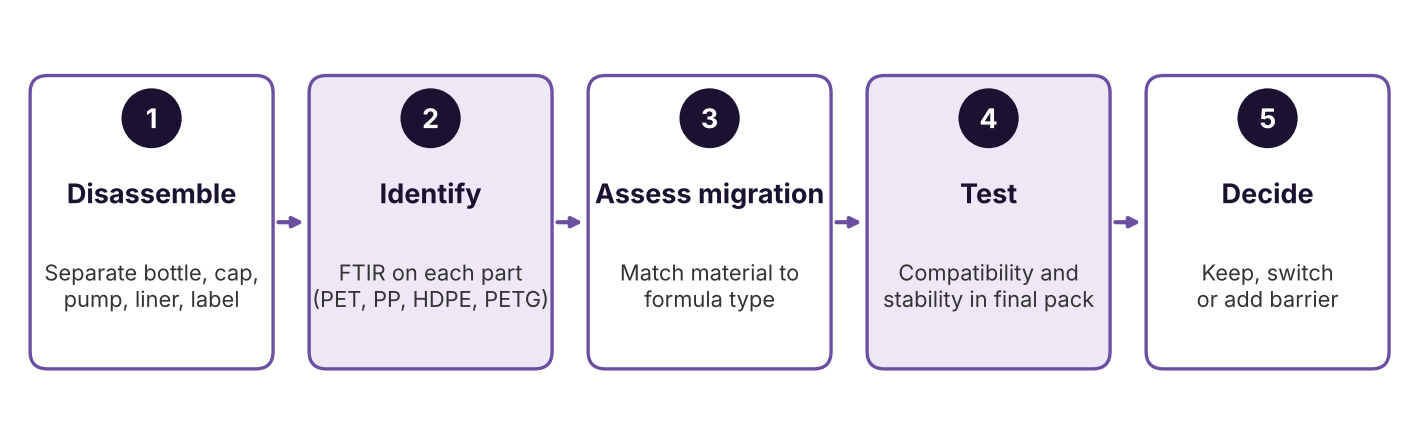
A benchmark pack is rarely one material. A pump bottle can combine a PET body, a PP closure, a PE dip tube, a metal spring and a printed label. A packaging teardown separates each component and identifies them one by one.
The main tool is FTIR (Fourier transform infrared) spectroscopy, usually in ATR mode; see our guide to FTIR analysis in cosmetics. Each polymer gives a characteristic infrared fingerprint that is matched against a reference library. ATR-FTIR has been validated as a fast, simple way to identify common plastics such as polyethylene and polypropylene, using reference spectra from consumer goods with resin codes 1–6, although telling HDPE from LDPE can be difficult [3]. Resin codes on the base help, but they do not cover caps, pumps, liners or coatings, and they cannot tell PET from PETG reliably.
02Why migration matters for packaging compatibility
Packaging and formula interact in both directions. Substances can move out of the plastic into the product, and ingredients can move from the product into or through the plastic. Both change quality, safety and shelf life.
- Extractables are substances that can be pulled out of a material under aggressive lab conditions, such as strong solvents or heat. They show what could migrate.
- Leachables are substances that actually migrate into the product under normal storage and use. They show what does migrate.
- Scalping (sorption) is the reverse: the plastic absorbs fragrance, oils or actives, so the product weakens or smells different.
In the EU, the cosmetic product safety report must describe the relevant characteristics of the packaging material, and the Commission guidelines ask for substance migration from and to the pack to be addressed [1]. A teardown gives your safety assessor the material data that section needs.
03PET, PP, HDPE and PETG compared
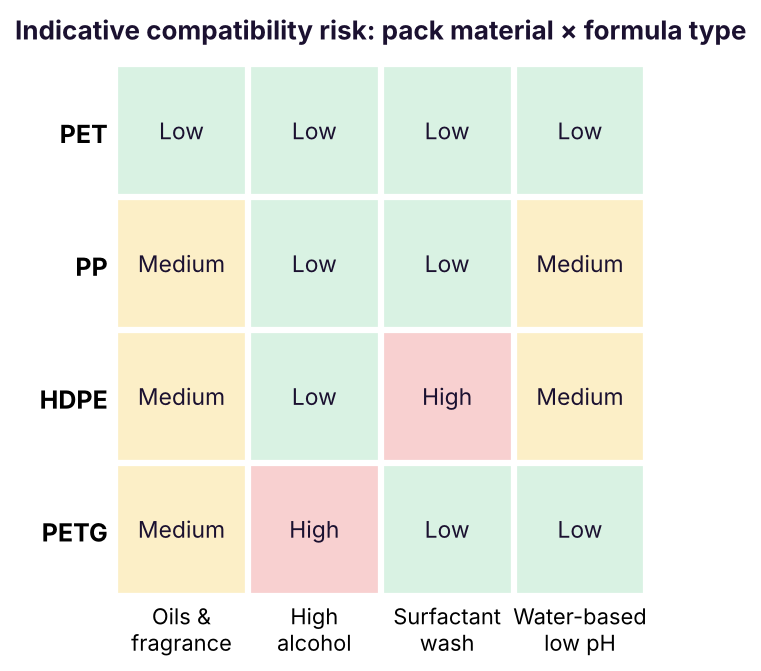
Most cosmetic packs use one of four plastics. Each behaves differently with different formula types.
| Material | Strengths | Watch for | Recyclability |
|---|---|---|---|
| PET | Clear, good barrier, resists oils and alcohol | Can stress-crack with alkaline or some solvent-rich formulas under load | Widely collected; keep labels and caps compatible |
| PP | Tough, heat-resistant, used for caps and jars | Absorbs fragrance and oils; lets oxygen through | Recyclable where PP is collected |
| HDPE | Good water barrier, squeezable, low cost | Stress cracking with surfactants; scalping of fragrance | Widely collected for bottles |
| PETG | Glass-like clarity, easy to mould | Lower resistance than PET to alcohols, oils and solvents; test for crazing | Can disrupt PET recycling; check local guidance |
04How compatibility testing works
Compatibility testing checks that the product and pack stay unchanged together over time. ISO/TR 18811 gives guidelines for the stability testing of cosmetic products, including a section on interaction with packaging [2]. A typical plan covers:
- Fill the final pack.
Use the real closure and pump, plus a glass control.
- Store under stress conditions.
Elevated temperature, cycling and light, alongside room temperature.
- Check the product.
Colour, odour, pH, viscosity, active content and fragrance strength.
- Check the pack.
Weight loss, panelling, cracking, discolouration, label adhesion and pump function.
- Investigate leachables if results drift.
Then decide on a switch or a barrier.
See our glossary entry on stability testing for how this fits your wider shelf-life plan.
05Our recommendation
Treat the pack as part of the formula. When you benchmark a competitor, identify their pack materials as well as their ingredients; the pairing often explains why their product stays stable. Then match material to formula type: PET for most oils and alcohol-rich products, HDPE with stress-crack testing for washes, and barrier or airless options for oxygen-sensitive actives. Test PETG carefully before using it for fragrance-heavy or high-alcohol products, and check recyclability in each market you sell in.
For the analytical method behind a full product teardown, read deformulation explained: from INCI list to a working formula, and to commission one, see how to brief a deformulation project.
06Questions readers ask
How do you identify the plastic in cosmetic packaging?
Each component is separated and analysed by FTIR spectroscopy, which matches the plastic's infrared fingerprint against a reference library. Resin codes alone are not enough for caps, pumps or coatings.
What is the difference between extractables and leachables?
Extractables are what can come out of a material under harsh lab conditions. Leachables are what actually migrates into the product during normal storage and use.
Which packaging is best for fragrance-rich products?
PET or glass usually performs best, because PP and HDPE can absorb fragrance. Confirm the choice with packaging compatibility testing in the final pack.
Is PETG recyclable?
PETG is technically recyclable, but it can contaminate the PET recycling stream. Check design-for-recycling guidance in each target market.
Know what your pack is made of
Our reverse engineering team identifies benchmark pack materials, maps migration risks to your formula and runs packaging compatibility testing in the final pack.
07References
- European Commission. Commission Implementing Decision 2013/674/EU of 25 November 2013 on Guidelines on Annex I to Regulation (EC) No 1223/2009 on cosmetic products. Annex, Part A, section 3.4.3: relevant characteristics of packaging material. legislation.gov.uk
- International Organization for Standardization. ISO/TR 18811:2018. Cosmetics: guidelines on the stability testing of cosmetic products. Geneva: ISO; 2018 (section 5.6, interaction with packaging). iso.org
- Jung MR, Horgen FD, Orski SV, Rodriguez CV, Beers KL, Balazs GH, et al. Validation of ATR FT-IR to identify polymers of plastic marine debris, including those ingested by marine organisms. Mar Pollut Bull. 2018;127:704–16. DOI
Update log
- Published by Cosmetic Science Lab
This article is general technical information, not legal, regulatory or medical advice. Confirm requirements for your product and market before launch.