Deformulation explained: from INCI list to a working formula
An INCI list tells you what is in a product, not how much, which grade or how it was made. How deformulation turns a label into a reconstructed % w/w formula, which method finds what, and why the result is a starting point, not a copy.
By Dr. Premalatha, Ph.D., Life Science, Regulatory Consultant, Cosmetic Science Lab

Quick answer
- What is deformulation? It is the reverse engineering of a finished cosmetic: separating it into fractions, identifying each ingredient by chemical analysis (FTIR, GC-MS, HPLC, NMR, ICP-MS), measuring how much is present, then rebuilding a formula that matches the benchmark.
- The INCI list is the map, not the answer. It gives identity and rough order, but no percentages, grades, suppliers or process.
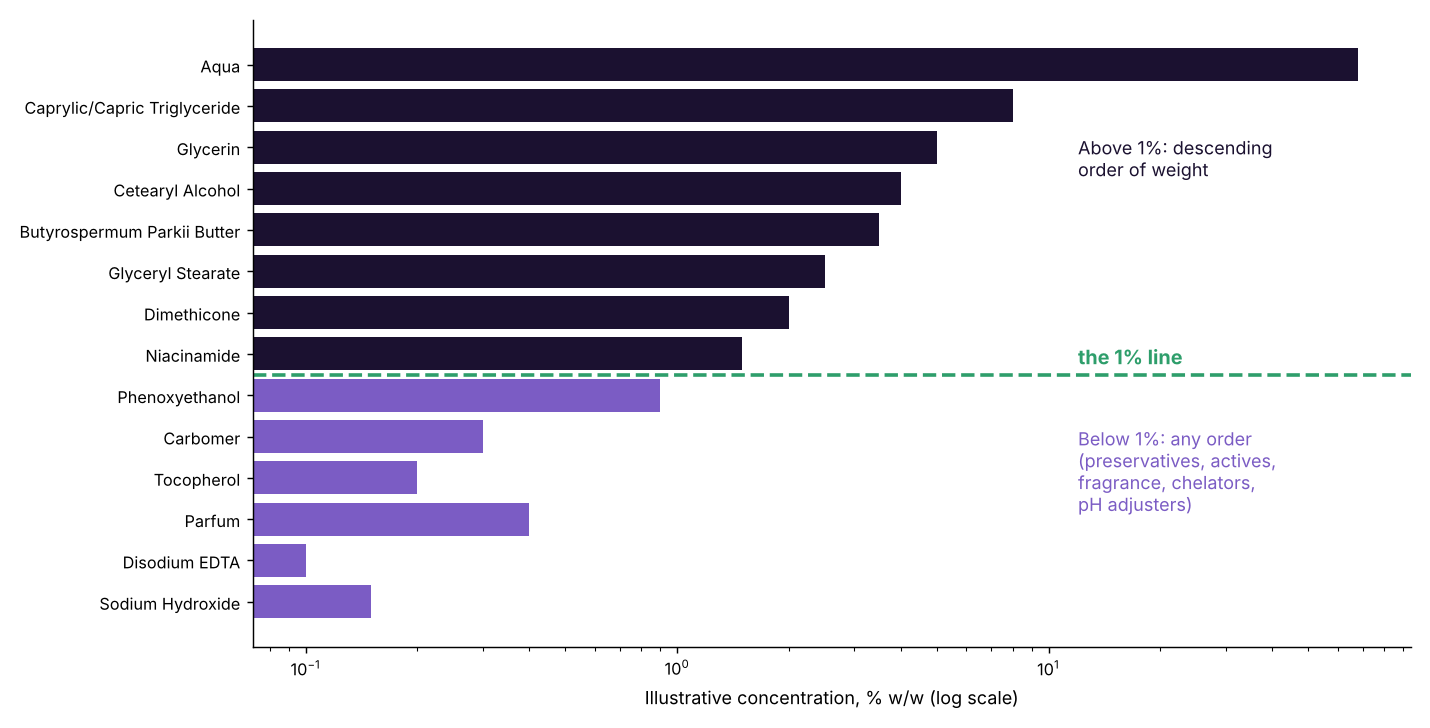
- The 1% rule blurs the tail. Below 1%, ingredients may be listed in any order [1], so preservatives, actives and fragrance cannot be ranked from the label.
- Expect a starting point, not a copy. Prototype matching on pH, viscosity, sensory and stability closes the gap between the report and a product you can make.
Take-home message for formulators
- Use INCI order to bracket use levels before booking instrument time
- Pair every identification method with a quantitation method, and match performance, not only composition
Take-home message for brand owners
- Deformulation is competitive intelligence and quality control, not a shortcut around intellectual property
- Budget for prototype rounds after the report, and clear patents before launch
01Why an INCI list is a map, not a formula
EU law requires ingredients to be listed by INCI name in descending order of weight at the time they are added, but anything below 1% may follow in any order [1]. Canada applies the same logic, allowing ingredients at 1% or less, and all colouring agents, to appear in random order [2]. The INCI order above the line therefore brackets each level: an ingredient cannot exceed the one before it. Below the line, the label tells you almost nothing about rank. Our guide on how to read an INCI list works through an example.
That is why reading a label is the first step of deformulation, not the last. The list hides trade-name blends, carrier solvents, the grade and chain length of a polymer, and every process decision.
02The deformulation workflow, step by step
A typical lab workflow runs in three analytical stages, screening, identification and quantitation, chosen to suit the sample and the question [3]. In cosmetics we add formulation stages either side: reading the label first, and reconstruction and prototype matching at the end.
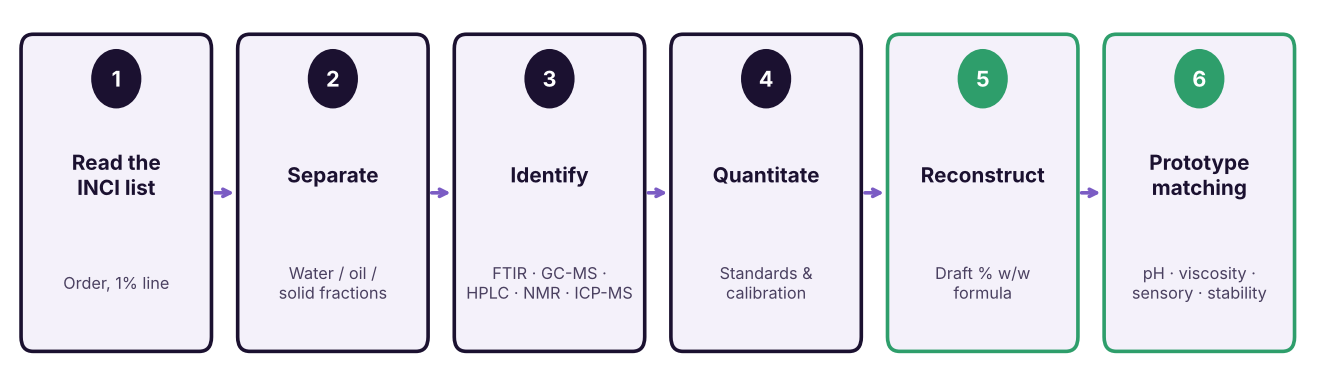
- Read the INCI list.
Bracket use levels with INCI order and the 1% rule.
- Separation.
Centrifuge, extract or break the emulsion into aqueous, oil and solid fractions so each method sees a cleaner sample.
- Identification.
Fingerprint each fraction with infrared spectroscopy and mass spectrometry.
- Quantitation.
Measure each ingredient against reference standards and calibration curves.
- Reconstruction.
Convert results into a draft % w/w formula, phase by phase.
- Prototype matching.
Make it, then compare it side by side with the benchmark.
03Which method finds what (and what it misses)
No single instrument decodes a cream. Run FTIR alone, for example, and low-level additives become essentially invisible in the spectrum [4].
| Technique | What it finds | What it misses |
|---|---|---|
| FTIR (infrared spectroscopy) | Functional groups and major components; a fast fingerprint of each fraction | Minor ingredients; one lab handout gives its detection range as components above about 5% [3] |
| GC-MS (mass spectrometry) | Volatile and semi-volatile compounds such as fragrance and solvents, then quantitation once identified [3]; see what GC-MS can and can't tell you | Non-volatile polymers, salts and large actives |
| HPLC / LC-MS | Preservatives, several in one run [5], plus UV filters and actives, quantified against standards | Compounds with no chromophore unless paired with MS or another detector |
| NMR | Structures of surfactants, esters and unknowns; blend ratios | Trace components; needs reasonably clean fractions |
| ICP-MS | Elements and trace metals in one run: zinc, titanium, heavy-metal impurities [6], [7] | Organic structure, and the chemical form the metal is in |
Identification also comes before quantitation: once LC-MS has named an unknown, HPLC can measure it [4]. See our guide to analytical methods in cosmetic formulation.
04Formulation variables the instrument cannot read
Chemistry gives you a parts list. A working formula also depends on four variables that the data only hint at:
- Use level. Quantitation has error bars. Gums, polymers and emulsifiers at 0.2–2% move texture more than their share of the formula suggests.
- pH. The final pH decides whether a carbomer thickens, a preservative works and an acid active is available.
- Compatibility. Cationics, electrolytes and plant extracts can break an emulsion that looked fine on paper.
- Process. Phase temperatures, order of addition, shear and cooling rate leave no peak on a chromatogram, yet they set droplet size and feel.
05Failure modes: why a first reconstruction misses
- Right ingredients, wrong grade. Same INCI name, different molecular weight or supplier, different viscosity.
- Hidden blends. A trade-name active arrives with its own solvent and preservative.
- Emulsion drift. The prototype separates in 40 °C storage because the emulsifier ratio is off.
- Scale-up surprises. A bench match changes in a production tank; see cosmetic tech transfer and scale-up.
Each miss is a failure analysis problem in its own right, which is why prototype matching runs pH, viscosity, sensory and stability testing against the benchmark, not just a second chromatogram.
06How CSL turns a benchmark into a formula
Our reverse engineering service combines materials testing, chemical analysis and product development under one roof. In one project, CSL scientists deformulated a benchmark body lotion, decoding 98% of the formula with analytical chemistry and machine learning. In another, we benchmarked a client's new range against the market.
We also use the same testing services for quality control and supplier checks; see our raw material screening checklist.
A matched formula can still raise patent infringement or trade dress questions. Treat the report as competitive intelligence, and check intellectual property before launch; see is reverse engineering a cosmetic legal?
07Questions readers ask
Is deformulation legal?
Analysing a product you bought is generally lawful, but selling a product that copies a patented composition or protected branding may not be. Take legal advice on intellectual property before launch.
How accurate is cosmetic deformulation?
Major ingredients can usually be identified and quantified well; trace ingredients below about 0.1% and process conditions are the hardest to pin down. Accuracy is finally judged by prototype matching, not by the report.
Can deformulation tell me the manufacturing process?
Only indirectly. Droplet size, rheology and crystal form give clues, but the process is rebuilt by trial batches.
Have a benchmark you want to match?
Our analytical chemists and formulators decode, rebuild and stability-test benchmark products for cosmetic and personal-care brands.
08References
- European Parliament and Council. Regulation (EC) No 1223/2009 on cosmetic products, Article 19(1)(g) (labelling). OJ L 342, 22.12.2009, p. 59. EUR-Lex
- Government of Canada. Cosmetic Regulations (C.R.C., c. 869), section 21.4: order of ingredients. Justice Laws
- SGS Polymer Solutions. Deformulation. Technical handout. SGS (PDF)
- Eurofins EAG Laboratories. The art and science of paint deformulation (M-006716). 2017, revised 2021. EAG (PDF)
- Rosenberg IE. Cosmetic analytical chemistry – coming of age. J Soc Cosmet Chem. 1982;33(8). SCC library
- Rubio L, Barrulas P, Costa M, Garcia-Jares C, Lores M, Barrocas Dias C. The chemistry behind the body art: unveiling the elemental profile and heavy metal content of natural tattoos and dyes by ICP-MS. RSC Adv. 2022;12:34414–34424. doi:10.1039/d2ra06126k. RSC
- Intertek. Heavy metals and elemental impurity testing for cosmetics (ISO 21392:2021, ICP-MS). Intertek
Update log
- Published by Cosmetic Science Lab
This article is general technical information, not legal, regulatory or medical advice. Confirm requirements for your product and market before launch.