Tea tree oil: what the evidence shows for blemishes and flaking scalp
Tea tree oil has small but real trial support for blemishes and flaking. New EU safety advice caps leave-on use far below trial levels. CSL formulation scientists explain what that means for products.
By CSL Formulation team · Evidence checked by CSL scientists
At a glance
- What it is
- The essential oil steam-distilled from the leaves of the Australian tea tree, Melaleuca alternifolia
- Main benefits
- Fewer visible blemishes; less visible flaking and itch on the scalp
- Levels tested in trials
- 5% gel for blemishes; 5% shampoo for flaking
- Time to results
- 4 weeks (scalp) to about 6 weeks or more (blemishes)
- Watch for
- Skin sensitisation, especially from oxidised oil; EU safe levels far below 5% in leave-on products
01What is it?
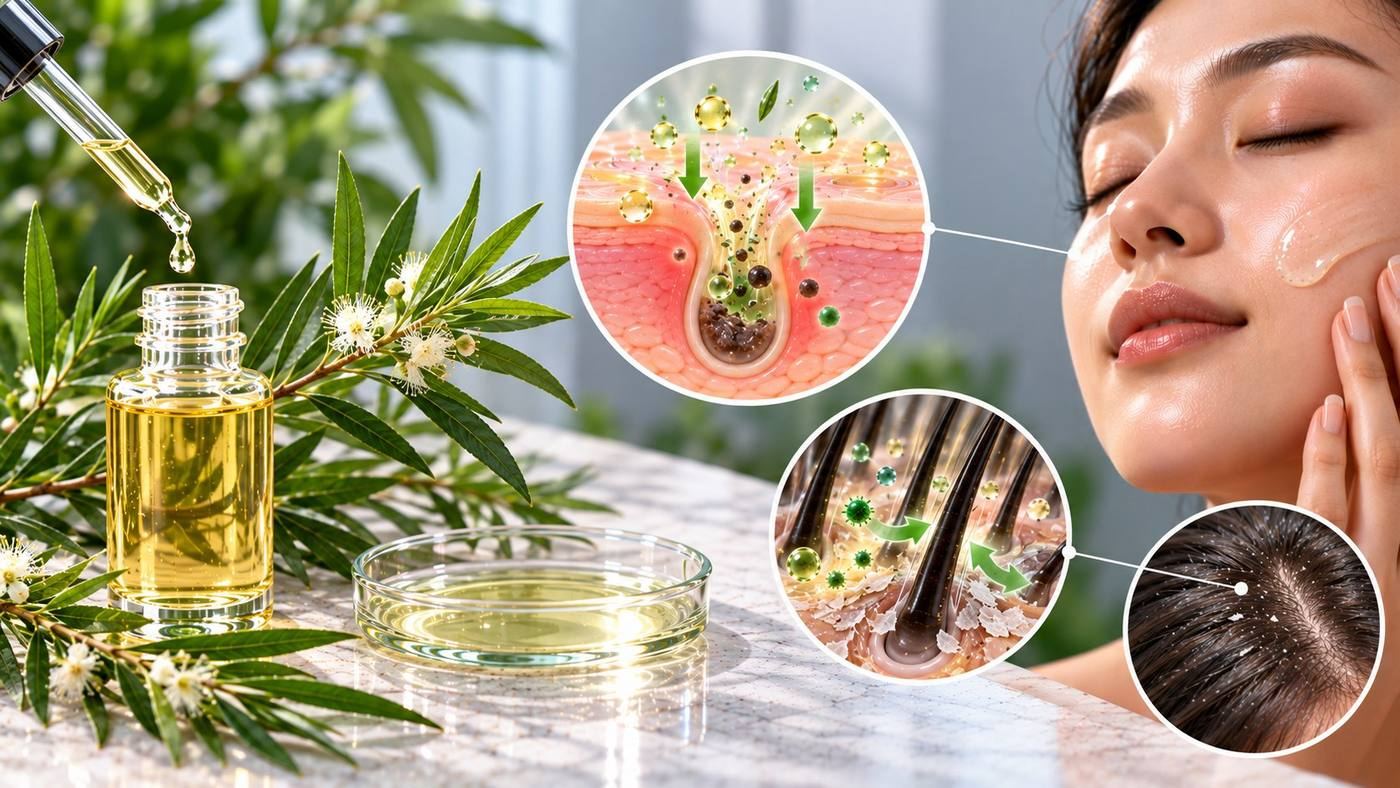
Tea tree oil is a plant essential oil rich in terpinen-4-ol. It has a long history of use on blemish-prone skin and scalps. The human evidence rests on a handful of small trials, most of them more than 15 years old.
02What it does
Tea tree oil has antimicrobial and anti-inflammatory activity against microbes linked to blemishes and flaking. In trials at 5%, it reduced visible blemishes more slowly than benzoyl peroxide but with fewer side effects, and a 5% shampoo reduced visible flaking and itch over four weeks.
03The evidence
Studies below were checked against the publisher, DOI or journal record on 26 Sep 2026. We list design and size so you can judge the strength of each result.
| Study | Design | Who and how long | What it found |
|---|---|---|---|
| Pezantes-Orellana et al. 2025, Frontiers in Medicine (Frontiers) Source | Systematic review | 70 studies of essential oils in skin care from the past decade | Tea tree oil was the most consistently effective oil for blemishes, but dermatitis was reported with tea tree and other oils. |
| Kairey et al. 2023, Frontiers in Pharmacology (Frontiers) Source | Systematic review of randomised trials | All human uses of tea tree oil; 3 acne trials and 1 dandruff trial | Evidence for most uses is limited and more is needed for blemishes. Side effects were minor except at 25% or more. |
| Enshaieh et al. 2007, Indian Journal of Dermatology, Venereology and Leprology Source | Randomised, double-blind, placebo-controlled trial | 60 people with mild to moderate acne, 45 days, 5% tea tree gel | Tea tree gel was 3.55 times more effective than placebo on lesion count and 5.75 times on severity index; side effects similar to placebo. |
| Satchell et al. 2002, Journal of the American Academy of Dermatology (Elsevier) Source | Randomised, single-blind, placebo-controlled trial | 126 people aged 14 and over with dandruff, 4 weeks, 5% tea tree shampoo daily | Scalp score fell from 91.0 to 53.0 versus 99.7 to 88.2 with placebo (p<0.001); itch and greasiness also improved. No serious side effects. |
| Bassett et al. 1990, Medical Journal of Australia (Wiley) Source | Randomised, single-blind trial against benzoyl peroxide | 124 people with mild to moderate acne, 5% tea tree gel vs 5% benzoyl peroxide lotion | Both reduced blemishes significantly. Tea tree acted more slowly but caused fewer side effects such as dryness and irritation. |
Tea tree oil has modest, consistent support for blemish-prone skin and flaking scalps, but the key trials are small and old. It suits cosmetic claims such as "helps reduce the look of blemishes" or "helps reduce visible flakes". In the EU, the new SCCS limits mean leave-on face products cannot reach the 5% level used in the trials.
04How CSL formulation scientists use it
- Match the level to the format and market. The 2025 SCCS opinion supports up to 2.0% in shampoo, 1.0% in shower gel and face wash, and 0.1% in face cream, well below the 5% used in trials.
- Specify oil that meets ISO 4730:2017 and check methyl eugenol against its EU Annex III limits.
- Prevent oxidation: oxidised oil is a stronger sensitiser. Use antioxidants, opaque or airless packs, limited headspace, and stability testing that tracks oxidation markers such as p-cymene.
- Rinse-off formats such as face washes and shampoos are the most practical home for tea tree in the EU. Run repeat-insult patch testing on the final formula.
05Regulatory and claims
The SCCS final opinion (SCCS/1681/25, 2025) found tea tree oil a moderate skin sensitiser and safe for adults only up to 2.0% in shampoo, 1.0% in shower gel and face wash and 0.1% in face cream, and not in sprays. It followed a 2023 ECHA RAC proposal to classify the oil as toxic for reproduction (Repr. 1B), which would otherwise trigger an EU cosmetics ban. CSL regulatory specialists track how these limits are written into law and confirm the status in each target market. Claims stay cosmetic, such as "helps reduce the look of blemishes", never "treats acne" or "cures dandruff".
06Questions brands ask
Can a leave-on tea tree serum still be sold in the EU?
Only at very low levels. The SCCS supports 0.1% in face cream, far below the 5% tested in blemish trials, so efficacy claims for leave-on products need their own testing.
Is tea tree oil as effective as benzoyl peroxide?
Not quite. In the 1990 comparison, 5% tea tree reduced blemishes but worked more slowly than 5% benzoyl peroxide, with fewer side effects.
Why does oxidation matter?
As tea tree oil ages in air and light it forms oxidation products that are stronger skin sensitisers. Fresh, specified oil and protective packaging reduce this risk.
07References
- Pezantes-Orellana C, et al. Evaluating efficacy, safety, and innovation in skin care applications of essential oils: a systematic review. Front Med. 2025;12:1589691. Link
- Kairey L, Agnew T, Bowles EJ, Barkla BJ, Wardle J, Lauche R. Efficacy and safety of Melaleuca alternifolia (tea tree) oil for human health: a systematic review of randomized controlled trials. Front Pharmacol. 2023;14:1116077. Link
- Enshaieh S, Jooya A, Siadat AH, Iraji F. The efficacy of 5% topical tea tree oil gel in mild to moderate acne vulgaris: a randomized, double-blind placebo-controlled study. Indian J Dermatol Venereol Leprol. 2007;73:22. Link
- Satchell AC, et al. Treatment of dandruff with 5% tea tree oil shampoo. J Am Acad Dermatol. 2002;47:852-855. Link
- Bassett IB, Pannowitz DL, Barnetson RS. A comparative study of tea-tree oil versus benzoylperoxide in the treatment of acne. Med J Aust. 1990;153(8):455-458. Link
- Scientific Committee on Consumer Safety. Scientific opinion on tea tree oil. SCCS/1681/25. Final version adopted 30 October 2025. Link
- Scientific Committee on Consumer Products. Opinion on tea tree oil. SCCP/1155/08. Adopted 16 December 2008. Link
Used in: Acne & oil controlDandruff & scalp health
Update log
- Evidence reviewed and page published by CSL scientists
This page summarises published research for brands and formulators. It is general information, not medical advice, and results in studies depend on the full formula tested.