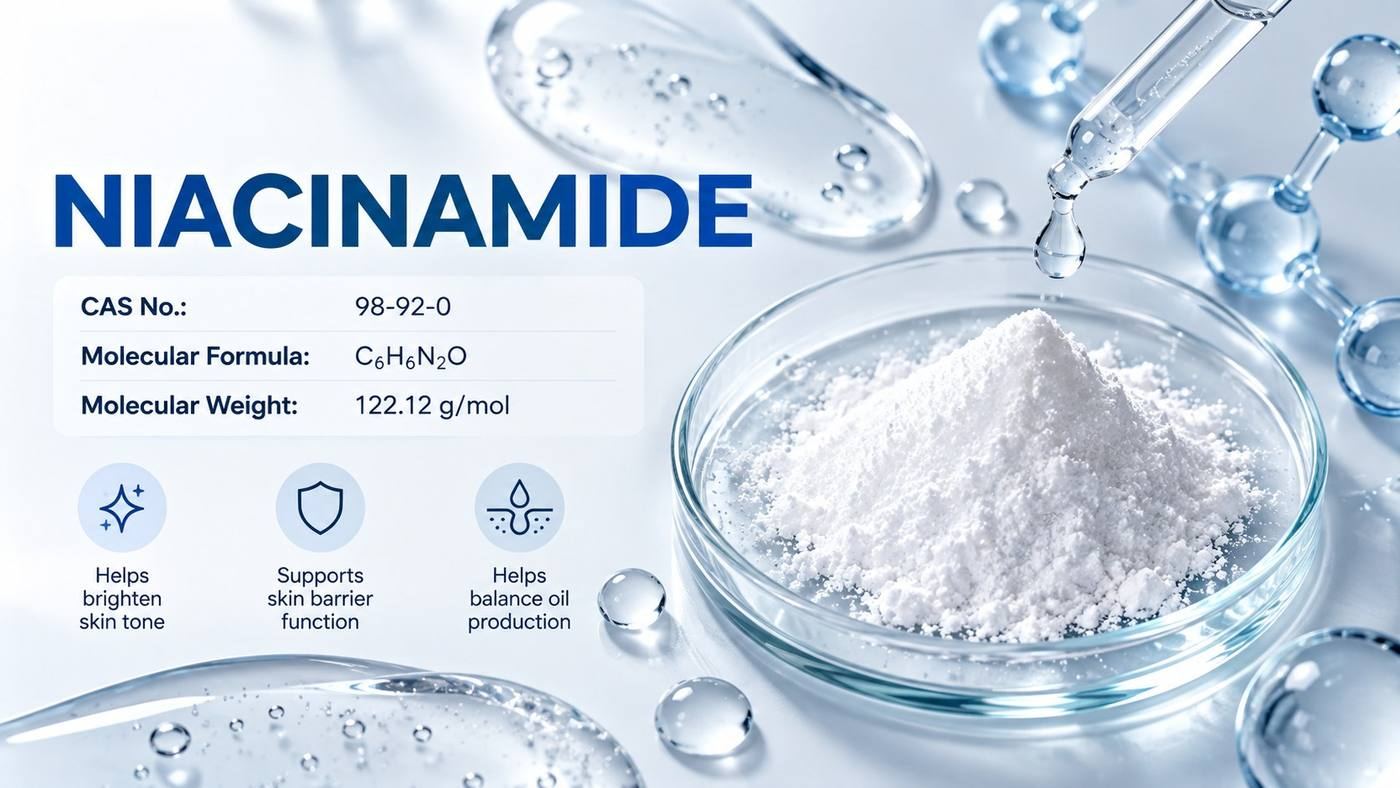
Niacinamide: the evidence behind a gentle, all-round brightening active
Niacinamide (vitamin B3) evens tone by a different route from most brighteners, and it is famously well tolerated. Here is what the trials show, from the landmark studies to 2025–2026 research.
By CSL Formulation team · Evidence checked by CSL scientists
At a glance
- What it is
- Niacinamide (nicotinamide), a form of vitamin B3
- Main benefits
- More even-looking tone, fewer visible spots, less sallowness and red blotchiness
- Levels tested in trials
- 2% to 10%, most often 4–5%
- Time to results
- 4 to 12 weeks
- Watch for
- Very few issues; claims should match combination data
01What is it?
Niacinamide is a water-soluble vitamin used in serums, moisturisers and sunscreens. It is stable, easy to formulate and suits most skin types, which is why it appears in so many brightening and barrier products.
02What it does
Unlike most brighteners, niacinamide does not block tyrosinase. It reduces the transfer of pigment packets (melanosomes) to skin cells, by 35–68% in laboratory models (Hakozaki 2002). That makes it a natural partner for actives that work earlier in pigment production.
03The evidence
Studies below were checked against the publisher, DOI or journal record on 26 Sep 2026. We list design and size so you can judge the strength of each result.
| Study | Design | Who and how long | What it found |
|---|---|---|---|
| Ghasemiyeh et al. 2025, Scientific Reports (Springer Nature) Source | Randomised, double-blind trial, three arms | 77 adults with melasma completed, 3 months; tranexamic acid + niacinamide creams vs 4% hydroquinone | Melasma score fell 62–67% with the niacinamide combinations, as effective as hydroquinone, with fewer side effects. |
| Rocio et al. 2025, Journal of Cosmetic Dermatology Source | Investigator-blind randomised trial | 60 women with melasma, 5 months; serum with 5% niacinamide, tranexamic acid, vitamin C and hydroxy acid | Pigmentation fell significantly, similar to hydroquinone, with better tolerance and acceptance. |
| Barbosa et al. 2024, Clinical, Cosmetic and Investigational Dermatology Source | Randomised, double-blind trial against 4% hydroquinone | 50 women with melasma, 60 days, 10% niacinamide with a vitamin C derivative | Melasma score −32% versus −43% with hydroquinone; no significant difference and no serious side effects. |
| Lee et al. 2014, Skin Research and Technology Source | Randomised, double-blind, vehicle-controlled trial | 42 women, 8 weeks, 2% niacinamide with tranexamic acid | Significantly more reduction in facial pigmentation than the vehicle, beyond the effect of sunscreen alone. |
| Navarrete-Solís et al. 2011, Dermatology Research and Practice Source | Double-blind randomised split-face trial | 27 adults with melasma, 8 weeks, 4% niacinamide vs 4% hydroquinone | No statistical difference by colour measurement; side effects 18% with niacinamide vs 29% with hydroquinone. |
| Bissett et al. 2004, International Journal of Cosmetic Science Source | Double-blind, placebo-controlled split-face trial | 50 women aged 40–60, 12 weeks, 5% niacinamide | Improved hyperpigmented spots, red blotchiness, sallowness, texture and fine lines versus control. |
| Hakozaki et al. 2002, British Journal of Dermatology Source | Laboratory models plus vehicle-controlled clinical studies | Women with hyperpigmentation, 4 weeks | Reduced melanosome transfer in the lab and significantly reduced hyperpigmentation versus vehicle. |
Niacinamide is one of the best-supported and best-tolerated tone actives. Most recent trials test it in combination, so product claims should say it is part of a formula shown to even tone, not credit it alone.
04How CSL formulation scientists use it
- Brightening benefits were shown from 2% (in combination) and at 4–5% on its own; 10% has been used in combinations.
- Pair it with an active that works earlier in pigment production, such as tranexamic acid, vitamin C or 4-hexylresorcinol.
- It is stable across a wide pH range and suits serums, moisturisers and sunscreens.
- Use it to improve tolerability: in trials it caused fewer reactions than hydroquinone.
05Regulatory and claims
Niacinamide is widely permitted in cosmetics. CSL regulatory specialists check the target markets and keep wording cosmetic, for example “improves the appearance of uneven tone”, and avoid comparisons with hydroquinone on pack.
06Questions brands ask
Why is niacinamide in so many products?
It is stable, well tolerated and has benefits for tone, barrier and oil, backed by trials.
Does it work on its own?
Yes. A 5% niacinamide moisturiser improved spots and tone versus control over 12 weeks. Most newer trials combine it with other actives.
Is 10% better than 5%?
Not necessarily. Strong results were seen at 4–5%. Higher levels are mostly used in combination products.
07References
- Ghasemiyeh P, et al. Niosomal and conventional tranexamic acid/niacinamide vs hydroquinone creams in melasma. Sci Rep. 2025;15:42739. doi.org/10.1038/s41598-025-26693-8
- Rocio J, et al. A serum containing niacinamide, tranexamic acid, vitamin C and hydroxy acid compared to 4% hydroquinone in melasma. J Cosmet Dermatol. 2025;24(3). doi.org/10.1111/jocd.70097
- Barbosa MMC, et al. Clin Cosmet Investig Dermatol. 2024;17:2215–2223. doi.org/10.2147/CCID.S473224
- Lee DH, et al. Topical niacinamide and tranexamic acid for facial hyperpigmentation. Skin Res Technol. 2014. doi.org/10.1111/srt.12107
- Navarrete-Solís J, et al. Niacinamide 4% versus hydroquinone 4% in melasma. Dermatol Res Pract. 2011:379173. doi.org/10.1155/2011/379173
- Bissett DL, et al. Topical niacinamide reduces yellowing, wrinkling, red blotchiness, and hyperpigmented spots in aging facial skin. Int J Cosmet Sci. 2004;26(5):231–238. doi.org/10.1111/j.1467-2494.2004.00228.x
- Hakozaki T, et al. The effect of niacinamide on reducing cutaneous pigmentation and suppression of melanosome transfer. Br J Dermatol. 2002;147(1):20–31. doi.org/10.1046/j.1365-2133.2002.04834.x
Used in: Brightening & radianceHyperpigmentation & even toneAcne & oil control
Update log
- Evidence reviewed and page published by CSL scientists
This page summarises published research for brands and formulators. It is general information, not medical advice, and results in studies depend on the full formula tested.