Glycolic acid: resurfacing, brightening and the evidence behind it
The smallest alpha hydroxy acid (AHA) penetrates fastest, which makes it the most effective for texture and the most likely to irritate. Here is what trials show and how strength, pH and labelling differ by market.
By CSL Formulation team · Evidence checked by CSL scientists
At a glance
- What it is
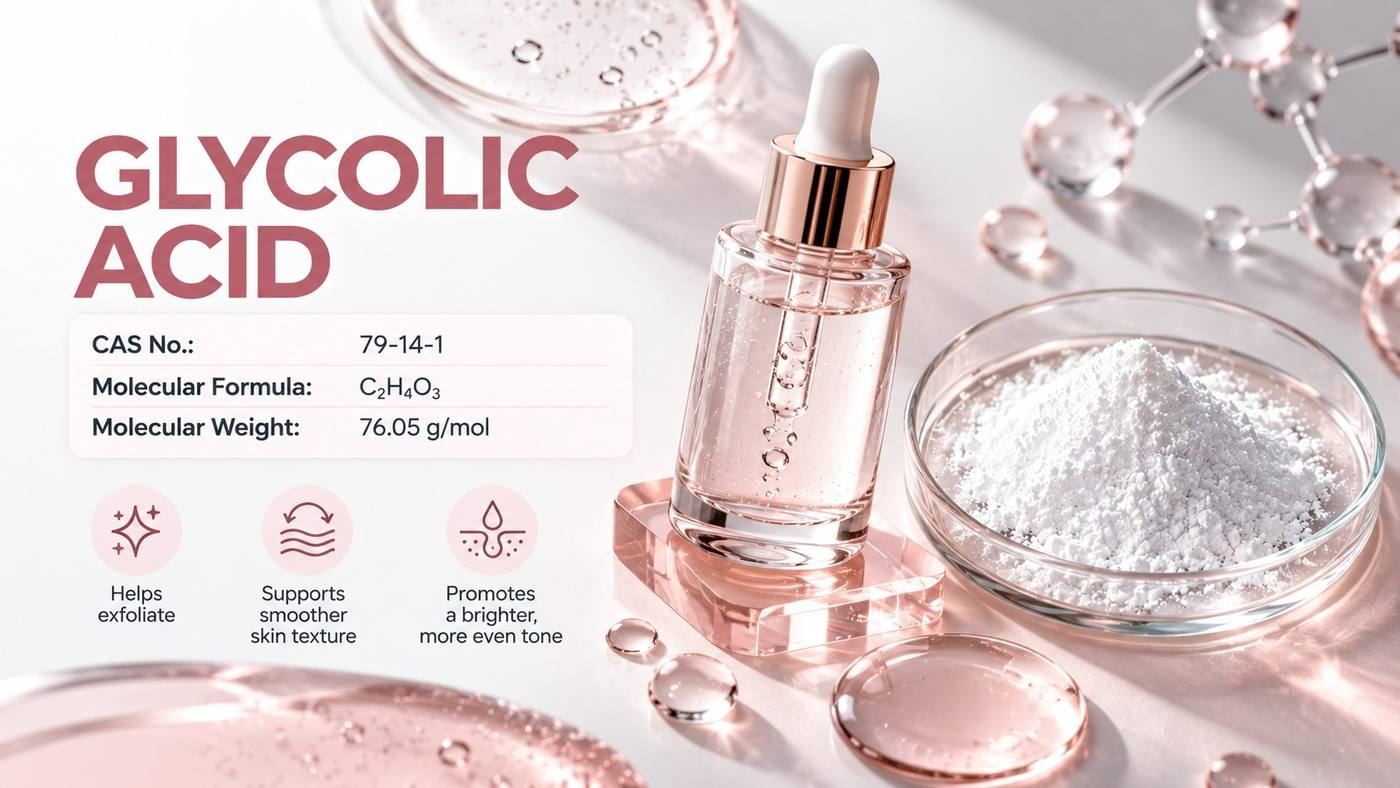
- An alpha hydroxy acid (AHA) from sugar cane or synthesis; molecular weight 76
- Main benefits
- Smoother texture, brighter-looking skin, appearance of photoageing
- Levels tested
- 8% leave-on creams; 35–70% in-clinic peels
- Time to results
- Weeks for texture; months for photoageing
- Watch for
- Irritation, sun sensitivity, market limits on % and pH
01What is it?
Glycolic acid loosens the bonds between dead cells on the skin surface so they shed more evenly. It is used in leave-on serums and toners at low strength, and in professional peels at much higher strength.
02What it does
By speeding up shedding of the outer layer, glycolic acid smooths texture and lets skin reflect light more evenly. Longer use at higher strength has also been linked to thicker, denser skin in biopsy studies (Ditre 1996).
03The evidence
Studies below were checked against the publisher, DOI or journal record on 26 Sep 2026. We list design and size so you can judge the strength of each result.
| Study | Design | Who and how long | What it found |
|---|---|---|---|
| Lin et al. 2025, Scientific Reports (Springer Nature) Source | Network meta-analysis of 23 randomised trials | 3,905 participants | Leave-on glycolic acid clearly improved skin roughness versus control; effects on wrinkles did not reach significance. Higher risk of side effects than some alternatives. |
| Rini et al. 2025/2026, Dermatologic Surgery Source | Randomised comparative trial | 60 adults with melasma, 6 peels two weeks apart, 35% glycolic acid vs 4% retinol peel | Both improved pigmentation and quality of life; side effects 3.3% with glycolic acid vs 13.3% with retinol. |
| Sarkar and Lakhani 2024, Dermatologic Surgery Source | Systematic review | 24 studies (15 randomised), 1,075 people | Glycolic acid was the safest and most effective peel for melasma. |
| Li and Xiang 2026, Journal of Cosmetic Dermatology Source | Evidence review (narrative) | Literature to January 2026 | Superficial glycolic acid has the strongest evidence among peels, working best alongside sunscreen and a brightening active. |
| Stiller et al. 1996, Archives of Dermatology Source | Double-blind, vehicle-controlled trial | 74 women aged 40–70, 22 weeks, 8% glycolic acid cream | 76% improved in overall photodamage vs 40% on the base cream; also less sallowness. |
| Ditre et al. 1996, Journal of the American Academy of Dermatology (Elsevier) Source | Pilot study, treated vs placebo forearm | About 6 months, 25% AHA lotion | Skin about 25% thicker, with denser collagen and better elastic fibres, and no inflammation. |
Glycolic acid is the best-supported AHA for texture and a well-proven peel. Most recent pigmentation data come from in-clinic peels at 35–70%, which should not be used to support claims for a retail product.
04How CSL formulation scientists use it
- Retail leave-on strength is limited by market (see below); trial benefits for photodamage were shown at 8% in a leave-on cream.
- pH matters as much as percentage: lower pH means more free acid, more effect and more irritation.
- Pair it with sunscreen advice and, for tone, with a brightening active; alone it mainly improves texture.
- For sensitive skin, lactic acid or mandelic acid is usually the better choice.
05Regulatory and claims
AHAs have clear limits. In the US, the Cosmetic Ingredient Review found AHAs safe in retail products at 10% or less with a final pH of 3.5 or higher, and FDA recommends a “Sunburn Alert” label because AHAs raise UV sensitivity (about 18% more reddening after 4 weeks in FDA-sponsored studies). In the EU, the SCCNFP advised precautionary consumer limits of 4% at pH 3.8 or higher for glycolic acid and 2.5% at pH 5 or higher for lactic acid, with warnings to avoid the eyes and protect from UV. CSL regulatory specialists set concentration, pH and warnings for each target market.
06Questions brands ask
Is glycolic acid safe for daily use?
At retail strengths within market limits, yes for most skin, with sunscreen. Start low and build up.
Why is it the most irritating AHA?
It is the smallest AHA, so it penetrates fastest. That helps results but raises irritation.
Do peel results apply to serums?
No. Peel trials use 35–70% in clinic. Retail serums are far weaker and need their own evidence.
07References
- Lin L, et al. Comparative efficacy of topical interventions for facial photoaging: a network meta-analysis. Sci Rep. 2025;15:26889. doi.org/10.1038/s41598-025-12597-0
- Rini T, et al. 35% glycolic acid peel versus 4% retinol peel in melasma. Dermatol Surg. 2026;52(3):232–236. doi.org/10.1097/DSS.0000000000004858
- Sarkar R, Lakhani R. Chemical peels for melasma: a systematic review. Dermatol Surg. 2024;50(7):656–661. doi.org/10.1097/DSS.0000000000004167
- Li Y, Xiang W. Advances in the application of chemical peels in pigmentary skin disorders. J Cosmet Dermatol. 2026;25(7):e71048. doi.org/10.1111/jocd.71048
- Stiller MJ, et al. Topical 8% glycolic acid and 8% L-lactic acid creams for photodamaged skin. Arch Dermatol. 1996;132(6):631–636. doi.org/10.1001/archderm.1996.03890300047009
- Ditre CM, et al. Effects of α-hydroxy acids on photoaged skin. J Am Acad Dermatol. 1996;34(2):187–195. doi.org/10.1016/S0190-9622(96)80110-1
- US FDA. Alpha hydroxy acids. FDA page
- SCCNFP/0370/00. Opinion on alpha hydroxy acids. 2000. EU opinion (PDF)
Used in: Brightening & radianceAnti-ageing & wrinkles
Update log
- Evidence reviewed and page published by CSL scientists
This page summarises published research for brands and formulators. It is general information, not medical advice, and results in studies depend on the full formula tested.