1,4-dioxane in shampoo: New York's 1 ppm limit, ethoxylated surfactants and how to test
New York caps 1,4-dioxane in shampoo, body wash and other personal care products at 1 ppm, and the waivers have run out. The chemistry behind it, the surfactants at risk, and how to prove every batch passes.
By CSL Formulation and analytical testing teams, Cosmetic Science Lab · Reviewed by Shreya Rangarajan
Rule at a glance
- Authority
- New York State Department of Environmental Conservation (DEC)
- Law
- Environmental Conservation Law §35-0105 and §37-0117; rules at 6 NYCRR Subpart 352-1
- Limits
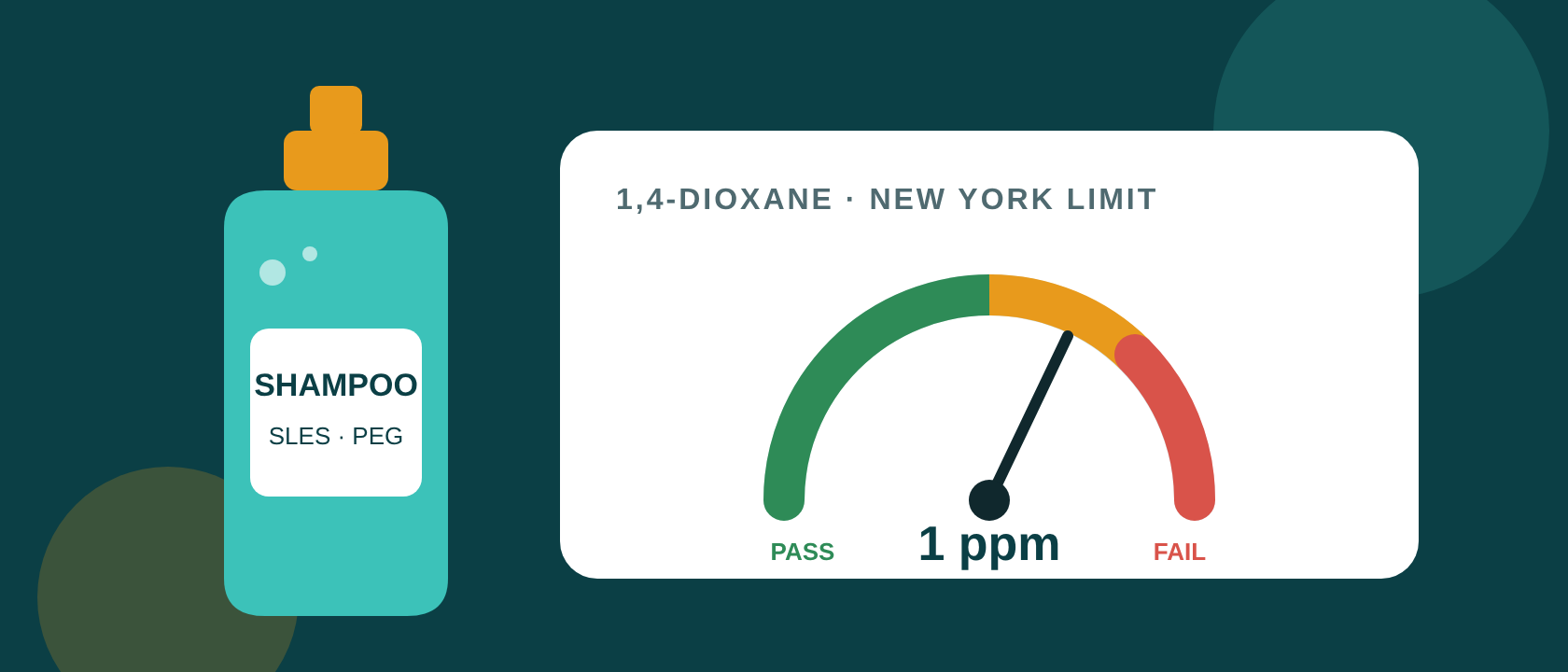
- 1 ppm in personal care and household cleansing products; 10 ppm in cosmetics
- Waivers
- None effective after 30 December 2025, so every product must now comply
- Contaminant source
- Ethoxylated surfactants such as SLES, PEGs, polysorbates and laureths
- Proof
- Finished-product testing by the method in section 352-1.6
Quick answer
- New York allows no more than 1 ppm of 1,4-dioxane in shampoo, body wash, soap and other personal care products, and no more than 10 ppm in cosmetics [1].
- DEC says no waiver is effective after 30 December 2025, so every product sold in the state must meet the limit now [1].
- 1,4-dioxane is not added on purpose. It is a by-product of making ethoxylated surfactants, so the fix starts at the raw-material specification [3].
- A supplier "free of" letter is not proof. DEC expects analytical testing of the product [1], usually by headspace GC-MS.
Take-home message for formulators
- Count every ethoxylated ingredient as a dioxane source
- Set a measured 1,4-dioxane limit on each raw-material CoA
- Test the finished product with a quantitation limit of 0.1 ppm or lower
Take-home message for brand owners
- Treat every batch shipped to New York as in scope today
- Retest after any supplier or grade change
- Keep CoAs, specs and test reports in one file for retailers
01New York's 1,4-dioxane limits
New York amended its Environmental Conservation Law to cap 1,4-dioxane in products sold in the state. The limits were phased in over two years [1]:
| Product category | Limit | Effective from |
|---|---|---|
| Personal care products (for example shampoo, body wash, soap) | 2 ppm | 31 Dec 2022 |
| Household cleansing products | 2 ppm | 31 Dec 2022 |
| Cosmetics | 10 ppm | 31 Dec 2022 |
| Personal care products | 1 ppm | 31 Dec 2023 |
| Household cleansing products | 1 ppm | 31 Dec 2023 |
DEC proposed implementing rules (6 NYCRR Subpart 352-1) on 6 December 2023 and adopted them on 18 September 2024 [1], [2]. The rules set out how compliance is evaluated, including analytical testing of the product under section 352-1.6. Waivers gave some manufacturers extra time, but DEC states that no waiver is effective after 30 December 2025 [1].
The 1 ppm and 10 ppm limits depend on whether the product is a personal care product or a cosmetic under the law's definitions. Check the category against DEC's definitions before you set a release specification. Most rinse-off cleansing products fall under the 1 ppm limit.
The driver is groundwater. 1,4-dioxane is persistent and mobile in water, and it has been found in Long Island's sole-source aquifer [2].
02Why ethoxylation creates 1,4-dioxane
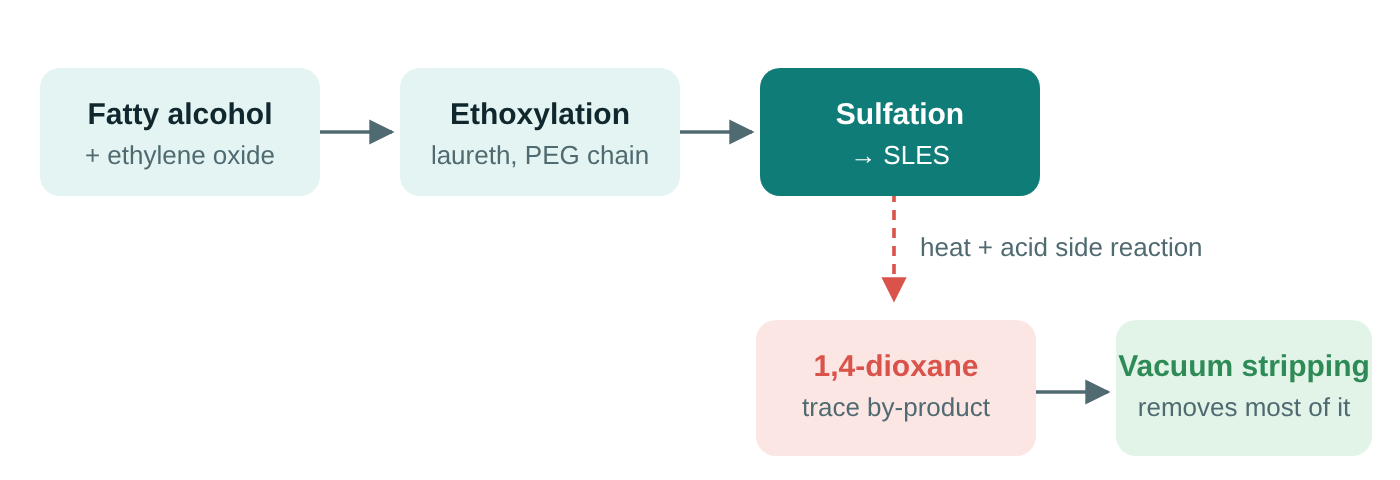
Ethoxylation adds ethylene oxide to a fatty alcohol to build a polyethylene glycol chain. The chain makes a surfactant milder, more water-soluble and better at foaming. Under heat and acid, especially during the sulfation step that turns an alcohol ethoxylate into SLES, two ethylene oxide units can close into a six-membered ring. That ring is 1,4-dioxane, a manufacturing by-product rather than an added ingredient [3].
Suppliers remove most of it by vacuum stripping: the surfactant is held under reduced pressure, often with steam or nitrogen sparging, so the volatile dioxane boils off. FDA has recommended this step to manufacturers [3]. How well and how consistently a supplier strips decides how much reaches your bottle, so two lots with the same INCI name can differ.
03Which surfactants carry the risk
FDA lists ingredient names containing "PEG", "polyethylene", "polyoxyethylene", "-eth-" or "-oxynol-" as possible sources [3]. The table ranks the common families by typical risk; the real figure for your lot is the one on its CoA.
| Ingredient family | Example INCI names | Risk |
|---|---|---|
| Ether sulfates | Sodium laureth sulfate (SLES), ammonium laureth sulfate | High |
| PEG compounds | PEG-150 distearate, PEG-7 glyceryl cocoate | Moderate–high |
| Alcohol ethoxylates | Laureth-n, ceteareth-n, oleth-n | Moderate |
| Polysorbates | Polysorbate 20, 60, 80 | Moderate |
| Amphoterics | Cocamidopropyl betaine | Low |
| Non-ethoxylated anionics | Sodium cocoyl isethionate, sodium lauroyl sarcosinate | Negligible |
| Glucosides | Decyl, coco- and lauryl glucoside | Negligible |
Risk adds up across the formula. A shampoo with SLES, a PEG thickener and a polysorbate solubiliser has three sources, and all three count toward the 1 ppm total. High risk does not mean non-compliant: well-stripped SLES can support a finished product below 1 ppm when the supplier's specification proves it.
Send us your INCI list and we will flag every ethoxylated source and estimate the worst-case load against 1 ppm. Request a source map
04How to keep every batch under 1 ppm
- Tighten supplier specs and CoA limits
Ask every supplier of an ethoxylated ingredient for a 1,4-dioxane specification and a batch Certificate of Analysis with a measured value, not just "complies". Work backwards from the limit: if SLES is used at 12% (as supplied) and is the only source, the raw material must sit at or below about 8 ppm before any safety margin (1 ppm ÷ 0.12).
- Move to low-dioxane grades
Major surfactant makers sell grades stripped harder and specified low in dioxane. They cost more, but they are usually the fastest route because they need little or no reformulation.
- Swap to non-ethoxylated systems
For new launches, a sulfate-free base removes the source entirely. Common pairs are sodium cocoyl isethionate with cocamidopropyl betaine, or glutamate and glucoside blends. Expect harder thickening, lower foam and new pH and preservative windows, so plan full stability testing.
- Check the whole formula
Fragrance, solubilisers and PEG conditioning agents each add a little. A finished-product test catches what raw-material specs miss.
05How to test with headspace GC-MS
Measuring 1 ppm in a foamy, surfactant-heavy sample needs real analytical chemistry. The standard approach is headspace GC-MS. The sample is sealed in a vial and heated so dioxane moves into the gas above it. That gas goes into the gas chromatograph, and the mass spectrometer confirms the compound by its fragment ions. A deuterated internal standard (1,4-dioxane-d8) corrects for matrix effects [4].
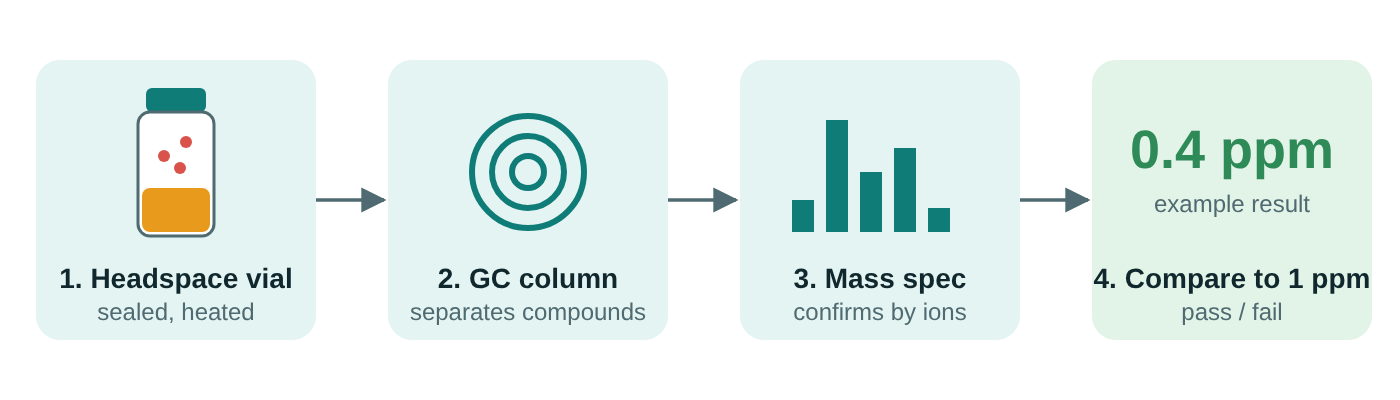
A sound testing programme covers five points:
- Low quantitation limit. A "<1 ppm" result from a method that cannot quantify below 1 ppm tells you nothing about your margin. Headspace GC-MS methods report quantitation limits of about 0.01 ppm (9–13 ppb) [4], so ask for 0.1 ppm or lower.
- DEC-aligned method. Confirm the laboratory's procedure meets the requirements in section 352-1.6 [1].
- Accredited laboratory. Use an ISO/IEC 17025-accredited laboratory with the method on its scope.
- Test on change. Test at first production, after any supplier or grade change, and periodically after that.
- Keep the paper trail. File CoAs, specifications and reports together to show due diligence to retailers and regulators.
06Build compliance into the formula
New York's limits are fully in force [1]. Brands selling rinse-off products there need 1 ppm built into the formula: well-stripped or low-dioxane surfactants, firm CoA limits, and headspace GC-MS testing as the final check. Brands that start at the raw-material specification rarely have problems at the testing stage. If you also sell in the EU or UK, the same documentation supports your US and EU safety files.
07Questions readers ask
What is the 1,4-dioxane limit in New York?
1 ppm for personal care products such as shampoo, body wash and soap, and for household cleansing products, since 31 December 2023. Cosmetics are capped at 10 ppm, since 31 December 2022.
Are 1,4-dioxane waivers still available in New York?
No. DEC states that no waiver is effective after 30 December 2025, so all products sold in New York must now meet the limits.
Why is 1,4-dioxane in shampoo?
It forms as a by-product when ethoxylated surfactants such as sodium laureth sulfate are made. It is not added on purpose, and suppliers remove most of it by vacuum stripping.
Does sulfate-free mean dioxane-free?
Not always. A sulfate-free formula can still contain PEGs, polysorbates or laureths. Only a formula with no ethoxylated ingredients removes the source.
How is 1,4-dioxane tested in cosmetics?
Usually by headspace GC-MS with a deuterated internal standard. Ask for a quantitation limit of 0.1 ppm or lower so the result shows your margin below 1 ppm.
Not sure your shampoo passes 1 ppm?
Send us your formula. We flag every ethoxylated source, set CoA limits with your suppliers, and build low-dioxane or ethoxylate-free formulas that keep their foam and feel.
08References
- New York State Department of Environmental Conservation. 1,4-Dioxane limits for household cleansing, personal care and cosmetic products. Accessed 16 October 2026. NYSDEC
- Personal Care Insights. Toxin takedown: New York pioneers 1,4-dioxane ban in household and personal care products. 24 September 2024. Personal Care Insights
- US Food and Drug Administration. 1,4-Dioxane in cosmetics: a manufacturing byproduct. Accessed 16 October 2026. FDA
- Agilent Technologies. Determination of 1,4-dioxane in consumer products by headspace GC/MS. Application note 5994-3220EN. Agilent PDF
Update log
- Published by Cosmetic Science Lab
This article is general technical information, not legal, regulatory or medical advice. Confirm requirements for your product and market before launch.