How to make body butter that doesn't go grainy
Graininess is a crystallisation problem, not a bad batch of shea. The fat science behind it, a % w/w formula that scales, a tempering method and the stability checks brands need.
By Dr. Premalatha, Ph.D., Life Science, Regulatory Consultant, Cosmetic Science Lab
Quick answer
- Why does body butter go grainy? Graininess is a crystallisation problem, not a bad batch of shea. When melted shea butter cools slowly, its higher-melting fats form a few large crystals that feel like sand.
- How to make body butter that stays smooth: weigh in grams, melt the hard butters, hold them at 75–80 °C for 15–20 minutes, stir in the liquid oils and vitamin E, then chill fast until set and whip for 5–8 minutes.
- The hold erases existing crystal seeds; the rapid chill makes many tiny crystals instead of a few gritty ones.
- Store below 25 °C. Heat cycling in transit or a warm bathroom can bring the grain back.
Take-home message for formulators
- Write the formula in % w/w, never in cups
- Control the cooling rate as tightly as the ingredients
- Validate hold and chill times on production equipment
Take-home message for brand owners
- Grain that appears weeks after launch is usually a process or storage issue
- Ask for freeze-thaw and heat-cycle data before you ship
- Specify peroxide value and free fatty acids for incoming shea
01Why body butter goes grainy: shea butter polymorphism
Shea butter is mostly two fatty acids. Stearic acid makes it solid and oleic acid makes it soft, and together they make up most of the fat. Across shea nuts from seven African countries, stearic acid ranged from 28% to 56% and oleic acid from 34% to 61% [1], which is one reason two lots of "the same" shea can behave differently in the same recipe.
Fats such as shea butter and cocoa butter are polymorphic: they can crystallise in several forms, each with its own melting point. Cocoa butter has at least six (Forms I–VI). Form V gives the right texture, gloss and melt; lower forms such as Form IV are too soft, and bloom comes from the slow change of Form V into Form VI [2]. Work on cocoa butter and shea stearin blends shows that both the cooling rate and the blend ratio change which crystal forms appear: faster cooling favoured the less stable forms, and more shea stearin slowed the move to the most stable one [3].
When melted shea cools slowly, its higher-melting fats crystallise first and keep growing. The result is the same fat bloom chocolatiers fight: hard, sand-like beads in an otherwise soft butter. The choice of liquid oil also changes how shea crystallises, and the slow change into larger crystals can take days, so grain can appear in storage, in transit or in the customer's hands rather than on the day the batch is made [4].
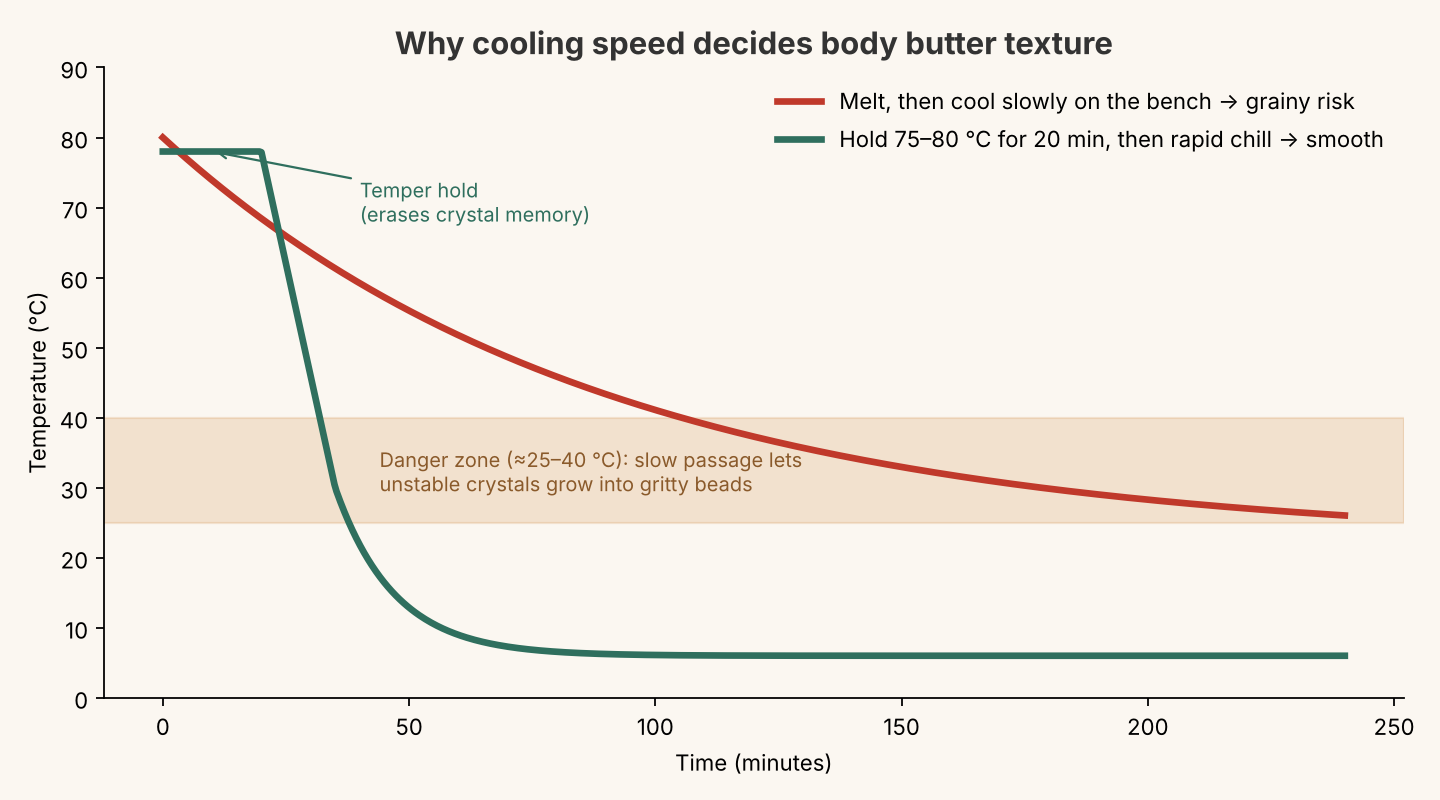
The fix follows from the cause: melt every crystal fully, then cool quickly so many tiny crystals form at once instead of a few large ones.
02The anti-grain body butter recipe (% formula)
This body butter recipe is written in percentages by weight, so it scales from a 100 g test jar to a 50 kg batch without changing the hard-to-soft fat ratio. Cup measures cannot do that, because a packed cup of shea weighs very differently from a scooped one.
| Ingredient (INCI) | % w/w | Role |
|---|---|---|
| Refined shea butter (Butyrospermum parkii butter) | 40 | Body and richness |
| Cocoa butter (Theobroma cacao seed butter) | 15 | Firmness and a higher melting point for warm climates |
| Jojoba oil (Simmondsia chinensis seed oil) | 15 | Light, oxidation-resistant glide |
| Sweet almond oil (Prunus amygdalus dulcis oil) | 13.5 | Slip and spreadability |
| Coconut oil (Cocos nucifera oil) | 10 | Fast melt on skin |
| Argan oil (Argania spinosa kernel oil) | 5 | Softer, less waxy after-feel |
| Essential oil blend | 1 | Fragrance (check IFRA limits and allergen labelling) |
| Vitamin E (Tocopherol) | 0.5 | Antioxidant against rancidity |
| Total | 100 |
Optional: for a less greasy feel, add 3–5% arrowroot powder and take the same amount out of the sweet almond oil.
03How to make whipped body butter: step by step
Equipment: a digital scale accurate to 0.1 g, a double boiler, a thermometer, a heat-proof bowl, an ice bath or freezer, and a stand or hand mixer.
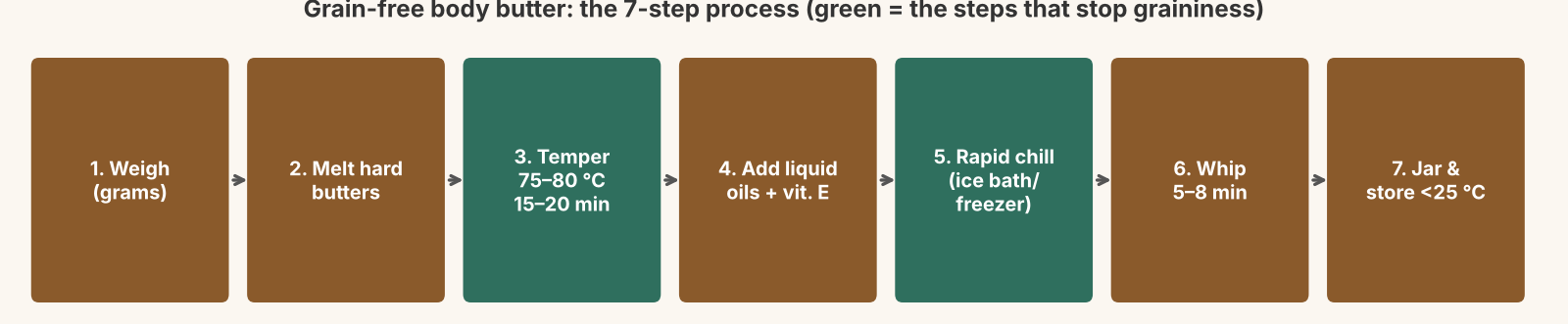
- Weigh everything in grams
Use the percentages in Table 1.
- Melt the hard butters
Put shea butter, cocoa butter and coconut oil in a double boiler over low heat.
- Temper: hold at 75–80 °C for 15–20 minutes
This melts every existing crystal, including the stable seeds that grow into grit. Supplier guidance recommends a hold of about 20 minutes at around 80 °C followed by quick chilling [7]. Stir now and then; do not let it smoke.
- Add liquid oils off the heat
Stir in jojoba, sweet almond and argan oil, then vitamin E. Add essential oils once the blend drops below 40 °C to protect the aroma.
- Rapid chill
Set the bowl in an ice bath, or place it in the freezer for 15–25 minutes, until it is opaque and firm at the edges but still soft in the centre. Speed through the 25–40 °C zone is the whole point.
- Whip
Beat for 5–8 minutes until pale, light and holding soft peaks. If it is too hard, rest it at room temperature for 10 minutes first.
- Jar and store
Fill clean, dry jars and keep them below 25 °C, away from sun and heat cycling.
04Worked example: a 200 g batch
Multiply each percentage by 2 to get grams for a 200 g batch. Whipping adds air, so leave extra space in the jar.
| Ingredient | Grams |
|---|---|
| Refined shea butter | 80 |
| Cocoa butter | 30 |
| Jojoba oil | 30 |
| Sweet almond oil | 27 |
| Coconut oil | 20 |
| Argan oil | 10 |
| Essential oil blend | 2 |
| Vitamin E | 1 |
A 200 g batch typically sets in 15–25 minutes in a freezer and whips in 5–8 minutes. For a 5 kg batch, multiply the percentages by 50 instead. The method stays the same, but a larger mass chills more slowly, so use a jacketed vessel or spread the blend into shallow trays.
05Common mistakes that make body butter grainy
- Melting only until liquid. Clear oil can still hold invisible crystal seeds. Hold it at temperature.
- Cooling on the counter. Slow cooling is the main cause of grit. Chill fast.
- Measuring by the cup. Volume measures let the hard-to-soft fat ratio drift between batches.
- Storing near heat. Partial melting and re-setting regrow grains in a finished jar.
- Warming a grainy jar just enough to soften it. That re-seeds the grit. Re-melt fully, temper and chill again.
- Skipping the antioxidant. A water-free butter has low microbial risk, but its oils still go rancid.
06For brands and formulators: stability is more than texture
An anhydrous body butter needs no preservative against microbes as long as water stays out of the jar, but it still needs stability work before launch.
- Rancidity. Shea fats break down by hydrolysis and oxidation. In a Rutgers study of seven West African shea butters, free fatty acid level was the most variable quality parameter, ranging from 1.07% to 8.56% [5]. Specify peroxide value and free fatty acids on incoming certificates of analysis.
- Antioxidant system. Tocopherol at 0.2–0.5% is a common baseline. In accelerated Rancimat and DSC tests, rosemary extract significantly slowed the oxidation of five vegetable oils [6], and it is often paired with tocopherol.
- Bloom stability. Run freeze-thaw and 40 °C heat-cycle tests to confirm the grain does not return in transit. Interesterified shea grades, modified to crystallise faster, are marketed to cut the risk of graininess at scale [4].
- Process control. Scale-up changes cooling rates. Validate hold temperatures, chill times and whip speed on production equipment, not the bench.
Add water, aloe or a hydrosol and the product becomes an emulsion that needs an emulsifier and a broad-spectrum preservative. See our guides to what an emulsion is and how to make lotion.
07Questions readers ask
Can I fix body butter that has already gone grainy?
Yes. Re-melt it completely, hold it at 75–80 °C for 15–20 minutes, then chill it fast and whip again.
Why does whipped body butter go grainy weeks later?
Temperature swings partly melt the fats, and slow re-setting grows larger crystals. Store it below 25 °C and away from sunlight.
Does cocoa butter make graininess worse?
It can if it cools slowly, because cocoa butter is strongly polymorphic. Tempered and chilled fast, it adds firmness without grit.
How long does homemade body butter last?
With tocopherol and cool, dark storage, most anhydrous butters stay fresh for around 6–12 months. Discard any batch that smells like crayons or old nuts, a sign of rancidity.
Do I need a preservative in body butter?
Not if the product stays water-free and water cannot get into the jar. Once water, aloe or a hydrosol is added, it needs a broad-spectrum preservative.
Need a body butter that survives shipping, shelf and summer?
Our formulation team develops and stability-tests anhydrous products for skin and body care brands.
08References
- Akihisa T, Kojima N, Katoh N, Ichimura Y, Suzuki H, Fukatsu M, Maranz S, Masters ET. Triterpene alcohol and fatty acid composition of shea nuts from seven African countries. J Oleo Sci. 2010;59(7):351–360. DOI
- Chen J, Ghazani SM, Stobbs JA, Marangoni AG. Tempering of cocoa butter and chocolate using minor lipidic components. Nat Commun. 2021;12:5018. DOI
- Macridachis J, Bayés-García L, Calvet T. Temperature-driven changes in the polymorphism, microstructure and thermal properties of cocoa butter/shea butter stearin blends. Food Biophys. 2025;20(4):153. DOI
- AAK. The impact of the oil phase and practical strategies to prevent grainy formulations. UL Prospector presentation; 2026. PDF
- Nahm HS. Quality characteristics of West African shea butter (Vitellaria paradoxa) and approaches to extend shelf-life. Rutgers University thesis (Food Science). RUcore
- Song X, Sui X, Jiang L. Protection function and mechanism of rosemary (Rosmarinus officinalis L.) extract on the thermal oxidative stability of vegetable oils. Foods. 2023;12(11):2177. DOI
- From Nature With Love. Vegetable butter crystallization (graininess). Supplier technical note. Web
Update log
- Published by Cosmetic Science Lab
This article is general technical information, not legal, regulatory or medical advice. Confirm requirements for your product and market before launch.