How is soap made? Saponification, cold process and melt-and-pour explained
Soap is made by reacting fats or oils with lye. How saponification works, how to calculate lye with a SAP value, how the four bar-making routes compare, and when a brand should choose a syndet or combo bar instead.
By CSL Formulation science team, Cosmetic Science Lab · Reviewed by Dr. Premalatha, Ph.D., Life Science, Regulatory Consultant
Quick answer
- How is soap made? By reacting fats or oils with a strong alkali (lye). The reaction, saponification, produces soap and glycerin [1].
- Sodium hydroxide makes bar soap; potassium hydroxide makes liquid soap. Each oil needs a calculated amount of lye, set by its SAP value.
- A correctly calculated bar contains no free lye once saponification is complete, but it is always alkaline, typically around pH 9–11 [5].
- For sensitive or facial skin, a lower-pH syndet or combo bar is usually the better format.
Take-home message for formulators
- Calculate lye from batch-specific SAP values, not a generic table
- Set superfat deliberately; it trades hardness and shelf life for mildness
- Specify cure and release checks, not just the recipe
Take-home message for brand owners
- Choose the format (soap, syndet, combo) before the fragrance
- "Gentle" and "pH-balanced" claims point to syndet, not true soap
- Your INCI list and claims decide who regulates the product
01How is soap made? The chemistry of saponification
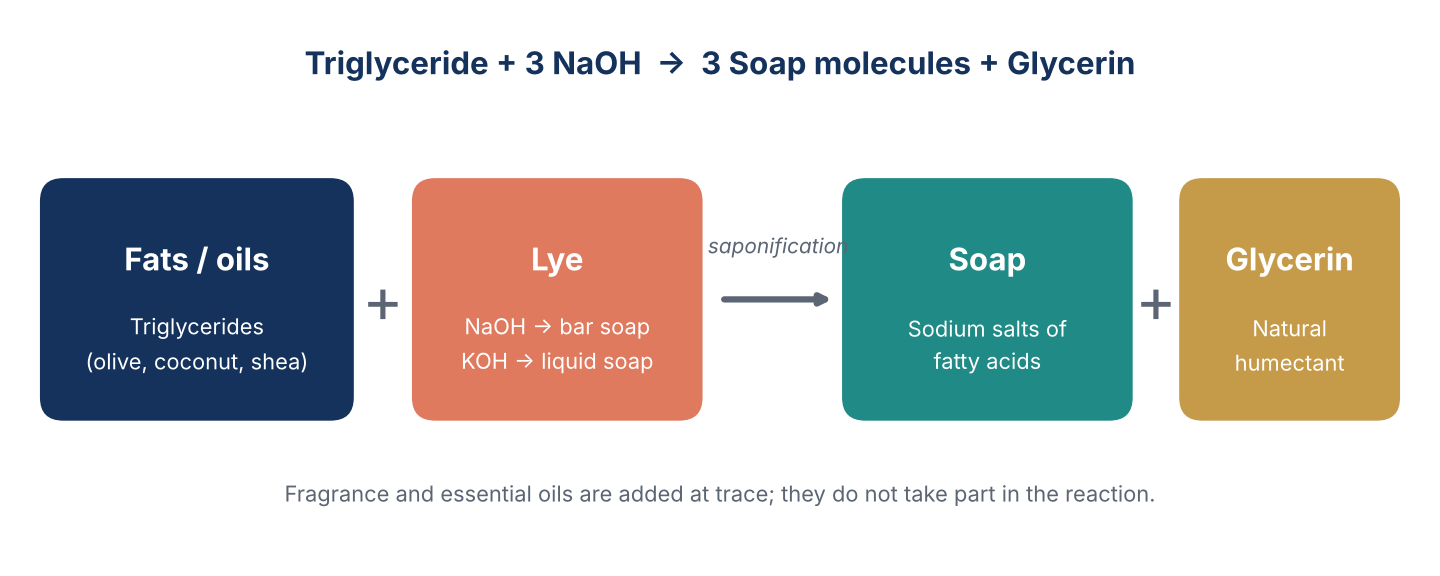
Fats and oils are triglycerides: three fatty-acid chains attached to a glycerol backbone. When lye is added, the alkali splits those ester bonds. The fatty acids combine with sodium or potassium to form soap, and the backbone is released as glycerin [1].
The alkali decides the format. Sodium hydroxide (caustic soda) gives a hard bar. Potassium hydroxide gives a soft paste that is diluted into liquid soap.
The oil blend decides how the bar performs. Coconut and palm kernel oils, rich in lauric acid, give fast, bubbly lather but can feel drying at high levels. Olive oil, rich in oleic acid, gives a mild, conditioning bar that hardens slowly. Glycerin is a humectant; handmade soap keeps it, while many industrial producers recover and sell it.
02Worked example: calculating lye with a SAP value
Each oil has a saponification (SAP) value: the mass of alkali needed to saponify one gram of that oil. Olive oil's NaOH SAP value is roughly 0.135. For 500 g of olive oil:
- Full saponification
500 g × 0.135 = 67.5 g NaOH.
- Apply a 5% superfat
67.5 g × 0.95 = 64.1 g NaOH.
Superfat means using slightly less lye than the oils need, so a little oil stays unreacted. It is a safety margin against free alkali and softens the feel; most recipes use 3–8%. Too much gives a soft bar and unsaturated oil that can go rancid, seen as orange spots in storage.
SAP values vary between oil grades and lots, and commercial sodium hydroxide is not 100% pure. A production recipe should use supplier data or a measured saponification value for each lot, and the batch record should state the lye purity assumed.
03Cold process vs hot process vs melt-and-pour vs syndet
| Method | How it works | Lye handled by maker? | Cure time | Typical pH | Best for |
|---|---|---|---|---|---|
| Cold process | Oils and lye solution blended to trace, poured, left to saponify | Yes | 4–6 weeks | About 9–11 | Artisan bars, full recipe control |
| Hot process | Batter cooked until saponification is complete | Yes | About 1–2 weeks | About 9–11 | Faster turnaround, rustic texture |
| Melt-and-pour | Ready-made soap base melted, scented and poured | No (done by the base supplier) | Sets in hours | Varies by base | Small batches, fast launches |
| Syndet bar | Synthetic surfactants such as sodium cocoyl isethionate formed into a bar | No lye used | None | Near neutral or slightly acidic | Sensitive and facial skin |
Trace is the point where cold-process batter thickens enough to hold a drizzled line. Fragrance and essential oils usually go in here; they do not take part in the reaction, although some speed up trace or discolour the bar. The cure that follows lets water evaporate and saponification finish, giving a harder, milder, longer-lasting bar.
04What the data show: soap pH and sensitive skin
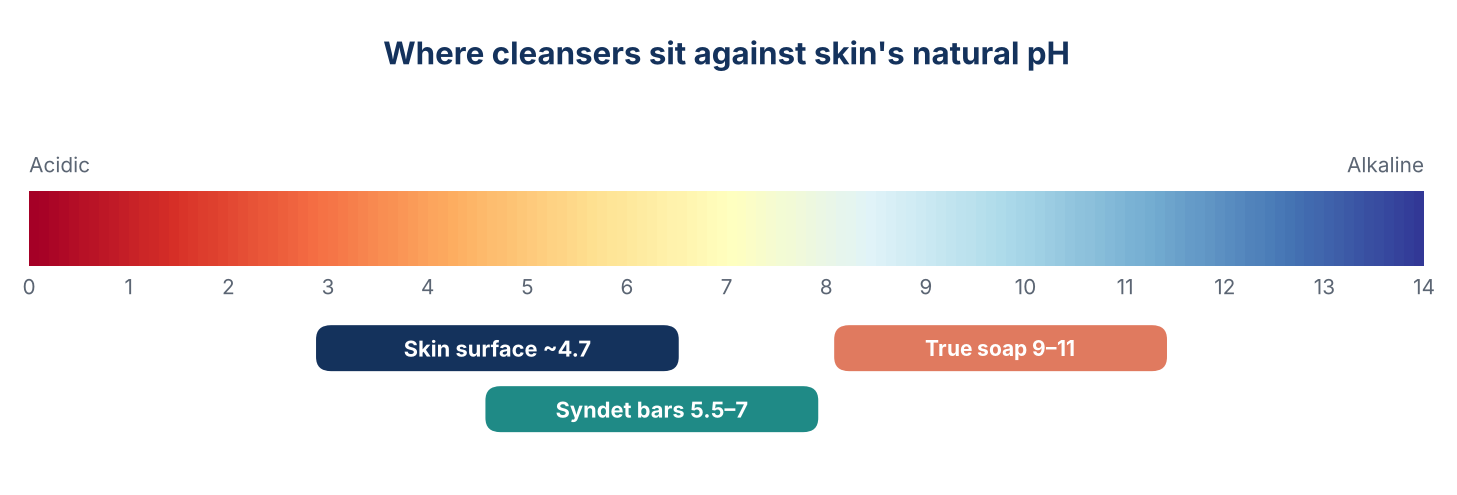
True soap is the salt of weak fatty acids and a strong base, so it is always alkaline in water whatever oils go into it; cleansing bars in one study measured pH 9.8–11.3, while a syndet bar was neutral [5]. Skin is acidic. A multicentre study of 330 volunteers estimated natural skin-surface pH at about 4.7, found that prior use of products, especially soaps, strongly influences it, and that even tap water raised it for up to six hours [2].
That gap matters for reactive skin. In a study of 30 people with sensitive skin, cleansers with a higher pH had a higher irritation index [3]. For most healthy skin, a quick rinse-off wash with soap is well tolerated. For dry, reactive or eczema-prone skin, a lower-pH syndet is usually gentler.
05How to tell soap from syndet on a label
- True soap: sodium olivate, sodium cocoate, sodium palmate or "saponified oils of…".
- Syndet: sodium cocoyl isethionate, sodium lauryl sulfate or cocamidopropyl betaine as the main cleansers.
- Combo bar: both types together.
- Regulatory status (US): a true soap marketed only to clean is regulated by the Consumer Product Safety Commission. Add synthetic detergents, or claims such as moisturising or deodorising, and it becomes an FDA-regulated cosmetic; claims to treat skin conditions can make it a drug [1], [4]. Other markets classify bars differently.
06For brands: when to choose soap, syndet or a combo bar
A combo bar blends soap with syndet surfactants to keep rich lather at lower cost while reducing pH and irritation. Use the brief to pick the starting format:
| If the brief says… | Start with | Watch |
|---|---|---|
| Artisan, natural positioning, body use | Cold-process true soap | Cure capacity, rancidity, fragrance discolouration |
| Sensitive skin, face, "pH-balanced" | Syndet bar | Higher raw-material cost, bar hardness, mush in the dish |
| Rich lather at a mass-market price, milder than soap | Combo bar | Label wording; the product is no longer "true soap" |
| Fast launch, small runs, many scents | Melt-and-pour base | Base supplier specifications and documentation |
Ask for three numbers on the batch record: the SAP values used, the superfat, and the measured pH of the cured bar. If nobody can supply them, the bar has not been formulated; it has been copied. We can review your recipe.
For syndet systems, see our guide to mild surfactants; for category expectations, our body care sector page.
07Questions readers ask
Is soap made with lye safe to use?
Yes. Once saponification is complete, the lye has been converted into soap and glycerin. Correct SAP calculations, a superfat and a full cure ensure no free alkali remains in the finished bar.
How long does cold process soap take to cure?
Most cold process soap needs four to six weeks. The bar becomes harder, milder and longer-lasting as water evaporates and saponification finishes.
Can you make soap without lye?
No. True soap always requires lye. Melt-and-pour lets the maker skip handling it because the base supplier has already completed saponification. Syndet bars use synthetic surfactants instead, so they are not true soap.
Planning a new cleansing bar?
We help brands choose between soap, syndet and combo formats, then build the recipe, test pH, stability and lather, and scale it for production.
08References
- U.S. Food and Drug Administration. Frequently asked questions on soap. Updated 20 August 2024. FDA
- Lambers H, Piessens S, Bloem A, Pronk H, Finkel P. Natural skin surface pH is on average below 5, which is beneficial for its resident flora. Int J Cosmet Sci. 2006;28(5):359–370. DOI
- Baranda L, González-Amaro R, Torres-Alvarez B, Alvarez C, Ramírez V. Correlation between pH and irritant effect of cleansers marketed for dry skin. Int J Dermatol. 2002;41(8):494–499. PubMed
- U.S. Consumer Product Safety Commission. Soap: frequently asked questions. CPSC
- Kulthanan K, et al. The pH of antiseptic cleansers. Asia Pac Allergy. 2014;4(1):32–36. DOI
Update log
- Published by Cosmetic Science Lab
This article is general technical information, not legal, regulatory or medical advice. Confirm requirements for your product and market before launch.