Perfume dupes: how they're made and how close they get
Perfume dupes promise designer-fragrance character without designer pricing. For brands and formulators the useful question is technical: how are dupes built, and how closely does the chemistry match? This entry sets out the published GC-MS evidence, our verdict, and the duties that apply to anyone selling fragrance dupes.
By Dr. Premalatha, Ph.D., Life Science, Regulatory Consultant, Cosmetic Science Lab
Quick answer
- Perfume dupes are lower-cost fragrances built to smell like a designer perfume. Makers profile the original with GC-MS and headspace analysis, then rebuild its main accords from commercial aroma chemicals and fragrance oils. Published comparisons show dupes share the major molecules but at different ratios, often miss trace materials, and can carry different allergens [1][2][5].
01What are perfume dupes?
A perfume dupe is a legally sold fragrance designed to evoke a well-known scent without copying its name, bottle or trademark. "Inspired by" lines, alt fragrances and fragrance oils sold by the millilitre all fall into this category. A counterfeit is different: it imitates the brand and packaging, and it is illegal.
That distinction matters for the evidence. Most published chemical comparisons set imitation or counterfeit perfumes against originals [1][3][4][5]. Both are reconstructions of the same target scent, so the analytical findings transfer well to dupes. They say nothing, however, about any single dupe brand.
02How are perfume dupes made?
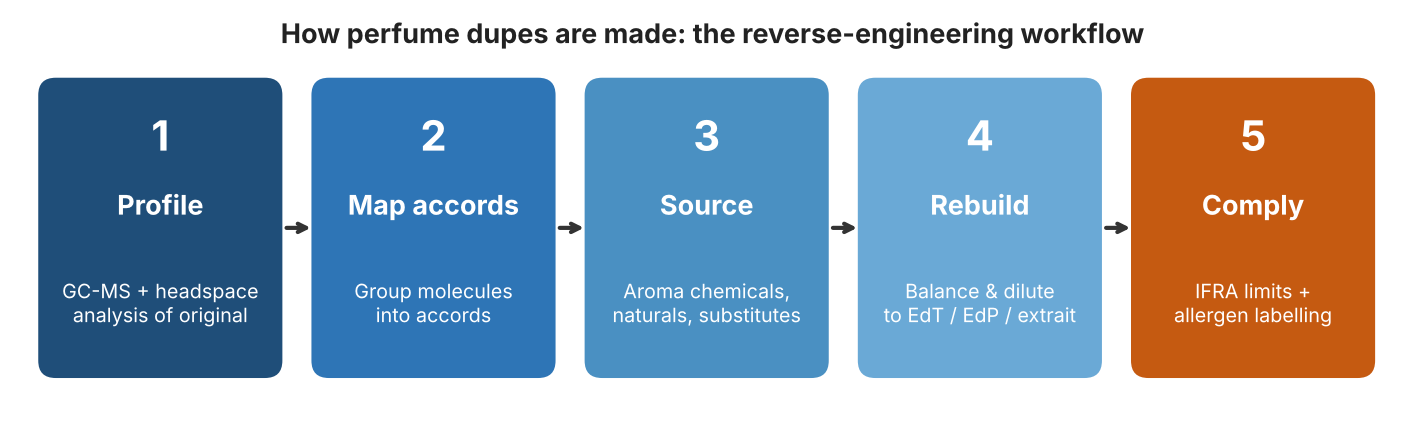
Dupe development is a form of reverse engineering. A typical workflow has five stages:
- Profile the original.
GC-MS fragrance profiling separates and identifies the volatile molecules in the liquid. Headspace analysis captures what actually evaporates from skin or a blotter. Two-dimensional GC×GC-MS resolves trace compounds that overlap in a standard run [3].
- Map the accords.
Analysts group the identified molecules into accords, such as the ambery, woody-saffron structure of Baccarat Rouge 540, a widely imitated niche fragrance.
- Source aroma chemicals.
Commodity aroma chemicals are easy to buy. Captive molecules owned by fragrance houses, and complex naturals, are not, so formulators substitute near-matches.
- Rebuild and dilute.
The concentrate is balanced against the target, then diluted to the chosen strength: eau de toilette (EdT), eau de parfum (EdP), parfum or extrait de parfum.
- Check compliance.
Every material is screened against IFRA Standards and allergen labelling thresholds before launch.
For the full method, read our hub guide Deformulation explained: from INCI list to a working formula.
03How close do fragrance dupes get? What the studies show
The claim: a good dupe is chemically the same as the original. The evidence does not support that. Studies show strong overlap in major components, with measurable differences in ratios, trace materials and allergens.
| Author | Year | n (samples) | Design | Result | Grade |
|---|---|---|---|---|---|
| Aghoutane et al.[1] | 2023 | 5 originals, 5 counterfeits (EdT) | GC-MS + electronic nose with PCA | 10 allergens identified, some only or at much higher levels in counterfeits | A |
| Villatoro, Vera & Gygax[2] | 2016 | 1 original, 1 twin | Headspace GC-olfactometry-ToFMS, 2 trained assessors | Shared odour compounds at different concentrations; a few key markers explained the perceived gap | B |
| ZOEX/JSB application study[3] | 2015 | 1 EdP, 1 imitation | 1D GC-MS vs GC×GC-MS | Standard GC-MS separated the pair; GC×GC revealed hidden trace aroma compounds and allergens | C |
| LECO application note[4] | 2023 | 1 original, 2 imitations | GC×GC-TOFMS with chemometric comparison | Distinct chemometric clusters; e.g. benzyl acetate higher in one imitation, 2-ethylhexyl salicylate higher in the original | C |
| UFPel forensic study[5] | 2019 | 1 original, 5 questioned | GC-MS profiling | No exact match; majors present in different proportions; some original compounds absent | C |
Grade key: A = peer-reviewed, multiple product pairs. B = peer-reviewed, single pair. C = application note or forensic/student report.
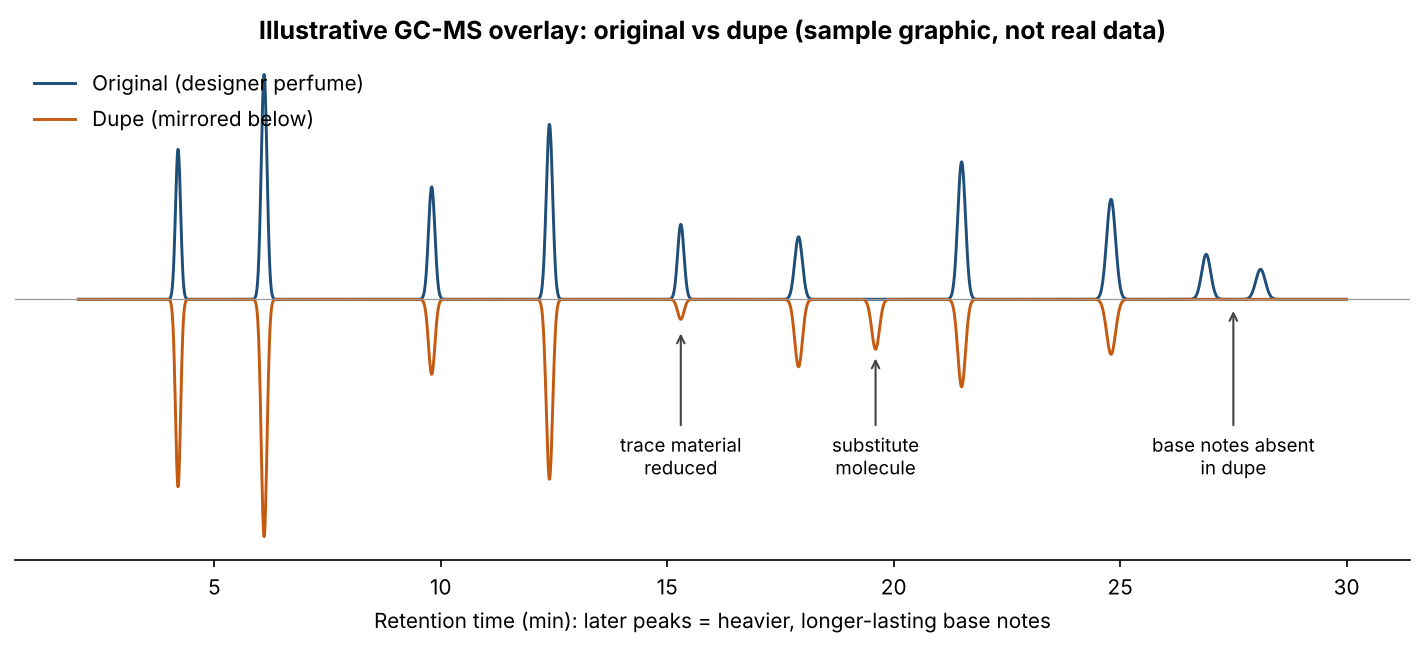
Verdict: close in character, not identical in composition. Well-made perfume dupes reproduce the dominant accords, but trained assessors and GC-MS still detect differences in ratios and trace materials [2][5]. Missing fixatives in one study suggest a likely effect on wear time [5]. Overall evidence grade: moderate, because samples are small and several sources are industry notes.
Evidence Library entries: GC-MS fragrance profiling
04Why do perfume dupes have weaker longevity?
Longevity is where dupes most often fall short, and the chemistry explains why.
- Base-note materials. Long wear depends on heavy, low-volatility molecules such as musks, ambery woods and resins. These are often the costliest or captive ingredients, so they are the first to be substituted or cut.
- Fixative shortcuts. Low vapour-pressure solvents such as benzyl benzoate and diethyl phthalate slow evaporation. A 1955 study by Poucher found they also flatten a fragrance's lift [6]. A dupe can last on a blotter yet smell duller.
- Missing traces. Compounds present in the original can be absent from the copy [5]. These often shape how the scent evolves over hours.
- Concentration. An EdP, parfum or extrait de parfum label does not guarantee oil load. In our experience real concentration varies between makers, so verify it analytically.
05IFRA and allergen obligations for dupe makers
Copying a scent does not copy its compliance file. Dupe makers carry the same legal and self-regulatory duties as designer brands.
- IFRA Standards. The 51st Amendment added 47 new restriction standards and one prohibition, taking the total to 263 [7]. Restrictions applied to new creations from 30 March 2024 and to existing creations from 30 October 2025 [8]. The 52nd Amendment, expected to be notified in January 2027, adds 48 more restriction standards [10]. A formula rebuilt from an older original can inherit levels that are no longer compliant.
- EU allergen labelling. Regulation (EU) 2023/1545 adds 56 labellable fragrance allergens to the 24 already listed, about 80 in total. Each must be declared above 0.001% in leave-on or 0.01% in rinse-off products [9]. Since 31 July 2026 only compliant products may be placed on the EU market; non-compliant products placed before that date may stay on sale until 31 July 2028 [9].
- Your allergen profile is your own. Imitations can carry allergens absent from the original [1]. Dupe makers cannot copy the original's label; they need their own quantified GC-MS allergen data.
- Claims. Terms such as "cruelty free", or comparisons naming a designer perfume, need substantiation and legal review in each market.
06For brands & formulators
Perfume dupes show what modern deformulation can achieve: recognisable accords from public aroma chemicals at a fraction of the cost. They also show its limits in trace materials, longevity and compliance. Whether you are benchmarking a competitor, building an inspired-by line, or testing your own product against a copy, start with validated GC-MS and headspace data.
Reverse engineering: our team profiles target fragrances, maps accords, quantifies allergens against Regulation (EU) 2023/1545 and checks IFRA conformity.
07Questions readers ask
Are perfume dupes the same as the original?
No. GC-MS studies show dupes share the major molecules but at different ratios, and often lack trace compounds found in the original [1][5].
Why don't perfume dupes last as long?
Many use fewer or substituted base-note materials and fixatives [5], and fixative choice changes how a scent evaporates [6]. Oil concentration also varies between makers, so the EdP or parfum label alone does not tell you.
Are fragrance dupes legal?
Dupes that do not copy trademarks or packaging are generally legal; counterfeits are not. Rules differ by country.
08References
- Aghoutane Y, Brebu M, Moufid M, Ionescu R, Bouchikhi B, El Bari N. Detection of counterfeit perfumes by using GC-MS technique and electronic nose system combined with chemometric tools. Micromachines (Basel). 2023;14(3):524. doi:10.3390/mi14030524. DOI
- Villatoro C, Vera L, Gygax H. Comparative study of odours present in twin fragrances by GC-sniffing-ToFMS. Chem Eng Trans. 2016;54:133–8. doi:10.3303/CET1654023. DOI
- ZOEX/JSB. Feasibility study of perfume authentication by GC-MS and GC×GC-MS [application note DPML001]. 2015. gcms.labrulez.com
- LECO Corporation. Differentiating original-brand and imitation perfumes with GC×GC-TOFMS and ChromaTOF Tile [application note 203-821-683]. St Joseph (MI): LECO; 2023. leco.com
- Veiga MRM, Santos MAZ, Santos CMM. Perfumes do comércio ilegal: avaliação da autenticidade por comparação de embalagem e GC-MS [abstract, in Portuguese]. In: Anais do SIIEPE 2019. Pelotas: Universidade Federal de Pelotas; 2019. ufpel.edu.br
- Poucher WA. A classification of odours and its uses. J Soc Cosmet Chem. 1955;6(2). scconline.org
- International Fragrance Association. Updating our flagship safe use program. Geneva: IFRA; 2023. ifrafragrance.org
- UL Solutions. IFRA notifies 51st Amendment to the IFRA Standards. 10 Jul 2023. ul.com
- Commission Regulation (EU) 2023/1545 of 26 July 2023 amending Regulation (EC) No 1223/2009 as regards labelling of fragrance allergens in cosmetic products. Off J Eur Union. 2023;L188:1. eur-lex.europa.eu
- International Fragrance Association. IFRA publishes End of Consultation letter for the 52nd Amendment to the IFRA Standards. 31 Aug 2026. ifrafragrance.org
Update log
- Published by Cosmetic Science Lab
This article is general technical information, not legal, regulatory or medical advice. Confirm requirements for your product and market before launch.