What GC-MS can (and can't) tell you about a cosmetic
Gas chromatography mass spectrometry is the workhorse for identifying fragrance ingredients, many preservatives and fragrance allergens in a cosmetic. A 2026 study of 106 products shows what it does well, and an undeclared allergen it caught. Here is how GC-MS works, what it misses, and what that means for formulators.
By Dr. Premalatha, Ph.D., Life Science, Regulatory Consultant, Cosmetic Science Lab

The study behind this article
- Paper
- Lee et al., Analytical Science and Technology 2026; 39(4): 243–255 [1]
- Design
- GC-MS method optimisation and validation, then a labelling-compliance survey
- Sample
- 106 products: 22 perfumes, 20 body mists, 23 hand creams, 20 body creams and 21 body washes; 23 fragrance allergens
- Performance
- Limit of detection 0.05–0.81 µg/mL; accuracy 84.7–109.6%; R² ≥ 0.987
- Funding
- Seoul Metropolitan Government Research Institute of Public Health and Environment, the authors' own institute
Quick answer
- What can GC-MS tell you about a cosmetic? GC-MS analysis separates and identifies volatile compounds: fragrance ingredients, fragrance allergens, many preservatives and solvents.
- It can find allergens a label leaves out, as one body mist in a 2026 study showed [1].
- Polymers and salts are out of its reach, and sugars and many acids often need derivatisation first [5].
- A library match is a lead, not proof. Confirm it with a reference standard.
Take-home message for formulators
- Use GC-MS for fragrance, solvents and many preservatives
- Pair it with HPLC, FTIR and ICP-MS for everything else
Take-home message for brand owners
- New EU launches must already declare the expanded fragrance allergens
- Existing products must comply by 31 July 2028
01Why this study matters now
The EU has expanded the list of fragrance allergens that must be named on cosmetic labels to more than 80. Products placed on the market since 31 July 2026 must already comply, and products placed on the market before then may be sold until 31 July 2028 [2]. An allergen must be declared above 0.001% in leave-on products and 0.01% in rinse-off products [3]. GC-MS is the standard way to check those levels.
02How gas chromatography mass spectrometry works
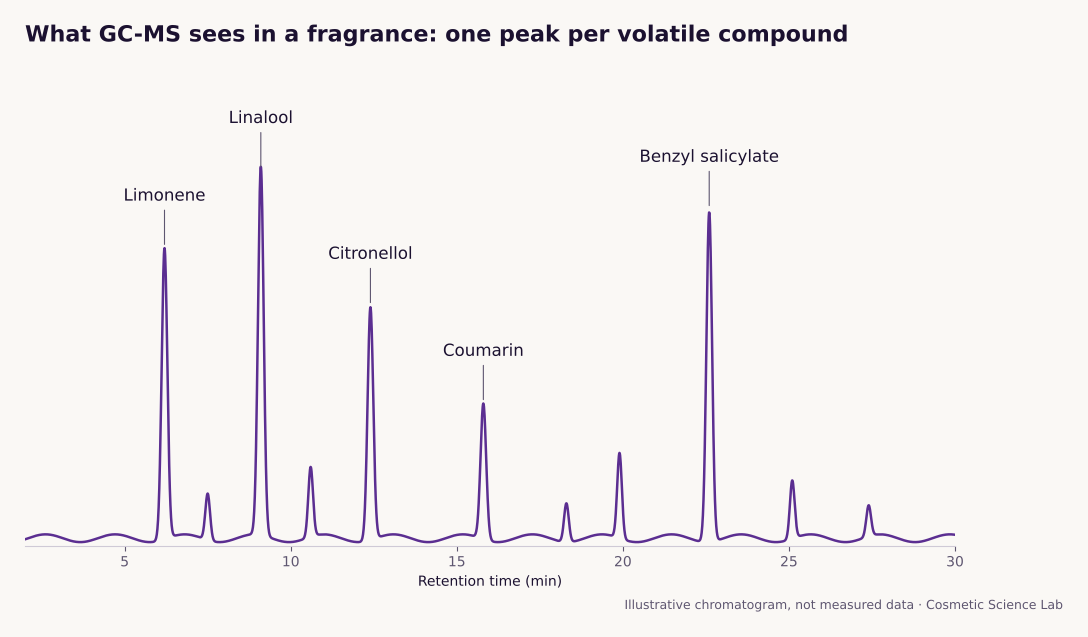
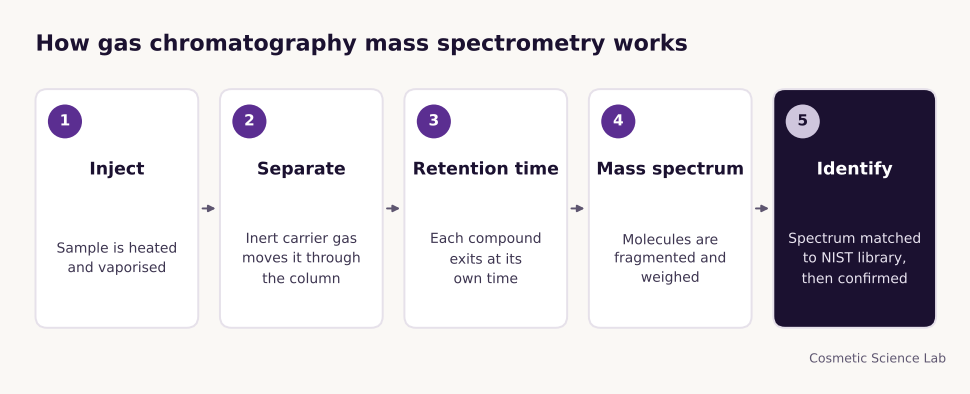
GC-MS joins two techniques. In gas chromatography (GC), the sample is vaporised and an inert gas, usually helium, carries it through a long, thin column at a set flow rate. Each compound leaves the column at its own retention time.
The mass spectrometer (MS) then breaks each compound into charged fragments and weighs them, giving a pattern that acts like a fingerprint. Software compares that pattern with reference libraries; the NIST 2026 library holds 431,277 electron ionisation spectra for 382,180 compounds [4].
03Key results
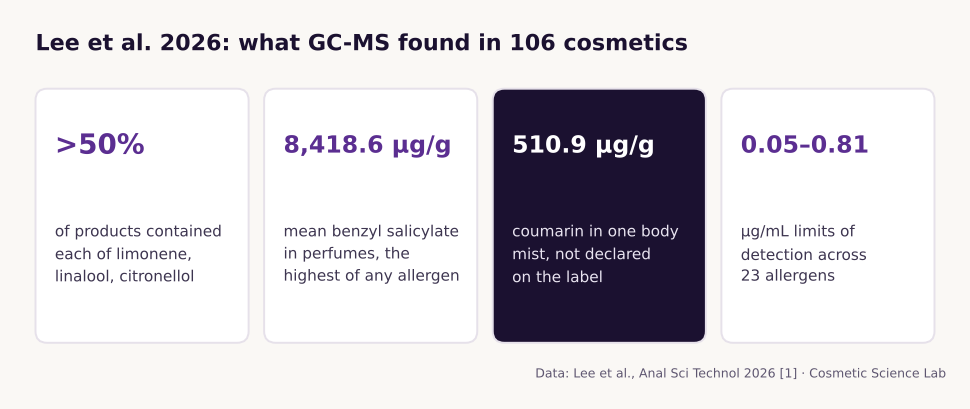
Limonene, linalool and citronellol were each found in more than half of the 106 products. Benzyl salicylate had the highest mean concentration in perfumes, at 8,418.6 µg/g. One body mist contained coumarin at 510.9 µg/g (0.0511%) that its label did not declare, which the authors classed as non-compliant [1].
The method itself was the other result. Cutting the internal standard (2,3-dichlorotoluene) from 100 µg/g to 2 µg/g raised the mean calibration fit (R²) from 0.790 to 0.994 [1], a reminder that quantitation depends on careful set-up.
04What GC-MS can tell you
| Question | GC-MS answer | Type of analysis |
|---|---|---|
| Which fragrance ingredients are present? | Yes: fragrance profiling of volatile organic compounds | Qualitative |
| Are labelled allergens above the limit? [3] | Yes, with calibration standards | Quantitative |
| Which preservatives are present? | Many, such as phenoxyethanol; others need another method | Qualitative or quantitative |
| Are there residual solvents? | Yes, often with headspace sampling | Quantitative |
05What GC-MS can't tell you
GC-MS only sees compounds that vaporise without breaking down. Molecules with active hydrogens in groups such as -OH, -COOH, -SH, -NH or -CONH, which include sugars, hydroxy acids and amino acids, often need derivatisation before GC analysis [5]. Large polymers and inorganic salts are outside its reach entirely.
| Ingredient type | Better method |
|---|---|
| Polymers and thickeners (carbomer, gums) | FTIR, gel permeation chromatography |
| Salts and minerals | ICP-MS, ion chromatography |
| Non-volatile actives (niacinamide, peptides) | HPLC |
| Sugars and acids | HPLC, or GC-MS after derivatisation [5] |
A NIST library match is also a probable identity, not proof: isomers can give near-identical spectra. Confirm with a reference standard at the same retention time. For the full toolbox, see what are the different analytical methods used in cosmetic formulation? and how to choose analytical methods at each stage.
06Limits and funding of the study
- Product mix. "Creams" here means hand creams and body creams; face products and rinse-off hair care were not tested [1].
- Funding. The work was funded by the Seoul Metropolitan Government Research Institute of Public Health and Environment, the authors' own public institute [1].
07What it means for formulators
New launches must already meet the expanded allergen list, and products placed on the market before 31 July 2026 may be sold until 31 July 2028. Check every fragrance against the list using your supplier's data and, where needed, GC-MS results [2]. In deformulation, use GC-MS for the fragrance and volatile fraction, alongside other methods for the rest of the formula; see how to read an INCI list for where the label stops.
CSL's reverse engineering team runs GC-MS in our analytical laboratory as one part of a full deformulation; see deformulation explained: from INCI list to a working formula and our body lotion case study. GC-MS also shows up in what lab analysis of counterfeit cosmetics finds.
We run GC-MS allergen screening and full deformulation. Request a GC-MS test plan or talk to our reverse engineering team.
08Questions readers ask
What is gas chromatography mass spectrometry used for in cosmetics?
Identifying and measuring volatile ingredients: fragrance components, allergens, many preservatives and residual solvents.
Can GC-MS analysis reveal a full cosmetic formula?
No. It misses polymers, salts and other non-volatiles, so full deformulation combines it with HPLC, FTIR and ICP-MS.
How small an amount can GC-MS detect?
It depends on the compound and method. In the 2026 study, limits of detection were 0.05–0.81 µg/mL across 23 allergens.
Is a NIST library match enough to identify an ingredient?
It is a strong lead. Confirm it with a reference standard, especially for isomers.
Checking fragrance allergens or decoding a benchmark?
We run GC-MS alongside HPLC, FTIR and ICP-MS to give you the full picture.
09References
- Lee Y, Han S, Jung S, Yu J, Jo S, Jung B, Kim H, Park J. Optimization and validation of a GC–MS method for the determination of fragrance allergens in cosmetic products. Anal Sci Technol. 2026;39(4):243–255. doi:10.5806/AST.2026.39.4.243. AccessON
- Health Products Regulatory Authority (Ireland). Labelling of cosmetic fragrance allergens (Commission Regulation (EU) 2023/1545). Accessed 29 Oct 2026. HPRA
- SGS. From 26 to 80+: EU's huge move to expand allergen listings in cosmetic products. 13 Aug 2024. SGS
- National Institute of Standards and Technology. NIST26: updates to the NIST electron ionization and tandem mass spectral libraries. 2026. NIST
- Moldoveanu SC, David V. Derivatization methods in GC and GC/MS. In: Kusch P, ed. Gas Chromatography: Derivatization, Sample Preparation, Application. IntechOpen; 2018. doi:10.5772/intechopen.81954. IntechOpen
Update log
- Published by Cosmetic Science Lab
This article is general technical information, not legal, regulatory or medical advice. Confirm requirements for your product and market before launch.