Responsible Person and the Product Information File: what EU/UK law needs before launch
No cosmetic reaches an EU or UK shelf without a named Responsible Person and a complete Product Information File. This guide sets out who can take the role, what the file must hold, how the UK system differs, and how the US, India and the GCC handle the same job.
By Dr. Premalatha, Ph.D., Life Science, Regulatory Consultant, Cosmetic Science Lab

Responsible Person and PIF at a glance
- Where
- Established in the EU for the EU; in the UK for Great Britain
- Pif retention
- 10 years after the last batch is placed on the market
- Notification
- EU: CPNP. Great Britain: SCPN, before placing on the market
- Next deadline
- 31 Dec 2027: GB label relief for EU/EEA RP details ends
Quick answer
- A Responsible Person for cosmetics is the person or company, established in the EU (or the UK for Great Britain), that is legally accountable for a product's compliance. The Responsible Person keeps the Product Information File: the product's description, safety report, manufacturing and GMP statement, claims evidence and animal-testing data.
- No product may be placed on the EU market without an EU-established Responsible Person [1].
Take-home message for formulators
- Build the PIF as you develop: stability, PET and impurity data feed the CPSR.
- Write the manufacturing method and GMP statement from the real batch record.
- Keep claims evidence in the file, matched to the exact wording.
Take-home message for brand owners
- Choose the Responsible Person before artwork is final; the name and address go on the label.
- A non-EU or non-UK brand must appoint a local RP by written mandate.
- Budget for two notifications (CPNP and SCPN) if you sell in both markets.
01The rule: market, effective date and source
| Market | Rule | Applies from | Source |
|---|---|---|---|
| EU | Every product needs an EU-established Responsible Person (Art. 4), a PIF (Art. 11) and CPNP notification (Art. 13) | 11 July 2013 | Regulation (EC) 1223/2009 [1] |
| Great Britain | UK-based Responsible Person, PIF in English, SCPN notification | 1 January 2021 | 1223/2009 as it applies in GB (assimilated law); GOV.UK guidance [2][3][4] |
| Northern Ireland | Follows the EU Regulation (Windsor Framework): Responsible Person in Northern Ireland or the EU, CPNP notification. If the product is also sold in GB, the same data goes to SCPN | EU rules since 2013; SCPN for GB sales since 1 January 2021 | GOV.UK guidance [8] |
02Who can act as the Responsible Person
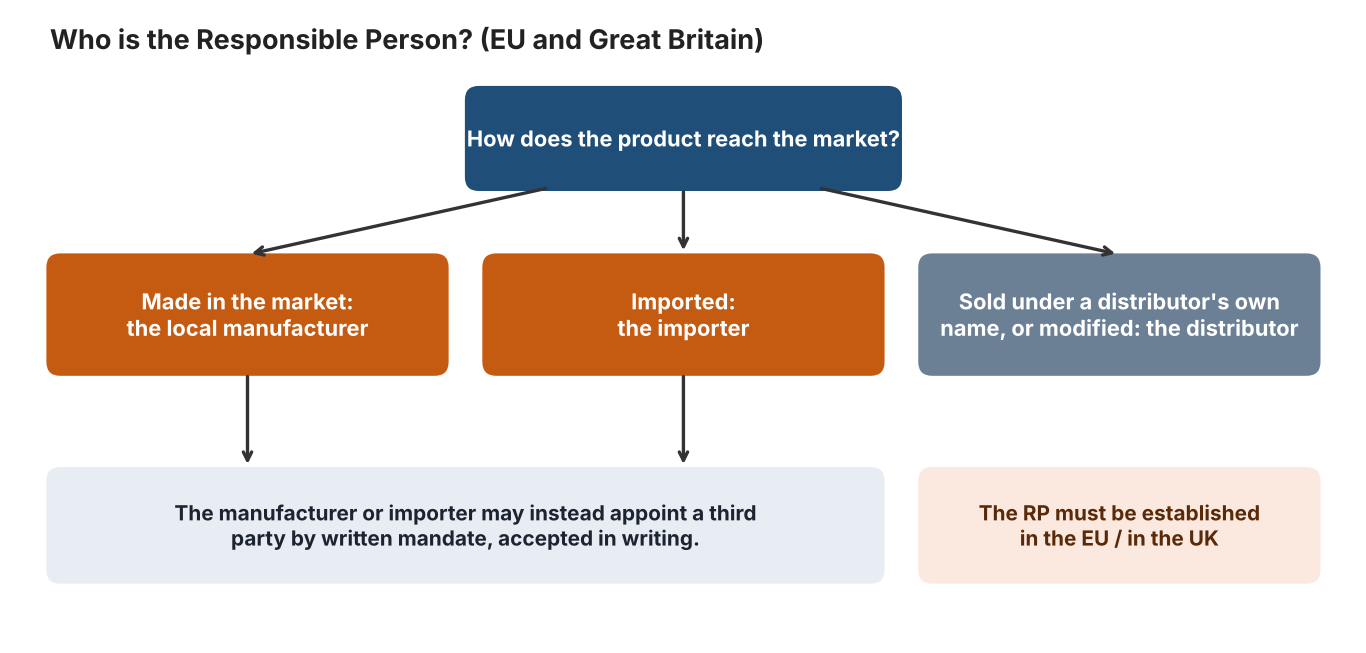
Under Article 4, the responsible person for cosmetics depends on how the product reaches the market [1]:
- Made in the EU by an EU manufacturer: the manufacturer, which may designate another EU-established person by written mandate.
- Made in the EU by a non-EU manufacturer: the manufacturer must designate an EU-established person by written mandate.
- Made outside the EU (imported): each importer, which may in turn designate someone by written mandate.
- Own-label or modified: a distributor that sells under its own name or modifies it in a way that may affect compliance (translating the label alone does not count).
A mandated person must accept the mandate in writing. Great Britain applies the same model, but the Responsible Person must be established in the UK [3].
Tasks such as testing or file assembly can be delegated. Legal accountability for safety, the PIF, notification, labelling and corrective action stays with the Responsible Person [1].
03What goes in the Product Information File
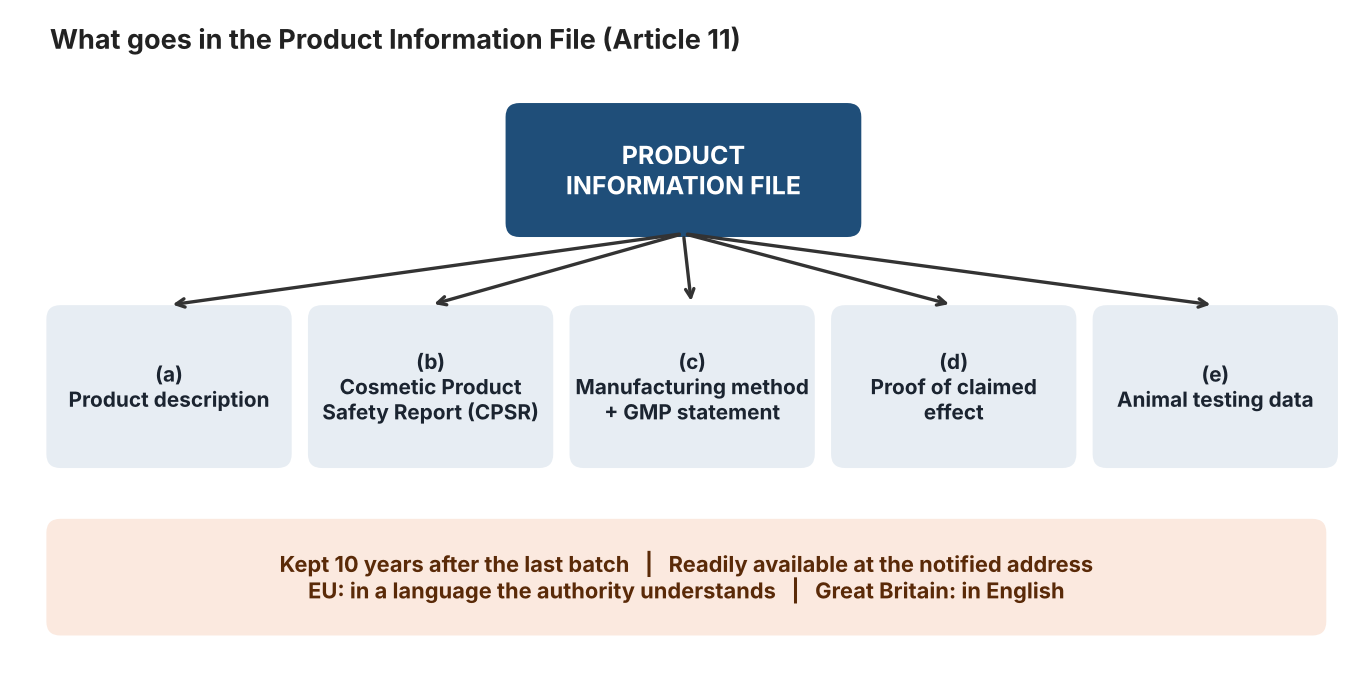
Article 11 lists five required parts. Use this table as the product information file checklist [1][4].
| PIF item (Art. 11) | What it contains | Common gap |
|---|---|---|
| (a) Product description | Enough detail to tie the file to one product: name, format, shade or variant | One file covering several variants without identifying each |
| (b) Cosmetic Product Safety Report | Part A safety data and Part B assessor conclusion; see our EU CPSR guide | Missing ISO 11930 or packaging data |
| (c) Manufacturing method and GMP statement | How the product is made, and a statement of compliance with GMP (Art. 8) (Quality & accreditations) | Generic method not matching the real batch record |
| (d) Proof of claimed effect | Claims evidence, where the product's nature or effect justifies it (claims and clinical support) | Evidence that does not match the label wording |
| (e) Animal testing data | Any animal testing by the manufacturer, its agents or suppliers, including for non-EU markets | Supplier declarations not collected |
04The UK equivalent: UK Responsible Person and SCPN
Great Britain kept the EU model but runs its own system:
- Responsible Person: must be established in the UK [3].
- Notification: through Submit cosmetic product notifications (SCPN) before the product is placed on the GB market. The notification covers the product category and name, the Responsible Person, where the PIF is kept, an urgent contact, nanomaterials and CMR substances, ingredient details, and label and packaging images [2].
- Label: must show the UK Responsible Person. Until 31 December 2027, a label showing an EU/EEA Responsible Person still meets the GB name-and-address rule; the UK Responsible Person must still exist [3].
05EU vs UK vs US vs India vs GCC
| Market | Who is accountable | Must be local? | Product file | Pre-market step |
|---|---|---|---|---|
| EU | Responsible Person | Yes, in the EU | PIF, 10 years | CPNP notification [1] |
| UK (GB) | Responsible Person | Yes, in the UK | PIF in English, 10 years | SCPN notification [2][3] |
| US | "Responsible person": manufacturer, packer or distributor named on the label | Domestic contact on label | Safety substantiation records; adverse event records 6 years (3 for qualifying small businesses) | Product listing (new products within 120 days of marketing); facility registration (MoCRA) [5] |
| India | Import registration holder: manufacturer, authorised agent, importer or Indian subsidiary | Yes, for imports | Registration dossier | Import registration certificate (apply on Form COS-1; certificate issued on Form COS-2) before the first import; RC number on label [6] |
| Saudi Arabia (GCC) | A Saudi-registered entity (local manufacturer or importer) | Yes, a Saudi entity | Ingredient dossier | SFDA notification via GHAD (replaced eCosma) before import [7] |
06What a brand must do, and by when
- Appoint the Responsible Person
for each market, by written mandate if you are not established there [1][3].
- Build the PIF
during development: safety report, GMP statement, claims evidence and supplier animal-testing declarations [1].
- Notify
on CPNP (EU) and SCPN (GB) before the product is placed on the market [1][2].
- Put the right name and address on the label
- Plan the dates:
the GB label relief for EU/EEA Responsible Person details ends 31 December 2027 [3]; in the US, list new products within 120 days of marketing and report serious adverse events within 15 business days [5]; in India, register before the first import [6].
Starting out? See New brand? Start here and How we work (brief to shelf).
Need a Responsible Person or a PIF review?
Our Global regulatory & retainers team audits your PIF against Article 11, prepares CPNP and SCPN notifications, and maps the rules for each launch market.
07Questions readers ask
What is a Responsible Person for cosmetics?
The legal or natural person, established in the EU (or the UK for Great Britain), who answers to the authorities for a product's compliance: safety assessment, Product Information File, notification and labelling [1][3].
Can a company outside the EU or UK be the Responsible Person?
No. It must appoint a manufacturer, importer or third party established in the market, by written mandate accepted in writing [1][3].
What is a Product Information File?
The file the Responsible Person keeps for each product: description, safety report, manufacturing method and GMP statement, claims evidence and animal-testing data, kept for 10 years after the last batch [1][4].
Do I need a UK Responsible Person if I already have an EU one?
Yes, for Great Britain. The Responsible Person must be UK-based and notify through SCPN; until 31 December 2027, GB labels may still show the EU/EEA Responsible Person's details [2][3].
Does the US require a Product Information File?
Not by that name. MoCRA requires the US responsible person to keep safety substantiation records and adverse event records, and to list products and register facilities [5].
08References
- Regulation (EC) No 1223/2009 of the European Parliament and of the Council on cosmetic products, Articles 4, 5, 8, 10, 11, 13 and 19 and Annex I. Off J Eur Union. 2009;L342:59–209. eur-lex.europa.eu
- Office for Product Safety and Standards. Submit a cosmetic product notification. London: GOV.UK; 31 Dec 2020. gov.uk
- Office for Product Safety and Standards. Regulation 1223/2009 and the Cosmetic Products Enforcement Regulations 2013: Great Britain. Statutory guidance, updated 29 Jun 2026. gov.uk
- Regulation (EC) No 1223/2009 as it has effect in Great Britain (assimilated law), Chapter III (Articles 10–13). legislation.gov.uk
- US Food and Drug Administration. Modernization of Cosmetics Regulation Act of 2022 (MoCRA). Updated 29 Oct 2026; and 21 U.S.C. §§ 364, 364a, 364c, 364d. fda.gov · 21 U.S.C. 364a
- Central Drugs Standard Control Organisation. Guidance document on registration and import of cosmetics into India (Cosmetics Rules, 2020). New Delhi: CDSCO; 19 Jan 2021. cdsco.gov.in
- Gautam S. SFDA cosmetics regulations and notification in Saudi Arabia. Artixio; 15 Oct 2026. artixio.com
- Office for Product Safety and Standards. Regulation 1223/2009 and the Cosmetic Products Enforcement Regulations 2013: Northern Ireland. Statutory guidance, updated 29 Jun 2026. gov.uk
Update log
- Published by Cosmetic Science Lab
This article is general technical information, not legal, regulatory or medical advice. Confirm requirements for your product and market before launch.