Pre-launch testing checklist: stability, compatibility, PET, safety and claims
Cosmetic product testing is where a formula proves it is stable, safe and honest about what it claims. This checklist sets out which tests each product type needs by market, how each test works, what counts as a pass, and which claim each result allows.
By Dr. Premalatha, Ph.D., Life Science, Regulatory Consultant, Cosmetic Science Lab
Cosmetic product testing at a glance
- Five gates
- Stability, packaging compatibility, preservative efficacy (PET), safety, claims
- Market rules
- EU 1223/2009 and 655/2013; US MoCRA; Canada heavy-metal guidance
- Longest lead time
- Stability: accelerated for months, real-time to end of shelf life
- Pass rule for pet
- ISO 11930 criterion A: bacteria down 3 log by day 7
- Common mistake
- Testing in glass instead of the final pack
- Continues to
- Safety assessment (EU CPSR guide)
Quick answer
- Cosmetic product testing before launch covers five gates: stability, packaging compatibility, preservative efficacy (PET), safety and claims substantiation. Every product needs the first four in some form; claims testing depends on what the label says.
- Test the final formula in the final pack; stability guidance asks for the marketed packaging material [1].
- Every claim needs evidence that matches its exact wording [5].
Take-home message for formulators
- Freeze the formula and pack before testing; a late change usually means repeating stability and PET.
- Run PET on the final pack, and again after stability storage if the preservative system is marginal.
- Use analytical chemistry, such as liquid chromatography, to confirm actives hold over shelf life.
Take-home message for brand owners
- Testing time, not cost, usually sets the launch date: plan stability first.
- Write claims before booking studies; the wording decides the panel and method.
- One extra market can add tests (heavy metals, SPF, local rules).
01The cosmetic product testing matrix
Which tests are must-have depends on product type and market. Use this matrix as the starting checklist, then let the safety assessor confirm it.
| Test | Leave-on skin care | Rinse-off | Eye area & baby | Colour cosmetics | Sunscreen |
|---|---|---|---|---|---|
| Stability (accelerated + real-time) | Must | Must | Must | Must | Must |
| Packaging compatibility | Must | Must | Must | Must | Must |
| PET (ISO 11930) | Must | Must | Must | Must | Must |
| Microbial limits (ISO 17516) | Must | Must | Must | Must | Must |
| Heavy metals | Nice | Nice | Nice | Must | Must |
| HRIPT (sensitisation) | If claimed | Nice | Must | Nice | Nice |
| SPF and broad spectrum | If claimed | – | If claimed | If claimed | Must |
| Efficacy claims studies | If claimed | If claimed | If claimed | If claimed | If claimed |
| Safety assessment (EU CPSR / US substantiation) | Must | Must | Must | Must | Must |
| Market | Must-have before launch |
|---|---|
| European Union | A Cosmetic Product Safety Report signed by a qualified safety assessor, built on stability, microbiology, impurity and packaging data [3] (see the EU CPSR guide). Claims must meet common criteria [5]. |
| United States | Adequate safety substantiation from tests, studies or analyses under MoCRA[4]. Sunscreens are OTC drugs: "Broad Spectrum" needs a critical wavelength of at least 370 nm [8]. |
| Canada | Heavy metals within Health Canada guidance limits [7]. |
02Methods, panels, duration and pass criteria
| Test | Method | Panel or samples | Duration | Pass criteria |
|---|---|---|---|---|
| Stability | Accelerated at 37–45 °C, cycling, freeze-thaw, light; real-time storage [1]; actives assayed by liquid chromatography | Final pack, smallest size, several orientations [1] | Months; no fixed duration is prescribed [1] | No meaningful change in appearance, odour, pH, viscosity, weight or active content (see why a lotion separates at 40 °C) |
| Packaging compatibility | Product stored in the final pack against a glass control [1] | Each pack type [1] | Alongside stability | No adsorption, migration, corrosion or barrier loss [1] |
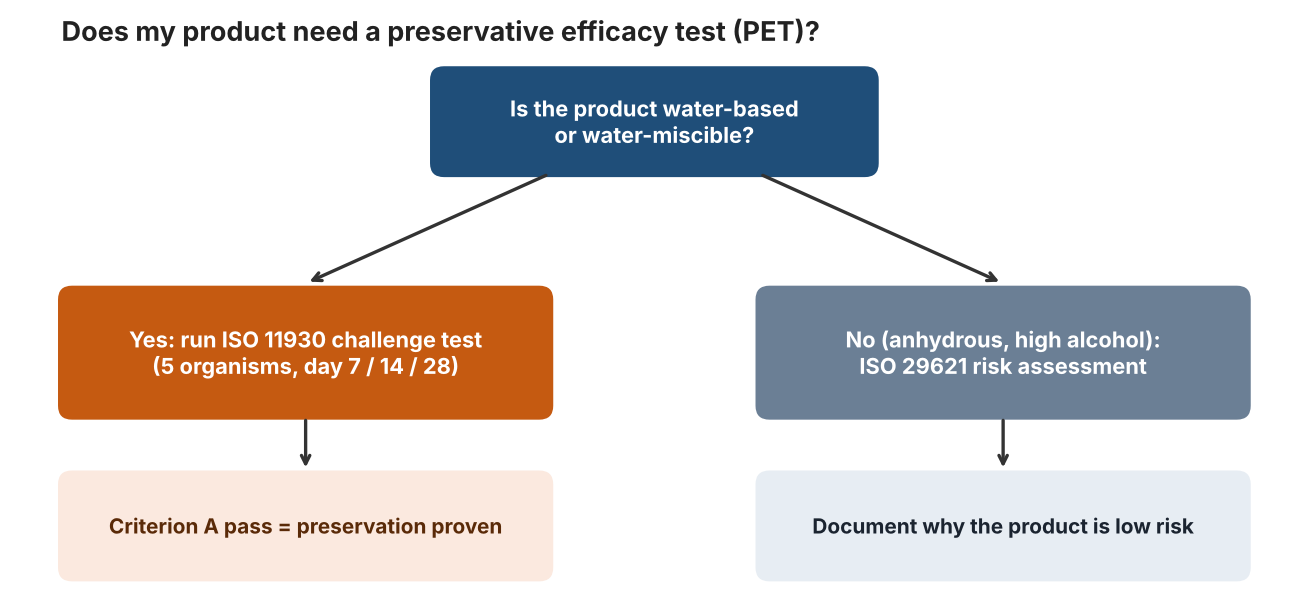
| PET | ISO 11930: five organisms incl. Candida albicans; counts at day 0 (inoculum), 7, 14 and 28 [2] | Each formula | 28 days [2] | Criterion A: bacteria ≥3 log and yeast ≥1 log by day 7; mould ≥1 log by day 28; no regrowth [2] |
| Microbiology | ISO 17516 limits [6] | Typically each batch under GMP | About a week | ≤1,000 CFU/g; ≤100 CFU/g for eye area, mucous membranes and under-3s; no E. coli, P. aeruginosa, S. aureus or C. albicans [6] |
| Heavy metals | Analytical chemistry (e.g. ICP-MS) on product or raw materials | Each formula | Days | Canada: lead 10, arsenic 3, cadmium 3, mercury 1, antimony 5 ppm [7] |
| SPF and broad spectrum | In vivo SPF (ISO 24444 in the EU; 21 CFR 201.327(i) in the US); in vitro UVA-PF and critical wavelength [8] | At least 10 valid subjects for SPF [8] | Weeks | US: critical wavelength ≥370 nm [8]; EU: UVA-PF at least one-third of SPF and critical wavelength ≥370 nm [9] |
| HRIPT | 3-week induction, 2-week rest, challenge read at 24–72 h, 96 h if needed [10] | 50–200 subjects; 100+ recommended [10] | About 6 weeks [10] | No sensitisation reactions at challenge |
03Which claim each result allows
Start from the claim wording and work back to the study. Under EU common criteria, evidence must match what the claim actually says [5].
| Result | Claim it can support | What it does not support on its own |
|---|---|---|
| Stability and compatibility pass | Shelf life and period-after-opening; "stable formula" | Any efficacy claim |
| PET criterion A | In-use microbial safety in the stated pack | "Preservative-free" or microbiome-friendly claims |
| HRIPT, no reactions | "Tested for skin sensitisation"; supports "dermatologically tested" with dermatologist oversight | "Hypoallergenic" without formula-level evidence |
| Heavy metals within limits | Factual "tested for heavy metals" | "Free from" a metal |
| SPF and UVA tests | "SPF 30"; "Broad Spectrum" (US) [8]; EU UVA claim (UVA-PF ≥1/3 SPF) [9]; the circled UVA logo follows the Cosmetics Europe recommendation | Water-resistance (needs its own test after 40 or 80 minutes of immersion) [8] |
| Instrumental or consumer product tester study | The specific benefit tested, e.g. "hydrates for 24 hours" | A broader benefit than the study measured [5] |
04Cost and time drivers
Prices vary by lab and scope, but the same factors drive both cost and time:
- Number of SKUs and pack variants: each pack type needs its own compatibility data [1].
- Formula changes after testing starts: stability and PET restart from day zero.
- Panel size and recruitment: sensitive-skin, eye-area or ethnic-specific panels take longer to fill.
- Markets: sunscreens for the US need drug-standard testing; Canada adds heavy-metal checks.
- Real-time stability length: a 30-month shelf life needs data that supports it.
- Analytical scope: lab testing on advanced instruments, such as ICP-MS for metals or liquid chromatography for actives, adds time per method.
For choosing cosmetic lab testing methods by stage, see choosing testing methods at each stage.
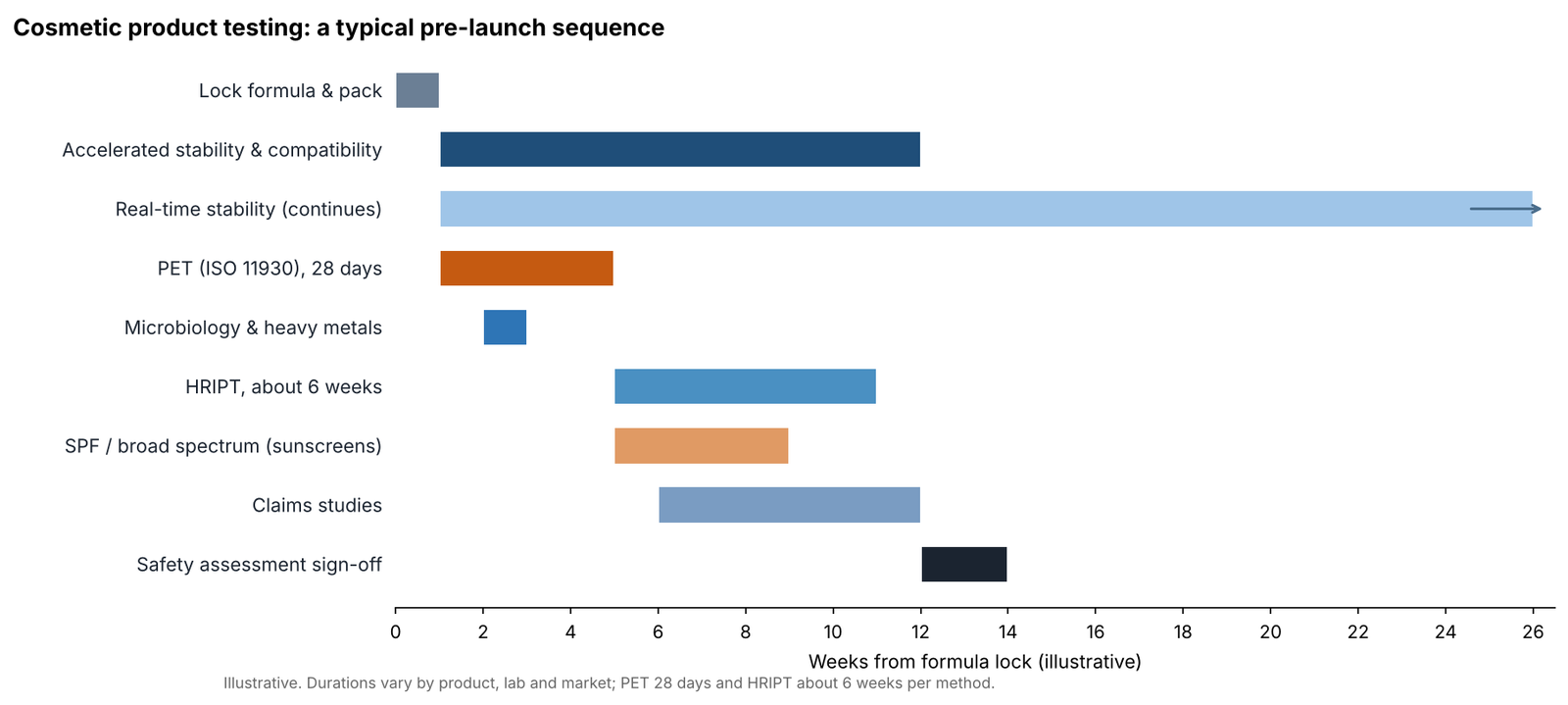
05The pre-launch sequence, step by step
- Lock the formula and final pack.
Freeze the formula and packaging before testing; any later change restarts stability and PET.
- Start stability and compatibility.
Run accelerated, cycling and real-time stability in the final pack, with a glass control.
- Run preservative efficacy (ISO 11930).
Challenge water-based products with five organisms over 28 days; risk-assess anhydrous ones under ISO 29621.
- Check microbiology and impurities.
Test against ISO 17516 limits and screen heavy metals by analytical chemistry.
- Run safety and claims studies.
HRIPT, SPF and efficacy studies matched to the exact claim wording.
- Sign off the safety assessment.
EU: CPSR by a qualified safety assessor. US: MoCRA safety substantiation on file.
New to launching? Start with New brand? Start here and How we work (brief to shelf).
Planning your pre-launch testing?
Our Safety & stability testing team builds the test plan from your formula, pack, markets and claims, then runs it to sign-off.
06Questions readers ask
What testing does a cosmetic product need before launch?
Every product needs stability, packaging compatibility, microbiological quality and a safety assessment. Water-based products also need a preservative efficacy test (ISO 11930). Claims testing depends on what the label says.
How long does cosmetic product testing take?
PET runs 28 days and an HRIPT about six weeks [2][10]. Stability sets the pace: accelerated tests run for months, and real-time testing continues to the end of shelf life [1].
07References
- Colipa (now Cosmetics Europe), CTFA. Guidelines on stability testing of cosmetic products. Brussels: Colipa; March 2004. cosmeticseurope.eu
- ISO 11930:2019. Cosmetics — Microbiology — Evaluation of the antimicrobial protection of a cosmetic product. Geneva: International Organization for Standardization; 2019. iso.org. See also our ISO 11930 guide.
- Regulation (EC) No 1223/2009 of the European Parliament and of the Council on cosmetic products, Article 10 and Annex I. Off J Eur Union. 2009;L342:59–209. eur-lex.europa.eu
- Safety substantiation, 21 U.S.C. § 364d (2022), added by the Modernization of Cosmetics Regulation Act. law.cornell.edu
- Commission Regulation (EU) No 655/2013 laying down common criteria for the justification of claims used in relation to cosmetic products. Off J Eur Union. 11 Jul 2013;L190:31–34. eur-lex.europa.eu
- ISO 17516:2014. Cosmetics — Microbiology — Microbiological limits. Geneva: International Organization for Standardization; 2014 (second edition due late 2026). standards.iteh.ai
- Health Canada. Guidance on heavy metal impurities in cosmetics. Ottawa: Health Canada; 2012 (modified 2017). canada.ca
- US Food and Drug Administration. Labeling and effectiveness testing; sunscreen drug products for over-the-counter human use. Final rule. Fed Regist. 2011;76(117):35620–65 (21 CFR 201.327(j)). govinfo.gov
- Commission Recommendation 2006/647/EC on the efficacy of sunscreen products and the claims made relating thereto. Off J Eur Union. 2006;L265:39–43. eur-lex.europa.eu
- Eurofins CRL. Human repeated insult patch test (HRIPT): study design. eurofinsus.com
- ISO 29621:2017. Cosmetics — Microbiology — Guidelines for the risk assessment and identification of microbiologically low-risk products. Geneva: International Organization for Standardization; 2017. iso.org
Update log
- Published by Cosmetic Science Lab
This article is general technical information, not legal, regulatory or medical advice. Confirm requirements for your product and market before launch.