Waterless beauty: formulation, preservation and claims
Waterless beauty promises smaller packs, lighter freight and simpler preservation. What removing water really saves, how water activity and ISO 29621 change the preservation case, and how solid, powder and oil formats compare.
By Dr. Meera Ravindran, PhD (Pharmaceutical Sciences), Senior Formulation Scientist, Cosmetic Science Lab · Reviewed by Dr. Premalatha, Ph.D., Life Science, Regulatory Consultant
Quick answer
- What is waterless beauty? Anhydrous products: oils, butters, waxes, powders or solid surfactants with no added water.
- The real savings are packaging, freight and plastic, not water at the tap.
- A product with water activity (aw) of 0.75 or below can be classed as microbiologically low risk under ISO 29621, if the full risk assessment supports it.
- Anhydrous formats trade microbial risk for oxidation, hardness and in-use water risks.
Take-home message for formulators
- Measure aw early and document an ISO 29621 risk assessment
- Move stability effort to antioxidants, barrier packaging and in-use testing
Take-home message for brand owners
- Choose the format by the product's job, not by trend
- Claim measured packaging and shipping savings; avoid "preservative-free" and "saves water" lines
01What is waterless beauty?
Waterless beauty is anhydrous skin care: products made with no added water. The base becomes oils, butters, waxes, esters, powders or solid surfactants. GlobalData puts the water content of an average beauty product at 60–85%, and higher still in rinse-off products such as shampoo [1].
GlobalData describes waterless beauty as a trend that began in South Korea and is spreading across Asia-Pacific with eco-conscious shoppers [1]. Most products fall into three families:
- Solid formats: cleansing bars, moisturiser sticks, balms and serum bars.
- Powder formats: powder-to-foam cleansers, enzyme powders and powder masks activated with water.
- Oil formats: facial oils, cleansing oils and oil serums.
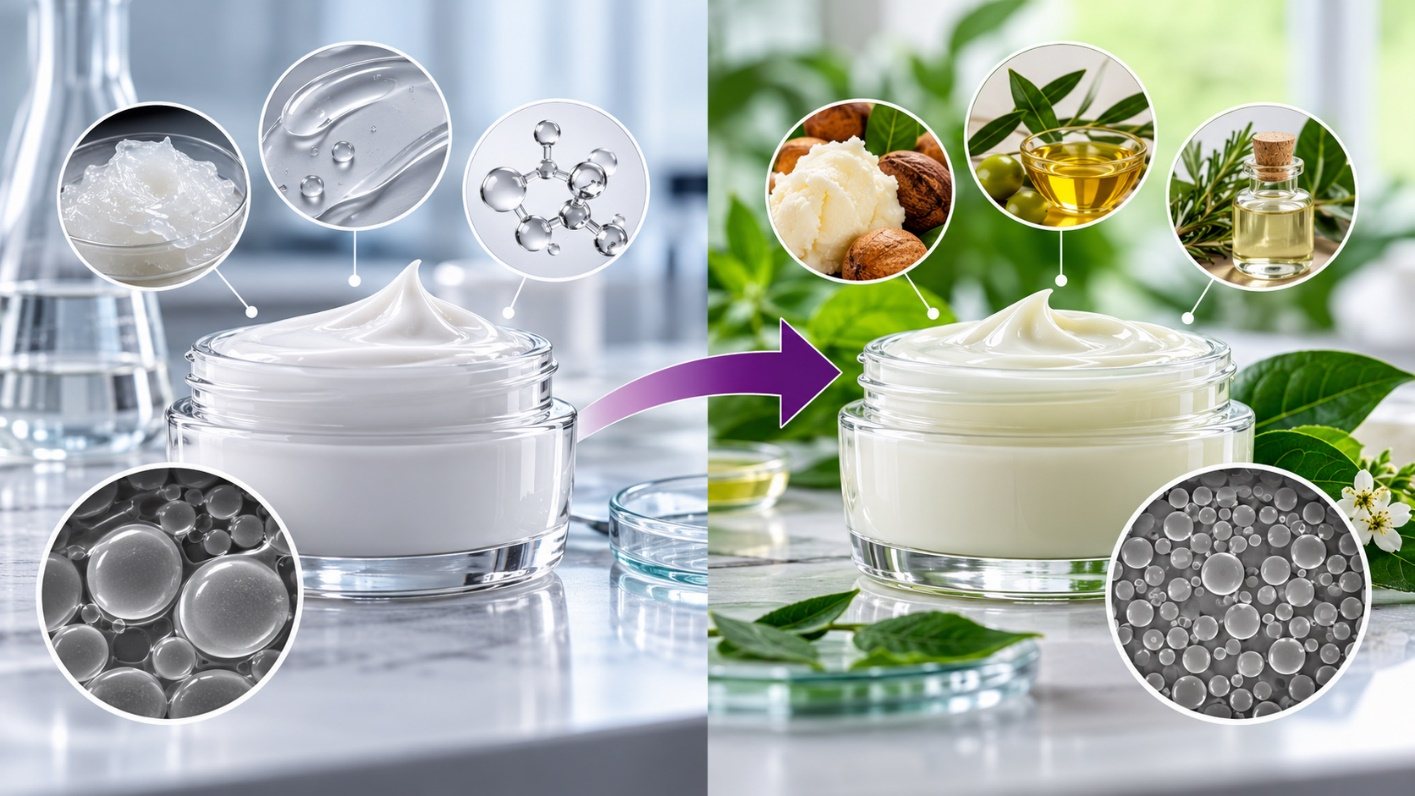
Taking out the water also takes out the emulsion. If your range is built on creams, read what an emulsion is and why creams separate to see which stability problems disappear and which new ones arrive.
02What removing water really saves
The biggest gains come from smaller packs and lighter freight, not from the water itself.
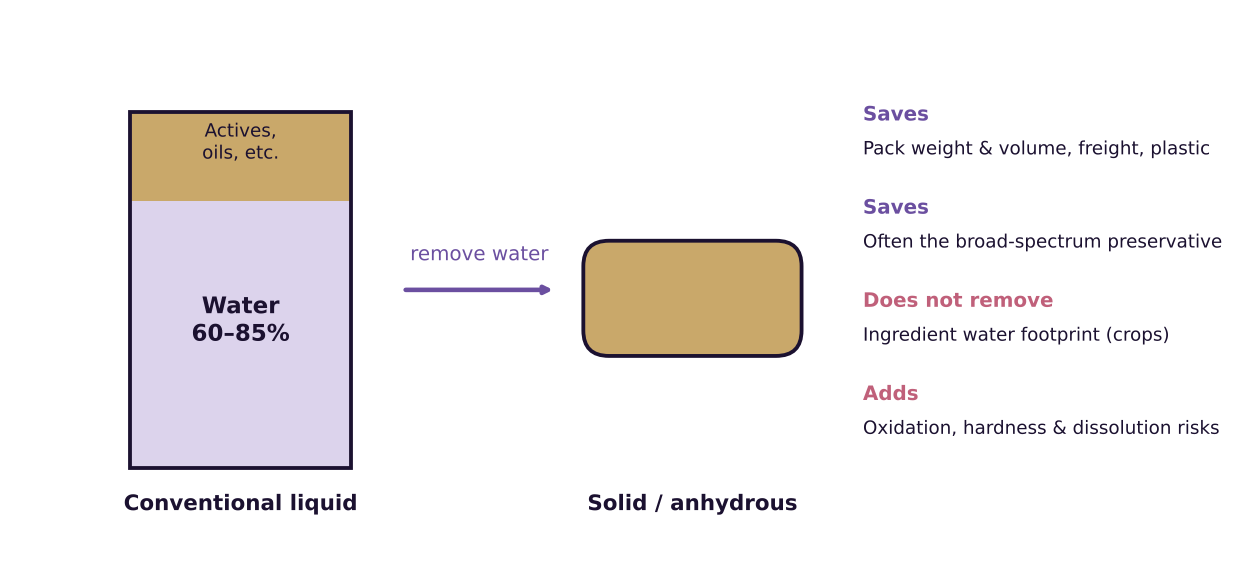
Packaging and freight. A concentrated solid needs a smaller pack, often paper rather than plastic, and ships less weight per use. An ETH Zurich life-cycle assessment compared bar and liquid hand soap [2]. As reported by Scientific American, the bar needed about one-fifth of the energy to produce, mainly because of its raw materials and packaging, and liquid soap used far more packaging [3].
Water footprint. Agriculture accounts for about 70% of global freshwater withdrawals [4], so much of a balm's water footprint sits in its plant-derived ingredients, not in its formula. The same soap study found the bar had the larger land-use impact, because of its vegetable oils [3].
Waterless products are water-responsible, not water-free. Position the benefit as fewer packs, lighter freight and less plastic.
03Water activity and ISO 29621: how the preservation case changes
Microbes need available water, not just water on the label. Water activity (aw) measures that free water on a 0–1 scale. Most bacteria need an aw of about 0.90 or more, most yeasts about 0.88 and most moulds about 0.80. Only specialised xerophilic moulds and osmophilic yeasts grow down to about 0.60–0.62 [5].
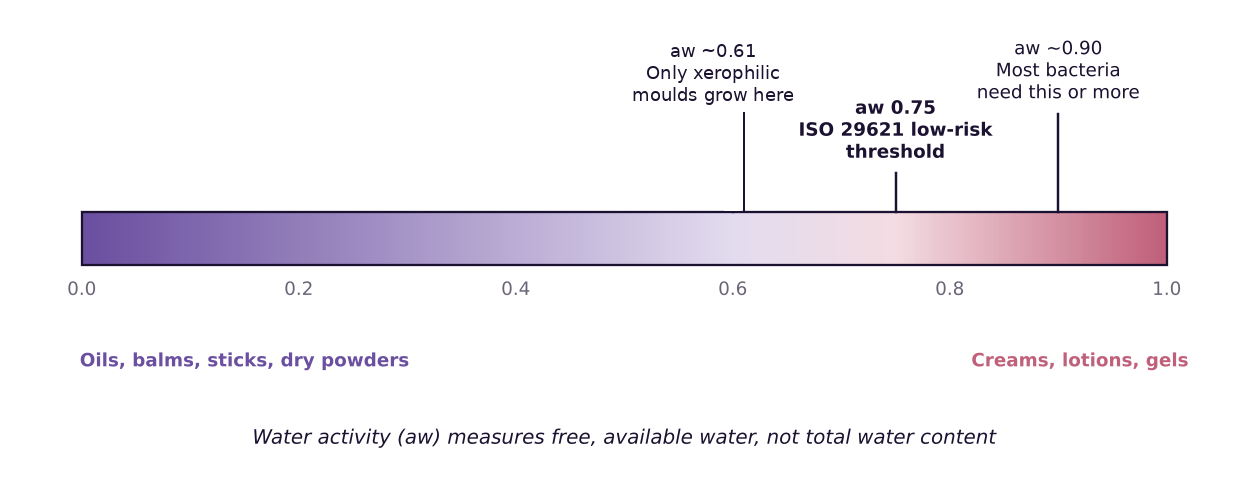
ISO 29621:2017 gives guidelines for identifying microbiologically low-risk cosmetics [6]. Products with an aw of 0.75 or below are listed as low risk, alongside high-alcohol and extreme-pH products and those filled hot [7]. Such products may not need a preservative efficacy (challenge) test under ISO 11930, but only with a documented justification backed by data [7].
Low aw is not a free pass. Water activity is one factor in a multi-factor assessment, not the whole case [8]. Bars sit in wet showers and powders meet damp fingers, so test how the product behaves once water gets onto its surface in use.
Anhydrous systems usually fail through oxidation, rancidity, crystallisation and heat sensitivity rather than microbial growth, so antioxidants and protective packaging carry more of the weight [9].
04Solid, powder and oil formats compared
Each format solves the packaging problem differently and brings its own compatibility and stability work.
| Format | Typical base | Packaging reduction | Main stability risk | Preservation case | Best fit |
|---|---|---|---|---|---|
| Solid (bars, sticks, balms) | Solid surfactants, butters, waxes | Highest: paper or card possible | Cracking, sweating, bloom, softening in wet dishes | Low aw when dry; in-use water on the surface | Cleansers, moisturiser sticks, travel ranges |
| Powder (powder-to-foam, enzyme powders) | Dry surfactants, starches, clays, enzymes | High: small jar or refill pouch | Caking, moisture pick-up, enzyme loss | Low aw when dry; seal against humidity | Exfoliating cleansers, masks, refills |
| Oil (facial and cleansing oils) | Plant oils, esters, squalane | Moderate: still needs a bottle | Oxidation and rancidity | Low aw; antioxidants do the main work | Serums, cleansing oils, lipid-rich care |
Powder-to-foam is the easiest bridge from a liquid range: the user adds water at the point of use, so you make, ship and preserve a dry product. Oils give the smallest packaging gain but the simplest manufacturing route. Check active solubility early, because many popular actives are water-soluble.
05Preservative-free and sustainability claims
Waterless formats invite two kinds of claim, and both need care.
Preservative-free claims. EU cosmetic claims must meet the common criteria in Regulation (EU) No 655/2013, including honesty and fairness [10]. The Commission's technical document on claims says "free from preservatives" should not be used when the product contains an ingredient that protects it against micro-organisms, such as alcohol, unless there is evidence that the ingredient plays no preserving role [11]. Germany's food chemistry society (GDCh) gives the same advice for products that rely on multifunctional ingredients such as alcohol [12]. Describe the format instead: "anhydrous formula with low water activity".
Sustainability claims. Keep them specific and measurable: grams of packaging saved, plastic removed, shipping weight per use. Your Product Information File must also hold evidence of stability and packaging compatibility [9]. Avoid blanket "saves water" lines.
06For brands and formulators: choosing a waterless format
Choose waterless for packaging and logistics gains, and build the preservation case on measured data.
- Pick the format by the product's job: solids for cleansers and sticks, powders for exfoliants and refills, oils for lipid-rich care.
- Measure aw early and complete an ISO 29621 risk assessment before deciding on a challenge test.
- Shift stability effort to oxidation: antioxidant systems, light and oxygen barriers, temperature cycling.
- Test in use, including wet-shower storage for bars and humidity for powders.
- Quantify claims in packaging grams and shipping weight, not water saved.
07Questions readers ask
Do waterless products need preservatives?
Not always. Products with a water activity of 0.75 or below can be classed as low risk under ISO 29621, but in-use water and the full risk assessment decide the final system.
Is waterless beauty really more sustainable?
It usually cuts packaging and freight. Much of a product's water footprint comes from farming its ingredients, so the water saving itself is small.
What is the difference between anhydrous and solid skin care?
Anhydrous means no added water. Solid skin care is one anhydrous format; oils and powders are anhydrous too.
Can I call an anhydrous product "preservative-free"?
Use caution. In the EU, the claim should not be used if an ingredient such as alcohol helps protect the product against micro-organisms, unless you have evidence that it does not.
Converting a cream into a waterless format?
Our formulation team handles format selection, water activity testing, stability programmes and claim substantiation for skin care brands.
08References
- GlobalData. Eco-consciousness to drive demand for waterless cosmetics in APAC. Press release, n.d. (c. 2023). globaldata.com
- Koehler A, Wildbolz C. Comparing the environmental footprints of home-care and personal-hygiene products: the relevance of different life-cycle phases. Environ Sci Technol. 2009;43(22):8643–8651. DOI
- Scientific American. The benefits of a bar (of soap, that is). Plugged In blog, reporting Koehler and Wildbolz [2]. scientificamerican.com
- World Bank. Water in agriculture: freshwater withdrawals. Open Knowledge Repository. worldbank.org
- Manitoba Agriculture. Water content and water activity: two factors that affect food safety. Government of Manitoba. gov.mb.ca
- ISO 29621:2017. Cosmetics. Microbiology. Guidelines for the risk assessment and identification of microbiologically low-risk products. International Organization for Standardization. iso.org
- EcoMundo. Understanding low-risk cosmetics: ISO 29621 guide. ecomundo.eu
- Cosmetics Business. The water activity measurement: a key indicator to evaluate the self-preservation of cosmetic products. cosmeticsbusiness.com
- Certified Cosmetics. Water-based vs anhydrous product regulations. certifiedcosmetics.com
- Commission Regulation (EU) No 655/2013 of 10 July 2013 laying down common criteria for the justification of claims used in relation to cosmetic products. OJ L 190, 11.7.2013. EUR-Lex
- European Commission. Technical document on cosmetic claims, agreed by the Working Group on Cosmetic Products, 3 July 2017; Annex III, "free from" claims. ec.europa.eu
- Lebensmittelchemische Gesellschaft (GDCh), Working Group Cosmetic Products. Preservation of cosmetic products. Position paper, July 2024. PDF
Update log
- Published by Cosmetic Science Lab
This article is general technical information, not legal, regulatory or medical advice. Confirm requirements for your product and market before launch.