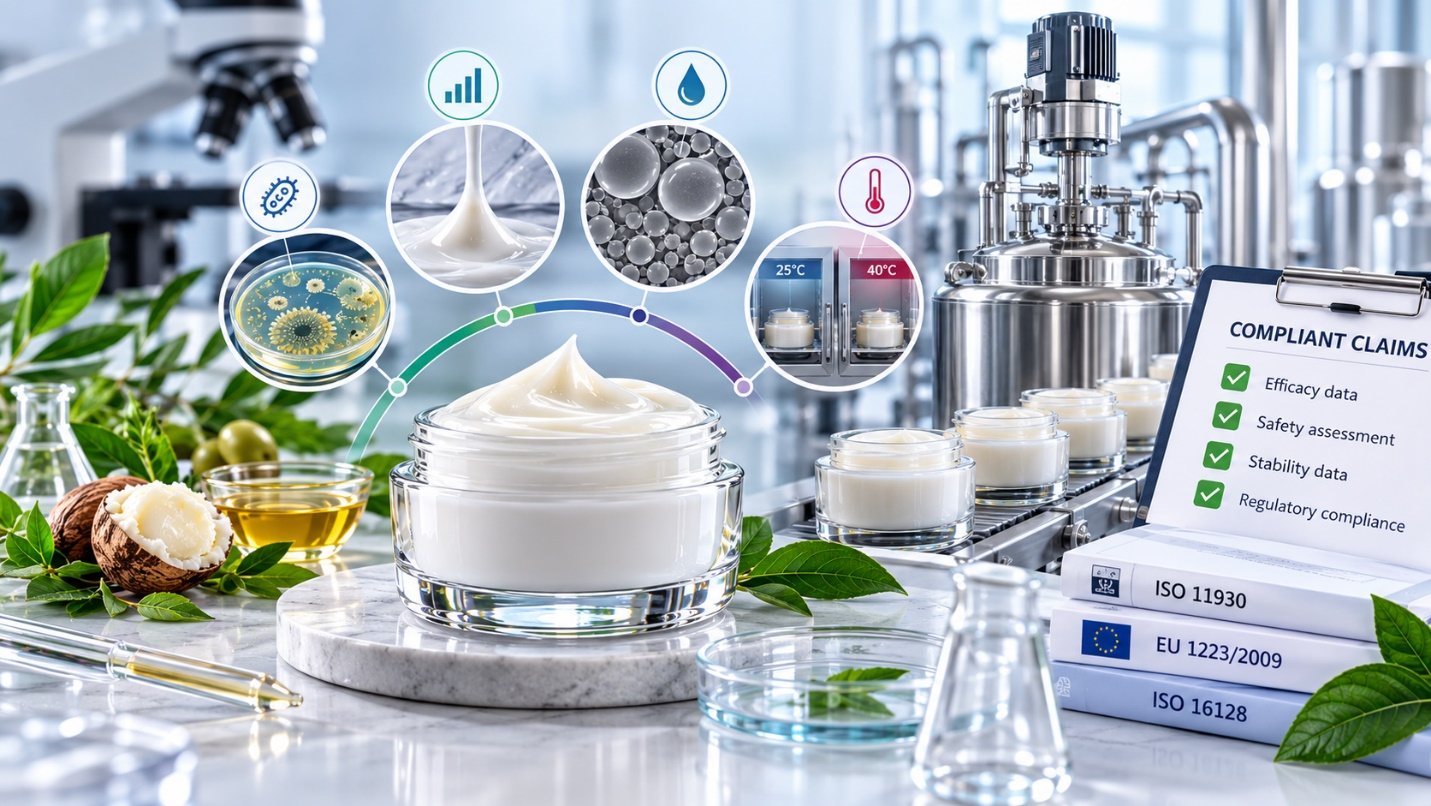
Replacing synthetic ingredients in O/W emulsions: why natural alternatives need reformulation
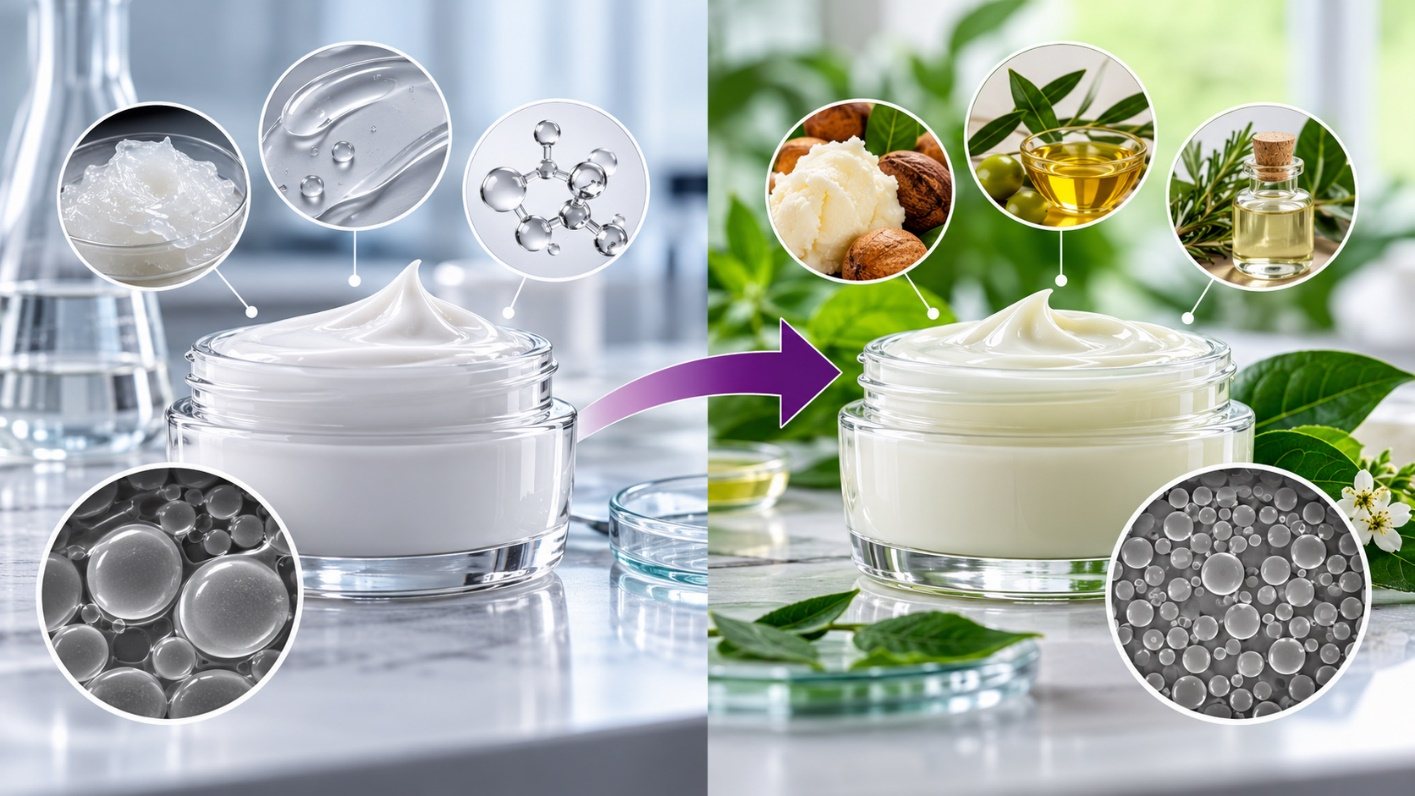
Your brand has committed to removing petrolatum, dimethicone and phenoxyethanol, and your supplier has a natural alternative for each. Six weeks later the cream is thinner and the 40 °C samples are drifting. The fix is reformulation, not substitution.
By CSL Formulation science team, Cosmetic Science Lab · Reviewed by Dr. Premalatha, Ph.D., Life Science, Regulatory Consultant
- Part 1Why natural alternatives need reformulation (this article)
- Part 2Testing, scale-up and compliant natural claims
Quick answer
- Each synthetic ingredient does several jobs. A natural alternative usually matches one of them, so a 1:1 swap shifts the whole emulsion.
- Petrolatum swaps change structure, occlusion and oxidation risk. Dimethicone swaps change slip and after-feel. Preservative swaps make protection pH-dependent.
- In the study, even the best combinations needed adjusted surfactant, a fatty alcohol and a natural gum blend to come close to the control [1].
Take-home message for formulators
- Score every alternative on function, not origin
- Protect unsaturated plant lipids with antioxidants
- Lock pH before you challenge-test an organic-acid preservative
Take-home message for brand owners
- Budget for reformulation time, not a supplier swap
- Expect the texture to change and plan a sensory panel
- Decide the claim before choosing ingredients (see Part 2)
01The substitution trap: why ingredient swaps fail
A 2020 study in Molecules tested this directly: replacing hydrocarbons, silicones and preservatives changed the emulsion's physicochemical and structural properties, above all its rheology [1]. Petrolatum provides occlusion, body and oil-phase structure. Dimethicone controls slip and a non-greasy after-feel. Phenoxyethanol gives broad-spectrum preservation across a wide pH range. Remove one and the oil-phase polarity, emulsifier demand, droplet population and viscosity all move.
The control contained 10% petrolatum, 5% dimethicone and 1% phenoxyethanol [1]. Before choosing any alternative, CSL scores it on nine criteria, in this order:
| Criterion | What to check |
|---|---|
| Origin and processing | Natural, or derived natural under ISO 16128 [3]; which chemical steps were used |
| INCI | Exact INCI of every component in a blend, not the trade name |
| Functionality | Which of the original ingredient's jobs it actually covers |
| Oxidation susceptibility | Degree of unsaturation; antioxidant need |
| Sensory and rheology | Spreading, after-feel, viscosity and structure in the full emulsion |
| Preservation impact | pH window and interactions with the preservative system |
| Supply variability | Harvest and lot-to-lot variation; number of qualified suppliers |
| Sustainability evidence | Supplier data such as life-cycle assessment and certification, not origin alone |
| Cost | Price per kg and volatility, plus any added structurants |
02How to replace petrolatum: plant-based emollients
Candidates included a castor oil, hydrogenated castor oil and carnauba wax blend; shea, mango and olive butters; plant-wax jellies; and PEG-8 beeswax [1]. Petrolatum is a stable, non-oxidising hydrocarbon. Plant oils and butters are mostly triglycerides, which can:
- Crystallise, giving a grainy texture over shelf life
- Oxidise at unsaturated sites, shifting colour and odour
- Vary by harvest and supplier, changing the melting profile batch to batch
No plant oil matches petrolatum's occlusion on its own. Semi-solid systems come closest: butters such as shea, and wax–oil blends built on hydrogenated castor oil with carnauba or other plant waxes, which were designed to reproduce petrolatum's texture and appearance [1]. If you claim barrier support, measure TEWL on the final formula.
How to fix it: select on physicochemical match rather than origin, protect unsaturated lipids with tocopherol or ascorbyl palmitate, and rebuild body with fatty alcohols or ester waxes. The study added myristyl myristate to the castor-blend formula [1].
03Natural alternatives to dimethicone: the sensory trade-off
Alternatives tested were hydrogenated ethylhexyl olivate with olive unsaponifiables, C15–19 alkane, octyldodecyl myristate, propylene glycol dipelargonate and hydrogenated polyisobutene [1]. The dimethicone in the control was a very high-viscosity grade, while the alternatives were far thinner, so glide, cushion and absorption time all shift.
How to fix it: blend low- and medium-viscosity esters against a target sensory profile, and confirm with a trained panel. In the study, volunteers found one formula more fluid yet slower to absorb, even though instruments placed it closest to the control [1]. Swapping out silicone also opens a "silicone-free" claim, which has its own rules.
04Preservative transition: synthetic to natural-compatible systems
Alternatives included gluconolactone with sodium benzoate, and benzyl alcohol with salicylic acid, glycerin and sorbic acid [1]. Organic-acid preservatives work mainly in their undissociated form, so their efficacy depends on pH, and pH drift over shelf life can quietly erode protection.
Benzyl alcohol, not "benzoyl alcohol". The two are easily confused in supplier documentation. Benzyl alcohol is also a labelled fragrance allergen in the EU, so check the 0.001% (leave-on) and 0.01% (rinse-off) thresholds.
How to fix it: set and lock the pH. The study paired gluconolactone and sodium benzoate with a sodium citrate buffer, and pH stayed stable in storage [1]. Then challenge-test the final formula to ISO 11930 [4].
05Rheological consequences of each substitution
| Substitution | What changes | Typical fix |
|---|---|---|
| Petrolatum → plant butter or wax blend | Consistency, structure, occlusion, crystallisation risk | Fatty alcohol, ester wax, controlled cooling |
| Dimethicone → ester or alkane | Lower viscosity, altered slip and after-feel | Emollient blending, panel-led selection |
| Phenoxyethanol → organic-acid system | pH sensitivity, ingredient interactions | Buffering, pH targeting, challenge testing |
The final reformulations kept a shear-thinning profile similar to the control, and all showed G′ > G″, indicating a solid-like structure [1]. Viscosity was rebuilt with stearyl alcohol and a natural gel of xanthan gum, lecithin, sclerotium gum and pullulan. If your new formula also carries botanical actives, check their carriers too: phytosome lecithin can weaken the emulsifier film.
06Droplet size and emulsion microstructure
Smaller droplets and tighter distributions resist creaming and coalescence better. The PEG-8 beeswax formula gave the smallest droplets (d90 about 25 µm, against about 44 µm for the castor-blend formula), suggesting that self-emulsifying wax-like ingredients favour physical stability [1]. At ten-fold scale both formulas produced larger droplets, so bench results must be re-verified in production. Part 2 covers the scale-up data.
07CSL's reformulation-first approach
The study's decision scheme is a useful model [1]. CSL screens every candidate in the same order:
- Appearance and centrifugation
If phases separate, adjust surfactant before rejecting the ingredient.
- Droplet size
Check the population and distribution width.
- Rheology
Flow curve, oscillation and tack against the control.
- Spreadability
Then adjust viscosity rather than swapping ingredients again.
Part 2 covers in vivo testing, scale-up and natural claims that hold up to regulators: Validating natural-alternative reformulations.
08Questions readers ask
Can I replace dimethicone with a plant ester one-for-one?
Rarely. Viscosity and after-feel change, so most formulas need an emollient blend and a sensory panel to match the original.
What is the best natural alternative to petrolatum in skin care?
There is no single drop-in. Semi-solid systems such as shea butter or hydrogenated castor oil and plant-wax blends come closest, but they need antioxidants, structurants and TEWL testing if you claim barrier support.
Are natural alternatives safer than synthetic ingredients?
Not inherently. Safety depends on the ingredient, its purity and its concentration, and must be assessed for the finished product under Regulation (EC) No 1223/2009.
Do natural preservatives need challenge testing?
Yes. Their efficacy depends on pH and the whole formula, so the finished product should be tested to ISO 11930.
Planning a clean-beauty reformulation?
We screen alternatives on function, rebuild rheology and preservation, and take the formula through stability and challenge testing.
09References
- Bom S, Fitas M, Martins AM, Pinto P, Ribeiro HM, Marto J. Replacing synthetic ingredients by sustainable natural alternatives: a case study using topical O/W emulsions. Molecules, 2020; 25(21): 4887. doi:10.3390/molecules25214887
- Regulation (EC) No 1223/2009 of the European Parliament and of the Council of 30 November 2009 on cosmetic products. EUR-Lex
- ISO 16128-1:2016 Guidelines on technical definitions and criteria for natural and organic cosmetic ingredients and products — Part 1: Definitions for ingredients. ISO
- ISO 11930:2019 Cosmetics — Microbiology — Evaluation of the antimicrobial protection of a cosmetic product. ISO
Update log
- Published by Cosmetic Science Lab
This article is general technical information, not legal or regulatory advice. Confirm requirements for your product and market before launch.