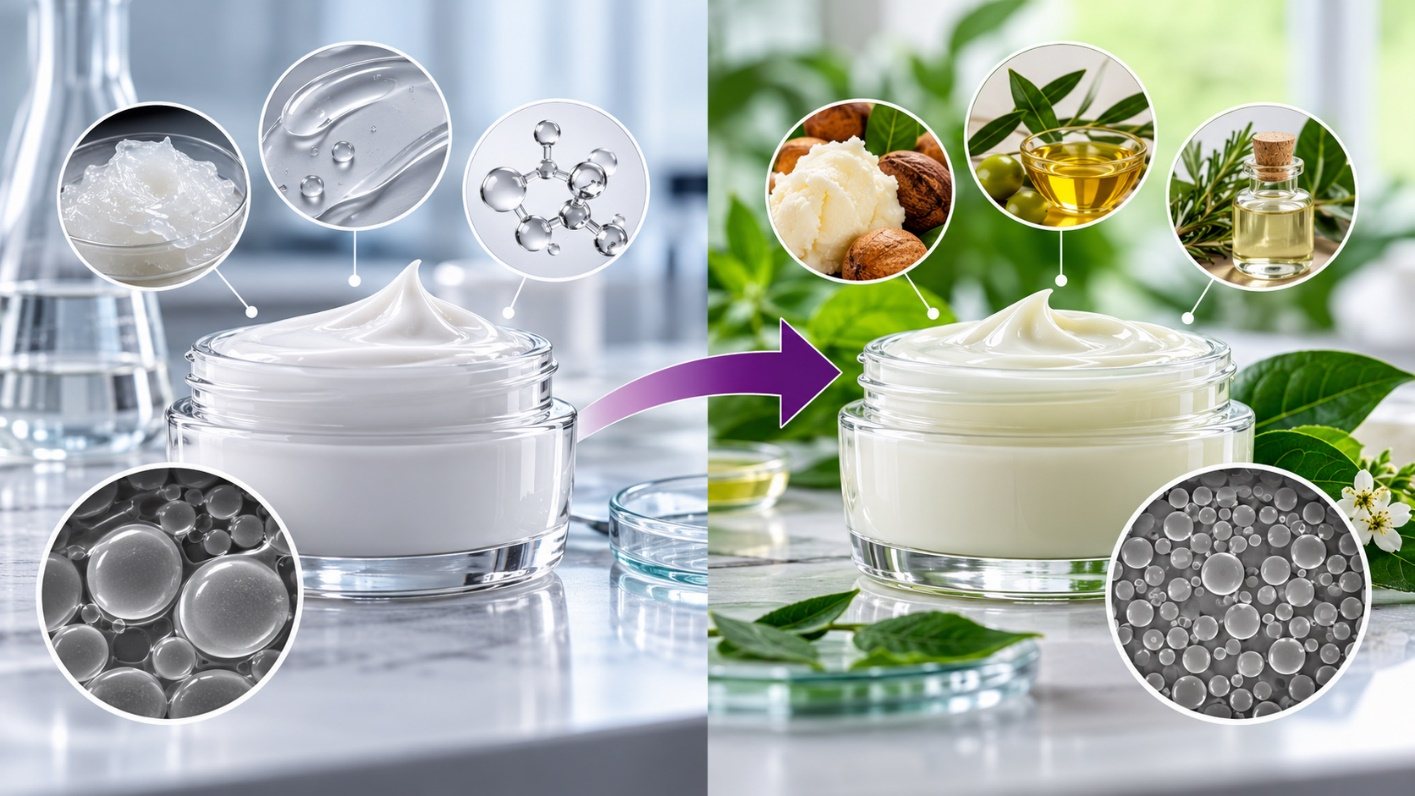
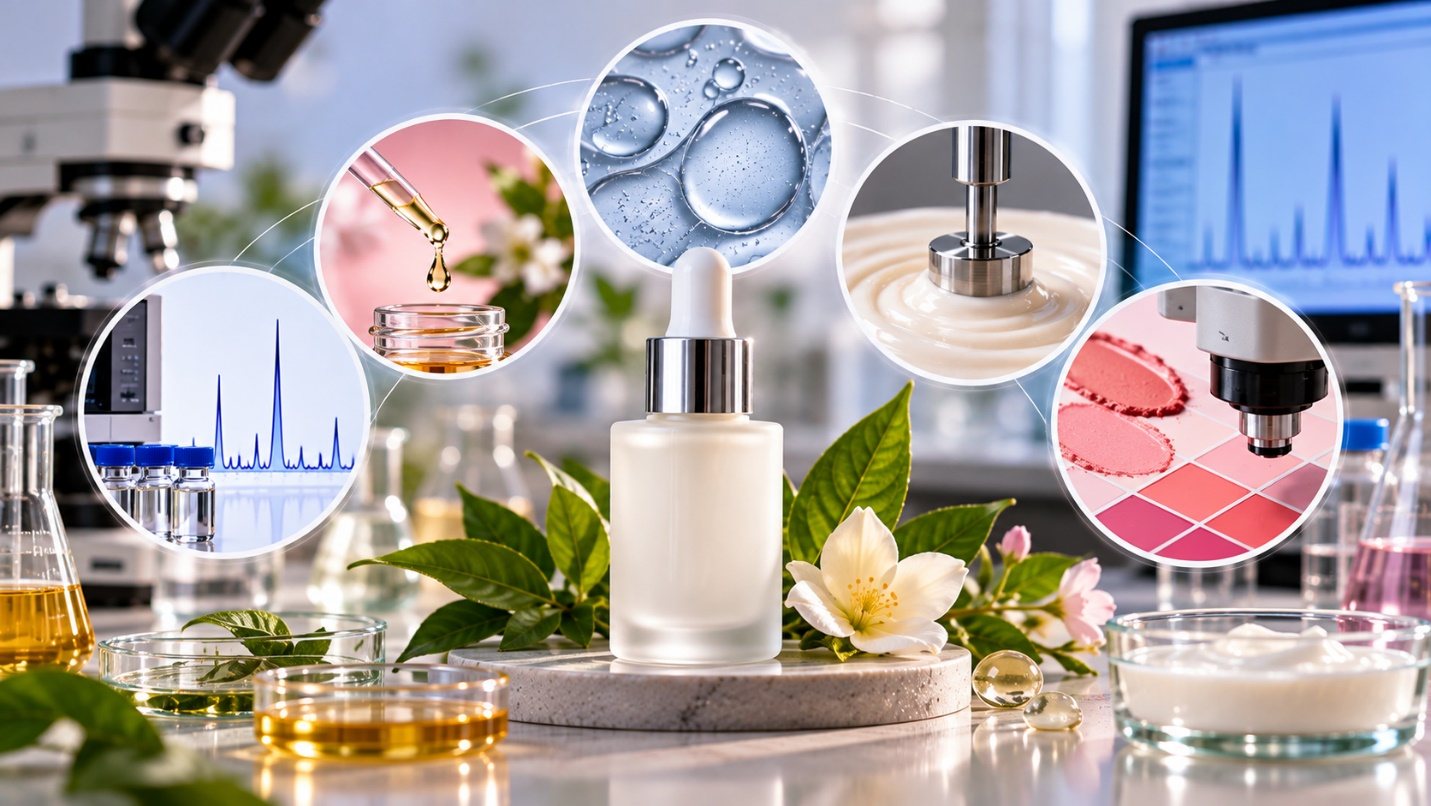
Why plant-based actives destabilise O/W emulsions, and how formulators fix it
Your botanical cream passes every room-temperature check, then separates after three months at 40 °C. The cause is often not the active but the carrier it arrives in. A published study shows how to catch it with rheology before ageing time is spent.
By CSL Formulation science team, Cosmetic Science Lab · Reviewed by Dr. Premalatha, Ph.D., Life Science, Regulatory Consultant
The study behind this article
- Paper
- Semenzato et al., Cosmetics 2018; 5(4): 59
- System
- Soothing O/W cream on a wax-based green emulsifier
- Actives
- Boswellia serrata phytosome, Sichuan pepper extract, tamarind seed polysaccharide
- Key finding
- Only the 2% phytosome prototype failed 40 °C ageing, and the temperature sweep flagged it first
Quick answer
Many plant-based actives arrive in carriers such as phytosomes, which contain lecithin, a surfactant. In the study cited here, the authors attribute the loss of structure to lecithin interfering with the emulsifier film, so the cream thinned and the 2% sample separated in warm storage [1].
- Spot it early: a 23–45 °C rheology temperature sweep flagged the one prototype that later failed 40 °C ageing.
- Fix it: 0.3% sodium polyacrylate restored stability at 1–1.5% active, but not at 2%.
If you are adding a botanical active
- Ask the supplier what the carrier contains: a phytosome or liposome brings its own surfactant
- Run rheology with and without the carrier before you lock the formula
- Know the melting range of every wax and fatty component
If your product is already in stability testing
- Do not rely on centrifugation alone: it passed a sample that later failed at 40 °C [1]
- Run a temperature sweep on retained samples to see a failure coming before month three
- Re-measure droplet size and rheology on the first pilot batch
01Why do plant-based actives destabilise O/W emulsions?
Accelerated storage is the industry's standard stress test [2], and stability data must support the safety report required under Regulation (EC) No 1223/2009 [3]. When a botanical cream fails it late, the team often starts reformulating without knowing what went wrong.
Many botanical actives are supplied inside delivery carriers, such as phytosomes or liposomes, to improve bioavailability. Those carriers bring their own surface-active chemistry into the emulsion.
A 2018 study in Cosmetics by Semenzato and colleagues shows this clearly [1]. The team built a soothing O/W emulsion with three plant-based actives: Bosexil® (a Boswellia serrata phytosome), Zanthalene® (a Sichuan pepper extract) and Xilogel® (tamarind seed polysaccharide). The phytosome contains lecithin, and lecithin is a surfactant.
02What the Bosexil® study found
Study finding. Adding Bosexil® at 0.5–2% shifted the whole flow curve about one decade lower than the active-free reference. At 0.5%, tan δ rose by 7.3%, so the cream became more fluid and less elastic [1]. The elastic modulus stayed above the viscous modulus (G′ > G″) in every sample, so the structure was weakened rather than destroyed.
Mechanism. The authors linked the loss of structure to lecithin from the phytosome interfering with the emulsifier film, and microscopy showed larger droplets at 2% Bosexil® [1]. Lecithin is itself used as an emulsifier because it acts at oil–water interfaces [4].
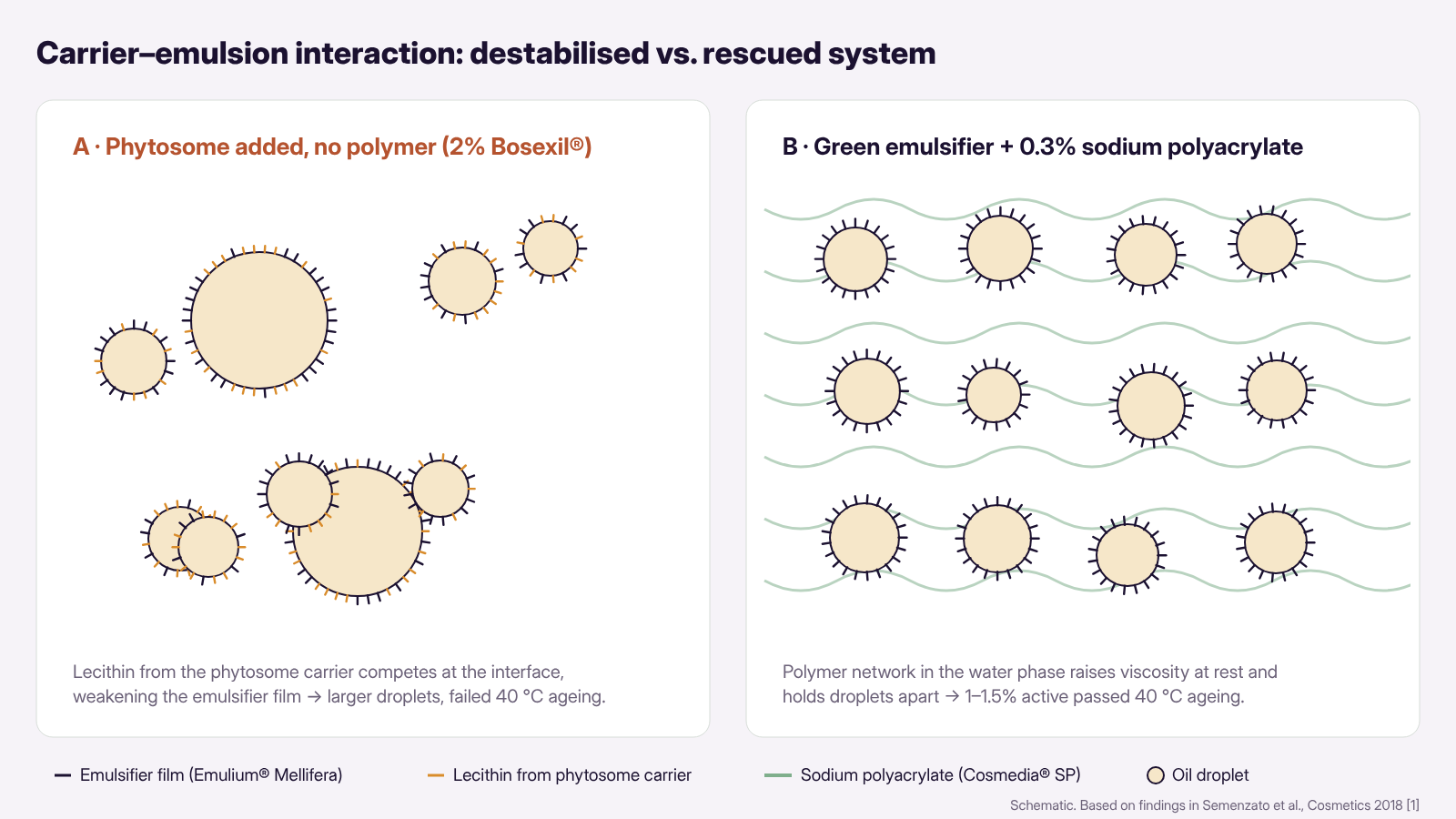
Carrier chemistry, not only active loading, decided the stability outcome in this study. The result applies to this Bosexil® system; every other carrier–emulsion pairing needs its own testing.
03Rheology as a design tool, not a QC checkpoint
All four prototypes passed centrifugation at 4,800 rpm for 30 minutes. Only the 2% Bosexil® sample later failed three months at 40 °C [1].
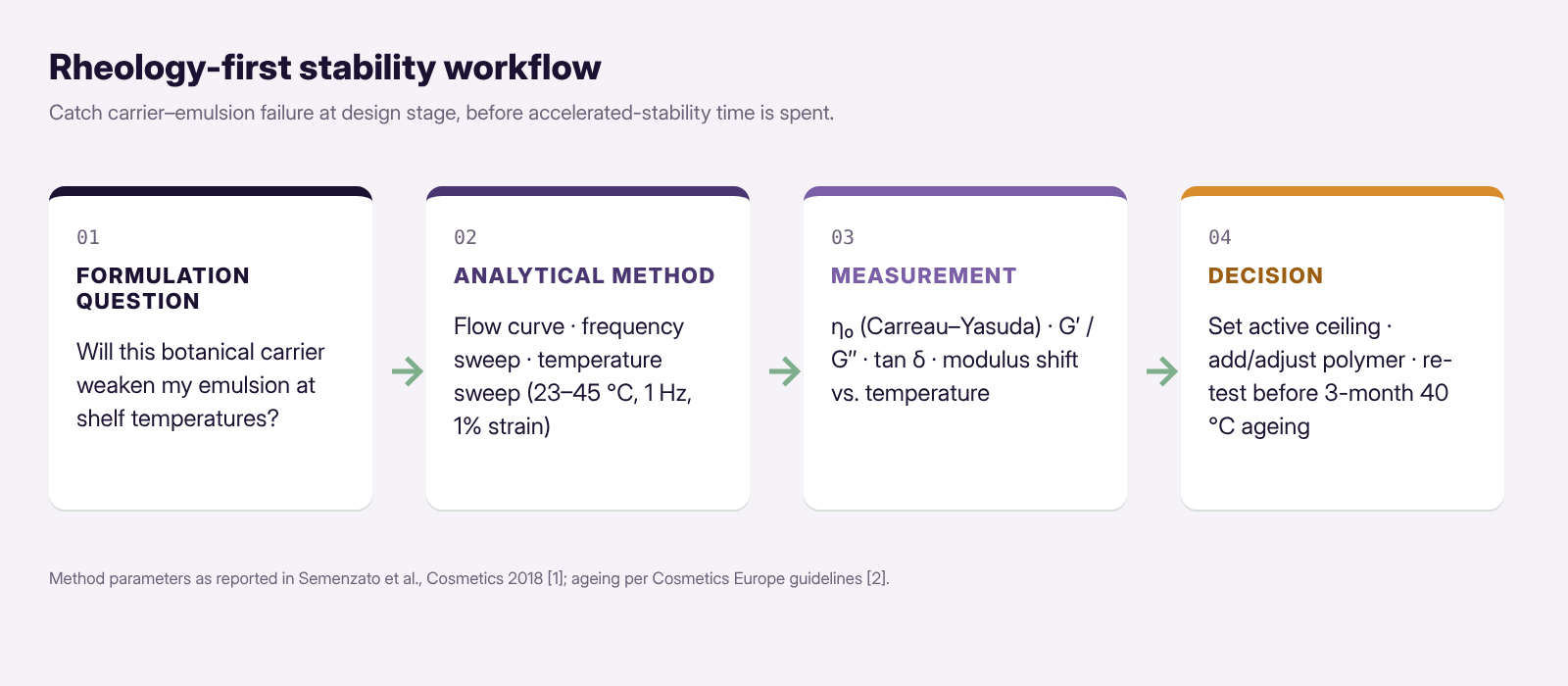
The temperature sweep had already flagged it. The 2% sample's moduli rose to 36 °C and then fell, while the others stayed near-linear up to 40 °C [1]. Rheology has long been used to objectify how emulsions feel on skin [5]; here it worked as an early warning for shelf-life failure.
| Test | What it measures | What it tells the formulator |
|---|---|---|
| Flow curve (Carreau–Yasuda fit) | Viscosity at rest and shear-thinning | How much the carrier thins the base |
| Frequency sweep | G′, G″ and tan δ in the linear region | How much emulsifier-film structure is lost |
| Temperature sweep (23–45 °C, 1 Hz, 1% strain) | Change in G′ and G″ as the sample warms | Likely failure in 40 °C storage |
| Centrifugation (4,800 rpm, 30 min) | Gross mechanical separation | Missed the 2% sample that later failed |
| Accelerated ageing (40 °C, 3 months) | Stability over time | Confirms the design; too slow to guide it |
Test conditions as reported in Semenzato et al. [1]; ageing per the Colipa/CTFA stability guidelines [2].
04Emulsifier selection for botanical-loaded systems
The study used Emulium® Mellifera, a wax-based green emulsifier (polyglyceryl-6 distearate, jojoba esters, polyglyceryl-3 beeswax, cetyl alcohol) [1]. The fatty acids in natural emulsifiers melt between 30 and 50 °C, which makes these systems more temperature-sensitive [1].
This does not show that green emulsifiers perform better or worse than PEG-based systems; only one system was tested. When choosing an emulsifier for a botanical-loaded cream:
- Check whether the active's carrier contains its own surfactant, and at what level
- Compare film strength with and without the carrier using tan δ, not viscosity alone
- Know the melting range of any waxes or fatty alcohols in the blend
- Leave room in the formula for a water-phase stabiliser
05Polymer rescue: acrylic or polysaccharide
To restore stability without losing the easy-spread texture, the team added Cosmedia® SP (sodium polyacrylate) to the external phase. At 0.3% and 0.5%, viscosity at rest and shear-thinning both increased [1].
The polysaccharide route is a second lever. Tamarind seed polysaccharide has rheology similar to hyaluronate, which suggests comparable sensory and moisturising effects [6]. In this study it was already in the water phase as Xilogel® [1].
| Sample | Bosexil® % | Cosmedia® SP % | 40 °C ageing | Rheology signal |
|---|---|---|---|---|
| CX0 | 0 | 0 | Pass | Reference; moduli near-linear to 40 °C |
| CX0.5 | 0.5 | 0 | Pass | Flow curve ~1 decade lower; tan δ +7.3% |
| CX1 | 1 | 0 | Pass | Weakened but still elastic (G′ > G″) |
| CX2 | 2 | 0 | Fail | Moduli rise to 36 °C then fall; larger droplets |
| CX1Y0.3 | 1 | 0.3 | Pass | Higher viscosity at rest |
| CX1.5Y0.3 | 1.5 | 0.3 | Pass | Higher G′ and G″; candidate formula |
| CX2Y0.3 | 2 | 0.3 | Critical | Modulus variation still at 25–35 °C |
Summarised from Semenzato et al. [1]. Spreadability was a design aim, not a measured endpoint.
The 1–1.5% Bosexil® + 0.3% Cosmedia® SP balance belongs to this tested formulation. It is a starting hypothesis for similar systems, not a universal rule.
Stabilising polymers also change how a product spreads, so each rescue must be checked against the sensory brief. The prototypes were made on a bench mixer at 4,500 rpm for five minutes [1]. Production equipment applies different shear and heat, so droplet size and rheology should be re-measured on the first pilot batch.
06Why botanical emulsions fail stability late
- The active is added at the end of development without testing its carrier against the emulsifier
- Viscosity is checked at room temperature only, so temperature-driven weakness goes unseen
- Centrifugation is treated as proof of stability
- A polymer is added without checking how it changes spreadability
07How CSL stabilises a botanical emulsion
- Carrier screen
We map the carrier chemistry of each botanical active and run rheology with and without it at your target loading.
- Emulsifier-film check
A frequency sweep compares tan δ against an active-free control.
- Temperature sweep
23–45 °C testing flags likely 40 °C failures before ageing begins.
- Polymer ladder
Acrylic and polysaccharide options at stepped levels, matched to your sensory target.
- Confirmation
Centrifugation plus accelerated ageing [2] on the final formula in the final pack, run by our stability testing team.
- Scale-up check
Pilot-batch rheology and droplet size confirm the lab result holds in production.
For the wider toolkit of methods, see our guide to analytical methods in cosmetic formulation. If you are replacing synthetic ingredients at the same time, read why natural alternatives need reformulation.
08Questions readers ask
Why does my natural cream separate in warm storage?
Often because a carrier in a botanical active, such as lecithin in a phytosome, weakens the emulsifier film. The weakness may not show at room temperature or under centrifugation.
Can rheology predict an emulsion stability failure?
It can flag the risk early. In the study cited here, a 23–45 °C temperature sweep identified the only prototype that later failed three months at 40 °C.
How much polymer is needed to stabilise a botanical emulsion?
It depends on the system. In this study, 0.3% sodium polyacrylate restored stability at 1–1.5% Bosexil® but not at 2%. Your formula needs its own polymer ladder.
Do green emulsifiers make botanical emulsions less stable?
Not as a rule. Wax-based emulsifiers are more temperature-sensitive, but this study tested one system and did not compare emulsifier classes.
Get a stability-ready botanical formula
Send us your formula and the botanical actives you plan to use. A formulation scientist will check each carrier, run flow, frequency and temperature-sweep rheology, and recommend an active ceiling and a stabilising polymer.
09References
- Semenzato A, Costantini A, Meloni M, Maramaldi G, Meneghin M, Baratto G. Formulating O/W emulsions with plant-based actives: a stability challenge for an effective product. Cosmetics, 2018; 5(4): 59. doi:10.3390/cosmetics5040059
- Colipa (now Cosmetics Europe) and CTFA. Guidelines on stability testing of cosmetic products. March 2004. Cosmetics Europe PDF
- Regulation (EC) No 1223/2009 of the European Parliament and of the Council of 30 November 2009 on cosmetic products. EUR-Lex
- Traynor MP, Burke R, Frias JM, Gaston E, Barry-Ryan C. Formation and stability of an oil in water emulsion containing lecithin, xanthan gum and sunflower oil. International Food Research Journal, 2013; 20(5): 2173–2181. TU Dublin Arrow
- Brummer R, Godersky S. Rheological studies to objectify sensations occurring when cosmetic emulsions are applied to the skin. Colloids and Surfaces A: Physicochemical and Engineering Aspects, 1999; 152(1–2): 89–94. doi:10.1016/S0927-7757(98)00626-8
- Semenzato A, Costantini A, Baratto G. Green polymers in personal care products: rheological properties of tamarind seed polysaccharide. Cosmetics, 2015; 2(1): 1–10. doi:10.3390/cosmetics2010001
Update log
- Published by Cosmetic Science Lab
This article is general technical information, not legal or regulatory advice. Confirm requirements for your product and market before launch.