Caffeine for hair: what the evidence shows for hair fall and fullness
Caffeine is the most tested cosmetic active for thinning hair, but most trials are small or industry-run. Here is what they show and how CSL formulation scientists use it in scalp products.
By CSL Formulation team · Evidence checked by CSL scientists
At a glance
- What it is
- Caffeine, a small water-soluble plant alkaloid, used in leave-on scalp lotions and shampoos
- Main benefits
- Less hair fall due to breakage and shedding; stronger, fuller-looking hair
- Levels tested in trials
- 0.2% caffeine liquid; many shampoo trials do not state the level
- Time to results
- 3 to 6 months of daily use
- Watch for
- Poorly designed, industry-funded studies; claims drifting into 'regrowth'
01What is it?
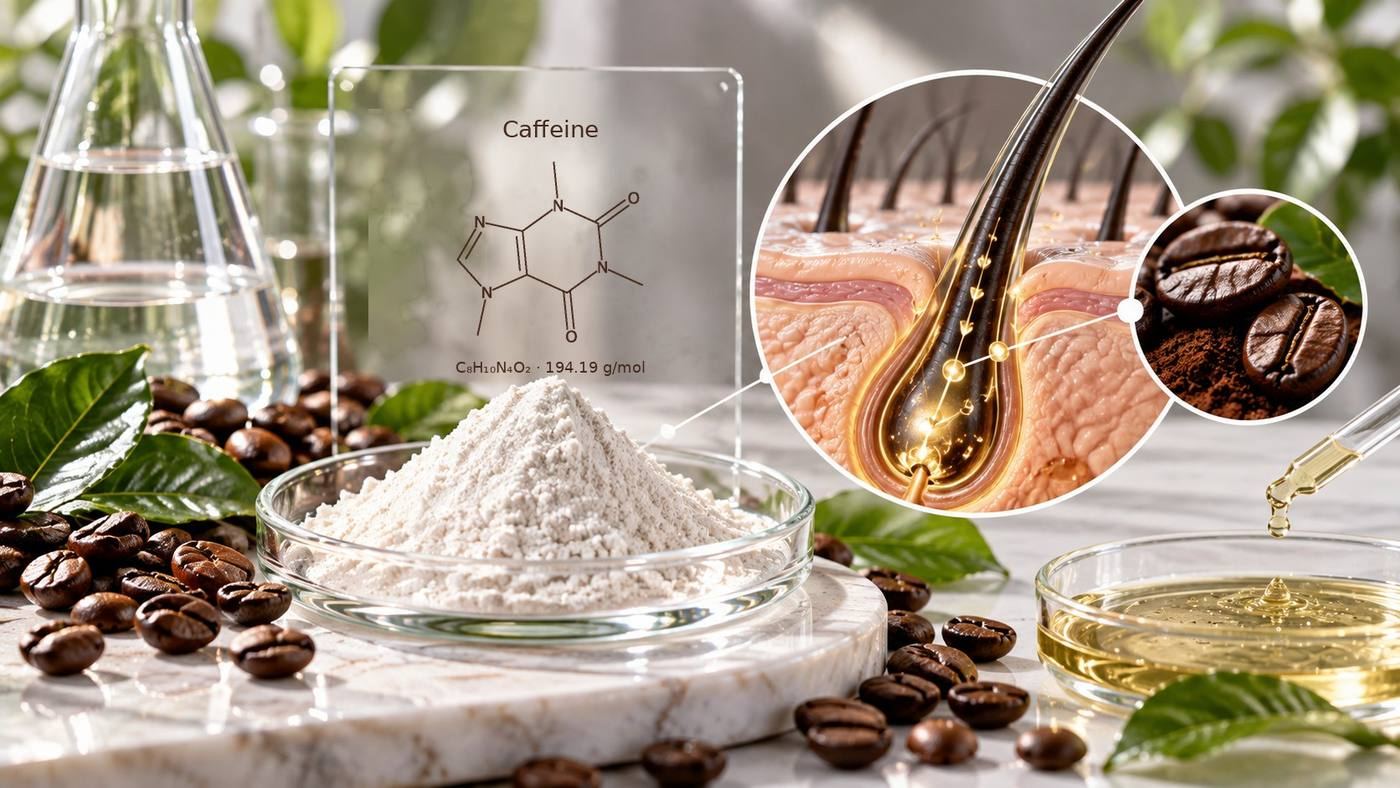
Caffeine is the same stimulant found in coffee and tea. In hair care it is added to scalp lotions and shampoos. It dissolves well in water and reaches the scalp's hair follicles quickly, which makes it easy to formulate.
02What it does
In laboratory work caffeine counteracts testosterone's growth-slowing effect on hair follicles and supports the growth phase of the hair cycle. On the scalp this is thought to show as less shedding and stronger, fuller-looking hair over several months. Human evidence is encouraging but thinner than marketing suggests.
03The evidence
Studies below were checked against the publisher, DOI or journal record on 26 Sep 2026. We list design and size so you can judge the strength of each result.
| Study | Design | Who and how long | What it found |
|---|---|---|---|
| Szendzielorz and Spiewak 2025, Healthcare (MDPI) Source | Systematic review of clinical studies | 9 studies, 684 people with pattern hair loss, excess shedding or thinning | All 9 favoured caffeine, but evidence quality was medium in 3, low in 1 and very low in 5; 7 of 9 did not state the caffeine level. |
| Dhurat et al. 2017, Skin Pharmacology and Physiology (Karger) Source | Open-label, randomised, multicentre non-inferiority trial against 5% minoxidil | 210 men with pattern hair loss (161 analysed), 6 months, 0.2% caffeine liquid | Growth-phase hair ratio rose 10.6% with caffeine vs 11.7% with minoxidil, within the non-inferiority margin. Not blinded and not placebo-controlled. |
| Bussoletti et al. 2020, Giornale Italiano di Dermatologia e Venereologia (Minerva Medica) Source | Randomised, double-blind trial against a control shampoo | 140 women aged 40 to 70 with pattern hair loss, 6 months, caffeine-based shampoo (level not stated) | Fewer hairs came out in the pull test than with the control shampoo (−3.1 vs −0.5 hairs), with more satisfied users. |
| Völker et al. 2020, Skin Pharmacology and Physiology (Karger) Source | Narrative review of laboratory, penetration and clinical data | Lab, skin-penetration and human studies of topical caffeine | Caffeine reaches the follicles within minutes and stays at least 24 hours; lab data show it offsets testosterone's effect on follicles. |
Caffeine is a reasonable, well-tolerated choice for anti-hair-fall products, and one large trial found a 0.2% liquid performed close to 5% minoxidil. Most other studies are small, unblinded or industry-run, so claims should stay cosmetic: 'reduces hair fall due to breakage' and 'fuller-looking hair', backed by the brand's own test data.
04How CSL formulation scientists use it
- Leave-on lotions and tonics give caffeine the longest scalp contact; shampoos rinse off fast, so they need their own clinical test before any claim.
- Caffeine is water-soluble and stable, and fits easily into water or water–alcohol bases; CSL formulation scientists check it stays dissolved in the cold.
- Pair with ingredients that support different targets, such as niacinamide or panthenol, and substantiate the finished formula rather than the single ingredient.
- Plan a 3 to 6 month consumer or instrumental study (hair count, pull test, shedding count) to support any hair fall claim.
05Regulatory and claims
Caffeine is widely used in cosmetics, and CSL regulatory specialists confirm its status for each target market. Claims to regrow hair or treat alopecia are medical claims and make a product a medicine in the EU, UK, US and India. Keep wording cosmetic, such as 'reduces hair fall due to breakage' or 'hair looks fuller'.
06Questions brands ask
Is caffeine as good as minoxidil?
One open-label trial found a 0.2% caffeine liquid was not inferior to 5% minoxidil in men over 6 months. It was not blinded, so it cannot support a medicine-style claim, and cosmetic products must not make one.
Does a caffeine shampoo work?
One randomised, double-blind study found less hair fall than a control shampoo in women over 6 months. Shampoo contact time is short, so each formula needs its own test.
How long before users notice anything?
Trials measured results at 3 to 6 months. Hair cycles are slow, so claims should reflect months of regular use.
07References
- Szendzielorz E, Spiewak R. Caffeine as an active ingredient in cosmetic preparations against hair loss: a systematic review of available clinical evidence. Healthcare. 2025;13(4):395. Link
- Dhurat R, Chitallia J, May TW, et al. An open-label randomized multicenter study assessing the noninferiority of a caffeine-based topical liquid 0.2% versus minoxidil 5% solution in male androgenetic alopecia. Skin Pharmacol Physiol. 2017;30(6):298–305. Link
- Bussoletti C, Tolaini MV, Celleno L. Efficacy of a cosmetic phyto-caffeine shampoo in female androgenetic alopecia. G Ital Dermatol Venereol. 2020;155(4):492–499. Link
- Völker JM, Koch N, Becker M, Klenk A. Caffeine and its pharmacological benefits in the management of androgenetic alopecia: a review. Skin Pharmacol Physiol. 2020;33(3):153–169. Link
Used in: Hair fall & hair growth
Update log
- Evidence reviewed and page published by CSL scientists
This page summarises published research for brands and formulators. It is general information, not medical advice, and results in studies depend on the full formula tested.