Panthenol (provitamin B5): what the evidence shows for skin barrier
Panthenol is a gentle humectant with decades of use in barrier and recovery care. CSL formulation scientists look at what recent studies show, where the evidence is thin, and how to use it well.
By CSL Formulation team · Evidence checked by CSL scientists
At a glance
- What it is
- The alcohol form of pantothenic acid (vitamin B5). Dexpanthenol (D-panthenol) is the active form; DL-panthenol is the mixed form
- Main benefits
- Better-looking hydration, a stronger-feeling skin barrier, less visible redness after procedures, softer, easier-to-comb hair
- Levels tested in trials
- 0.5% to 5% in skin studies, most often 2.5% to 5%; level not disclosed in recent mask studies
- Time to results
- Hydration within days; barrier and redness changes over 1 to 2 weeks after procedures
- Watch for
- Most recent studies test whole products, not panthenol alone; rare allergic contact reactions; medicine status of some 5% ointments
01What is it?
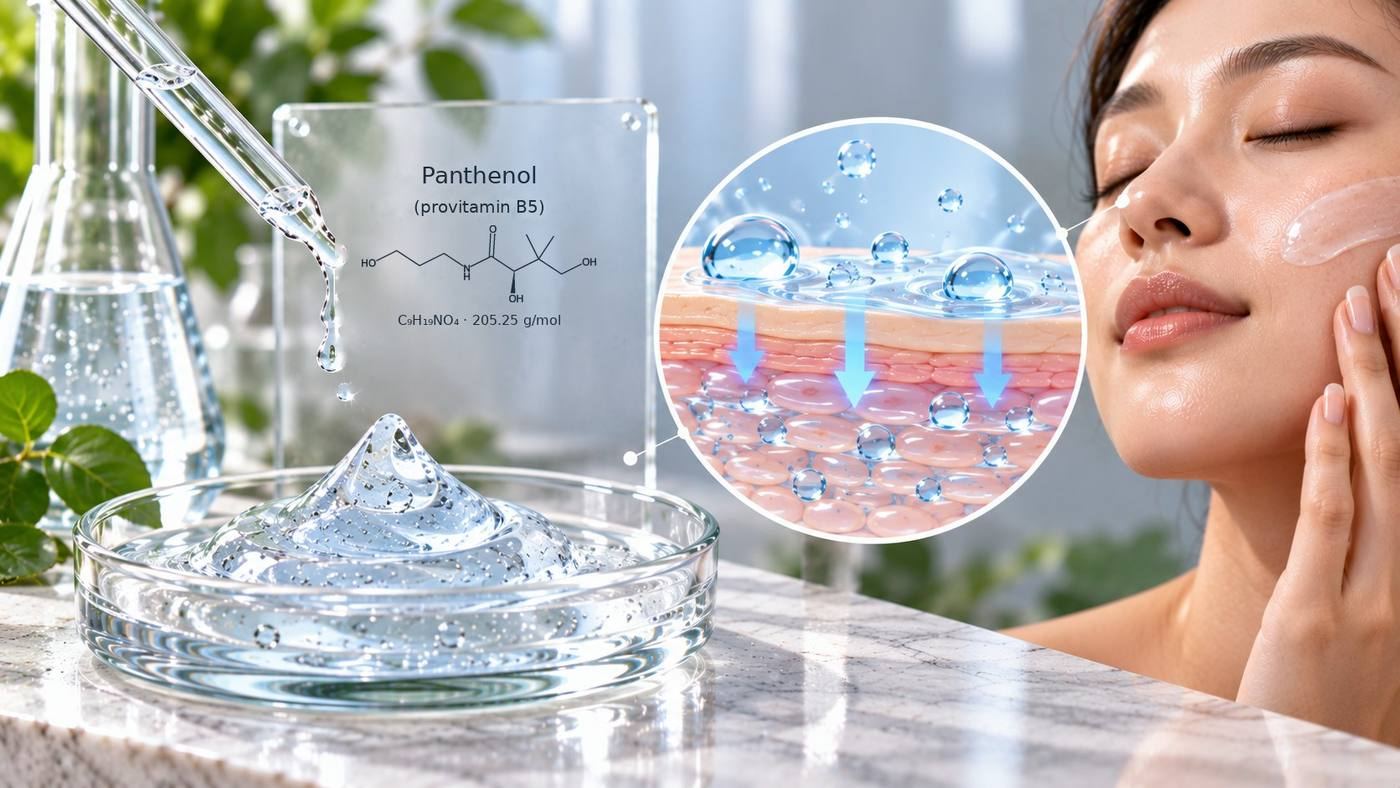
Panthenol is a clear, water-soluble provitamin of vitamin B5. Skin converts it to pantothenic acid, a building block of coenzyme A. It has been used in skin and hair care for more than 70 years and is one of the most widely used soothing and conditioning ingredients.
02What it does
Panthenol attracts and holds water in the outer skin layer and helps the barrier lipids stay mobile. Human biopsy work shows it changes the activity of genes involved in skin repair. On skin this shows as better hydration, lower water loss and calmer-looking skin; on hair it acts as a humectant and antistatic conditioner.
03The evidence
Studies below were checked against the publisher, DOI or journal record on 26 Sep 2026. We list design and size so you can judge the strength of each result.
| Study | Design | Who and how long | What it found |
|---|---|---|---|
| Gao et al. 2025, Journal of Cosmetic Dermatology (Wiley) Source | Double-blind, randomised controlled trial | 60 adults aged 32–54 with photoageing, 14 days after facial laser treatment, panthenol-enriched mask (level not stated) vs saline dressing | At day 14 the mask group had lower redness (erythema index 11.0 vs 13.3), higher skin moisture (51.6 vs 44.8) and lower water loss than control, with similar side effects. |
| Zhang et al. 2024, Journal of Cosmetic Dermatology (Wiley) Source | Multicentre study, no separate control group | 177 adults aged 18–45 with dry sensitive, oily sensitive or acne-prone skin, panthenol-enriched mask 3 times a week for 14 days | Hydration rose 34–39% and water loss fell 9–20% across the three groups, with no adverse reactions. Weaker evidence because there was no comparison group. |
| Gorski et al. 2020, Pharmaceuticals (MDPI) Source | Narrative review of post-procedure healing studies | Trials after laser resurfacing, skin grafts and tattooing, mostly 5% dexpanthenol ointment | In a 38-person double-blind trial after CO2 laser, 5% dexpanthenol healed faster than petroleum jelly over 7 days; in 54 people with new tattoos, water loss was close to normal by day 14. |
| Proksch et al. 2017, Journal of Dermatological Treatment (Taylor & Francis) Source | Narrative review of 70 years of studies | Studies of 0.5% to 5% dexpanthenol for dryness, barrier repair, nappy area, minor wounds and scars | Studies consistently show better hydration and barrier repair, with 5% tending to work best and very good tolerance in babies and adults. The authors note that the exact mechanism is not fully understood. |
| Cho et al. 2022, Journal of Clinical Medicine (MDPI) Source | Narrative review | Studies of dexpanthenol in dry, atopic-prone skin, including a 60-person double-blind study of 2.5% dexpanthenol for 7 days | Twice-daily 2.5% dexpanthenol improved skin hydration and reduced water loss. In children on maintenance care, 96% stayed flare-free with dexpanthenol versus 77% with the comparison product. |
| Heise et al. 2012, Skin Pharmacology and Physiology (Karger) Source | Placebo-controlled study of gene activity in skin biopsies | Small wounds in healthy volunteers treated with dexpanthenol or placebo | Dexpanthenol switched on several genes involved in skin repair, such as IL-6, matching earlier laboratory findings. This explains the mechanism rather than a visible benefit. |
Panthenol is a safe, well-tolerated humectant with a long record of improving skin hydration and helping the barrier recover, but most trials are small, older and often industry-funded, and recent studies test complete products. Claims such as “helps support the skin barrier”, “soothes the look of redness” and “improves hydration” are reasonable when supported by testing of the finished product.
04How CSL formulation scientists use it
- Most skin studies use 2.5% to 5%. CSL formulation scientists typically use 1% to 5% in leave-on skin care and lower levels for hair care, where it acts as a humectant and antistatic conditioner.
- Panthenol is water-soluble, works in clear gels, serums, creams and masks, and is compatible with most actives. It is best kept in a mild pH range (roughly 4 to 7) and added below high-heat stages to avoid breakdown.
- Dexpanthenol (D-panthenol) is the biologically active form; DL-panthenol contains only half as much of it. Claims should reflect the form used.
- It pairs well with ceramides, glycerin, niacinamide and centella in barrier and post-procedure products. Allergic contact reactions are rare but reported, so tolerance testing on sensitive skin is still advised.
05Regulatory and claims
The US Cosmetic Ingredient Review panel (2022) concluded panthenol and related ingredients are safe as used in cosmetics, with reported uses up to about 5% in body, hand and hair products and 2.5% in baby lotions and creams. No specific EU restriction is listed in the Cosmetics Europe ingredient database, which names its functions as antistatic, hair conditioning and skin conditioning; CSL regulatory specialists confirm the status in each target market. Some 5% dexpanthenol ointments for wounds and nappy rash are sold as medicines, so claims must stay cosmetic: “soothes and protects the look of dry, irritated skin”, not “heals wounds” or “treats nappy rash”.
06Questions brands ask
Is panthenol the same as vitamin B5?
Nearly. Panthenol is the provitamin form; skin converts it into pantothenic acid (vitamin B5). It is more stable and penetrates skin better than the vitamin itself.
What level of panthenol works?
Studies show benefits from 0.5%, with 2.5% to 5% the most tested. Around 5% tends to give the strongest results in skin trials.
Is panthenol suitable for sensitive and baby skin?
Generally yes. It has a long record of good tolerance in babies and adults, including in nappy-area products. Rare allergic reactions have been reported, so finished products should still be tolerance-tested.
07References
- Gao M, Gao N, Wang L, Yao T, Jing H, Liu H, Gao L. Evaluation of the efficacy and safety of a panthenol-enriched mask for skin barrier recovery after facial laser treatment: results of a double-blind randomized controlled study. J Cosmet Dermatol. 2025;24(7). Link
- Zhang X, Tao H, Deng Y, et al. Efficacy and safety of a panthenol-enriched mask for individuals with distinct impaired skin barrier subtypes. J Cosmet Dermatol. 2024;23(6):2109–2116. Link
- Gorski J, Proksch E, Baron JM, Schmid D, Zhang L. Dexpanthenol in wound healing after medical and cosmetic interventions (postprocedure wound healing). Pharmaceuticals (MDPI). 2020;13(7):138. Link
- Proksch E, de Bony R, Trapp S, Boudon S. Topical use of dexpanthenol: a 70th anniversary article. J Dermatolog Treat. 2017;28(8):766–773. Link
- Cho YS, Kim HO, Woo SM, Lee DH. Use of dexpanthenol for atopic dermatitis: benefits and recommendations based on current evidence. J Clin Med (MDPI). 2022;11:3943. Link
- Heise R, Skazik C, Marquardt Y, et al. Dexpanthenol modulates gene expression in skin wound healing in vivo. Skin Pharmacol Physiol. 2012;25(5):241–248. Link
- Scott LN, Fiume M, Bergfeld WF, et al. Safety assessment of panthenol, pantothenic acid, and derivatives as used in cosmetics. Int J Toxicol. 2022;41(3 suppl):77–128. Link
- COSMILE Europe (Cosmetics Europe). Panthenol: INCI ingredient functions. Link
Used in: Hydration & barrier repairSensitive skin
Update log
- Evidence reviewed and page published by CSL scientists
This page summarises published research for brands and formulators. It is general information, not medical advice, and results in studies depend on the full formula tested.