Licorice root extract: what the evidence really shows for tone and redness
Licorice is the most studied botanical for uneven tone, and its licochalcone A is a well-known soothing ingredient. The trials are small, so here is an honest look at what they show.
By CSL Formulation team · Evidence checked by CSL scientists
At a glance
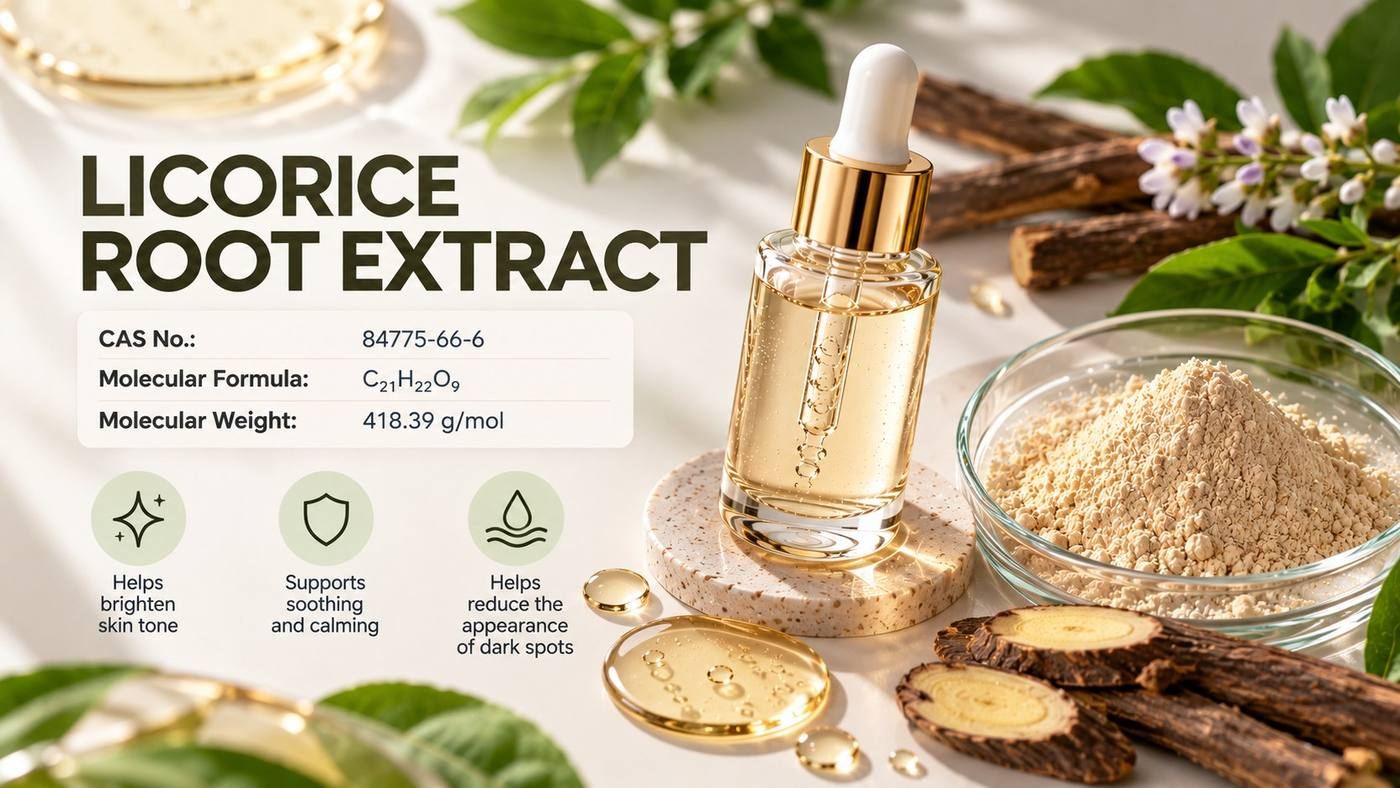
- What it is
- Extracts of Glycyrrhiza root; key markers liquiritin, glabridin, licochalcone A and dipotassium glycyrrhizate
- Main benefits
- More even-looking tone (liquiritin); calmer, less red-looking skin (licochalcone A, glycyrrhizate)
- Levels tested
- 2–4% liquiritin; dipotassium glycyrrhizate up to 1%
- Time to results
- 4 to 8 weeks
- Watch for
- Specify the marker; stability to light and oxygen
01What is it?
“Licorice extract” covers several different ingredients. Liquiritin and glabridin are used for tone; licochalcone A (from Glycyrrhiza inflata) and dipotassium glycyrrhizate are used for soothing and redness. The evidence belongs to the specific marker, not to licorice in general.
02What it does
Licorice compounds reduce pigment production and calm inflammation in the skin. Liquiritin has been studied for melasma; licochalcone A for redness, sensitive skin and acne-prone skin.
03The evidence
Studies below were checked against the publisher, DOI or journal record on 26 Sep 2026. We list design and size so you can judge the strength of each result.
| Study | Design | Who and how long | What it found |
|---|---|---|---|
| Parvizi et al. 2025, Journal of Cosmetic Dermatology Source | Scoping review of 21 herbal melasma trials | Clinical trials to 2024 | Licorice is the most extensively studied herbal melasma remedy and beat placebo in two studies; the trials are few and small. |
| Pennitz et al. 2022, British Journal of Dermatology (Oxford) Source | Systematic review and meta-analysis | 36 randomised, investigator-blinded trials | No licorice trial met the quality bar for inclusion: an honest limit on the evidence. |
| How et al. 2023, Clinical, Cosmetic and Investigational Dermatology Source | Randomised, double-blind trial | 49 adults with acne on retinoids, 4 weeks, licochalcone A sunscreen vs niacinamide sunscreen | Post-acne marks improved equally; less scaling and retinoid irritation with licochalcone A. |
| Puaratanaarunkon and Asawanonda 2022, Clinical, Cosmetic and Investigational Dermatology Source | Randomised, double-blind split-face trial | 59 adults after laser, 6 weeks, sunscreen with licochalcone A vs same filters alone | No difference in post-laser pigmentation; acne calmed faster on the licochalcone side. |
| Schoelermann et al. 2016, JEADV Source | Single-group study | 32 adults with mild–moderate rosacea redness, 8 weeks, licochalcone A regimen | Significant improvement in redness and roughness, with high skin compatibility. No control group. |
| Zubair and Mujtaba 2009, Journal of Pakistan Association of Dermatologists Source | Three-arm comparison | 90 adults with melasma, 8 weeks | Improvement in 96.7% with 4% liquiritin, 86.7% with 2% and 73.3% with 4% hydroquinone; no side effects. Regional journal. |
| Amer and Metwalli 2000, International Journal of Dermatology Source | Split-face, vehicle-controlled trial | 20 women with melasma, 4 weeks | Most liquiritin-treated sides responded well; vehicle sides did not. |
Licorice has encouraging results for tone and good support for soothing, but the trials are small and mostly older. Keep claims modest, for example “helps even the look of skin tone” and “calms the look of redness”, and back them with your own study.
04How CSL formulation scientists use it
- Buy against a marker: ask suppliers for the liquiritin, glabridin or licochalcone A content on the certificate of analysis.
- Match the claim to the marker: tone for liquiritin and glabridin, redness and soothing for licochalcone A and dipotassium glycyrrhizate.
- Glabridin and licochalcone A dissolve poorly in water and degrade in light: plan solubilisers, antioxidants and opaque packs.
- No sensitisation was reported across the reviewed human studies.
05Regulatory and claims
Licorice extracts are widely used in cosmetics. CSL regulatory specialists review each supplier’s safety data and keep claims cosmetic: “evens the look of skin tone”, not “treats melasma”.
06Questions brands ask
Is licorice as strong as hydroquinone?
Some small older trials suggested similar results, but no high-quality trial confirms it. It is a gentler, cosmetic option.
Which licorice extract should I use?
It depends on the claim: liquiritin or glabridin for tone, licochalcone A or dipotassium glycyrrhizate for redness.
Is it good for sensitive skin?
Yes, the soothing forms are among the better-tolerated botanicals, with no sensitisation reported in the studies reviewed.
07References
- Parvizi MM, et al. Clinical trials conducted on herbal remedies for melasma: a scoping review. J Cosmet Dermatol. 2025;24(2):e16741. doi.org/10.1111/jocd.16741
- Pennitz A, et al. Self-applied topical interventions for melasma: a systematic review and meta-analysis. Br J Dermatol. 2022;187(3):309–317. doi.org/10.1111/bjd.21244
- How KN, et al. Sunscreen with licochalcone A and L-carnitine as an adjunct to retinoids in acne. Clin Cosmet Investig Dermatol. 2023;16:3719–3729. doi.org/10.2147/CCID.S422898
- Puaratanaarunkon T, Asawanonda P. Sunscreen with anti-inflammatory agent to reduce PIH after picosecond laser. Clin Cosmet Investig Dermatol. 2022;15:331–337. doi.org/10.2147/CCID.S355329
- Schoelermann AM, et al. Licochalcone A and 4-t-butylcyclohexanol regimen in rosacea subtype I. J Eur Acad Dermatol Venereol. 2016;30(S1):21–27. doi.org/10.1111/jdv.13531
- Zubair S, Mujtaba G. Topical 2% and 4% liquiritin vs 4% hydroquinone in melasma. J Pak Assoc Dermatol. 2009;19(3):158–163. Journal page
- Amer M, Metwalli M. Topical liquiritin improves melasma. Int J Dermatol. 2000;39(4):299–301. doi.org/10.1046/j.1365-4362.2000.00943.x
Used in: Brightening & radianceHyperpigmentation & even toneSensitive skin
Update log
- Evidence reviewed and page published by CSL scientists
This page summarises published research for brands and formulators. It is general information, not medical advice, and results in studies depend on the full formula tested.