Piroctone olamine: what the evidence shows for dandruff and shedding
Piroctone olamine is a widely used anti-dandruff agent. Here is what the trials show, how strong they are, and how CSL formulation scientists use it within EU limits.
By CSL Formulation team · Evidence checked by CSL scientists
At a glance
- What it is
- An antifungal salt (the ethanolamine salt of piroctone) used in shampoos and scalp care against dandruff yeast
- Main benefits
- Fewer visible flakes, less itch; some evidence of less hair shedding
- Levels tested in trials
- 0.5% to 1% in shampoos, often with salicylic acid, climbazole or other actives
- Time to results
- 2 to 4 weeks for flakes; 8 weeks to 6 months for shedding
- Watch for
- EU concentration limits, small and mostly industry-run trials, combination products
01What is it?
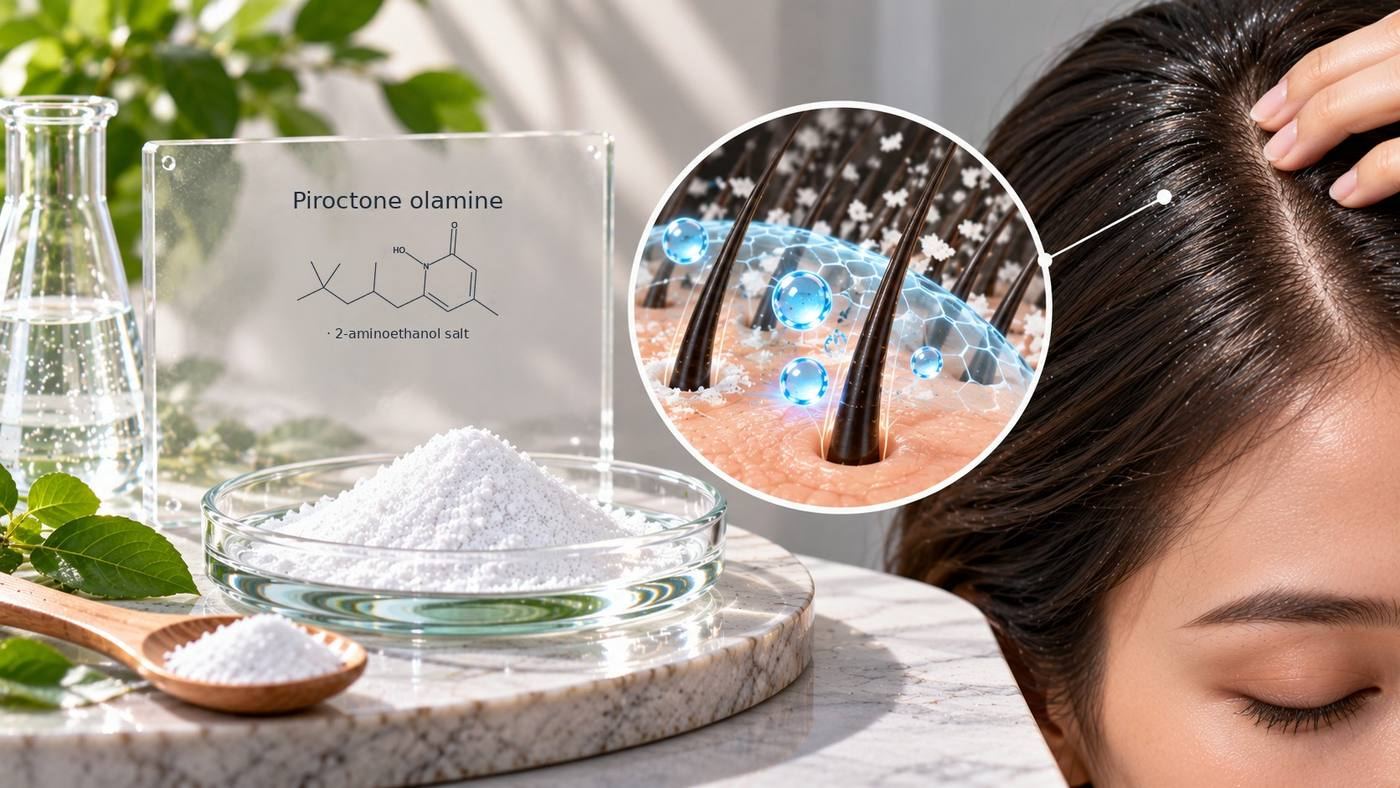
Piroctone olamine is an antifungal ingredient developed for anti-dandruff shampoos. It also works as a preservative. In the EU it has become the main alternative to zinc pyrithione since that ingredient was banned in cosmetics in 2022.
02What it does
It slows the growth of Malassezia, the yeast that feeds on scalp oil and drives flaking; iron chelation is one proposed mechanism. In use this shows as fewer visible flakes and less itch within a few weeks. Some trials also report less hair shedding, which may partly reflect a calmer scalp.
03The evidence
Studies below were checked against the publisher, DOI or journal record on 26 Sep 2026. We list design and size so you can judge the strength of each result.
| Study | Design | Who and how long | What it found |
|---|---|---|---|
| Maître et al. 2025, Dermatology and Therapy (Springer Nature) Source | Randomised, controlled, parallel-group study (after an open intensive phase) | 42 adults with mild-to-moderate scalp seborrhoeic dermatitis, 2-week intensive phase then 8-week maintenance; shampoo with piroctone olamine plus ciclopirox olamine and other actives (levels not disclosed) | Dandruff fell 70.9% after the intensive phase; in maintenance it improved a further 56% with the test shampoo but worsened 117.4% with a neutral shampoo. Manufacturer-funded, and piroctone was one of several actives. |
| Ge et al. 2025, Journal of Cosmetic Dermatology (Wiley) Source | Prospective cohort study, no control group | 20 adults with moderate-to-severe scalp seborrhoeic dermatitis, 16 weeks (4-week gel phase, 12-week cleanser phase); salicylic acid and piroctone olamine (levels not reported) | Dandruff score fell from 2.45 to 1.10 and itch from 2.35 to 1.10 (0–3 scale) by week 4; 80% overall improvement at week 16. Weak design with no comparison group. |
| Davis et al. 2021, International Journal of Cosmetic Science (Wiley) Source | Randomised, double-blind, placebo-controlled trial | Women with self-perceived hair thinning, 8 weeks, piroctone olamine shampoo and leave-on treatment (level not confirmed) | Less hair shedding and a significant increase in hair amount (phototrichogram) versus placebo, with lower scalp oxidative stress. Run by the manufacturer of the products. |
| Schmidt-Rose et al. 2011, International Journal of Cosmetic Science (Wiley) Source | Split-head comparison with in-use testing | Adults with moderate-to-severe dandruff, 4 weeks; 0.5% piroctone olamine plus 0.45% climbazole versus 1% zinc pyrithione | The piroctone/climbazole shampoo reduced dandruff as well as 1% zinc pyrithione; 90% of users reported less itch after 4 weeks. |
| Piérard-Franchimont et al. 2002, International Journal of Cosmetic Science (Wiley) Source | Randomised comparison of three active shampoos, no placebo arm | 150 men with dandruff and androgenetic hair shedding, 6 months; 1% ketoconazole, 1% piroctone olamine or 1% zinc pyrithione | Hair shedding fell 16.5% with piroctone, 17.3% with ketoconazole and 10.1% with zinc pyrithione; hair diameter rose 7.7%, 5.4% and 2.2%. |
| Lodén and Wessman 2000, International Journal of Cosmetic Science (Wiley) Source | Double-blind, randomised, bilateral (half-head) trial | 19 adults with dandruff, about 4 weeks, twice weekly; 0.75% piroctone olamine with 2% salicylic acid versus 1% zinc pyrithione | Both shampoos strongly reduced dandruff; the piroctone/salicylic acid shampoo was slightly more effective on severity and affected area. |
Piroctone olamine reliably reduces the look of dandruff at 0.5–1% in rinse-off products, performing about as well as 1% zinc pyrithione in head-to-head studies. Evidence on hair shedding is encouraging but comes from few, mostly industry-run trials. Suitable claims are "helps reduce visible flakes" and "helps reduce hair shedding" only where the finished product has been tested.
04How CSL formulation scientists use it
- Stay within EU limits: 1% in rinse-off and 0.5% in other products. Shampoo trials used 0.5% to 1%.
- Pair with salicylic acid (keratolytic) or climbazole for a broader effect; test the final formula, as combinations were used in most trials.
- Deposition on the scalp drives results, so the surfactant and conditioning system matter; CSL formulation scientists check retention and wet-combing in the finished product.
- It can chelate metal ions and discolour with iron traces; use chelators and check colour stability over shelf life.
05Regulatory and claims
In the EU piroctone olamine is listed in Annex V of Regulation (EC) No 1223/2009 at up to 1% in rinse-off and 0.5% in other products, and the SCCNFP applied the same limits to non-preservative uses. It is not an active ingredient in the US OTC dandruff monograph (21 CFR 358.710), so US anti-dandruff drug claims cannot rest on it. CSL regulatory specialists confirm the status in each other target market and keep wording cosmetic, such as "visibly reduces flakes", not "treats seborrhoeic dermatitis".
06Questions brands ask
Is piroctone olamine as good as zinc pyrithione?
In head-to-head shampoo studies, 0.5–1% piroctone olamine reduced dandruff about as well as 1% zinc pyrithione. Results depend strongly on the whole formula.
Can it stop hair loss?
It cannot treat pattern hair loss. Two trials found less shedding over 8 weeks to 6 months, so modest shedding claims are possible if the finished product is tested.
Can it be used in leave-on scalp products in the EU?
Yes, up to 0.5%. Rinse-off products can use up to 1%.
07References
- Maître M, Baradat S, Froliger M, Turlier V, et al. Scalp microbiome dynamics can contribute to the clinical effect of a novel antiseborrheic dermatitis shampoo containing patented antifungal actives: a randomized controlled study. Dermatol Ther (Heidelb). 2025;15:2077–2097. Link
- Ge L, et al. A cohort clinical study on the efficacy of topical salicylic acid/piroctone olamine dandruff pre-gel and cleanser in improving symptoms of moderate to severe seborrheic dermatitis of the scalp. J Cosmet Dermatol. 2025;24(1):e16742. Link
- Davis MG, Piliang MP, Bergfeld WF, Caterino TL, Fisher BK, Sacha JP, Carr GJ, Moulton LT, Whittenbarger DJ, Schwartz JR. Scalp application of the antioxidant piroctone olamine reduces hair shedding in an 8-week randomized, double-blind, placebo-controlled clinical study. Int J Cosmet Sci. 2021. Link
- Schmidt-Rose T, et al. Efficacy of a piroctone olamine/climbazol shampoo in comparison with a zinc pyrithione shampoo in subjects with moderate to severe dandruff. Int J Cosmet Sci. 2011. Link
- Piérard-Franchimont C, et al. Nudging hair shedding by antidandruff shampoos. A comparison of 1% ketoconazole, 1% piroctone olamine and 1% zinc pyrithione formulations. Int J Cosmet Sci. 2002;24:249–256. Link
- Lodén M, Wessman C. The antidandruff efficacy of a shampoo containing piroctone olamine and salicylic acid in comparison to that of a zinc pyrithione shampoo. Int J Cosmet Sci. 2000;22(4):285–289. Link
- SCCNFP. Opinion concerning piroctone olamine and its monoethanolamine salt. SCCNFP/0525/01, 27 February 2002. Link
- US Code of Federal Regulations. 21 CFR 358.710: Active ingredients for the control of dandruff, seborrheic dermatitis, or psoriasis. Link
Used in: Dandruff & scalp health
Update log
- Evidence reviewed and page published by CSL scientists
This page summarises published research for brands and formulators. It is general information, not medical advice, and results in studies depend on the full formula tested.