Zinc pyrithione: evidence for dandruff and where it is still allowed
Zinc pyrithione was the benchmark anti-dandruff active for decades but has been banned in EU cosmetics since 2022. Here is the evidence, the rules, and how CSL formulation scientists use it where permitted.
By CSL Formulation team · Evidence checked by CSL scientists
At a glance
- What it is
- A zinc complex of pyrithione with antifungal and antibacterial activity, used in anti-dandruff shampoos
- Main benefits
- Fewer visible flakes and less itch; long track record
- Levels tested in trials
- 1% in most shampoo trials; US monograph range 0.3–2% rinse-off, 0.1–0.25% leave-on
- Time to results
- 2 to 4 weeks in clinical studies
- Watch for
- Banned in EU and GB cosmetics; an OTC drug in the US; formula design drives results
01What is it?
Zinc pyrithione (ZPT) is a fine particle active that sits on the scalp after rinsing and acts against dandruff yeast. It was the most widely used anti-dandruff active worldwide. Since 1 March 2022 it has been banned in EU cosmetics after being classed as toxic for reproduction, but it remains an approved over-the-counter dandruff active in the US.
02What it does
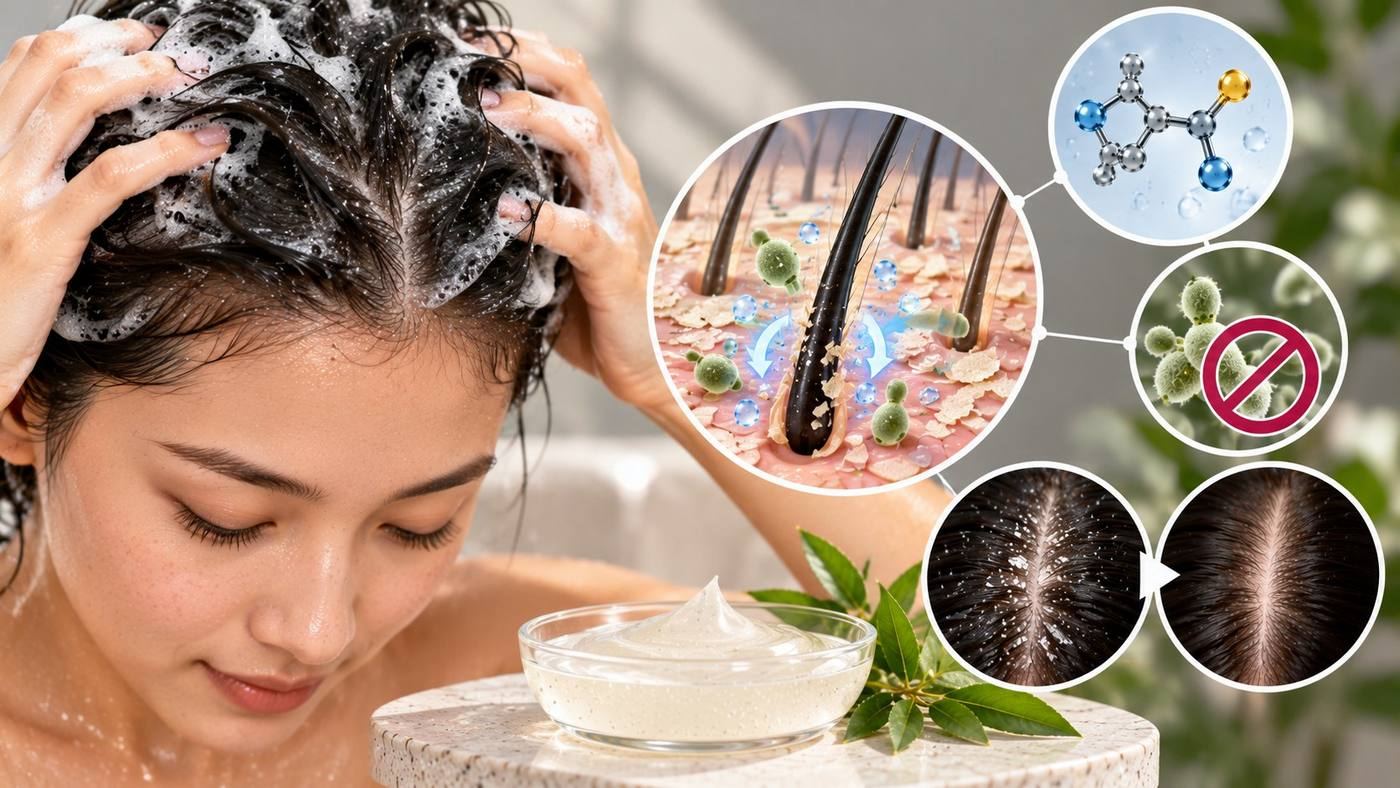
In lab studies ZPT floods Malassezia yeast with zinc, disrupts its energy production and switches off the enzymes it uses to feed on scalp oil. On the scalp this shows as fewer visible flakes and less itch within weeks, with benefits fading once use stops.
03The evidence
Studies below were checked against the publisher, DOI or journal record on 26 Sep 2026. We list design and size so you can judge the strength of each result.
| Study | Design | Who and how long | What it found |
|---|---|---|---|
| Schwartz et al. 2013, International Journal of Cosmetic Science (Wiley) Source | Randomised, double-blind clinical trial | 620 adults with dandruff, 4 weeks; an optimised ('potentiated') zinc pyrithione shampoo versus a zinc pyrithione/climbazole shampoo | The optimised zinc pyrithione shampoo reduced flaking more at every weekly visit, showing that the base formula matters as much as adding a second active. Manufacturer study. |
| Turner et al. 2013, International Journal of Cosmetic Science (Wiley) Source | Half-head clinical comparison plus lab testing | 69 adults with dandruff, 4 weeks' use plus 2-week regression; 1% zinc pyrithione with 0.5% climbazole | The dual-active shampoo reduced visible flakes more than the comparison shampoo (P<0.002) and kept its lead after use stopped (P<0.001). Manufacturer study. |
| Piérard-Franchimont et al. 2002, International Journal of Cosmetic Science (Wiley) Source | Randomised comparison of three active shampoos, no placebo arm | 150 men with dandruff and androgenetic hair shedding, 6 months; 1% ketoconazole, 1% piroctone olamine or 1% zinc pyrithione | Hair shedding fell 16.5% with piroctone, 17.3% with ketoconazole and 10.1% with zinc pyrithione; hair diameter rose 7.7%, 5.4% and 2.2%. |
| Lodén and Wessman 2000, International Journal of Cosmetic Science (Wiley) Source | Double-blind, randomised, bilateral (half-head) trial | 19 adults with dandruff, about 4 weeks, twice weekly; 0.75% piroctone olamine with 2% salicylic acid versus 1% zinc pyrithione | Both shampoos strongly reduced dandruff; the piroctone/salicylic acid shampoo was slightly more effective on severity and affected area. |
| Schmidt-Rose et al. 2011, International Journal of Cosmetic Science (Wiley) Source | Split-head comparison with in-use testing | Adults with moderate-to-severe dandruff, 4 weeks; 0.5% piroctone olamine plus 0.45% climbazole versus 1% zinc pyrithione | The piroctone/climbazole shampoo reduced dandruff as well as 1% zinc pyrithione; 90% of users reported less itch after 4 weeks. |
| Park et al. 2018, Scientific Reports (Springer Nature) Source | Laboratory (in-vitro) study, not human | Cultures of Malassezia restricta, the main dandruff yeast, exposed to zinc pyrithione | Zinc pyrithione raised zinc levels inside the yeast, disrupted its mitochondria and switched off lipase genes it uses to feed on sebum. |
Zinc pyrithione reliably reduces dandruff at around 1% in shampoo, and remains a benchmark in comparative trials. How well it works depends heavily on how the formula delivers it. It can no longer be used in EU or GB cosmetics; elsewhere, check whether it is regulated as a cosmetic or a drug before making claims.
04How CSL formulation scientists use it
- Confirm the target market first: ZPT cannot be placed on the EU market in cosmetics from 1 March 2022, or in Great Britain from 15 October 2022.
- For US products, use 0.3–2% in rinse-off or 0.1–0.25% in leave-on formulas, as set by the OTC monograph, with drug-facts labelling.
- ZPT is an insoluble particle: particle size, suspension stability and deposition aids decide how much stays on the scalp. A large trial showed an optimised ZPT base outperforming a two-active formula.
- Avoid strong chelators (such as EDTA) and iron contamination, which can discolour or destabilise ZPT; check colour and dispersion over shelf life.
05Regulatory and claims
Commission Regulation (EU) 2021/1902 added zinc pyrithione to Annex II (prohibited substances) of Regulation (EC) No 1223/2009 from 1 March 2022, after its classification as toxic for reproduction (category 1B); Great Britain followed from 15 October 2022. In the US it is an OTC drug active for dandruff under 21 CFR 358.710 at 0.3–2% in wash-off and 0.1–0.25% in leave-on products. CSL regulatory specialists confirm the status in each other target market; in drug markets the permitted claims follow the monograph, while cosmetic wording stays at "helps reduce visible flakes".
06Questions brands ask
Can zinc pyrithione be used in products sold in the EU or UK?
No. It has been banned in EU cosmetics since 1 March 2022 and in Great Britain since 15 October 2022. Piroctone olamine and climbazole are the usual replacements.
Is zinc pyrithione still allowed in the US?
Yes, as an OTC drug active for dandruff at 0.3–2% in rinse-off and 0.1–0.25% in leave-on products, with drug labelling.
Is a higher percentage more effective?
Not necessarily. A 620-person trial showed that an optimised formula matters more than adding more actives, and most trials used 1%.
07References
- Schwartz JR, Bacon RA, Shah R, Mizoguchi H, Tosti A. Therapeutic efficacy of anti-dandruff shampoos: a randomized clinical trial comparing products based on potentiated zinc pyrithione and zinc pyrithione/climbazole. Int J Cosmet Sci. 2013;35(4):381–387. Link
- Turner GA, Matheson JR, Li G-Z, Fei X-Q, Zhu D, Baines FL. Enhanced efficacy and sensory properties of an anti-dandruff shampoo containing zinc pyrithione and climbazole. Int J Cosmet Sci. 2013;35:78–83. Link
- Piérard-Franchimont C, et al. Nudging hair shedding by antidandruff shampoos. A comparison of 1% ketoconazole, 1% piroctone olamine and 1% zinc pyrithione formulations. Int J Cosmet Sci. 2002;24:249–256. Link
- Lodén M, Wessman C. The antidandruff efficacy of a shampoo containing piroctone olamine and salicylic acid in comparison to that of a zinc pyrithione shampoo. Int J Cosmet Sci. 2000;22(4):285–289. Link
- Schmidt-Rose T, et al. Efficacy of a piroctone olamine/climbazol shampoo in comparison with a zinc pyrithione shampoo in subjects with moderate to severe dandruff. Int J Cosmet Sci. 2011. Link
- Park M, Cho Y-J, Lee YW, Jung WH. Understanding the mechanism of action of the anti-dandruff agent zinc pyrithione against Malassezia restricta. Sci Rep. 2018;8:12086. Link
- Commission Regulation (EU) 2021/1902 of 29 October 2021 amending Annexes II, III and V to Regulation (EC) No 1223/2009 as regards the use in cosmetic products of certain substances classified as CMR. Link
- US Code of Federal Regulations. 21 CFR 358.710: Active ingredients for the control of dandruff, seborrheic dermatitis, or psoriasis. Link
Used in: Dandruff & scalp health
Update log
- Evidence reviewed and page published by CSL scientists
This page summarises published research for brands and formulators. It is general information, not medical advice, and results in studies depend on the full formula tested.