Salicylic acid: what the evidence shows for blemishes, pores and scalp
Salicylic acid is the classic oil-soluble exfoliant for blemish-prone skin and flaky scalps. CSL formulation scientists review what recent trials show and where the evidence is thinner than its reputation.
By CSL Formulation team · Evidence checked by CSL scientists
At a glance
- What it is
- A beta hydroxy acid (BHA) that dissolves in oil, so it can work inside oily pores
- Main benefits
- Fewer visible blemishes and blackheads, clearer-looking pores, less visible flaking on the scalp
- Levels tested in trials
- 2% leave-on gel; 30% in-clinic peels; shampoos in combination with other anti-dandruff actives
- Time to results
- 2 to 12 weeks in the studies reviewed
- Watch for
- Dryness and stinging, pH-dependent activity, age and product-type limits in some markets
01What is it?
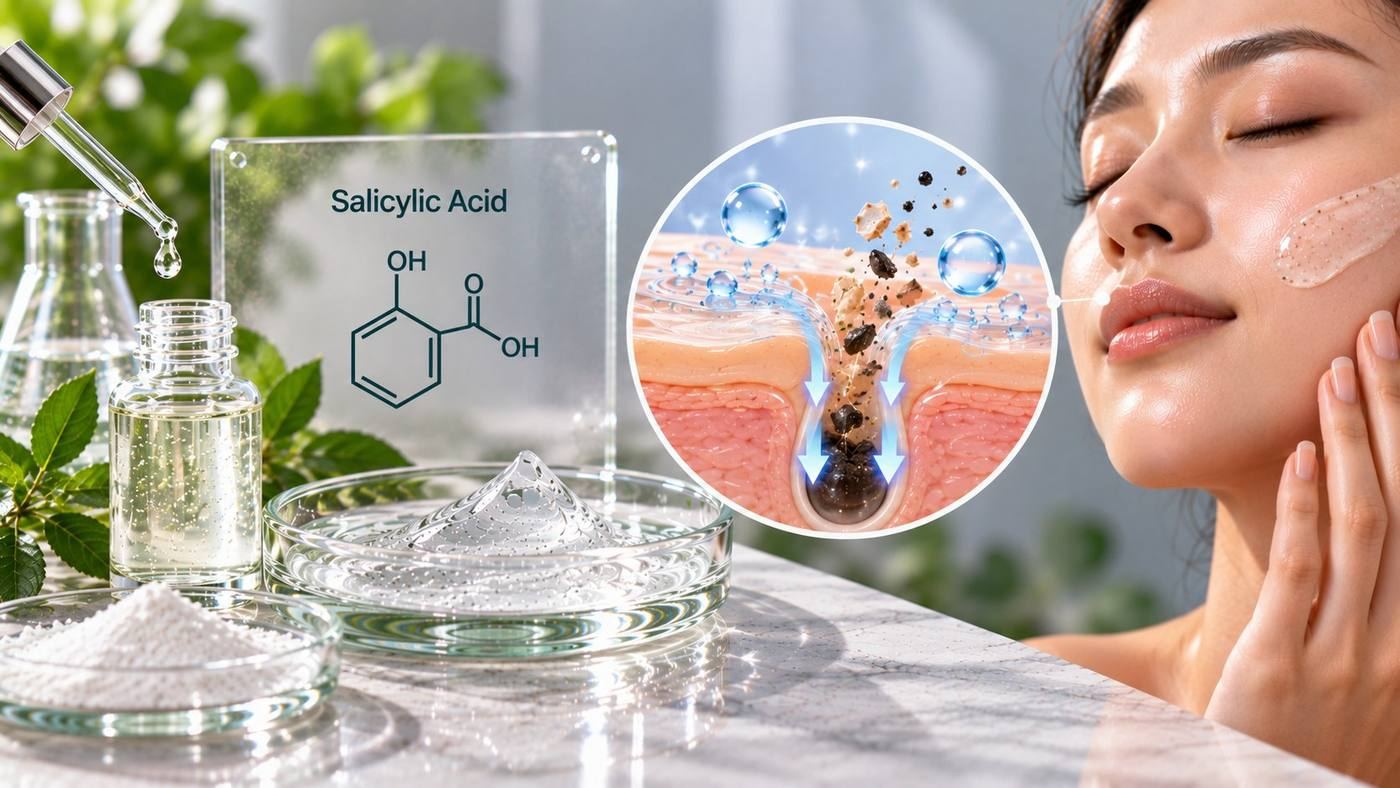
Salicylic acid is a beta hydroxy acid. Unlike glycolic or lactic acid, it dissolves in oil, so it can reach the sebum-filled openings of pores. It is one of the most widely used ingredients in products for blemish-prone skin and in anti-dandruff shampoos.
02What it does
Salicylic acid loosens the bonds between dead skin cells, helping them shed rather than clog pores. It also has a mild calming effect. On the face this shows as fewer visible blackheads and spots; on the scalp it helps lift visible flakes so other anti-dandruff actives can work.
03The evidence
Studies below were checked against the publisher, DOI or journal record on 26 Sep 2026. We list design and size so you can judge the strength of each result.
| Study | Design | Who and how long | What it found |
|---|---|---|---|
| Ye et al. 2024, Journal of Cosmetic Dermatology (Wiley) Source | Multicentre, randomised, assessor-blind trial against adapalene gel | 500 adults with mild to moderate acne, 16-week trial, 2% supramolecular salicylic acid gel once daily | At 12 weeks, 51% improved markedly with salicylic acid versus 43% with adapalene; the difference was not significant, and side effects were rare in both groups (0.4% vs 0.8%). |
| Wang Z et al. 2025, Journal of Cosmetic Dermatology (Wiley) Source | Randomised, vehicle-controlled trial (in-clinic peel) | 34 adults with papulopustular rosacea, four treatments two weeks apart, 30% supramolecular salicylic acid | 68.75% responded in the salicylic acid group; symptom scores were lower than vehicle (1.75 vs 2.40) and redness fell 25%. This is a professional peel, not a home-use product. |
| Mavranezouli et al. 2022, British Journal of Dermatology Source | Systematic review and network meta-analysis | Randomised trials of acne treatments; salicylic acid assessed only within chemical peels | Peels containing salicylic or mandelic acid improved mild to moderate acne versus placebo (mean difference 39.7%), but the authors rated the uncertainty as high. |
| Wang L et al. 2025, Journal of Dermatological Treatment (Taylor & Francis) Source | Cross-sectional real-world study, no control group | 560 people with seborrhoeic dermatitis of the scalp, 21 days, shampoo with selenium sulfide and salicylic acid | Dandruff, redness, itch and greasiness all improved (p < .001); 93.6% of men and 87.5% of women responded. The effect of salicylic acid alone cannot be separated. |
| Li et al. 2025, Clinical, Cosmetic and Investigational Dermatology (Dove Press) Source | Retrospective comparison, no randomisation | 22 people with moderate acne in the salicylic acid arm, 4 weeks, 2% salicylic acid daily | Lesions fell by 52% on average after 4 weeks, but only 22.7% met the study's definition of effective treatment. Weak design. |
| Armanious et al. 2026, Journal of Cosmetic Dermatology (Wiley) Source | Open-label study, no control group | 20 adults with acne-prone skin, 30 days, eight-product regimen with salicylic acid, zinc PCA and niacinamide | Sebum fell 9.1%, inflammatory spots 23% and non-inflammatory spots 32%, with less visible pores. The effect of each ingredient cannot be separated. |
Salicylic acid is a sensible, well-tolerated choice for blemish-prone skin, and a 2% gel performed about as well as a retinoid gel in a large trial. But recent vehicle-controlled data at cosmetic leave-on levels are scarce, and much of the evidence comes from peels or combination products. Suitable claims are “helps unclog pores” and “reduces the look of blemishes”.
04How CSL formulation scientists use it
- Salicylic acid has a pKa of about 3, so the share of free, active acid depends on pH. CSL formulation scientists set pH to balance exfoliating activity against tolerability, and test both.
- It is poorly soluble in water, so formulas need a suitable solvent system (for example glycols or alcohol) or a carrier technology; check for crystallisation in stability testing at low temperatures.
- Leave-on and rinse-off products behave differently: shampoos and cleansers have short contact times, so claims should be based on tests of the finished format.
- Pair with soothing and barrier-supporting ingredients, and take care when layering with retinoids or other acids. Salicylates are not suitable for people with a known salicylate allergy.
05Regulatory and claims
Salicylic acid is a regulated ingredient. In the EU it appears in Annex III (restricted substances) of the Cosmetics Regulation with product-type limits and conditions of use, and in the US it is an over-the-counter acne drug active when acne claims are made. CSL regulatory specialists confirm the status in each target market, including the permitted level for the product type and any age restrictions, before a formula is finalised. Claims stay cosmetic: “helps clear the look of blemishes”, not “treats acne”.
06Questions brands ask
Is 2% salicylic acid better than 0.5%?
Most clinical data use about 2% in leave-on products. Lower levels may still help, but there is little direct trial evidence comparing strengths in cosmetic formats. The permitted maximum also varies by market and product type.
Can salicylic acid be used on sensitive skin?
Often, yes. In the large 2024 trial side effects were rare. It can still cause dryness or stinging, so CSL formulation scientists balance pH and add soothing ingredients.
Does salicylic acid work in shampoo?
It helps loosen visible flakes, and it is common in anti-dandruff shampoos. Recent studies test it with other actives such as selenium sulfide, so its own contribution is hard to measure.
07References
- Ye C, Yi J, Su Z, et al. 2% supramolecular salicylic acid hydrogel vs. adapaline gel in mild to moderate acne vulgaris treatment: a multicenter, randomized, evaluator-blind, parallel-controlled trial. J Cosmet Dermatol. 2024;23(6):2125–2134. Link
- Wang Z, Wu Y, Nozzari Varkani F, et al. 30% supramolecular salicylic acid improved symptoms and skin barrier in papulopustular rosacea. J Cosmet Dermatol. 2025;24:e70046. Link
- Mavranezouli I, Daly CH, Welton NJ, et al. A systematic review and network meta-analysis of topical pharmacological, oral pharmacological, physical and combined treatments for acne vulgaris. Br J Dermatol. 2022;187:639–649. Link
- Wang L, Liu H, Li N, et al. Effectiveness and tolerance of medicated shampoo containing selenium sulfide and salicylic acid in patients with seborrheic dermatitis. J Dermatolog Treat. 2025;36(1). Link
- Li L, Huang Y, Lai J, Lin X. Effectiveness of photodynamic therapy, 2% salicylic acid, and their combination for moderate acne. Clin Cosmet Investig Dermatol. 2025;18:1783–1790. Link
- Armanious YM, Neaz OS, Abdelghany AH, et al. Efficacy and tolerability of a multi-targeted anti-acne regimen incorporating salicylic acid, prebiotics, and zinc PCA: a 30-day clinical trial. J Cosmet Dermatol. 2026;25(7):e71034. Link
Used in: Acne & oil controlDandruff & scalp health
Update log
- Evidence reviewed and page published by CSL scientists
This page summarises published research for brands and formulators. It is general information, not medical advice, and results in studies depend on the full formula tested.