Retinol and retinal: what the evidence shows for fine lines
Retinol and retinal are the best-studied cosmetic retinoids for fine lines. Here is what the trials show, where the evidence is thin, and how CSL formulation scientists work within the new EU limits.
By CSL Formulation team · Evidence checked by CSL scientists
At a glance
- What it is
- Vitamin A forms used in cosmetics: retinol, retinal (retinaldehyde) and retinyl esters such as retinyl palmitate
- Main benefits
- Smoother-looking skin and fewer visible fine lines; more even-looking tone in some trials
- Levels tested in trials
- 0.05% to 0.1% retinal; 0.1% to 0.4% retinol
- Time to results
- 4 to 24 weeks in controlled studies; longer use in some trials
- Watch for
- Dryness, peeling and stinging at the start; light and oxygen sensitivity; EU concentration limits and warning label
01What is it?
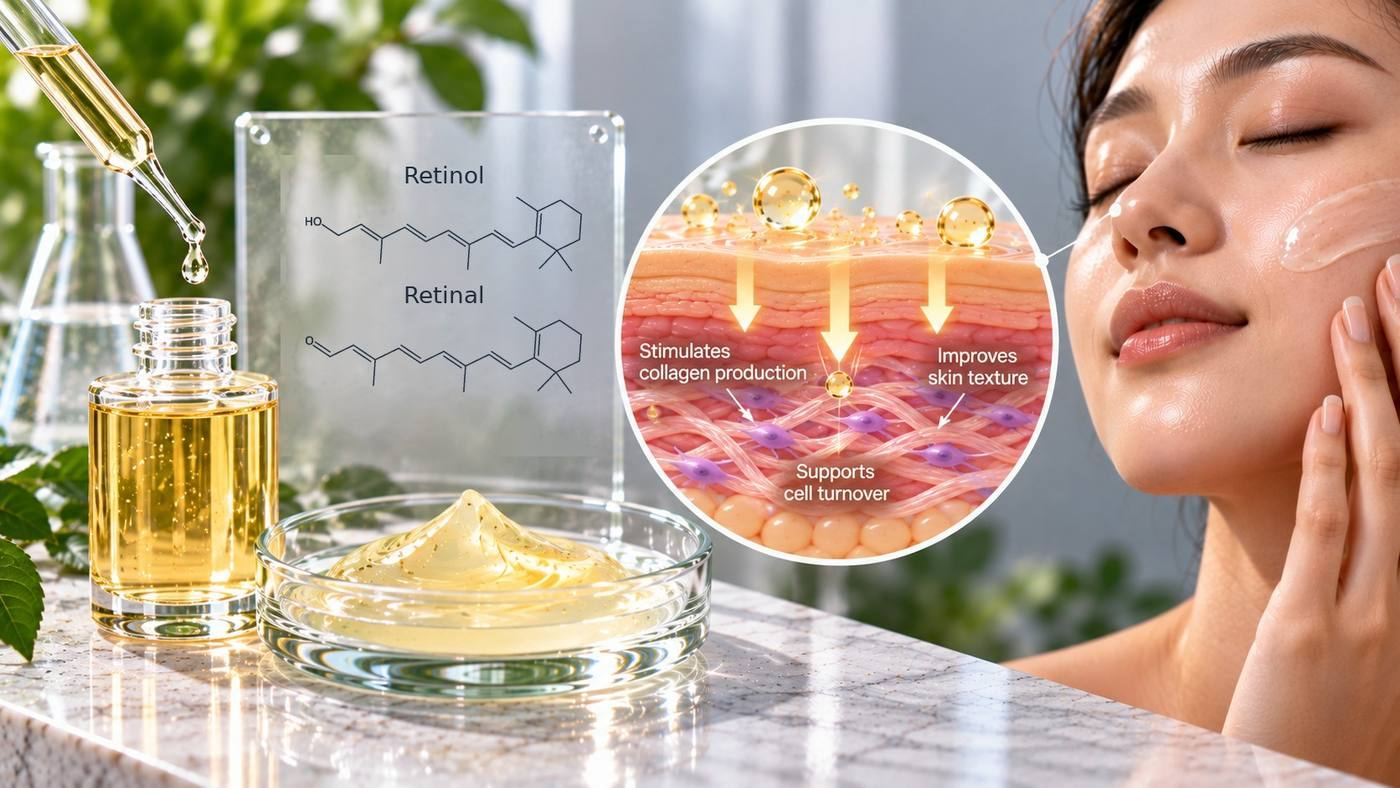
Retinol and retinal are forms of vitamin A. Skin converts them, step by step, into retinoic acid, the form that acts on skin cells. Retinal is one step closer to retinoic acid than retinol, and retinyl esters are one step further away. Cosmetic retinoids are much milder than prescription tretinoin; one review puts retinol at roughly one tenth of its potency.
02What it does
Once converted, retinoids switch on genes that speed up skin renewal and support collagen and other structural molecules in the dermis. In trials this shows as fewer visible fine lines and smoother texture over several months. Early irritation is common and usually settles as skin adjusts.
03The evidence
Studies below were checked against the publisher, DOI or journal record on 26 Sep 2026. We list design and size so you can judge the strength of each result.
| Study | Design | Who and how long | What it found |
|---|---|---|---|
| Kafi et al. 2007, Archives of Dermatology (JAMA Network) Source | Randomised, double-blind, vehicle-controlled arm-to-arm trial | 36 adults aged 80 to 96, 24 weeks, 0.4% retinol lotion up to three times a week | Fine wrinkling improved far more than vehicle (score −1.64 vs −0.08), with more collagen-building markers; most had mild irritation and 3 withdrew. |
| Creidi et al. 1998, Journal of the American Academy of Dermatology (Elsevier) Source | Double-blind, vehicle-controlled trial against tretinoin | 125 adults with facial wrinkles, 44 weeks, 0.05% retinal vs 0.05% tretinoin vs vehicle | Both retinoids reduced wrinkle and roughness measures at week 18; vehicle did not. Retinal caused less irritation than tretinoin. |
| Farris et al. 2024, Journal of Drugs in Dermatology Source | Pooled analysis of 6 vehicle-controlled trials | 471 women, 12 weeks, 0.1% stabilised retinol | Retinol beat vehicle on all photoageing measures from week 4 to week 12; irritation was rare, mild and short-lived. Sponsored by the product maker. |
| Monteil et al. 2025, Journal of Cosmetic Dermatology (Wiley) Source | Randomised split-face study against a plain moisturiser | 66 adults after laser, peel or filler, 3 months, 0.1% retinal with 2% niacinamide | At month 1 wrinkles fell 7% vs 3% on the control side, with gains in firmness and radiance; 2 people stopped because of irritation. Sponsored by the product maker. |
| Siddiqui et al. 2024, American Journal of Clinical Dermatology (Springer Nature) Source | Systematic review of trials against tretinoin | 25 comparative studies | Alternatives often matched tretinoin and were better tolerated; retinal is suggested as a second-line option for people who cannot tolerate tretinoin. |
| Lin et al. 2025, Scientific Reports (Springer Nature) Source | Network meta-analysis of randomised trials | 23 trials, 3,905 participants, topical photoageing treatments | Retinol ranked second for fine wrinkles versus placebo (odds ratio 14.1). The authors flag industry sponsorship and mainly white study groups. |
| Spierings 2021, Journal of Clinical and Aesthetic Dermatology Source | Systematic review of over-the-counter vitamin A trials | 9 randomised, vehicle-controlled trials | Four trials found no difference from vehicle; the rest gave only weak evidence of a mild effect on fine lines. Eight of nine were sponsored by the product maker. |
Retinol and retinal have the strongest evidence of any cosmetic anti-ageing active for fine lines, but effects are modest and much of the data comes from product makers. Suitable claims are ‘visibly reduces the look of fine lines’ and ‘smoother-looking skin’ after weeks of regular use, supported by product-specific testing.
04How CSL formulation scientists use it
- Levels are set by market as well as by performance: in the EU, retinol and its esters are capped at 0.3% retinol equivalent in most products and 0.05% in body lotion. Retinal sits outside that entry but is often used at 0.05% to 0.1%.
- Retinoids break down in light and air. CSL formulation scientists use encapsulation, antioxidants, oxygen-free filling and airless or opaque packs, and confirm the level with real-time stability testing.
- To limit irritation, use lower strengths, soothing partners such as niacinamide and barrier lipids, and directions to start two or three nights a week.
- Pair evening retinoid use with daytime sunscreen advice. Many brands also advise people who are pregnant or breastfeeding to speak to a doctor first.
05Regulatory and claims
Commission Regulation (EU) 2024/996 of 3 April 2024 added retinol, retinyl acetate and retinyl palmitate to Annex III of the EU Cosmetics Regulation. Limits are 0.05% retinol equivalent (RE) in body lotion and 0.3% RE in other leave-on and rinse-off products, with the label warning ‘Contains Vitamin A. Consider your daily intake before use’. Non-compliant products cannot be placed on the EU market from 1 November 2025 or made available from 1 May 2027. Retinal is not named in this entry; CSL regulatory specialists confirm its status, and the rules in other markets, for each launch, and keep claims cosmetic (‘improves the look of fine lines’, not ‘repairs sun damage’).
06Questions brands ask
Is retinal better than retinol?
Retinal is one conversion step closer to the active form and performed as well as tretinoin on wrinkle measures in one older trial, with less irritation. There are few direct head-to-head trials against retinol, so claims should rest on testing of the finished product.
Can a face serum still contain 1% retinol in the EU?
No. Since the 2024 amendment, face and other leave-on products are capped at 0.3% retinol equivalent, and body lotions at 0.05%. Products that do not comply cannot be placed on the EU market from 1 November 2025.
How long before customers see results?
Controlled trials show changes from about 4 to 12 weeks, with further gains over 6 months or more. Early dryness and peeling are common and usually settle.
07References
- Kafi R, Kwak HSR, Schumacher WE, et al. Improvement of naturally aged skin with vitamin A (retinol). Arch Dermatol. 2007;143(5):606–612. Link
- Creidi P, Vienne MP, Ochonisky S, et al. Profilometric evaluation of photodamage after topical retinaldehyde and retinoic acid treatment. J Am Acad Dermatol. 1998;39(6):960–965. Link
- Farris P, Berson D, Bhatia N, et al. Efficacy and tolerability of topical 0.1% stabilized bioactive retinol for photoaging: a vehicle-controlled integrated analysis. J Drugs Dermatol. 2024;23(4):209–215. doi:10.36849/JDD.8124 Link
- Monteil C, Barreto-Campos V, Lain E, et al. Enhancing facial rejuvenation outcomes with a novel retinaldehyde-based cream: a comparative randomized intra-individual study. J Cosmet Dermatol. 2025;24(12):e70555. Link
- Siddiqui Z, Zufall A, Nash M, et al. Comparing tretinoin to other topical therapies in the treatment of skin photoaging: a systematic review. Am J Clin Dermatol. 2024;25(6):873–890. Link
- Lin L, Chen X, Liu C, et al. Comparative efficacy of topical interventions for facial photoaging: a network meta-analysis. Sci Rep. 2025;15:26889. Link
- Spierings NMK. Evidence for the efficacy of over-the-counter vitamin A cosmetic products in the improvement of facial skin aging: a systematic review. J Clin Aesthet Dermatol. 2021;14(9):33–40. Link
- Milosheska D, Roškar R. Use of retinoids in topical antiaging treatments: a focused review of clinical evidence for conventional and nanoformulations. Adv Ther. 2022;39(12):5351–5375. Link
- Commission Regulation (EU) 2024/996 of 3 April 2024 amending Regulation (EC) No 1223/2009 as regards vitamin A, alpha-arbutin and arbutin and substances with potential endocrine disrupting properties. OJ L, 2024/996. Link
Used in: Anti-ageing & wrinkles
Update log
- Evidence reviewed and page published by CSL scientists
This page summarises published research for brands and formulators. It is general information, not medical advice, and results in studies depend on the full formula tested.