Sulphur in skin care: what the evidence shows for blemishes and flaking
Sulphur is one of the oldest actives for blemishes and dandruff. CSL formulation scientists found a small, mostly older evidence base, much of it testing sulphur combined with other actives.
By CSL Formulation team · Evidence checked by CSL scientists
At a glance
- What it is
- Elemental sulphur (sulfur), a yellow mineral used in spot treatments, masks, cleansers and anti-dandruff shampoos
- Main benefits
- Fewer visible blemishes and less redness in combination products; less visible scalp flaking
- Levels tested in trials
- 2% to 5% in shampoos (with 2% to 3% salicylic acid); 5% with 10% sodium sulfacetamide in face products
- Time to results
- Days to 5 weeks for flaking; 4 to 12 weeks for blemishes and redness
- Watch for
- Odour, yellow colour, dryness; mostly old, small studies; drug status for acne and dandruff claims in the US
01What is it?
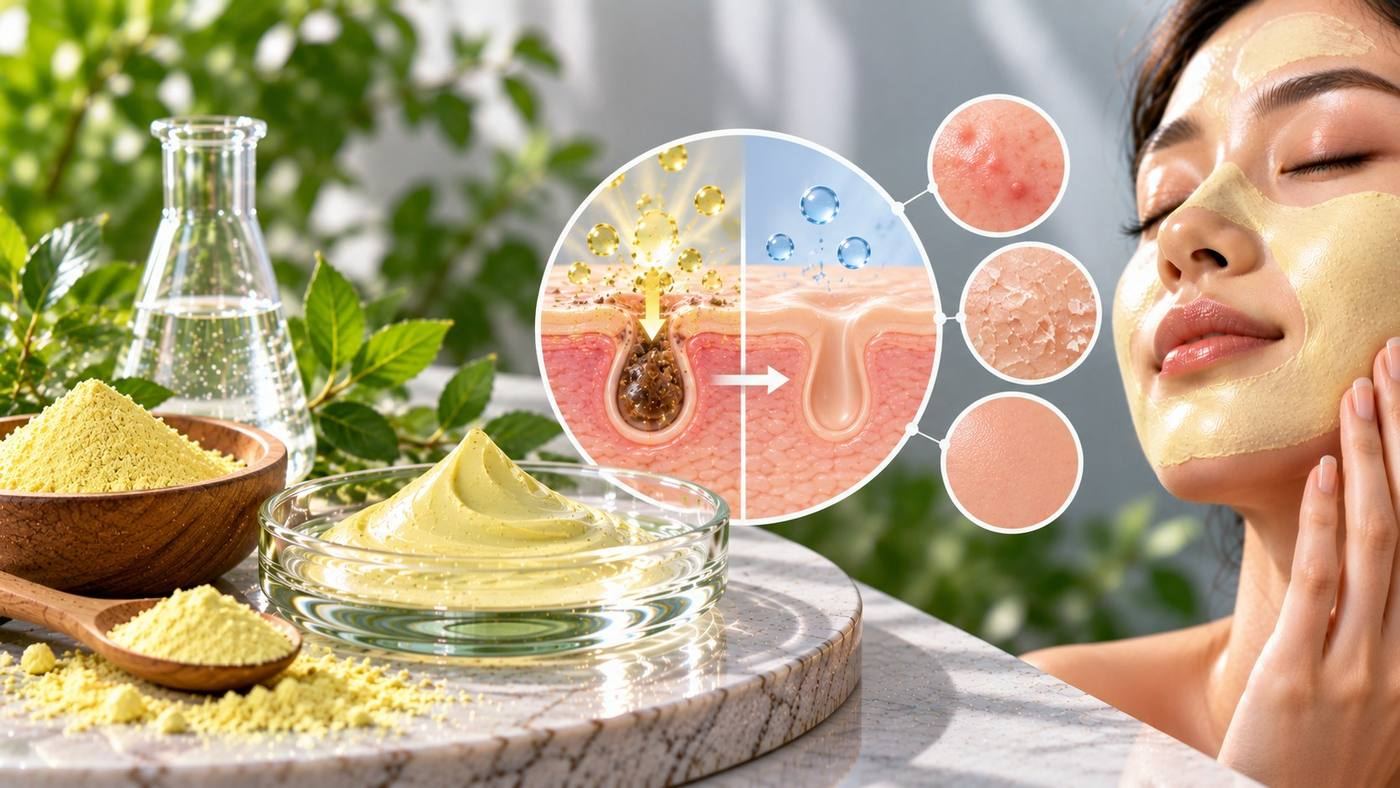
Sulphur is a non-metallic element that has been used on the skin for more than a century. A 2025 textbook chapter lists acne, rosacea, scabies and some fungal skin conditions among its traditional uses, and notes that its use has declined in modern practice. Today it appears mainly in spot treatments, masks, cleansers and anti-dandruff shampoos, often with salicylic acid or sodium sulfacetamide.
02What it does
Reviews describe sulphur as keratolytic (it helps loosen dead surface cells) with antibacterial, antifungal and antiparasitic effects, including against Demodex mites. In a controlled dandruff trial, 2% sulphur with 2% salicylic acid reduced scaling faster than either active alone. In face products it is almost always tested with 10% sodium sulfacetamide, so its own share of the visible benefit on blemishes and redness is not clear.
03The evidence
Studies below were checked against the publisher, DOI or journal record on 26 Sep 2026. We list design and size so you can judge the strength of each result.
| Study | Design | Who and how long | What it found |
|---|---|---|---|
| Torok et al. 2005, Cutis Source | Investigator-blinded, randomised, parallel-group trial against 0.75% metronidazole | 152 adults with rosacea at 6 sites, 12 weeks, 10% sodium sulfacetamide with 5% sulphur cream with sunscreens | Inflammatory lesions fell 80% vs 72% and redness improved 69% vs 45% with metronidazole; tolerance rated good to excellent in 85% vs 97%. |
| Leyden et al. 1987, Cutis Source | Double-blind, vehicle-controlled trial comparing combination and single actives | 48 adults with moderate to severe dandruff, 5 weeks, shampoos with 2% sulphur, 2% salicylic acid, both, or vehicle | The combination gave significantly greater and earlier reductions in scaling and shed skin-cell counts than either active alone or the vehicle. |
| Hochman and Schwartz 1988, Current Therapeutic Research (Elsevier) Source | Randomised, double-blind comparison of two strengths | 44 people with dandruff, 6 days (two washes), 5% sulphur with 3% salicylic acid vs 2% sulphur with 2% salicylic acid | The higher-strength shampoo gave significantly greater improvement in adherent dandruff after only two applications. |
| Trumbore et al. 2009, Journal of Drugs in Dermatology Source | Open-label case series, no control group | 8 adults with papulopustular rosacea, 10% sodium sulfacetamide with 5% sulphur emollient foam | Clinically significant improvement in severity, good tolerance and better reported quality of life. Very weak evidence: tiny and uncontrolled. |
| Wolf and Silapunt 2015, Cutis Source | Narrative review | Studies of sodium sulfacetamide alone and with sulphur in acne, rosacea and seborrhoeic dermatitis | Reports that twice-daily 10% sodium sulfacetamide with 5% sulphur for 12 weeks cut inflammatory acne lesions by 80.4% to 83%, and describes sulphur's action on Demodex mites. |
| Bubna 2025, Therapeutics in Dermatology (Springer Nature) Source | Textbook chapter (expert review) | Overview of sulphur's dermatological uses | Lists acne, rosacea, scabies and fungal infections as uses and notes safety in pregnancy and breastfeeding, while acknowledging that use has declined. |
Sulphur has a long track record but a thin, dated clinical evidence base. The best data support sulphur with salicylic acid for visible flaking, and sulphur with sodium sulfacetamide, a medicinal combination, for blemishes and redness. Cosmetic claims should stay modest, such as “helps reduce the look of blemishes” or “helps reduce visible flakes”, and rest on testing of the finished product.
04How CSL formulation scientists use it
- Shampoo trials used 2% to 5% sulphur with 2% to 3% salicylic acid, and the stronger pairing worked faster; the US OTC ranges are 2% to 5% for dandruff and 3% to 10% for acne.
- Sulphur does not dissolve in water, so it is used as a fine, well-suspended dispersion; particle size and suspending system affect feel, colour and settling, so CSL formulation scientists run real-time stability tests.
- Its odour and yellow colour need managing through fragrance, masking and pack choice, especially in leave-on spot products and masks.
- Sulphur can dry and irritate the skin; CSL formulation scientists add barrier-supporting ingredients and run tolerance tests. Elemental sulphur is not a sulfonamide (“sulfa”) drug, but products that pair it with sodium sulfacetamide are a different matter for people with sulfa allergy.
05Regulatory and claims
In the US, sulphur is an OTC drug active: 3% to 10% for acne, or 3% to 8% combined with 2% resorcinol or 3% resorcinol monoacetate (21 CFR 333.310), and 2% to 5% for dandruff (21 CFR 358.710). Products making these claims follow the monograph labelling rules. Outside the US, CSL regulatory specialists confirm the status in each target market and keep claims cosmetic: “helps reduce the look of blemishes”, not “treats acne”.
06Questions brands ask
Does sulphur work for spots?
There is some support, but most of it comes from older studies in which sulphur was combined with sodium sulfacetamide. One randomised rosacea trial found the combination cut inflamed bumps and redness as well as or better than metronidazole over 12 weeks. Evidence for sulphur on its own on the face is limited.
Is sulphur good for dandruff?
In a controlled 5-week trial, a shampoo with 2% sulphur and 2% salicylic acid reduced flaking faster than either ingredient alone. A small trial found a 5% sulphur and 3% salicylic acid shampoo worked faster than a 2% and 2% version.
Is sulphur a cosmetic or a drug ingredient?
It depends on the market and the claim. In the US, sulphur products for acne (3% to 10%) or dandruff (2% to 5%) are OTC drugs. CSL regulatory specialists check the rules in each target market.
07References
- Torok HM, Webster G, Dunlap FE, Egan N, Jarratt M, Stewart D. Combination sodium sulfacetamide 10% and sulfur 5% cream with sunscreens versus metronidazole 0.75% cream for rosacea. Cutis. 2005;75(6):357–363. Link
- Leyden JJ, McGinley KJ, Mills OH, Kyriakopoulos AA, Kligman AM. Effects of sulfur and salicylic acid in a shampoo base in the treatment of dandruff: a double-blind study using corneocyte counts and clinical grading. Cutis. 1987;39(6). Link
- Hochman HA, Schwartz SR. A comparison of two sulfur and salicylic acid shampoos in the treatment of dandruff. Curr Ther Res. 1988;44(6):1071–1075. Link
- Trumbore MW, Goldstein JA, Gurge RM. Treatment of papulopustular rosacea with sodium sulfacetamide 10%/sulfur 5% emollient foam. J Drugs Dermatol. 2009;8(3):299–304. Link
- Wolf K, Silapunt S. The use of sodium sulfacetamide in dermatology. Cutis. 2015 Aug;96:128 onwards. Link
- Bubna AK. Sulphur. In: Therapeutics in Dermatology: Essentials for Clinical Practice. Singapore: Springer; 2025:223–226. Link
- US Code of Federal Regulations. 21 CFR 333.310 Acne active ingredients. Link
- US Code of Federal Regulations. 21 CFR 358.710 Active ingredients for the control of dandruff, seborrheic dermatitis, or psoriasis. Link
Used in: Acne & oil control
Update log
- Evidence reviewed and page published by CSL scientists
This page summarises published research for brands and formulators. It is general information, not medical advice, and results in studies depend on the full formula tested.