Tranexamic acid: what the evidence shows for uneven skin tone
Topical tranexamic acid is a popular, gentle choice for dark patches and uneven tone. Here is what the trials show, how strong the evidence is, and how CSL formulation scientists use it in cosmetic products.
By CSL Formulation team · Evidence checked by CSL scientists
At a glance
- What it is
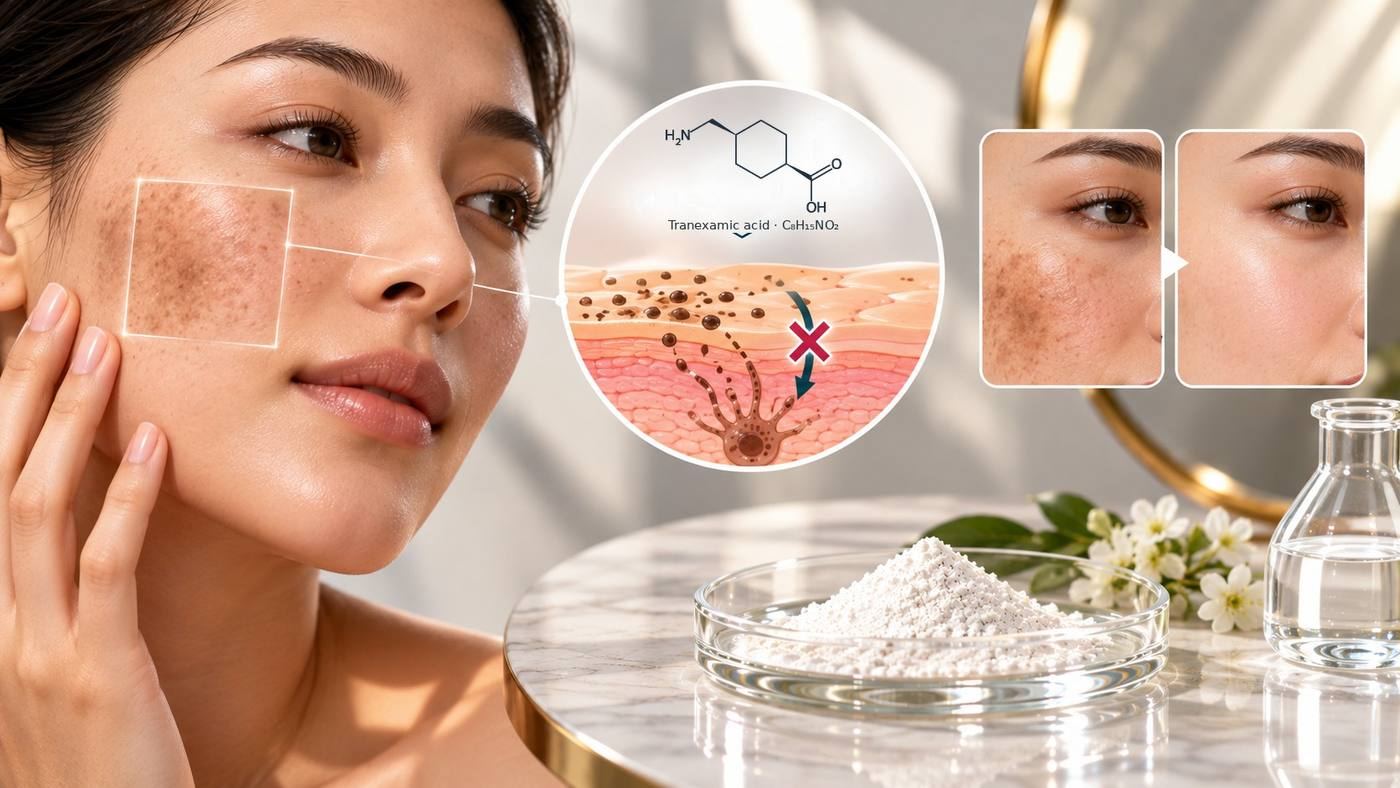
- A synthetic amino-acid derivative (trans-4-aminomethylcyclohexanecarboxylic acid), used in skin care as a water-soluble tone-evening active
- Main benefits
- More even-looking tone; less visible dark patches and post-blemish marks
- Levels tested in trials
- 2% to 5% in creams and solutions; 3% in a device-assisted essence
- Time to results
- About 12 weeks in controlled studies
- Watch for
- Mild redness or dryness in some users; oral and injected use is a medicine, not a cosmetic
01What is it?
Tranexamic acid was first developed as an oral medicine to reduce bleeding. At low levels in creams and serums it is used to even out skin tone. Tablets for melasma are prescribed or sold as medicines in some countries; this page covers only topical cosmetic use.
02What it does
Tranexamic acid blocks plasmin activity in the skin, which reduces the signals, such as prostaglandins, that keratinocytes send to pigment cells after UV exposure. It also appears to calm the blood-vessel component of patchy pigmentation. Over about three months this shows as lighter-looking patches and a more even tone.
03The evidence
Studies below were checked against the publisher, DOI or journal record on 26 Sep 2026. We list design and size so you can judge the strength of each result.
| Study | Design | Who and how long | What it found |
|---|---|---|---|
| Ghasemiyeh et al. 2025, Scientific Reports (Springer Nature) Source | Randomised, double-blind trial against 4% hydroquinone | 99 adults with melasma (77 completed), 3 months; 2% tranexamic acid with 2% niacinamide (niosomal) or 5% tranexamic acid with 4% niacinamide | Melasma scores fell by 67% and 62% with the two tranexamic acid creams, not significantly different from hydroquinone, which caused more side effects. |
| Guo et al. 2024, Drug Design, Development and Therapy (Dove Press) Source | Randomised, double-blind, placebo-controlled trial | 30 women with melasma (26 completed), 12 weeks, 3% tranexamic acid essence delivered by iontophoresis twice a week | Melasma scores fell more than with placebo and skin lightness rose (L value 61.3 to 63.3, p = 0.037); no side effects. The device-assisted delivery limits how far this applies to a leave-on product. |
| Liang et al. 2024, Journal of Cosmetic Dermatology (Wiley) Source | Systematic review and network meta-analysis | Randomised trials comparing oral, topical, injected and microneedled tranexamic acid | Oral use worked fastest (by week 4 versus week 8), but over longer treatment the benefit of tranexamic acid alone did not depend on how it was given. |
| Chen et al. 2024, Clinical, Cosmetic and Investigational Dermatology (Dove Press) Source | Narrative review of trials outside melasma | Includes a 12-week study of 5% tranexamic acid solution in 30 people with post-acne marks | Topical 5% tranexamic acid matched 20% azelaic acid for post-acne marks and was better tolerated in the first month. |
| Kim et al. 2017, Acta Dermato-Venereologica Source | Systematic review and meta-analysis | Oral, injected and topical tranexamic acid; topical subgroup of 2 studies using 2% to 3% for 3 to 7 months | Topical use reduced melasma scores but the pooled result was not statistically significant (p = 0.08); side effects were redness, irritation, dryness and scaling. |
| Atefi et al. 2017, Dermatology and Therapy (Springer Nature) Source | Randomised, double-blind trial against 2% hydroquinone | 60 women with melasma, 12 weeks, 5% tranexamic acid twice daily with SPF 30 | Melasma scores fell from 72.4 to 26.6, similar to hydroquinone; satisfaction was higher (33% vs 7% highly satisfied) and no side effects were seen versus 10% with hydroquinone. |
Topical tranexamic acid evens tone about as well as low-strength hydroquinone in small trials and is much better tolerated. But most studies are small, short and compare it with another active rather than a plain base, so the evidence is moderate. Suitable wording is “helps even out the look of skin tone” or “visibly reduces the look of dark patches”.
04How CSL formulation scientists use it
- Levels of 2% to 5% match what has been tested on skin; CSL formulation scientists claim only what the chosen level and format support.
- It is water-soluble and stable across a wide pH range, so it suits serums, essences and creams, and pairs well with niacinamide, vitamin C and sunscreens.
- Daily broad-spectrum sun protection belongs in any tone-evening routine; trials used sunscreen alongside the active.
- Oral and injected tranexamic acid are medicines with different risks; cosmetic products and claims must stay topical.
05Regulatory and claims
Status differs by market. In Japan tranexamic acid is an approved whitening active for quasi-drug (medicated cosmetic) products, and oral tranexamic acid is sold there as an over-the-counter medicine for melasma. China lists it among its recognised whitening agents, and Taiwan sets a 2% to 3% maximum. CSL regulatory specialists confirm the status in each target market, including the EU, and keep claims cosmetic: “more even-looking tone”, never “treats melasma”.
06Questions brands ask
Is topical tranexamic acid the same as the tablets?
No. Tablets are a medicine with systemic effects and need medical advice. Creams and serums use low levels on the skin and are a cosmetic use with a different, milder safety profile.
Is it as good as hydroquinone?
In small trials, 5% tranexamic acid gave similar results to 2% to 4% hydroquinone over about three months, with fewer side effects. Larger, vehicle-controlled trials are still needed.
Can it be combined with other brightening actives?
Yes. Recent trials pair it with niacinamide, and it is often combined with vitamin C. These act at different steps of pigment formation.
07References
- Ghasemiyeh P, Fazelzadeh Haghighi N, Dastgheib L, Ranjbar S, Mohammadi-Samani S. Safety and efficacy of niosomal and conventional tranexamic acid/niacinamide vs. hydroquinone creams in melasma: a randomized, double-blind, case-controlled clinical trial. Sci Rep. 2025;15:42739. Link
- Guo L, Liu X, Liu Q, Xie X, Jiang X. Treatment of melasma with tranexamic acid essence combined with iontophoresis: a randomized, double-blind, placebo-controlled clinical trial. Drug Des Devel Ther. 2024;18:3659–3666. Link
- Liang R, Luo H, Pan W, Yang S, et al. Comparative efficacy and safety of tranexamic acid for melasma by different administration methods: a systematic review and network meta-analysis. J Cosmet Dermatol. 2024;23(13). Link
- Chen T, Xue J, Wang Q. Tranexamic acid for treatment of hyperpigmentation and telangiectatic disorders other than melasma: an update. Clin Cosmet Investig Dermatol. 2024;17:2151–2163. Link
- Kim HJ, Moon SH, Cho SH, Lee JD, Kim HS. Efficacy and safety of tranexamic acid in melasma: a meta-analysis and systematic review. Acta Derm Venereol. 2017;97(7). Link
- Atefi N, Dalvand B, Ghassemi M, et al. Therapeutic effects of topical tranexamic acid in comparison with hydroquinone in treatment of women with melasma. Dermatol Ther (Heidelb). 2017;7:417–424. Link
- Maeda K. Mechanism of action of topical tranexamic acid in the treatment of melasma and sun-induced skin hyperpigmentation. Cosmetics (MDPI). 2022;9(5):108. Link
- ChemLinked. Permitted freckle-removing and whitening ingredients in cosmetics in major countries/regions worldwide (regulatory summary). Link
Used in: Hyperpigmentation & even tone
Update log
- Evidence reviewed and page published by CSL scientists
This page summarises published research for brands and formulators. It is general information, not medical advice, and results in studies depend on the full formula tested.