Competitor benchmarking: how to test your product against the market leader
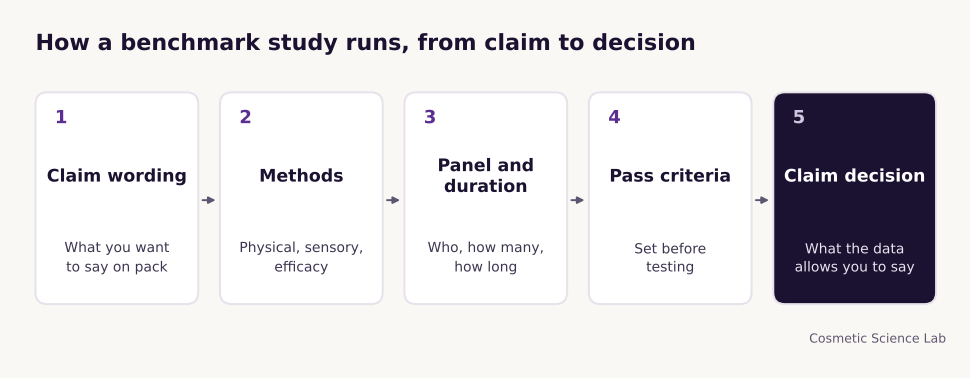
Competitor product analysis tells you where your formula wins, matches or falls short, and which claims you can make about it. This guide walks through a benchmark study step by step: claim wording, the methods to use, panel size and duration, pass criteria, and what each result lets you say on pack.
By Dr. Premalatha, Ph.D., Life Science, Regulatory Consultant, Cosmetic Science Lab

Quick answer
- How do you benchmark a cosmetic against the market leader? Write the claim first, then test both products side by side on physical, sensory and efficacy measures, with pass criteria set in advance.
- The claim decides every method, panel and pass criterion that follows.
- Claim only what the data supports, and keep comparative claims objective and fair [2].
Take-home message for brand owners
- Write the claim before you test
- It is the cheapest way to avoid a study that cannot support what marketing needs
Take-home message for formulators
- Treat the gap map as a brief
- Physical and sensory gaps usually point straight to the ingredients to change
01Start with the claim wording
Most competitive analysis starts with market research: who leads the target market and why. Competitor product analysis goes further, and it should start with the sentence you want on pack. "Hydrates as well as the leading brand" and "absorbs faster than the leading brand" need different tests.
In the EU, Regulation (EU) No 655/2013 sets common criteria for cosmetic claims, including that claims are supported by adequate and verifiable evidence, from studies that are relevant to the product and the benefit claimed and use valid, reliable and reproducible methods [1]. The Commission's technical document on claims adds that claims should be objective, should not denigrate competitors and should not create confusion with a competitor's product [2]. Fix the exact wording first, then design the study to prove it.
02What to measure in a benchmark study
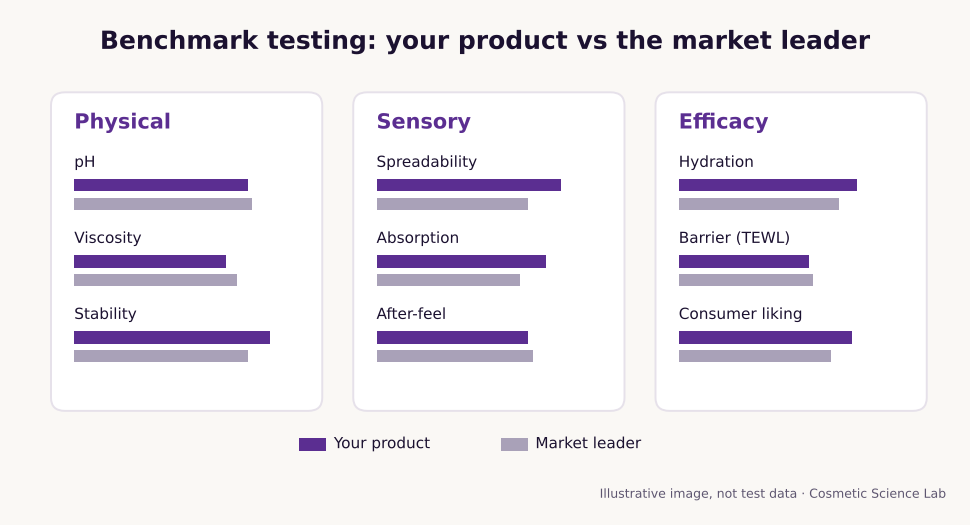
Good benchmark testing for cosmetics combines instrumental measurements with human judgement, across three layers.
| Layer | What to measure | Typical method | What it tells you |
|---|---|---|---|
| Physical | pH, viscosity, appearance, stability at 25 °C and 40 °C | pH meter, rotational viscometer, stability storage | Whether the products are built alike |
| Sensory | Spreadability, absorption, tackiness, after-feel | Trained panel sensory profile [3] | How the products feel, attribute by attribute |
| Efficacy, instrumental | Skin hydration, TEWL, firmness | Corneometer and other skin probes [4] | Measured performance on skin |
| Efficacy, perceived | Liking, perceived benefit, purchase intent | Consumer panel questionnaire | What real users notice |
For the sensory layer, ISO 13299 gives general guidance for building a sensory profile, and lists comparing a product with a reference product or with similar products on the market among its uses [3].
03How to run side-by-side testing
- Buy the references. Use retail batches of the market leader, recording batch codes and expiry dates.
- Blind and code the samples. Decant into identical packs so neither panel nor technician knows which is which.
- Randomise application. Use split-face, split-arm or randomised order so each person tests both products.
- Measure baseline and time points. Record readings before application and at fixed times after, under controlled room conditions.
- Analyse with statistics. Use a test that fits the design, such as a paired comparison for split-face data, and do not read more into the result than the test supports [2].
04Panel size and duration
EU guidance asks for a statistically representative sample of the target population, defined by strict inclusion and exclusion criteria [2]. The table shows typical starting points; the final number comes from a power calculation.
| Study type | Typical panel | Typical duration | Note |
|---|---|---|---|
| Instrumental (corneometer, TEWL) | 20–30 subjects | Single application with readings over hours, or 2–4 weeks | Train operators and standardise methods |
| Trained sensory profile | 10–15 trained assessors | 1–2 sessions per product | Same attribute list for every product |
| Consumer panel | 50–100+ target users | 2–4 weeks of home use | Match the target market |
Instrument readings depend on who takes them. A 2025 study of corneometry found coefficients of variation mostly below 10%, with higher variability between observers, so train operators and keep one method throughout [4].
05Pass criteria: how to read the gap
Decide before testing what counts as a win. A clear pass rule protects your decisions from wishful reading of results.
- Superiority: your product is statistically better on the chosen measure.
- Parity: no meaningful difference, within a margin you defined in advance.
- Physical match: pH and viscosity within your specification of the leader's values.
A gap on one layer is useful too: it tells product management exactly where to reformulate to build a competitive advantage.
06Which claim each result allows
| Result | Claim it can support | Claim it cannot support |
|---|---|---|
| Hydration significantly higher than the leader | "More hydrating than the leading brand" | "Best moisturiser on the market" |
| No significant difference in hydration | "Hydrates as well as the leading brand" | "Better than the leading brand" |
| Consumer panel prefers your product | "Preferred by [your result]% of users tested" | Any instrumental performance claim |
| Sensory profile shows faster absorption | "Absorbs faster than the leading brand" | "Works faster" |
07What drives cost and time
- Number of products and references in the study.
- Which layers you test: physical tests are quickest; consumer panels take longest.
- Panel size and recruitment criteria, such as dry or sensitive skin.
- Study length and number of time points.
- Reporting needs: an internal gap map or a full claims dossier.
Benchmarking works best alongside reverse engineering: the test shows where the gap is, and deformulation shows why. Read our case study benchmarking a client's new range against the market, where three products were benchmarked against market references without animal testing.
08Questions readers ask
What is competitor product analysis in cosmetics?
A side-by-side test of your product against a market reference on physical, sensory and efficacy measures, used to find gaps and support claims.
Can I name the competitor in my claim?
Comparative claims must be objective and must not denigrate the competitor. Many brands use "the leading brand" and take legal advice before naming one.
How many people do I need for a benchmark test?
Enough to be statistically representative of your target users; Table 2 gives typical starting points, and a power calculation sets the final number.
Is a benchmark study the same as deformulation?
No. Benchmarking measures performance; deformulation identifies what is in the formula. Used together, they explain the gap. See are skincare dupes the same formula?
Planning a benchmark against a market leader?
Tell us your product, the reference and the claim you want, and we will design the study.
09References
- Commission Regulation (EU) No 655/2013 of 10 July 2013 laying down common criteria for the justification of claims used in relation to cosmetic products. OJ L 190, 11.7.2013, p. 31. EUR-Lex
- European Commission (DG GROW). Technical document on cosmetic claims, agreed by the Sub-Working Group on Claims. Version of 3 July 2017. European Commission
- ISO 13299:2016. Sensory analysis — Methodology — General guidance for establishing a sensory profile. Geneva: ISO; 2016. ISO
- Aiello LM, Vergílio MM, Monteiro e Silva SA, Leonardi GR. Evaluation of operational parameters for clinical evaluation of skin hydration by corneometry method. Braz J Pharm Sci. 2025;61:e23182. doi:10.1590/s2175-97902025e23182. DOI
Update log
- Published by Cosmetic Science Lab
This article is general technical information, not legal, regulatory or medical advice. Confirm requirements for your product and market before launch.