How to choose analytical methods at each stage of cosmetic formulation development
Your lab owns an HPLC, so every question becomes an HPLC question, while the emulsion keeps thinning and nobody has run a flow curve. Choosing methods by the instruments on hand is the most common selection error. Start with the formulation question instead.
By CSL Analytical and formulation teams, Cosmetic Science Lab · Reviewed by Dr. Premalatha, Ph.D., Life Science, Regulatory Consultant

- Part 1What each analytical method measures
- Part 2How to choose the right method at each stage (this article)
Quick answer
- Trace every test from a formulation question, through a method and measurement, to a specific decision.
- Stages 1 to 3 (intake, prototype, stability) change the formula. Stages 4 and 5 confirm it.
- Use entry-level methods in-house and step up to advanced methods only when a decision needs them [1].
01Start with the question, not the instrument
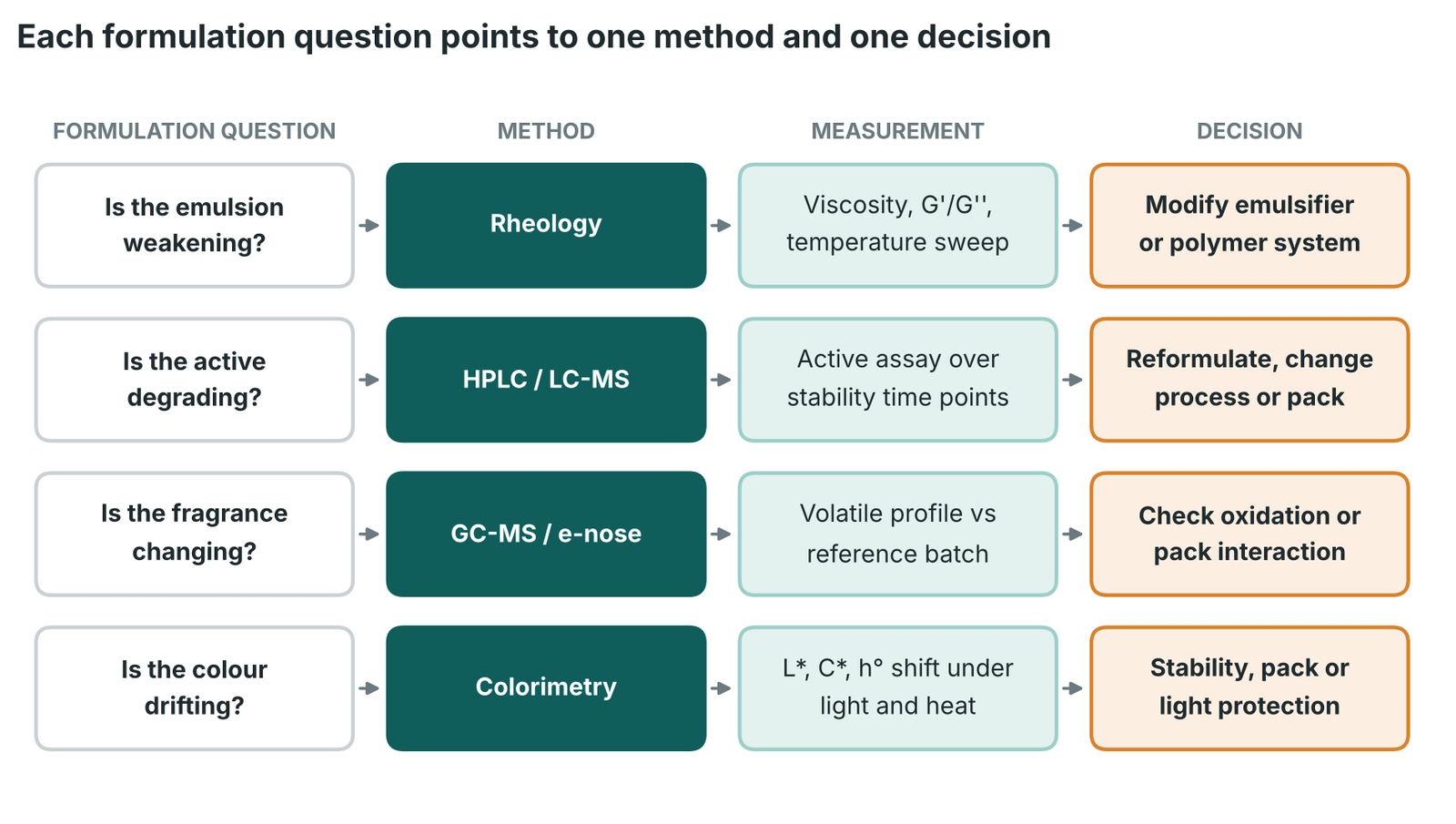
A 2024 review groups cosmetic analytics into five categories and stresses that the right method depends on the product matrix [1]. Figure 1 maps four common problems to the method, measurement and decision each one points to. A weakening emulsion calls for rheology. A degrading active calls for HPLC or LC-MS. A shifting fragrance calls for GC-MS or an electronic nose, and drifting colour calls for colorimetry [1], [6].
Before booking any test, write down the decision it will inform. If no decision changes with the result, the test is reporting, not formulation.
02Which analytical method at which stage
| Stage | Question | Primary methods | Output |
|---|---|---|---|
| 1. Raw-material intake | Is this lot what the supplier claims? | HPLC, LC-MS/MS, GC-MS | Identity, purity, impurities [1] |
| 2. Prototype design | Will this emulsifier and polymer system hold? | Rheology, interfacial tension, droplet sizing | Flow curve, G′/G″ balance [1], [7] |
| 3. Stability screening | Which prototype survives stress? | Centrifugation, zeta potential, colorimetry | Separation rate, colour shift [4], [6] |
| 4. Scale-up | Does the plant batch match the lab? | Rheology, HPLC assay, e-nose | Batch match to reference |
| 5. Release | Is the batch safe and compliant? | Qualified assays, real-time stability | Certificate of analysis [2], [3] |
For emulsion stability, stages 2 and 3 matter most: droplet size and viscosity set early decide how a product ages [6], [7]. Part 1 explains what each of these methods measures.
03Sample preparation for complex cosmetic matrices
A cream is not a clean solution. Oils, pigments and polymers interfere with measurement, so preparation is part of choosing the method [1], [6]. Common routes before chromatography include [1]:
- Emulsion breaking: ethanol or methanol, sometimes with low pH or heat, before analysing UV filters.
- Solid-phase extraction (SPE): pulls target compounds out of the matrix.
- Microextraction: ultrasound-assisted or dispersive methods for preservatives such as parabens.
How to fix it: validate the method for each new matrix. A method built for a serum rarely transfers to a sunscreen unchanged, and zeta potential dilution can alter the structure being measured [1].
04A cost-performance framework for lab methods
The review compares methods on cost, specificity, ease of use and precision [1]. LC-MS/MS is highly specific but scores lower on cost and ease of use; HPLC with UV or DAD detection suits routine industrial work [1].
| Need | Entry option | Advanced option | Step up when |
|---|---|---|---|
| Ingredient assay | HPLC-UV or DAD | LC-MS/MS | Unknown impurities or trace levels [1] |
| Fragrance control | Electronic nose | GC-MS with olfactometry | Off-notes must be identified [1] |
| Flow and texture | Viscometer | Rotational rheometer | Structure or elasticity matters [7] |
| Stability screening | Microscopy checks | Centrifugation, zeta potential | Many prototypes to rank [6] |
| Colour | Visual panel | Spectrophotometric colorimetry | Colour needs a numeric spec [1] |
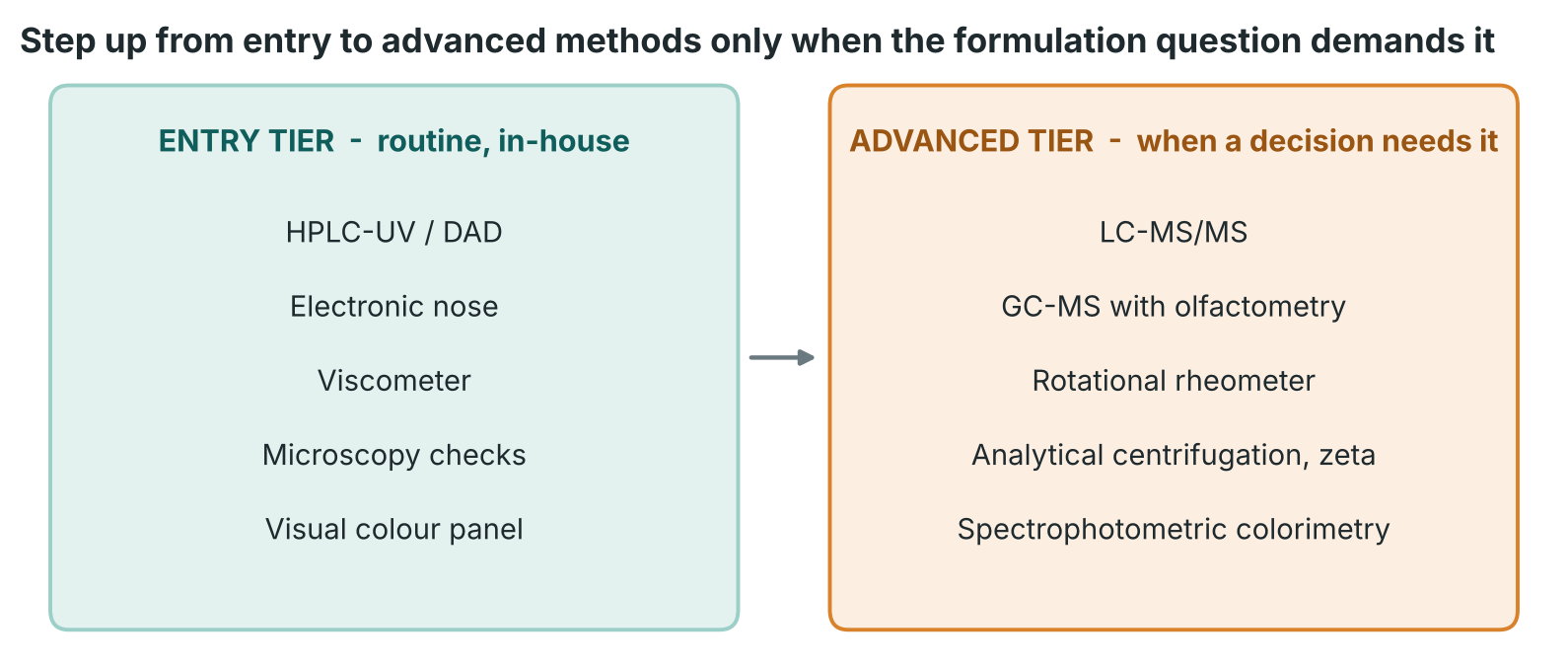
Tiers are relative, not price quotes. Most brands run entry methods in-house and use a partner lab such as our testing team when a decision needs advanced data. That keeps routine checks fast without giving up depth when it counts.
05Regulatory analytics: what the EU safety file needs
EU law requires a Product Information File and a Cosmetic Product Safety Report for every product [2]. Much of that report depends on analytical data, and manufacturing must follow good manufacturing practice (Article 8), which ISO 22716 is used to demonstrate [2], [3].
| Requirement | Source | Analytical evidence |
|---|---|---|
| Composition | Reg. 1223/2009, Annex I [2] | Chromatographic assay of actives and preservatives |
| Physical/chemical properties and stability | Reg. 1223/2009, Annex I [2] | Rheology, droplet size, colour and stability data [4], [5] |
| Fragrance allergen labelling | Reg. 1223/2009, Annex III, as amended by Reg. (EU) 2023/1545 [2], [8] | GC-MS quantification of regulated allergens [1] |
| Controlled production | Article 8; ISO 22716 [3] | Qualified methods, batch records, lab controls |
Regulation (EU) 2023/1545 adds new fragrance allergens to the labelling list. It applies to products newly placed on the market from 31 July 2026 and to all products on the market from 31 July 2028, so GC-MS allergen methods need updating now.
Planned during development, this data builds the safety file alongside the formula. Retrofitted after a regulatory query, it costs time, samples and often a reformulation. Our regulatory team plans the dossier from the first prototype.
06Five common mistakes in selecting analytical methods
- Testing only at release: the formula is fixed, so a failure means costly rework.
- Defaulting to the most advanced instrument: LC-MS/MS adds cost when HPLC-UV can answer the question [1].
- Reusing one method across products: each matrix needs its own preparation and validation [1].
- Measuring without a decision: a test that changes nothing in the formula, process or pack is reporting, not development.
07Inside CSL's integrated analytical workflow
Complete characterisation needs nano, micro and macro data together [1]. CSL matches each method to the question it answers, not to the instrument that happens to be free. Results are reviewed at each stage gate, so a weak prototype is dropped before it reaches scale-up.
- Upstream
Intake chromatography and interfacial screening shape the formula.
- Midstream
Rheology and accelerated stability rank prototypes.
- Downstream
Colorimetry, fragrance analytics and qualified QC methods confirm batches.
08Questions readers ask
Should a small brand buy LC-MS/MS?
Rarely. Most routine assays run on HPLC-UV; send advanced work to a partner lab when a decision needs it.
Which tests does an EU safety report need?
Data on composition, physical and chemical characteristics, stability, microbiological quality and impurities, supported by reliable analytical evidence, under Annex I of Regulation (EC) No 1223/2009.
When should stability testing start?
At prototype stage. Accelerated screening ranks candidates early, then real-time studies confirm shelf life.
How do I validate a method for a new product?
Re-check sample preparation, accuracy and recovery in the new matrix before relying on results, even if the method worked on a similar product.
Not sure which tests your product needs?
Tell us the product and the decision you need to make. We plan the method set by stage and cost tier, and build the safety-file data as we go.
09References
- Rico F, Mazabel A, Egurrola G, Pulido J, Barrios N, Marquez R, García J. Meta-analysis and analytical methods in cosmetics formulation: a review. Cosmetics, 2024; 11(1): 1. doi:10.3390/cosmetics11010001
- Regulation (EC) No 1223/2009 of the European Parliament and of the Council of 30 November 2009 on cosmetic products (consolidated). EUR-Lex
- ISO 22716:2007 Cosmetics — Good Manufacturing Practices (GMP) — Guidelines on Good Manufacturing Practices. ISO
- Colipa (now Cosmetics Europe) and CTFA. Guidelines on stability testing of cosmetic products. March 2004. Cosmetics Europe PDF
- ISO/TR 18811:2018 Cosmetics — Guidelines on the stability testing of cosmetic products. ISO
- McClements DJ. Critical review of techniques and methodologies for characterization of emulsion stability. Critical Reviews in Food Science and Nutrition, 2007; 47(7): 611–649. PubMed
- Tadros TF. Rheology of Dispersions: Principles and Applications. Weinheim: Wiley-VCH, 2010. Wiley-VCH
- Commission Regulation (EU) 2023/1545 of 26 July 2023 amending Regulation (EC) No 1223/2009 as regards labelling of fragrance allergens in cosmetic products. EUR-Lex
Update log
- Published by Cosmetic Science Lab
This article is general technical information, not legal or regulatory advice. Confirm requirements for your product and market before launch.