Three international cosmetic safety actions Indian brands should study, and the supply-chain lessons they teach
Mercury in European skin-lightening products, 89 cosmetic batches refused at the US border, and unregistered whitening creams flagged by CDSCO. What each authority found, what it did, and what Indian brands should change in their supply chain.
By CSL Regulatory affairs team, Cosmetic Science Lab · Reviewed by Dr. Premalatha, Ph.D., Life Science, Regulatory Consultant

Alert summary
- Authorities
- EU national authorities (Safety Gate); US FDA; CDSCO (DCGI)
- Period
- January 2025 to September 2026
- Hazards
- Mercury, hydroquinone, BMHCA (Lilial), heavy metals, unapproved drug claims
- Measures
- Withdrawal, recall, border rejection, import refusal, public notice, seizure
- Who should act
- Indian brands exporting to the EU or US, or using imported raw materials
Quick answer
Three recent actions point to one pattern. EU authorities stopped mercury, hydroquinone and Lilial (BMHCA) products in a single month [1]; the US FDA refused 89 cosmetic batches in January 2025, with India the largest source [2]; and CDSCO warned against two imported whitening creams with excessive heavy metals and no import registration [3]. Each failure traces back to raw materials, suppliers, claims or paperwork that nobody checked.
Take-home message for exporters
- Screen high-risk raw materials before production, not after a refusal
- Check every claim against the destination market
- Keep lot-level traceability so a recall takes hours, not days
Take-home message for importers and traders
- Confirm the Indian import registration of every finished product
- Ask fragrance houses for lot-specific declarations
- Treat a price far below market as a reason to test
01Three international cosmetic safety actions
Cosmetic safety actions, from EU Safety Gate alerts to US import refusals, are usually reported as isolated news. Read together, three recent cases from the EU, the US and India show one pattern. Prohibited substances, contamination and missing registrations survive into finished products when raw materials and suppliers are not controlled. Indian brands share many of the same raw-material sources, so these cases work as a free stress test of your own supply chain.
02Case 1: EU Safety Gate, September 2025
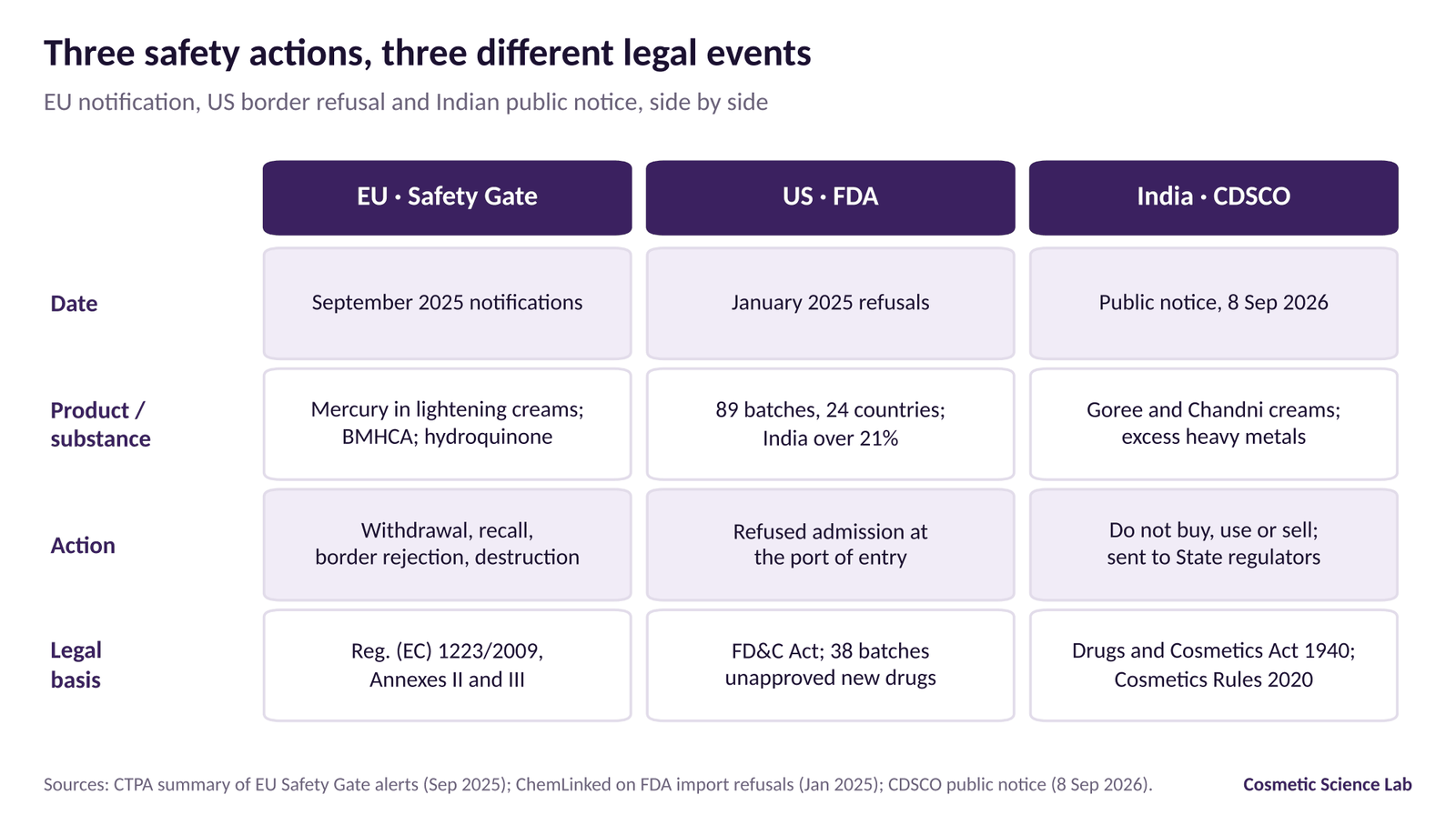
In a single month, EU authorities notified mercury-containing skin-lightening products from France, Germany, Sweden and Northern Ireland. Lilial (BMHCA) appeared in hair dyes, hairspray, conditioner, creams, body sprays and perfumes notified by Czechia, France, Hungary and Ireland. Sweden and Northern Ireland rejected hydroquinone lightening creams at the border, and Sweden a tanning cream. The same month also brought lead in a Hungarian make-up set, arsenic in an Irish eyeshadow palette and dibutyl phthalate in a German hair wax [1].
Action and legal basis. Products were withdrawn, recalled from end users, destroyed or rejected at the border [1]. The EU Cosmetics Regulation prohibits mercury and BMHCA in Annex II, and prohibits hydroquinone in Annex II except in professional artificial nail systems (Annex III) [4], [5]. No concentrations were published in the alert summaries.
03Case 2: US FDA import refusals, January 2025
In January 2025, the FDA refused 89 imported cosmetic batches from 24 countries. India accounted for over 21%, the largest share. Make-up made up 35.96% of refused batches and skin care 26.97% [2].
Why they were refused. The leading reason was misclassification: 38 batches were treated as unapproved new drugs, with labelling and colour-additive violations also cited [2]. Foreign cosmetics that appear adulterated or misbranded can be refused entry at the port [6]. A skin-lightening claim, for example, makes a product a drug: every over-the-counter skin lightener needs an FDA-approved new drug application [7].
For an Indian exporter, a refusal is expensive. The goods cannot be sold in the US, so the shipment is re-exported or destroyed at the importer's cost, and the buyer relationship takes the hit. Most of these refusals trace back to a claim, label or colour decision made months earlier in India.
04Case 3: India CDSCO public notice, September 2026
On 8 September 2026, the Drugs Controller General (India) issued a public health alert on Goree Beauty Cream and Chandni Whitening Cream, both labelled "Made in Pakistan". Testing found excessive heavy metals, and neither product had a registration certificate for import. The notice cites the Drugs and Cosmetics Act, 1940 and the Cosmetics Rules, 2020, and went to all State and UT Drugs Controllers and to CDSCO's zonal and port offices [3]. The specific metals and levels were not published.
"…excessive heavy metals beyond the specified limits which may pose health risk to the consumers including toxic effects."
CDSCO public health alert, 8 September 2026 [3]
Enforcement followed. On 30 September 2026, Hyderabad police working with CDSCO seized skin-whitening creams and soaps worth about Rs 7 lakh, and registered two cases under the Bharatiya Nyaya Sanhita and the Drugs and Cosmetics Act [8]. Our fairness to brightening analysis explains where cosmetic claims cross into drug territory in India.
05Notification, withdrawal, recall, border rejection, enforcement
These words describe different legal events. Mixing them up misstates the risk to customers and buyers.
| Term | What it means | Example from these cases |
|---|---|---|
| Safety Gate notification | An EU alert shared between authorities; it records whichever measure was taken | All September 2025 EU entries |
| Market withdrawal | Stopping a product in the supply chain from being made available on the market | BMHCA perfume, Ireland |
| Recall | Return of a product already made available to consumers | Mercury lightening creams, Germany |
| Border rejection / import refusal | Entry refused at import | Hydroquinone creams, Sweden; 89 FDA batches |
| Enforcement action | A legal measure by an authority, such as a seizure or prosecution | Hyderabad seizure, September 2026 |
Withdrawal and recall as defined in Article 3 of the EU General Product Safety Regulation [9].
06Why banned substances reach finished products
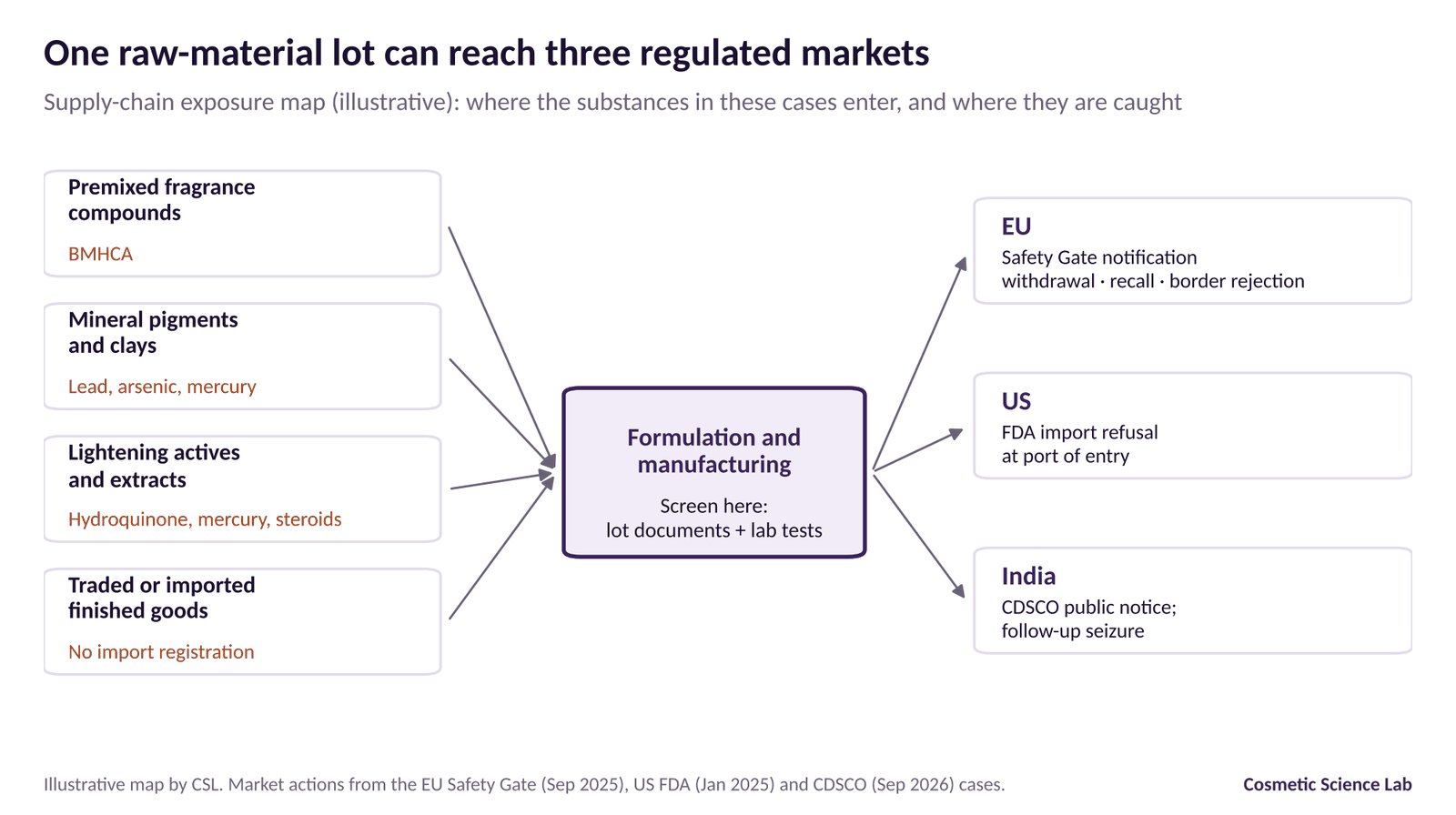
Banned substances rarely enter by design. In CSL's view, they arrive through four common gaps: a raw material whose specification does not list them, a supplier who changes source without notice, a contract manufacturer reusing an old formula, and a trader reselling grey-market stock. Each gap is an assumption that nobody tested.
07The fragrance compound problem
BMHCA has been prohibited in EU cosmetics since 1 March 2022 [5], yet almost eight in ten EU cosmetic alerts in 2025 related to it [10]. Fragrances are bought as premixed compounds with confidential formulas, so a brand sees only "parfum" unless it demands a full declaration for every lot.
Closing the gap is straightforward. Ask the fragrance house for a lot-specific declaration that names butylphenyl methylpropional as absent, and match it to the compound code on the delivery note. For a new supplier, a non-EU source or incomplete papers, add a targeted GC-MS screen before the compound enters production.
08What this means for Indian exporters
One failed shipment can mean a refused batch, a public alert in the importing country and closer checks on later consignments. In the US, MoCRA adds facility registration, product listing, serious adverse event reporting within 15 business days, and FDA authority to order a mandatory recall [11]. Compliance now has to be designed into the product, not added at the port. Our MoCRA guide for brands outside the US sets out each obligation in order.
Exporting to the EU or US?
Check your formulas and claims before the shipment leaves. Talk to our regulatory team →
09What to fix first
CSL recommendation: screen by risk, not by habit. Test pigments, minerals and botanical extracts for mercury, lead and arsenic by ICP-MS; fragrance compounds for BMHCA by GC-MS; lightening actives for hydroquinone by HPLC; and run microbiology on every finished batch. Then make three controls routine:
- Qualify suppliers on documents, then verify
A certificate of analysis per lot, a no-prohibited-substances declaration per market, full fragrance allergen disclosure and a duty to notify any change of source.
- Test the first three lots from any new supplier in full
Use an ISO/IEC 17025-accredited laboratory for results you may need to show a regulator or buyer.
- Stay recall-ready
Trace every finished batch to its raw-material lots and customers, keep retained samples, and run a mock recall each year.
Our pre-production screening checklist sets out each test, method and legal limit by market, with a five-step workflow.
10How CSL helps
CSL's regulatory and analytical teams work with Indian brands at each point where these cases failed. We screen raw materials for banned substances, audit supplier documentation, review claims for each export market, and assess recall readiness for the EU, US and India. The aim is simple: your product should pass the checks that stopped these ones, before it leaves the factory.
11Questions readers ask
What is an EU Safety Gate alert?
Safety Gate is the EU rapid alert system for dangerous non-food products. National authorities notify products they have stopped, and each entry records the measure taken, such as a withdrawal, recall or border rejection.
Why were Indian cosmetics refused by the US FDA?
In January 2025, the most common reason for refusing imported cosmetics was misclassification: 38 of 89 batches were treated as unapproved new drugs, usually because of their claims. Labelling and colour-additive violations were also cited.
What did CDSCO warn about in September 2026?
On 8 September 2026, CDSCO issued a public health alert against Goree Beauty Cream and Chandni Whitening Cream, labelled "Made in Pakistan", which contained excessive heavy metals and had no registration certificate for import into India.
Is Lilial (BMHCA) banned in cosmetics?
Yes, in the EU. Butylphenyl methylpropional (BMHCA, Lilial) has been listed in Annex II of the Cosmetics Regulation since 1 March 2022, so it may not be used in cosmetics placed on the EU market.
Is your supply chain export-ready?
From raw-material screening to export-ready formulas, our regulatory and analytical teams help Indian brands pass the checks that stopped these products.
12References
- CTPA. EU Safety Gate alerts, September 2025 (summary of Safety Gate cosmetic notifications). 23 October 2025. CTPA
- ChemLinked. U.S. FDA import refusal reports (January 2025 section: 89 batches of imported cosmetics rejected). ChemLinked
- CDSCO (DCGI). Public health alert against the use of unauthorised cosmetics products. Public notice, 8 September 2026. CDSCO (PDF)
- Regulation (EC) No 1223/2009 on cosmetic products, Annexes II and III, as amended. EUR-Lex
- Commission Regulation (EU) 2021/1902 amending Annexes II, III and V to Regulation (EC) No 1223/2009 (CMR substances, including butylphenyl methylpropional, Annex II/1666; applies from 1 March 2022). EUR-Lex
- US FDA. Cosmetics importers. FDA
- US FDA. FDA works to protect consumers from potentially harmful OTC skin lightening products. 19 April 2022. FDA
- Deccan Chronicle (PTI). Unauthorised Pak-origin cosmetic products seized in Hyderabad. 1 October 2026. Deccan Chronicle
- Regulation (EU) 2023/988 on general product safety, Article 3(25) and 3(26). EUR-Lex
- European Commission. Commission's 2025 Safety Gate report shows increased action against dangerous products. 5 March 2026. European Commission
- US FDA. Modernization of Cosmetics Regulation Act of 2022 (MoCRA). FDA
Update log
- Published by Cosmetic Science Lab
This article is general technical information, not legal or regulatory advice. Confirm requirements for your product and market before launch.