Mercury, hydroquinone and Lilial: a pre-production screening checklist for Indian cosmetic brands
The same banned substances keep turning up in finished cosmetics stopped by regulators in the EU, the US and India. This checklist shows what to test before the next batch: which raw materials, which method, and which legal limit.
By CSL Regulatory affairs team, Cosmetic Science Lab · Reviewed by Dr. Premalatha, Ph.D., Life Science, Regulatory Consultant

Screening summary
- Substances
- Mercury, lead, arsenic, hydroquinone, Lilial (BMHCA), corticosteroids, microbes
- Methods
- ICP-MS, GC-MS, HPLC, LC-MS/MS, microbiology
- High-risk inputs
- Mineral pigments, fragrance compounds, lightening actives, traded goods
- Based on
- EU Safety Gate (2025), US FDA refusals (2025), CDSCO notice (2026)
- Who should act
- Purchasing, QA and regulatory teams at Indian cosmetic brands
Quick answer
Screen the three or four high-risk raw materials in each formula before production: pigments and clays for heavy metals by ICP-MS, fragrance compounds for Lilial by GC-MS, lightening actives for hydroquinone and steroids by HPLC or LC-MS/MS, and water-based products for microbes. These are the substances behind recent EU alerts [1], US import refusals [2] and a CDSCO public notice [3].
Take-home message for QA teams
- Test the high-risk materials, not every material
- Sample the delivered drum, not the supplier's retained sample
- Ask for method, limit of quantification and uncertainty on every report
Take-home message for purchasing
- No certificate of analysis per lot, no approval
- A price far below the market is a reason to test
- Imported goods need an Indian import registration
01Why screen before production
In September 2025 alone, EU authorities notified mercury in skin-lightening products from four markets, the banned fragrance ingredient Lilial (BMHCA) in perfumes and hair products, and hydroquinone in creams stopped at the border [1]. In January 2025, India was the largest source of cosmetic batches refused by the US FDA, with over 21% of 89 refusals [2]. On 8 September 2026, CDSCO warned against two imported whitening creams with excessive heavy metals and no import registration [3].
Every one of these products passed through purchasing, formulation and release. A pre-production screen is the cheapest point to stop them. A failed lot costs a supplier conversation. A failed product costs a recall, a refused shipment or a public alert, and the buyer trust that goes with it.
What the three cases tell you. Each points to a different weak spot. The EU alerts show that banned substances hide in specific inputs: lightening actives, pigments and fragrance compounds. The US refusals show that a claim can be as risky as an ingredient. The CDSCO notice shows that traded and imported goods need the same scrutiny as your own formulas, starting with their registration papers. Our analysis of the three cases covers what each authority found and did.
02The screening checklist
Each row links a risk to where it hides, the test that finds it, and the legal limit in each market. Use it to brief purchasing and QA teams, and as the agenda for every supplier audit.
| Risk | Where it hides | Test method | Limit and legal basis |
|---|---|---|---|
| Mercury | Imported skin-lightening products, pigments, clays, botanical extracts | ICP-MS | EU: prohibited (Annex II) [4]. US: below 1 ppm as an unavoidable trace; up to 65 ppm only as a preservative in eye-area products where no safe, effective alternative exists [5]. |
| Lead, arsenic | Mineral pigments, eyeshadow and make-up powders, clays | ICP-MS | EU: traces allowed only if technically unavoidable and safe (Article 17) [4]. US: FDA recommends no more than 10 ppm lead in lip products and externally applied cosmetics (non-binding guidance) [6]. |
| Hydroquinone | Skin-lightening actives, nail products | HPLC-UV | EU: prohibited (Annex II), except in professional artificial nail systems (Annex III) [4]. US: OTC skin lighteners are unapproved new drugs [7]. |
| Lilial (BMHCA) | Premixed fragrance compounds, legacy formulas | GC-MS | EU: prohibited since 1 March 2022 (Annex II/1666) [8]. |
| Corticosteroids (e.g. clobetasol) | Unregistered lightening creams and oils | LC-MS/MS | EU: prohibited in cosmetics (Annex II) [4]; clobetasol creams rejected at the Northern Ireland border in 2025 [1]. |
| Microbial contamination | Water-based products, powders, wipes | Total viable count, specified pathogens, preservative efficacy | A sunscreen in Croatia, a tooth powder in Ireland and wipes in Northern Ireland were recalled or withdrawn in 2025 [1]. |
| Registration status | Imported and traded finished goods | Document check | India: import registration certificate required [3]. US: facility registration and product listing under MoCRA [9]. |
03How each test works
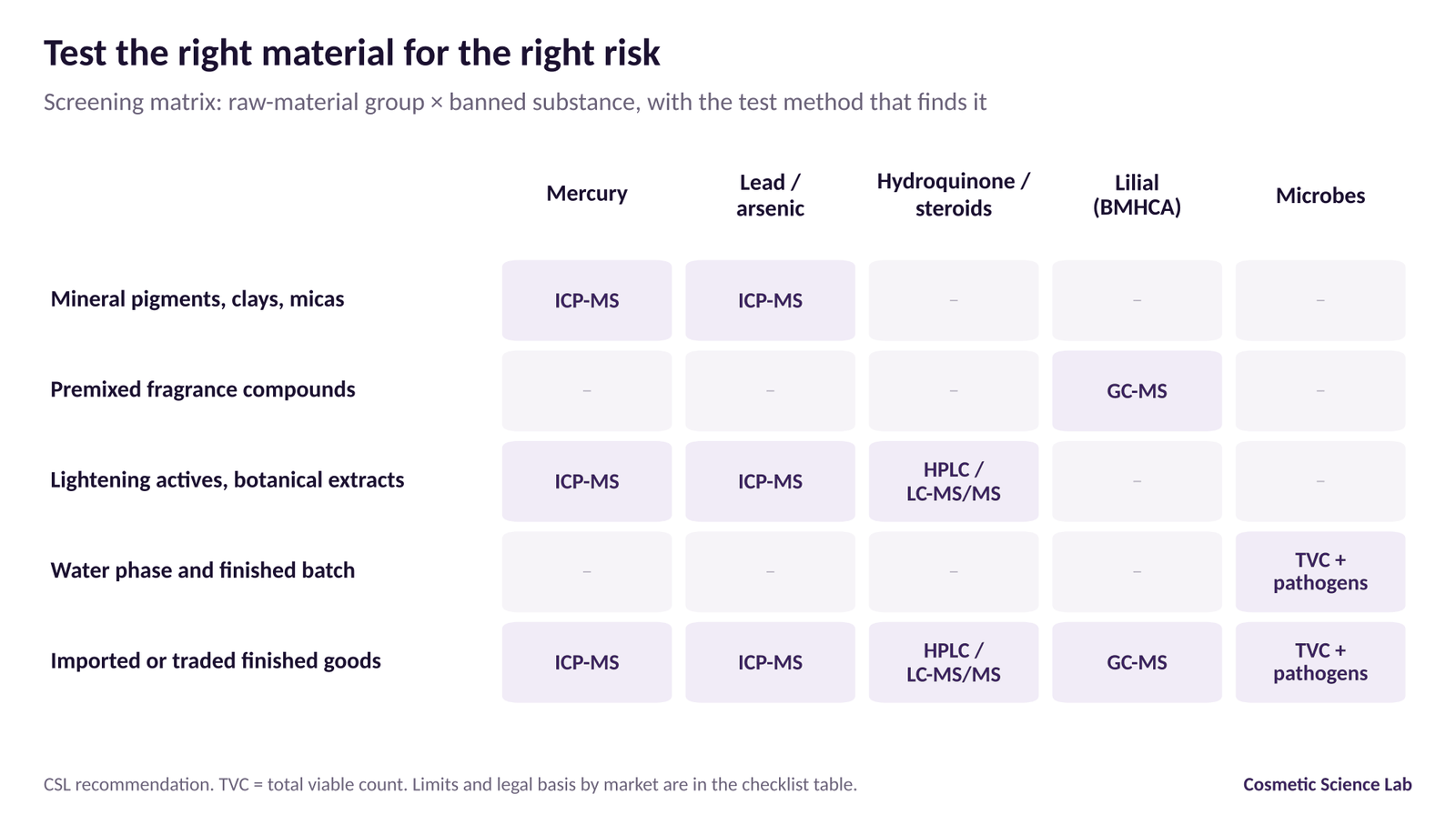
ICP-MS. Turns a digested sample into charged atoms and counts them by mass. It measures mercury, lead and arsenic at trace levels.
GC-MS. Separates volatile molecules, then identifies each by its mass fingerprint. It is the standard way to find BMHCA in a fragrance.
HPLC and LC-MS/MS. Separate non-volatile actives in liquid. HPLC quantifies hydroquinone; LC-MS/MS confirms steroids such as clobetasol at low levels.
Microbiology. Counts bacteria, yeast and mould, checks for specified pathogens, and challenge-tests the preservative system. Our ISO 11930 guide explains the challenge test.
Use a laboratory accredited to ISO/IEC 17025 for any result you may need to show a regulator, an importer or a retail buyer. In India, NABL accredits testing laboratories to this standard. Ask for the method, the limit of quantification and the measurement uncertainty on every report, so a "not detected" result means something.
04Step 1: Rank raw materials by risk
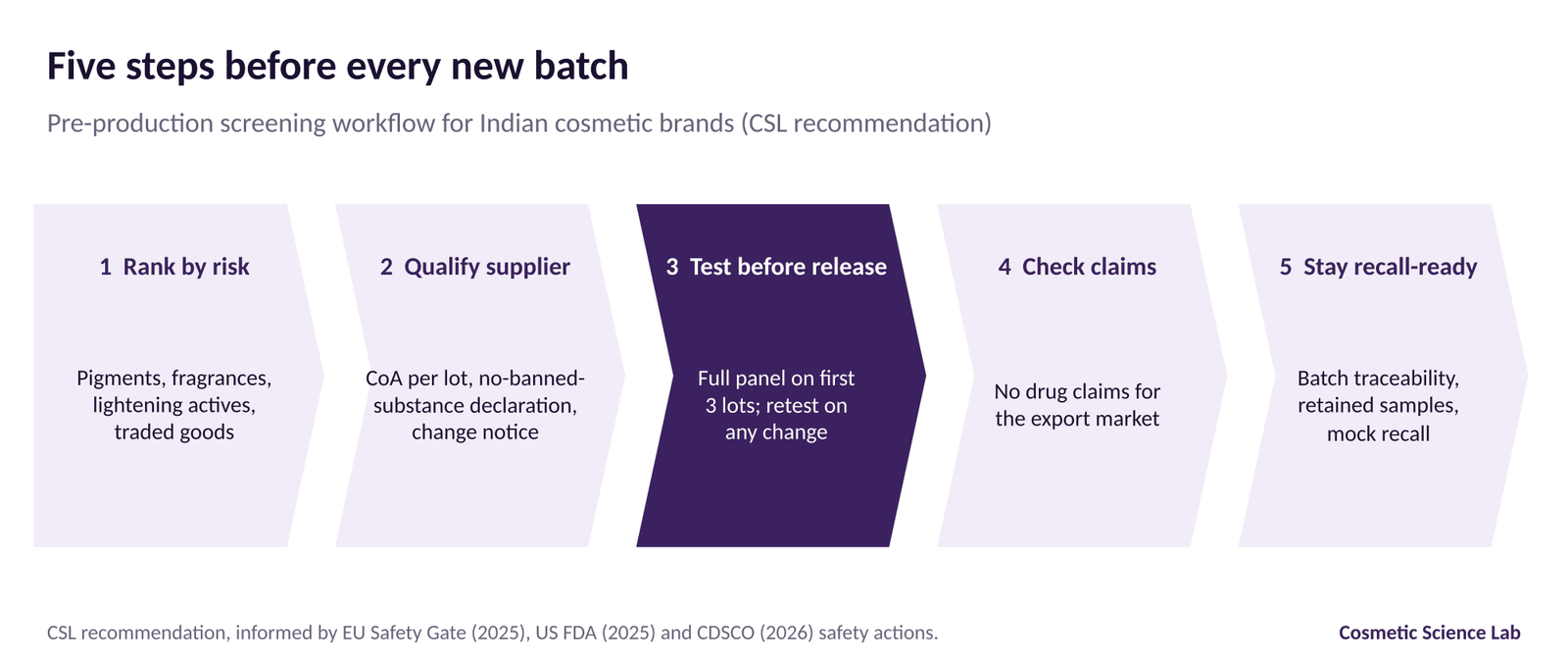
Not every ingredient needs the full panel. CSL recommendation: treat these as high risk and test them first.
- Mineral pigments, clays and micas: natural sources of lead, arsenic and mercury.
- Premixed fragrance compounds: confidential formulas where BMHCA can hide behind "parfum".
- Skin-lightening actives and botanical extracts: where mercury, hydroquinone and steroids appeared in the cases above.
- Traded or imported finished goods: products you sell but did not make, with no formula visibility.
Then map each formula. List every raw material with its supplier and country of origin, and mark the high-risk ones. In our experience most formulas have only three or four. Those materials get the full test panel; the rest are covered by supplier documents and periodic checks, which keeps screening affordable for a growing brand.
05Step 2: Qualify the supplier
Before approving a supplier, confirm you hold:
- a certificate of analysis for every lot, matching the lot number on the drum;
- a signed declaration of no prohibited substances for each target market;
- full fragrance allergen disclosure, not just "parfum";
- country of origin, and a written duty to notify you before any change of source or process;
- the right to audit the site and its records.
Red flags. A new trader, an unfamiliar origin, a price far below the market, or imported goods without an Indian registration number should all trigger full testing.
06Step 3: Test before release, then on change
CSL recommendation: test the first three lots from any new supplier against the full panel for that material, and record every result against the lot number. After that, move to reduced testing, such as every fifth lot, only while results stay clean. Return to full testing whenever the supplier, source country, grade or process changes. Keep a retained sample of every lot for at least the shelf life of the product, so any later complaint can be traced and tested.
Sample from the delivered drum, not from a supplier's retained sample. Where a lot arrives in several containers, take a composite sample across them. Compare every result with the supplier's certificate of analysis: a large gap between the two is itself a reason to stop the lot and ask questions.
07Step 4: Keep claims inside the cosmetic category
In January 2025, 38 of the 89 batches refused by the FDA were flagged as unapproved new drugs [2]. Words such as "whitening", "treats pigmentation" or "heals" can turn a cosmetic export into a drug in the US. Wording such as "brightens the look of skin" describes appearance; wording that promises to treat or change the skin describes a drug. Review every claim against the destination market before artwork is printed. Check colour additives too: a colour permitted in India may not be permitted for the same use in the US. Our fairness to brightening analysis sets out claim wording and the proof each needs.
Planning an export launch?
Have your claims and ingredients checked for each market. Talk to our regulatory team →
08Step 5: Stay recall-ready
Link every finished batch to the raw-material lots inside it, and record where each batch was shipped. Run a mock recall once a year: pick one raw-material lot, then time how long it takes to list every finished batch that used it and every customer who received them. If the answer takes days rather than hours, fix the records first. Keep supplier certificates, test reports and shipping records together for each batch, so a regulator's question can be answered the same day.
For US exports this is no longer optional good practice. Under MoCRA, the FDA can order a mandatory recall when a responsible person refuses to recall voluntarily, and serious adverse events must be reported within 15 business days [9].
CSL view: screening is not about testing everything. It is about knowing which three or four materials in each formula could carry a banned substance, and never releasing them on paperwork alone.
09How CSL helps
CSL's analytical team screens raw materials and finished products for heavy metals, banned fragrance materials, restricted actives and microbes, and our regulatory team reviews supplier documents and claims for the EU, US and India. Send us a formula and its supplier list, and we will tell you which materials need testing and for what.
10Questions readers ask
Which cosmetic raw materials should be tested for heavy metals?
Mineral pigments, clays, micas and some botanical extracts carry the highest risk of lead, arsenic and mercury. Test them by ICP-MS before first use and whenever the supplier or source changes.
How do you test a fragrance for Lilial (BMHCA)?
By GC-MS, which separates the volatile components of the fragrance compound and identifies butylphenyl methylpropional by its mass spectrum. Pair the test with a lot-specific declaration from the fragrance house.
What is the US limit for mercury in cosmetics?
Under 21 CFR 700.13, mercury is limited to a trace below 1 ppm where unavoidable. Eye-area products may contain up to 65 ppm as a preservative only when no safe and effective alternative exists.
Is hydroquinone allowed in cosmetics in the EU?
No, except in professional artificial nail systems. Hydroquinone is listed in Annex II of Regulation (EC) No 1223/2009, with a narrow Annex III entry for nail systems used by professionals.
Screen your raw materials before the next batch
Our analytical team screens raw materials and finished products for heavy metals, banned fragrance materials, restricted actives and microbes.
11References
- CTPA. EU Safety Gate alerts, September 2025 (summary of Safety Gate cosmetic notifications). 23 October 2025. CTPA
- ChemLinked. U.S. FDA import refusal reports (January 2025 section: 89 batches of imported cosmetics rejected). ChemLinked
- CDSCO (DCGI). Public health alert against the use of unauthorised cosmetics products. Public notice, 8 September 2026. CDSCO (PDF)
- Regulation (EC) No 1223/2009 on cosmetic products, Article 17 and Annexes II and III, as amended. EUR-Lex
- US eCFR. 21 CFR 700.13: use of mercury compounds in cosmetics, including use as a preservative. eCFR
- US FDA. Lead in cosmetics (guidance for industry: lead in cosmetic lip products and externally applied cosmetics, recommended maximum level). FDA
- US FDA. FDA works to protect consumers from potentially harmful OTC skin lightening products. 19 April 2022. FDA
- Commission Regulation (EU) 2021/1902 amending Annexes II, III and V to Regulation (EC) No 1223/2009 (CMR substances, including butylphenyl methylpropional, Annex II/1666; applies from 1 March 2022). EUR-Lex
- US FDA. Modernization of Cosmetics Regulation Act of 2022 (MoCRA). FDA
Update log
- Published by Cosmetic Science Lab
This article is general technical information, not legal or regulatory advice. Confirm requirements for your product and market before launch.