From fairness to brightening: what India's claim shift means for cosmetic formulation
India's skin-tone category now speaks of "brightening", "glow" and "tone-evening" rather than "whitening" and "fairness". Demand for an even, brighter-looking tone has not gone away, so each new word needs its own formulation, evidence and regulatory check.
By CSL Consumer insight and regulatory teams, Cosmetic Science Lab · Reviewed by Dr. Premalatha, Ph.D., Life Science, Regulatory Consultant
2 Jul 2020
Fair & Lovely becomes Glow & LovelyHUL announces the rebrand
15 Dec 2020
Cosmetics Rules 2020Notified as G.S.R. 763(E)
2022–2024
Glow and health claimsMintel: whitening falls out of favour in launches
Now
Claim files catch upNew words need matching evidence
Quick answer
Indian shoppers still want an even, brighter-looking tone, but the vocabulary has moved from "whitening" to "brightening" and "glow" [1], [2]. Each word implies a different outcome and a different burden of proof. A rebrand does not replace formulation work, evidence or a classification check.
Take-home message for manufacturers
- Treat the claim shift as a formulation brief, not a naming change
- Assess each active on mechanism, evidence, stability and regulatory status
- Validate stability for tropical storage and transport
Take-home message for brand owners
- Match claim wording to the evidence you hold
- Check cosmetic versus drug classification before launch
- Expect ingredient-literate shoppers to read your INCI list
01The Indian brightening market: from whitening to glow
Mintel's India research describes a category shifting from a focus on fairness towards glow and skin-health claims, with whitening falling out of favour in new launches [1], [2]. Brightening and illuminating claims remain among the most common in facial skincare launches, although Mintel notes their growth has plateaued [2]. Its 2021 consumer work found brands tagging "brightening" and "glow" onto whitening positioning, and one consumer segment seeing no clear distinction between the two [3]. The language moved; demand for tone-evening did not.
| India search query | Monthly searches | Reading |
|---|---|---|
| fairness cream | ~4,800 | Old vocabulary still searched |
| brightening cream | ~5,900 | New vocabulary has overtaken it |
| skin brightening | ~3,000 | Category interest |
| brightening serum | ~2,100 | Format shift to serums |
Ahrefs Keywords Explorer, India, monthly volume estimates, checked 13 October 2026.
02From "fairness" to "glow": what changed
On 2 July 2020, Hindustan Unilever announced Glow & Lovely as the new name for Fair & Lovely [4]. The rebrand is documented; what it did to the formulation is not, so we make no assumption either way. For formulators, each word sets a different target:
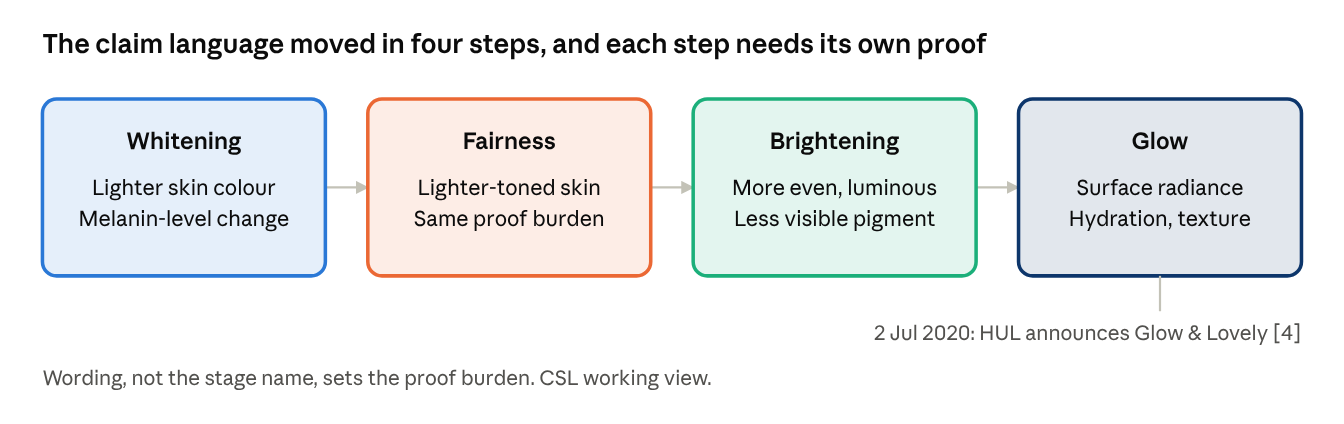
- Whitening and fairness imply lighter skin colour, a melanin-level change
- Brightening and tone-evening imply a more even complexion with less visible pigmentation
- Glow and radiance imply surface luminosity, hydration and smoothness
Each is measured differently, so each needs its own study design.
03Why rebranding without reformulating creates risk
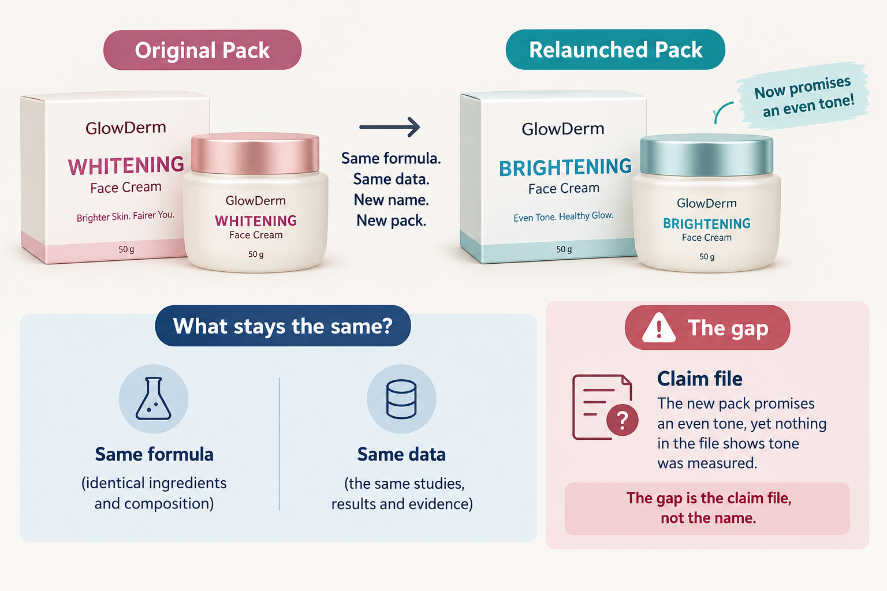
- Commercial: shoppers reading INCI lists notice a "brightening" product with no brightening active, or one dosed too low to matter
- Regulatory: under Rule 36 of the Cosmetics Rules 2020, no cosmetic may purport or convey any idea that is false or misleading to the intending user [5]
- Evidence: a claim that was never substantiated is not substantiated by a new name
04Cosmetic or drug under the Cosmetics Rules 2020
Section 3 of the Drugs and Cosmetics Act defines a cosmetic as an article applied to the body for cleansing, beautifying, promoting attractiveness or altering appearance. A drug includes substances for the diagnosis, treatment, mitigation or prevention of disease or disorder, and certain substances intended to affect the structure or function of the body [6]. The Cosmetics Rules 2020 apply to cosmetics as defined in section 3(aaa) [5]. Brightening claims sit near that line, and the risk rises when a claim:
"Visibly brighter, more even-looking skin in 8 weeks"
"Reduces melanin production" · "Treats melasma"
- Refers to reducing melanin production or permanently changing skin colour
- Names a medical condition such as melasma
- Relies on an active or concentration that regulators may treat as drug-like
That is why the move from a drug-like active to a cosmetic one is a reformulation, not a swap. In a split-face melasma trial, 4% niacinamide gave good-to-excellent improvement in 44% of patients against 55% for 4% hydroquinone, with fewer side effects [7]. Our brightening ingredients guide compares the main actives on evidence, stability and claim risk. Confirm each active and claim against the current CDSCO position with our India regulatory team before launch.
05Claim substantiation: what "brightening" and "glow" require
| Claim wording | What it implies | Typical proof | Claim risk (CSL view) |
|---|---|---|---|
| Whitening, fairness | Lighter skin colour | Melanin-level evidence; may need drug-level proof | High |
| Brightening, tone-evening | More even tone, less visible pigment | Colorimetry, melanin index, expert grading and standardised photography, typically over 8–12 weeks | Medium |
| Glow, radiance | Surface luminosity and smoothness | Reflectance or gloss, hydration data, consumer panel | Lower |
Evidence must match the wording. A 2017 meta-analysis of tranexamic acid pooled 11 studies and 667 participants with melasma across oral, topical and injected routes [8]. That is evidence in a medical condition, not a ready-made file for a cosmetic tone claim. Test your finished formula, recruit panels across Indian skin tones and record tone by colorimetry with our claims and clinical team.
06D2C disruption: transparency raises the bar
D2C brands have made ingredient transparency a selling point, and shoppers now read INCI lists and compare percentages. That raises the bar for every brand and pushes active levels up, which increases irritation risk if tolerance is not tested. Irritation can itself leave marks on deeper skin tones, so a transparent claim needs transparent tolerance data.
07CSL's evidence-based brightening approach
CSL formulates across Indian skin tones and use conditions. Every brightening active passes four checks before a claim is written:
- Regulatory classification
Of the active, its level and the claim wording.
- Evidence level
For the specific claim, not the ingredient in general.
- Stability validation
Under tropical storage and transport conditions.
- Claim substantiation
With an endpoint that matches the wording.
See our brightening and radiance and hyperpigmentation and even tone development pages.
08Questions readers ask
Is "brightening" a regulated claim in India?
There is no single legal definition, but under Rule 36 of the Cosmetics Rules 2020 cosmetic claims must not be false or misleading, and drug-like wording can change a product's classification.
Does a rebrand from "fairness" to "glow" need new evidence?
Yes, if the claim changes. A new claim needs evidence that matches its wording, and old data may not cover it.
What is the difference between skin whitening and skin brightening?
Whitening implies lighter skin colour, a melanin-level change that can push a product towards drug status. Brightening implies a more even, less visibly pigmented complexion, measured by colorimetry, melanin index and expert grading.
Is your brightening claim backed by evidence?
Bring a brief or a benchmark. We check classification, evidence and stability, then design the study that matches your wording.
09References
- Mintel. Skin Glow and Brightening Trends – Indian Consumer – 2022 (report summary). Mintel
- Mintel. India Skintone Management Market Report 2024. Mintel
- Mintel. Brightening Trends in Facial Skincare – Indian Consumer – 2021 (report summary). Mintel
- Hindustan Unilever Limited. Press release, Mumbai, 2 July 2020: Fair & Lovely to be known as Glow & Lovely. HUL
- Ministry of Health and Family Welfare, Government of India. The Cosmetics Rules, 2020, G.S.R. 763(E), 15 December 2020 (Rule 36: misleading claims). CDSCO
- The Drugs and Cosmetics Act, 1940, section 3(aaa) and 3(b). Indian Kanoon
- Navarrete-Solís J, et al. A double-blind, randomized clinical trial of niacinamide 4% versus hydroquinone 4% in the treatment of melasma. Dermatology Research and Practice, 2011; 2011: 379173. PMC3142702
- Kim HJ, Moon SH, Cho SH, Lee JD, Kim HS. Efficacy and safety of tranexamic acid in melasma: a meta-analysis and systematic review. Acta Dermato-Venereologica, 2017; 97(7): 776–781. PubMed
Update log
- Published by Cosmetic Science Lab
This article is general technical information, not legal or regulatory advice. Confirm requirements for your product and market before launch.