Banned in 2022, still flagged in 2025: why Lilial (BMHCA) keeps triggering EU cosmetic alerts
The fragrance ingredient was banned more than three years ago, yet it still drove most EU cosmetic alerts in 2025. Why it keeps reaching the bottle, what our analysis of Q4 2025 alerts shows, and the controls that stop it.
By CSL Regulatory affairs team, Cosmetic Science Lab · Reviewed by Mr. Benjamin, M.Sc., Chemistry
Alert summary
- Substance
- Butylphenyl methylpropional (BMHCA, "Lilial"), CAS 80-54-6
- Status
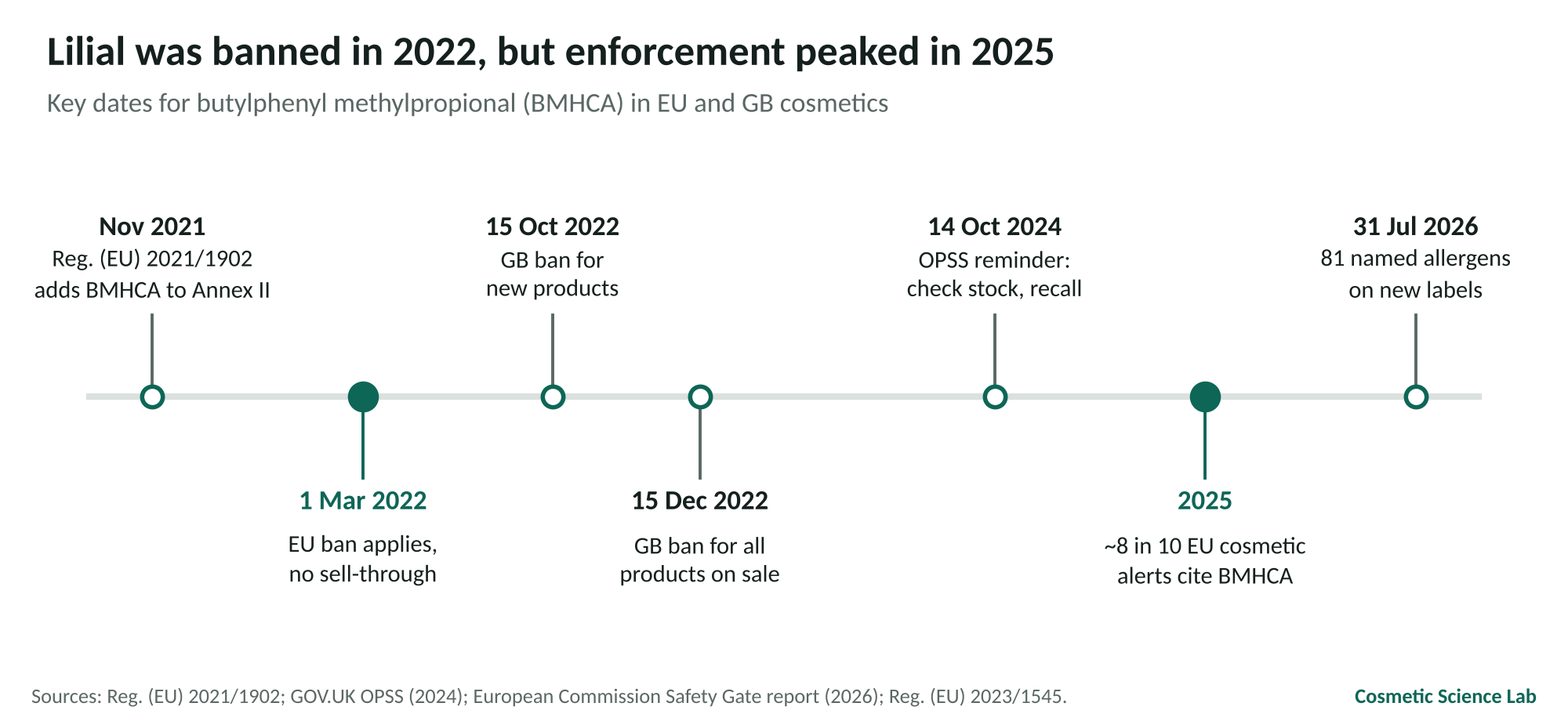
- Prohibited in EU cosmetics (Annex II) since 1 March 2022; banned in Great Britain since 15 December 2022
- Why banned
- Classified toxic for reproduction, category 1B (CMR 1B)
- 2025 picture
- Record 4,671 Safety Gate alerts; cosmetics 36%; almost 8 in 10 cosmetic alerts concerned BMHCA
- Products hit
- Perfumes, creams, shower gels, hair care, deodorants
- Who should act
- Brands, Responsible Persons, fragrance buyers, retailers and marketplace sellers
Quick answer
- Almost eight in ten cosmetic alerts concerned one banned fragrance ingredient: butylphenyl methylpropional (BMHCA), sold for decades as Lilial [2].
- This is a supply-chain control problem, not a knowledge problem. Lot-level fragrance declarations and a stock audit close most of the gap.
Take-home message for brands and RPs
- Get an Annex II and allergen declaration for every fragrance lot
- Search every live INCI list and artwork file for BMHCA
- File the evidence in the Product Information File
Take-home message for retailers and sellers
- Audit warehouse and marketplace listings for pre-2022 stock
- Ask non-EU suppliers for lot-level declarations before listing
- Withdraw, document and inform the supplier when BMHCA is found
01What the 2025 Safety Gate data shows
Lilial has been banned in EU cosmetics since 1 March 2022. More than three years later, it is still the most common reason a cosmetic is pulled from the EU market [2]. Most brands know about the ban. The alerts show that the controls behind each batch and each listing are what fail.
02What Lilial (BMHCA) is and why the EU and UK banned it
BMHCA (INCI: butylphenyl methylpropional; CAS 80-54-6) is a synthetic aldehyde with a fresh, lily-of-the-valley scent. It was widely used in fine fragrances, body lotions, shower gels, deodorants and hair care. It was also one of the 26 fragrance allergens that had to be named on EU labels above set thresholds [3].
The EU classified BMHCA as toxic for reproduction, category 1B (CMR 1B). The Cosmetics Regulation bans CMR 1B substances unless a specific exemption is granted, and none was requested for BMHCA. Regulation (EU) 2021/1902, the "Omnibus IV" act, therefore added it to Annex II (prohibited substances) from 1 March 2022, with no sell-through period [4]. The same act banned zinc pyrithione. BMHCA sits in Annex II as entry 1666 [5].
Great Britain followed: from 15 October 2022 for products newly placed on the market, and from 15 December 2022 for products already on sale [5]. On 14 October 2024, the Office for Product Safety and Standards (OPSS) reminded businesses to check their stock, stop selling affected products and consider recalls [6].
03Why a 2022 ban still fails: four routes into the market
In our regulatory work, BMHCA rarely comes back because someone adds it on purpose. It comes back through gaps in documentation and stock control.
- Old stock that never left the channel
Products made before March 2022 sit in warehouses, wholesaler stock or discount outlets. The EU ban had no sell-through period, so selling them is already a breach.
- Non-EU online sellers
Marketplaces let sellers outside the EU ship straight to consumers, often with formulas made for markets where BMHCA is still allowed. More than 1,200 online marketplaces had registered on the Safety Gate portal by the end of 2025 [1].
- Fragrance compounds bought without lot-level documents
A brand may receive a compliance certificate for the first batch only. If the supplier later changes the compound or its source, nobody re-checks it, and BMHCA can return in a later lot.
- Legacy formulas and labels
Some small brands re-run old formulas or reuse old supplier specs. A formula copied from an older product can carry the banned ingredient into a "new" launch.
Routes 3 and 4 are fully within a brand's control. Routes 1 and 2 need retailer and marketplace checks as well. If you are unsure which applies to your range, our regulatory team can audit formulas, fragrance documents and live labels in one pass.
04CSL analysis: Lilial alerts in Q4 2025
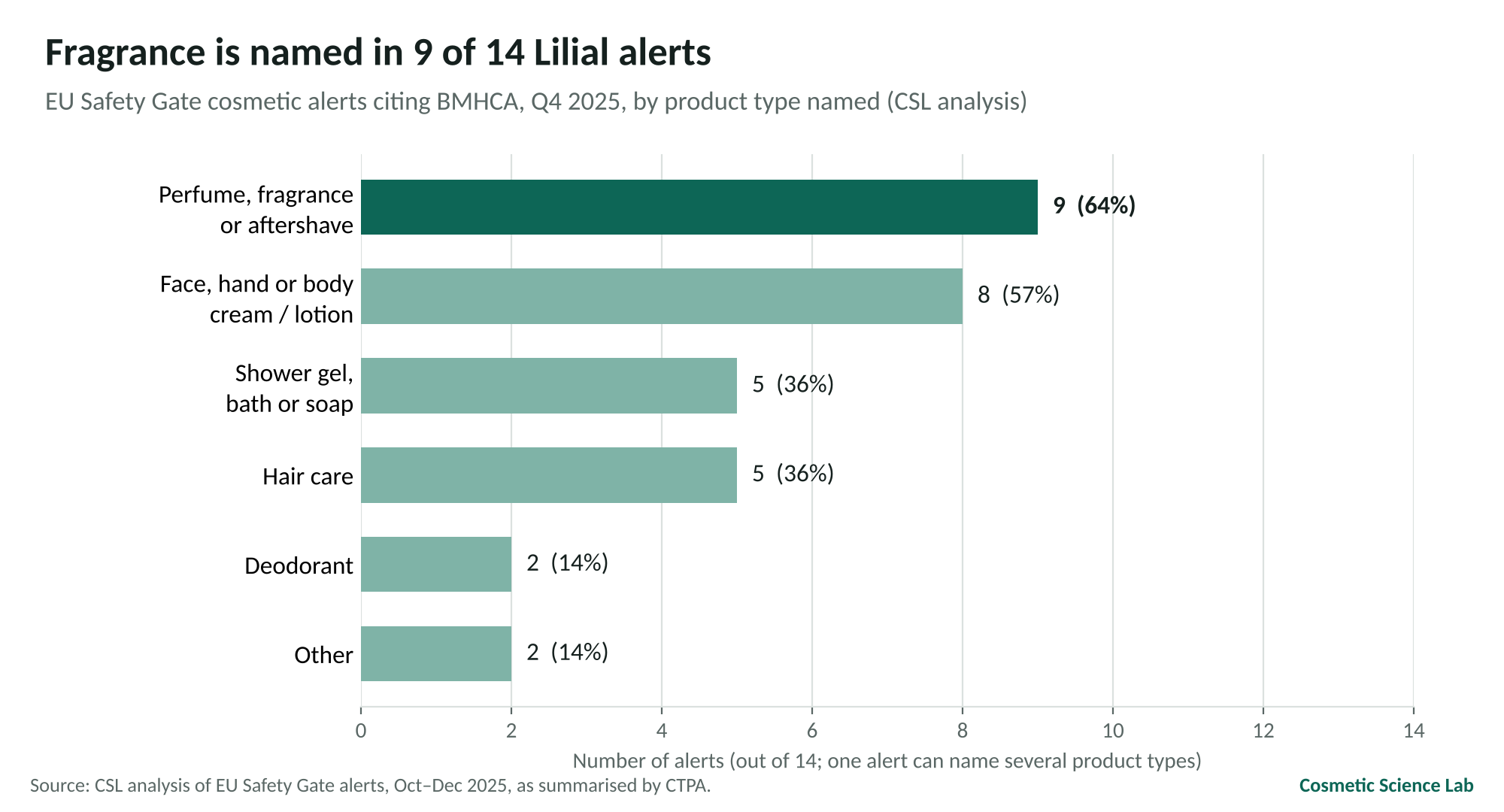
To see what the alerts look like on the ground, we coded every cosmetic alert citing butylphenyl methylpropional from October to December 2025, as summarised by the UK trade body CTPA [7], [8]. BMHCA appeared in 14 of the 51 cosmetic alert entries. Many single entries covered a range of products from one seller, which is consistent with old catalogues and stock rather than one-off formulation errors.
| Product type named in the alert | Alerts | Share of 14 | Typical measure |
|---|---|---|---|
| Perfume, fragrance or aftershave | 9 | 64% | Marketing ban, withdrawal or recall |
| Face, hand or body cream / lotion | 8 | 57% | Marketing ban or withdrawal |
| Shower gel, bath or soap | 5 | 36% | Marketing ban, destruction or recall |
| Hair care (mousse, gel, shampoo, dye) | 5 | 36% | Marketing ban or recall |
| Deodorant | 2 | 14% | Destruction or marketing ban |
| Other (hand sanitiser, talc, shaving gel) | 2 | 14% | Withdrawal or marketing ban |
One alert can name several product types, so the shares add up to more than 100%.
| Notifying country | Lilial alerts | Measures taken |
|---|---|---|
| Italy | 4 | Marketing banned, with accompanying measures |
| United Kingdom (Northern Ireland) | 3 | Recall from end users; withdrawal; destruction |
| Czechia | 2 | Destruction; recall from end users |
| Hungary | 2 | Withdrawal; marketing banned |
| France | 1 | Withdrawal and recall from end users |
| Germany | 1 | Sales ceased |
| Lithuania | 1 | Withdrawal from the market |
Counts are CSL analysis of public records, not an official Commission statistic, and count alert entries rather than individual products. Country of origin is not stated in the CTPA summaries. The Commission's "almost eight in ten" is calculated on its own basis across all of 2025, so the two shares are not directly comparable.
Fragrance is the common thread: 9 of the 14 alerts named a perfume or fragrance, and most others were fragranced body, bath or hair products. Italy alone raised 4 alerts, each covering a range of products from one supplier. The weak points are fragrance supply chains and old stock, which is exactly where the checklist below applies.
05Prevention checklist for brands, Responsible Persons and retailers
A ban is only as strong as the paperwork behind each batch. This is the minimum control set we recommend for any fragranced product sold in the EU or GB.
| Control | What to do | Owner | How often |
|---|---|---|---|
| Supplier declaration per lot | Ask the fragrance house for an Annex II/CMR statement and full allergen declaration for each lot, naming BMHCA as absent | Purchasing + RP | Every lot |
| Certificate match | Check that the IFRA certificate and allergen list carry the same compound code and version as the delivery note | QA | Each new compound version |
| GC-MS screen | Run a targeted GC-MS screen for BMHCA when the supplier is new, the origin is non-EU, or documents are incomplete | QA / contract lab | Risk-based |
| INCI and label check | Search every live INCI list and artwork file for "butylphenyl methylpropional"; its presence on a label is enough for an alert | Regulatory | Now, then at each artwork change |
| Stock and listing audit | Check warehouse, distributor and marketplace listings for pre-2022 stock or old artwork; withdraw and document | Sales / e-commerce | Quarterly |
| Product Information File | Keep declarations, test reports and audit records in the PIF to show due diligence | RP | Ongoing |
Retailers and marketplace sellers should ask for the same lot-level declaration before listing a fragranced product, especially from non-EU suppliers. For a pre-production version of these checks, see our raw-material screening checklist.
06What's next: TPO and 81-allergen labelling
The same pattern is starting again with other ingredients, so the BMHCA lesson applies now.
- TPO in nail products. Trimethylbenzoyl diphenylphosphine oxide, a photoinitiator in gel nail polish, was classified CMR 1B. It has been banned under Regulation (EU) 2025/877 since 1 September 2025, with no sell-through period, including salon use [9]. TPO nail products appeared in Safety Gate for the first time in 2025.
- Expanded allergen labelling. Regulation (EU) 2023/1545 extends individual labelling from 24 to 81 named fragrance allergens, above 0.001% in leave-on and 0.01% in rinse-off products [10]. Products placed on the market from 31 July 2026 must comply, and products already on the market by 31 July 2028 [3].
More named allergens on labels means more ingredients inspectors can check from the pack alone. Brands that build lot-level fragrance documentation now, with a current EU safety report, will be ready for both changes.
07Questions readers ask
Why was Lilial banned in cosmetics?
Lilial (butylphenyl methylpropional, BMHCA) was classified as toxic for reproduction, category 1B, under EU CLP rules. EU cosmetics law bans CMR 1B substances unless an exemption is granted. None was requested, so Regulation (EU) 2021/1902 added BMHCA to Annex II.
When did the Lilial ban start in the EU and GB?
In the EU, the ban has applied since 1 March 2022, with no sell-through period. In Great Britain, it applied from 15 October 2022 for new products and from 15 December 2022 for products already on sale.
Why is Lilial still flagged in EU alerts?
Most cases come from old stock still in the supply chain, products sold online by non-EU sellers, and fragrance compounds bought without lot-level compliance documents. Because BMHCA was a labelled allergen, inspectors can often spot it from the ingredient list alone.
How can I check whether a fragrance contains Lilial?
Search the INCI list for "butylphenyl methylpropional". Then ask the fragrance supplier for a lot-specific Annex II and allergen declaration confirming BMHCA is absent. If the supplier is new, the origin is non-EU, or the documents are incomplete, a targeted GC-MS screen can confirm it.
What should a retailer do if a product contains Lilial?
Stop selling it, remove online listings and quarantine the stock. Inform the supplier and, where required, the market surveillance authority. Consider a recall if the product reached consumers after the ban, and keep records of every step.
Selling fragranced products in the EU or UK?
Our regulatory team reviews your formulas, fragrance documents and labels against Annex II, the CMR list and the new 81-allergen rules, before an inspector does.
08References
- European Commission. Increased action against dangerous products in the EU in 2025. 9 March 2026. European Commission
- European Commission Representation in Cyprus. Commission's 2025 Safety Gate report shows increased action against dangerous products. 5 March 2026. European Commission
- Health Products Regulatory Authority (HPRA). Labelling of cosmetic fragrance allergens. HPRA
- European Commission. Commission Regulation (EU) 2021/1902 of 29 October 2021 amending Annexes II, III and V to Regulation (EC) No 1223/2009 as regards the use in cosmetic products of certain substances classified as CMR. OJ L 387, 3 November 2021. EUR-Lex
- CosLaw.eu. Butylphenyl methylpropional: ingredient record (Annex II/1666; UK dates). CosLaw.eu
- GOV.UK, Office for Product Safety and Standards. OPSS issues cosmetics reminder on banned chemical. 14 October 2024. GOV.UK
- CTPA. EU Safety Gate alerts, October 2025. CTPA
- CTPA. EU Safety Gate alerts, November and December 2025. 9 January 2026. CTPA
- European Commission, Transition Pathways. TPO in nail products: questions and answers. European Commission
- Ecomundo. Fragrance allergen labelling: amendment (EU) 2023/1545. Ecomundo
Update log
- Published by Cosmetic Science Lab
This article is general technical information, not legal, regulatory or medical advice. Confirm requirements for your product and market before launch.