In vivo or in vitro SPF testing? What ISO 24444, ISO 23675 and ISO 23698 can each support on your label
In vitro SPF testing became an ISO option in December 2024, and Australia's 2025 sunscreen failures showed what a wrong SPF number costs. This guide shows which method supports which claim, in which market, at which stage.
By CSL Claims and testing team, Cosmetic Science Lab · Reviewed by Dr. Premalatha, Ph.D., Life Science, Regulatory Consultant

Quick answer
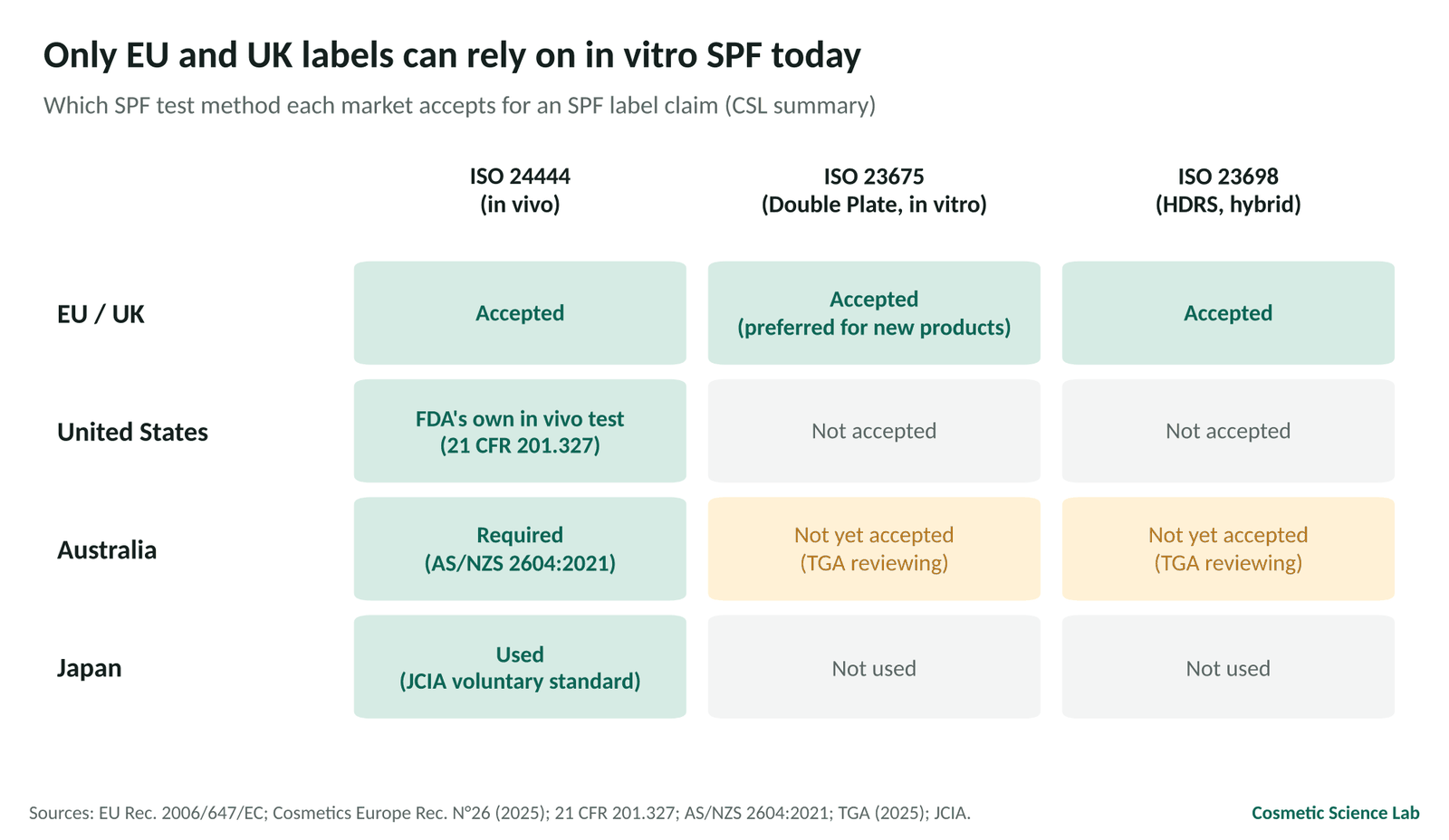
ISO 24444 measures SPF on human volunteers and is accepted almost everywhere. ISO 23675 (Double Plate) is fully in vitro and ISO 23698 (HDRS) is a no-sunburn hybrid; both were published in December 2024 [3]. Today, only EU and UK labels can rely on the new methods alone. The US, Australia and Japan still expect in vivo SPF, so the right test depends on the claim, the market and the development stage.
Take-home message for formulators
- Use in vitro SPF for screening and, for the EU and UK, for label claims
- Check scope first: ISO 23675 excludes sticks, powders and compressed products
- Water-resistance claims always need their own test
Take-home message for brand owners
- Plan the SPF test by market before the formula is frozen
- Australia, Japan and the US still need in vivo SPF
- An SPF number is only as good as the method, lab and batch behind it
01Why the SPF method is now a commercial risk: Australia 2025
In June 2025, the Australian consumer group CHOICE had 20 popular SPF 50 and 50+ sunscreens tested. Sixteen did not meet their label claim. One mineral product labelled SPF 50+ tested at SPF 4, and a different batch tested at a second laboratory gave SPF 5 [1].
The brand then recalled all batches of that product and, in consultation with the Therapeutic Goods Administration (TGA), cancelled its entry on the Australian Register of Therapeutic Goods. The TGA went further than CHOICE. Because an SPF 50+ product must have a test result of at least SPF 60, it considers that 18 of the 20 products did not meet the testing requirements. It also identified 20 other products made with the same base formulation and is determining whether regulatory action is required [2].
The TGA pointed to a root cause every brand should note. The human test varies from person to person, between technicians applying the product, and in how redness is assessed by eye, and the TGA does not regulate testing laboratories. It is now considering newer in vitro methods because they appear to improve consistency [2].
What this means
An SPF number is only as good as the method, the laboratory and the batch behind it. Choosing a test is now a commercial decision, not just a technical one.
02How ISO 24444, the Double Plate method (ISO 23675) and HDRS (ISO 23698) work
For years, ISO 24444 was the only internationally agreed SPF method. Technicians apply the product to volunteers' backs, expose the skin to a solar simulator, and compare the UV dose that causes redness (the minimal erythemal dose, MED) with and without sunscreen. In December 2024, ISO published two alternatives that need no sunburn [3]. Both were validated in a ring study by the ALT-SPF consortium of industry and laboratory partners [13].
| ISO 24444:2019 | ISO 23675:2024 (Double Plate) | ISO 23698:2024 (HDRS) | |
|---|---|---|---|
| Type | In vivo | Fully in vitro | Hybrid: optical measurement on skin plus in vitro data |
| Volunteers | Yes, UV exposure until redness | None | Yes, with no sunburn |
| How it works | Ratio of MED on protected and unprotected skin | Product spread on moulded and sandblasted PMMA plates; UV transmission measured and SPF calculated | Diffuse reflectance on skin combined with in vitro spectral data |
| Also gives | SPF only | Static SPF only | SPF, UVA-PF and critical wavelength [4] |
| Product scope | All sunscreen formats | Emulsions and alcoholic one-phase products; not loose or compressed powders or sticks [4] | Emulsions and single-phase products; powders not yet evaluated [5] |
| Water resistance | Paired with ISO 16217 immersion | Out of scope [4] | Static SPF only |
| Main trade-off | Ethics, cost, lab-to-lab variation | Trained laboratory needed; limited scope | Specialist equipment; few laboratories |
CSL summary of the ISO standard abstracts and published method descriptions.
CSL view
The Double Plate method is the most practical choice for screening and, where accepted, for claims. HDRS helps when you also need UVA data, or as a bridge to in vivo results. See how our claims and clinical team plans SPF studies.
03What your label can rely on, market by market
The EU is the most open market to in vitro SPF. The US and Japan still expect human testing. Australia sits in between, because sunscreens there are regulated as therapeutic goods.
- EU and UK. Recommendation 2006/647/EC sets SPF bands from 6 to 50+, a UVA-PF of at least one third of the labelled SPF, and a critical wavelength of at least 370 nm. It asks for standardised, reproducible test methods and allows in vitro methods [6]. Cosmetics Europe Recommendation N°26 (revised June 2025) strongly recommends that members phase in ISO 23675 or ISO 23698, where possible, for new products; existing ISO 24444 values remain valid and need no retesting [7]. In the EU-funded JACOP 2025 action, 11 market surveillance authorities tested 74 products in vivo and in vitro and found a strong correlation between ISO 23675 and ISO 24444, r = 0.855 [8].
- United States. Sunscreens are over-the-counter drugs. SPF must be determined on human subjects under 21 CFR 201.327, and "broad spectrum" needs a critical wavelength of at least 370 nm [9]. The regulation does not include ISO 23675 or ISO 23698.
- Australia. Sunscreens are listed on the ARTG. The TGA adopted AS/NZS 2604:2021 in April 2024, for new products from 1 July 2024; it uses ISO 24444 for SPF, ISO 24443 for UVA and ISO 16217 for water resistance [10].
| Claim | EU / UK | US | Australia | Japan |
|---|---|---|---|---|
| SPF value | ISO 24444, or ISO 23675 / ISO 23698 | In vivo only (21 CFR 201.327) | ISO 24444 (AS/NZS 2604) | In vivo (JCIA) |
| UVA claim | ISO 24443 (UVA-PF ≥ ⅓ SPF) or HDRS | Critical wavelength ≥ 370 nm | ISO 24443 | PA grade: ISO 24442 |
| Water resistance | ISO 16217 / ISO 18861 | In vivo, 40 or 80 min | ISO 16217 | JCIA, based on ISO 18861 |
| In vitro SPF alone? | Yes | No | No (under review) | No |
CSL summary of Recommendation 2006/647/EC, 21 CFR 201.327, AS/NZS 2604:2021 and JCIA standards [6], [9], [10], [11].
Selling into the Gulf as well? Our Gulf sunscreen research covers what consumers there expect from texture and finish.
04Where in vitro SPF testing struggles, and what the newest data says
In vitro SPF is not a shortcut for every product. Laboratories and reviewers report three weak spots:
- High inorganic filter loads. Zinc oxide and titanium dioxide scatter as well as absorb UV, and thick mineral films are harder to spread evenly on a plate.
- Format. Sticks, loose powders and compressed products fall outside ISO 23675 [4].
- Water resistance. ISO 23675 measures static SPF only, so a "water resistant" claim needs a separate test [4].
The evidence on mineral sunscreens is split, so both sides belong here:
A 2024 review of zinc oxide sunscreens reported in vitro SPF values running too low compared with in vivo results, and linked the gap to formulation density and weight-based application [14].
Pissavini and colleagues (2025) concluded that ISO 23675 can reliably measure the SPF of sunscreens with inorganic filters, even at high concentrations, and that concerns raised about older in vitro methods do not apply to it [15]. Pouradier and colleagues (2025) described the Double Plate method as highly reproducible and accurate in the ALT-SPF consortium [13].
Real-world check. In the JACOP 2025 market surveillance action, ISO 23675 results correlated strongly with ISO 24444 (r = 0.855), although in vitro values were generally somewhat lower. Two lip products could not be tested in vitro. Overall, 33 of 74 products (45%) failed UV protection requirements [8].
CSL view
The method matters less than the match between method and product. A mineral stick and a clear alcoholic spray should not follow the same test plan. Our UV filter guide covers filter choice across the EU, US, Australia and ASEAN.
05The CSL SPF Evidence Ladder: which test at which stage
The right question is not "in vivo or in vitro?" but "what does this claim, in this market, at this stage, need?" Each rung costs more and supports more. Stop at the lowest rung that fully supports the claim you plan to make.
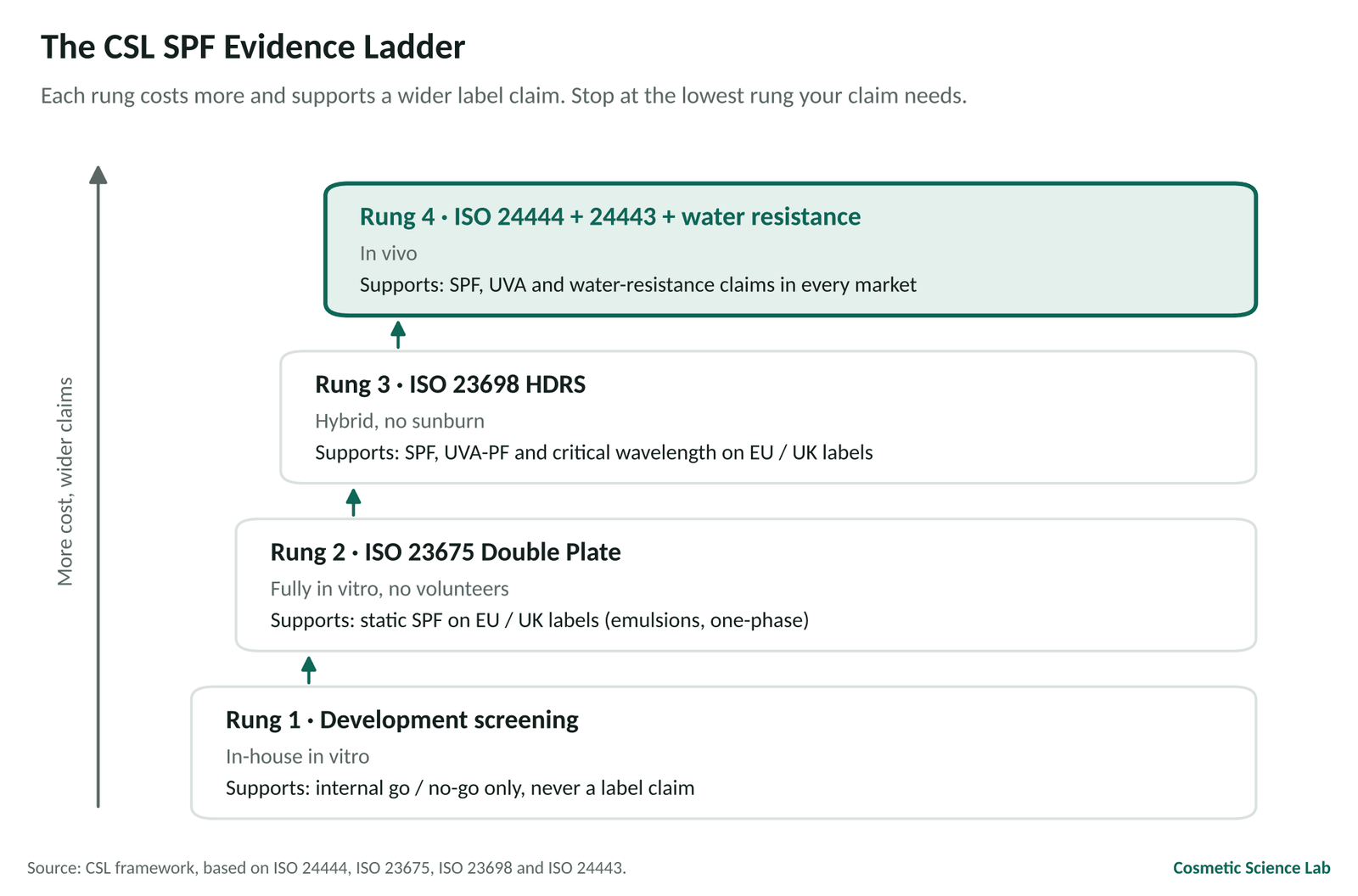
An EU-only cream can often stop at Rung 2. A stick, a water-resistant product, or a launch in Australia, Japan or the US must reach Rung 4. Our testing team can map your portfolio to the ladder.
06Self-check: three quick cases
- Your new SPF 30 mineral stick launches in the EU and Australia. Can ISO 23675 alone support the label?
No. Sticks are outside its scope, and Australia expects ISO 24444.
- You want a "broad spectrum" claim in the US. What must you show?
In vivo SPF under 21 CFR 201.327 and a critical wavelength of at least 370 nm.
- Does an existing EU product tested under ISO 24444 need retesting with ISO 23675?
No. Cosmetics Europe says existing ISO 24444 values remain valid.
07Questions readers ask
How is SPF tested?
The classic method, ISO 24444, applies sunscreen to volunteers' backs and exposes the skin to a solar simulator. SPF is the ratio of the UV dose that causes redness with and without the product. Two newer ISO methods, ISO 23675 and ISO 23698, measure SPF without causing sunburn.
What is the Double Plate method?
The Double Plate method (ISO 23675:2024) is a fully in vitro SPF test. The product is spread on two types of PMMA plate, moulded and sandblasted, and a spectrophotometer measures how much UV passes through. It suits emulsions and alcoholic one-phase products, not sticks, powders or water-resistance claims.
Can in vitro SPF be used on EU labels?
Yes. The EU asks for standardised, reproducible methods and allows in vitro testing. Cosmetics Europe recommends phasing in ISO 23675 or ISO 23698 for new products, and existing ISO 24444 results remain valid.
Why did so many sunscreens fail SPF tests in Australia?
In June 2025, CHOICE tested 20 SPF 50 and 50+ sunscreens and found 16 below their claim. The TGA judged 18 of 20 short of the SPF 60 result an SPF 50+ product needs, and named variability in human SPF testing as a key issue.
What is the US position on SPF testing?
In the US, sunscreens are over-the-counter drugs. SPF must be measured on human subjects under 21 CFR 201.327, and a broad-spectrum claim needs a critical wavelength of at least 370 nm.
Planning a sunscreen launch?
We design the test plan behind your SPF claim: which method, at which stage, for which market, so the number on your label holds up when a regulator or consumer group retests it.
08References
- CHOICE. 16 of 20 sunscreens didn't meet SPF claims in CHOICE test. Media release, June 2025. CHOICE
- Therapeutic Goods Administration. Sunscreen testing results and regulatory review, 2025. TGA
- CTPA. ISO publishes new SPF test methods. 14 January 2025. CTPA
- ISO 23675:2024. Cosmetics – Sun protection test methods – In vitro determination of sun protection factor (Double Plate method). ISO
- ISO 23698:2024. Cosmetics – Measurement of the sunscreen efficacy by diffuse reflectance spectroscopy (HDRS). ISO
- European Commission. Recommendation 2006/647/EC on the efficacy of sunscreen products and the claims made relating thereto. EUR-Lex
- Cosmetics Europe. Recommendation N°26: use of alternative methods to ISO 24444:2019, version 2, 20 June 2025. Cosmetics Europe (PDF)
- JACOP 2025. Joint action on market surveillance of sun protection products, final report (Polish edition), June 2026. Report (PDF)
- US FDA. 21 CFR 201.327: Over-the-counter sunscreen drug products; required labeling based on effectiveness testing. eCFR
- ChemLinked. Australia adopts updated sunscreen standards (AS/NZS 2604:2021). 15 May 2024. ChemLinked
- ChemLinked. Japan revises the sun protection test methods. 15 September 2022. ChemLinked
- ChemLinked. Japan releases labeling method for water resistance related to sunscreen products. 7 February 2023. ChemLinked
- Pouradier F, et al. Performance assessment of the Double Plate method (ISO23675) in ALT-SPF Consortium: a highly reproducible and accurate in vitro method to determine SPF. International Journal of Cosmetic Science, 2025. doi:10.1111/ics.13088
- Osterwalder U, Hubaud J-C, Perroux-David E, Moraine T, et al. Sun-protection factor of zinc-oxide sunscreens: SPF in vitro too low compared to SPF in vivo – a brief review. Photochemical & Photobiological Sciences, 2024; 23(10): 1999–2009. doi:10.1007/s43630-024-00644-0
- Pissavini M, Pouradier F, Lapalud P, Batzer J, Contier M, Matts P. The double plate in vitro SPF test method (ISO23675:2024) is a reliable means of measuring the performance of sunscreen products with high concentrations of zinc oxide and inorganic-only UV filters. Photochemical & Photobiological Sciences, 2025; 24(10): 1797–1805. doi:10.1007/s43630-025-00798-5
Update log
- Published by Cosmetic Science Lab
This article is general technical information, not legal or regulatory advice. Confirm requirements for your product and market before launch.