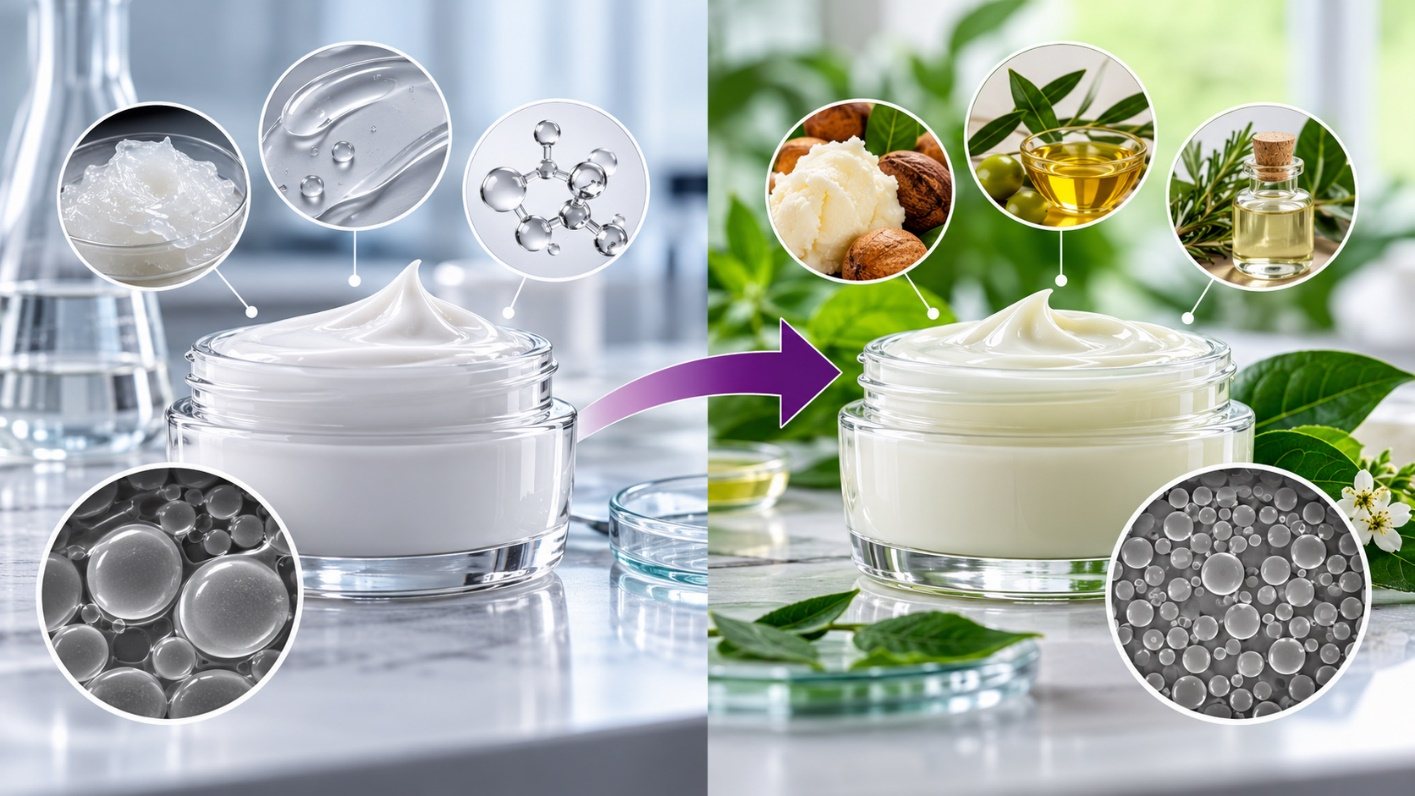
Validating natural-alternative reformulations: testing, scale-up and compliant claims
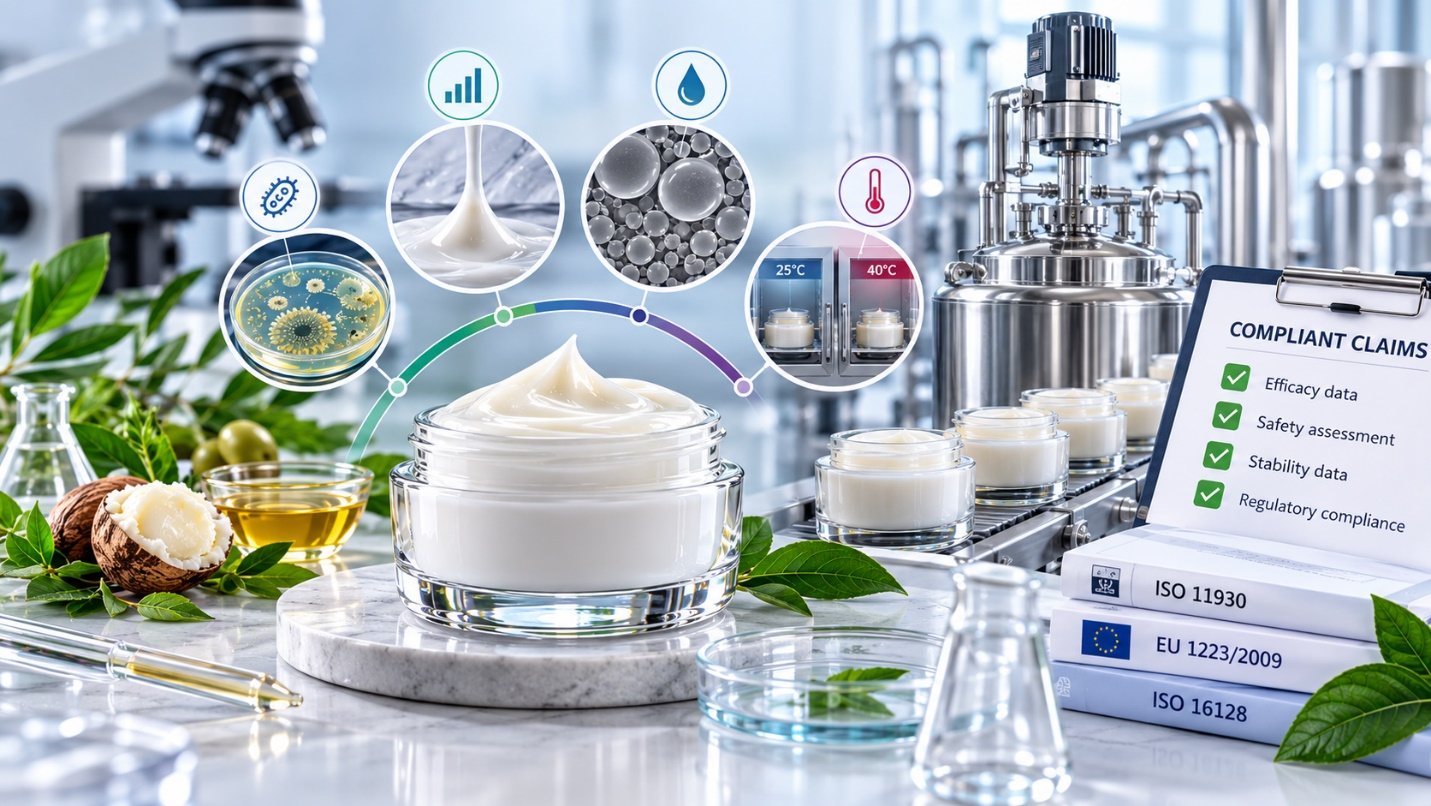
A reformulation is finished only when three things are true: the product performs on skin, it survives scale-up, and every word on the label can be defended. This is how to prove all three, using a published case study as the evidence base.
By CSL Claims and clinical team, Cosmetic Science Lab · Reviewed by Dr. Premalatha, Ph.D., Life Science, Regulatory Consultant
- Part 1Why natural alternatives need reformulation
- Part 2Testing, scale-up and compliant natural claims (this article)
Quick answer
- "Natural", "naturally derived", "bio-based" and "clean beauty" mean different things. Fix the claim first, then design the tests that support it.
- The study's reformulations passed a patch test on 52 volunteers and matched the control for skin hydration over 28 days [1].
- Scaling from 100 g to 1 kg increased droplet size and viscosity, so every scale step needs re-verification [1].
Take-home message for R&D and QA
- Size each panel to the claim it must support
- Qualify at least two lots of every natural raw material
- Run stability in the final pack, not only in glass
Take-home message for brand and marketing
- Pick the claim wording before the ingredients
- "Free from" claims must not denigrate permitted ingredients
- Update the PIF and INCI list for every blend component
01A natural claim is not a natural formulation
Natural origin does not make a product safer, more sustainable, more stable or more effective by default. Each claim term has a specific meaning and a different way to verify it:
| Term | What it means | How it is verified |
|---|---|---|
| Natural | From plants, animals, micro-organisms or minerals by physical or traditional processes [4] | Supplier origin and process data |
| Derived natural ("naturally derived") | More than 50% natural origin by molecular weight, renewable carbon content or another relevant method, after defined processing [4] | ISO 16128 natural origin index [5] |
| Bio-based | Carbon comes from biomass | Radiocarbon (bio-based carbon) analysis |
| Biodegradable | Breaks down under defined test conditions | Standard tests such as the OECD 301 series |
| Renewable feedstock | Source replenishes on a human timescale | Supplier sourcing documentation |
| COSMOS-compatible | Meets COSMOS ingredient and process rules [6] | Approval by a COSMOS certifier |
| Clean beauty | No regulatory definition; usually a brand "free-from" list | Only the published criteria behind it |
The study's most stable formula used PEG-8 beeswax [1]. PEG-8 beeswax is an ethoxylated ingredient, and COSMOS prohibits ingredients made by ethoxylation [6]. That is why COSMOS formulation work starts from the certification rules, not from the bench.
02The claim-to-evidence matrix
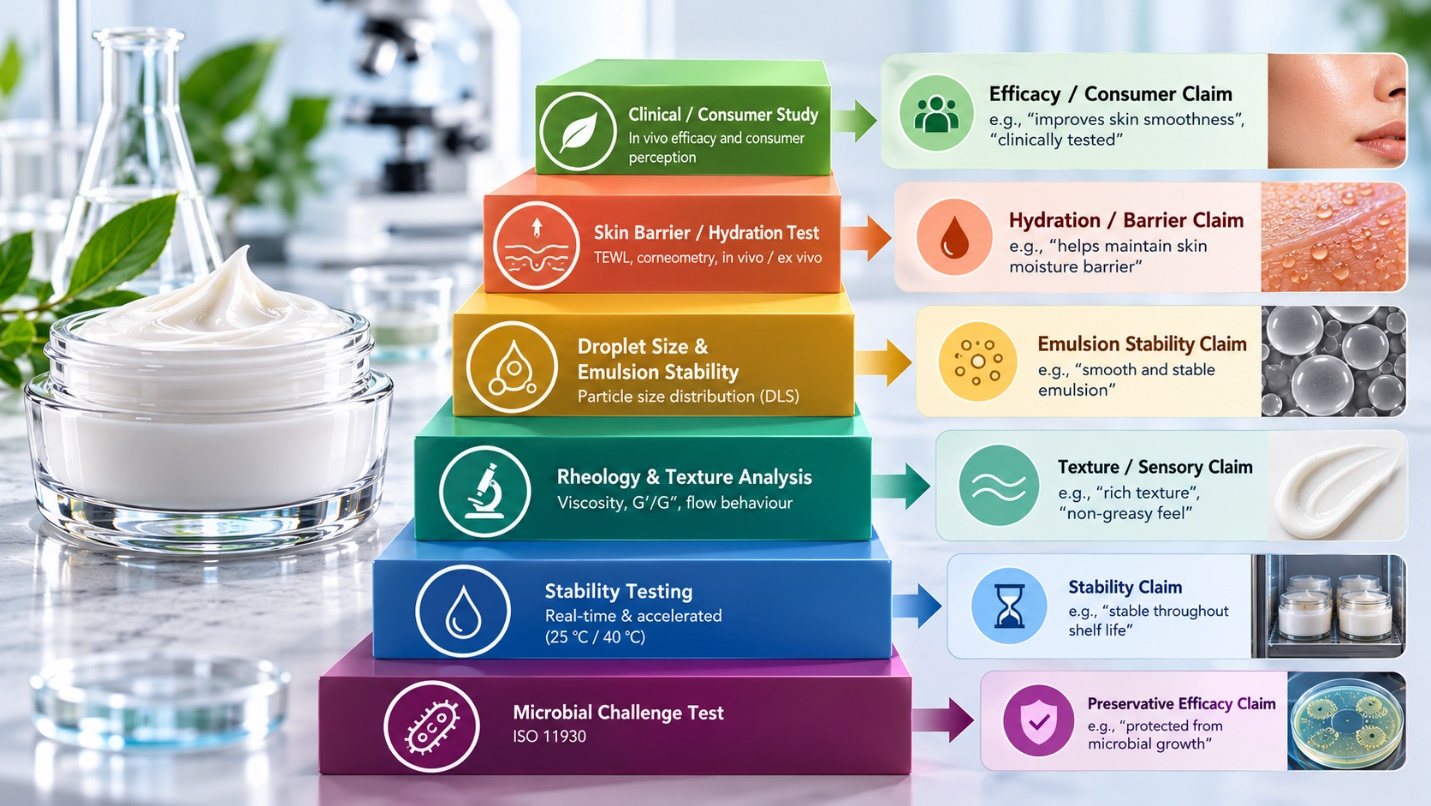
Each claim needs its own test. The table shows what the study proved and what a brand would still need to add:
| Claim | Evidence needed | Covered by the study? |
|---|---|---|
| Well tolerated / suitable for sensitive skin | HRIPT, dermatologist-scored | Yes 52 volunteers, no reactions [1] |
| Moisturising | Corneometry over time, statistically powered panel | Partly 9 volunteers, development level [1] |
| Barrier support | Transepidermal water loss (TEWL) | No not measured |
| Same feel as before | Sensory panel against the original formula [8] | Partly 9 volunteers [1] |
| "X% natural origin" | ISO 16128 index from supplier data [5] | No brand to calculate |
| Adequately preserved (safety file) | ISO 11930 challenge test [7] | Yes criterion A met (tested to ISO 11930:2012) [1] |
03In vivo testing protocols
- Safety: human repeat insult patch test on 52 volunteers aged 21–55, with no reactions in induction or challenge [1].
- Efficacy: 28-day hydration study using a Corneometer and MoistureMap imaging; both reformulations matched the control [1].
- Sensory: hedonic panel to ISO 11136 covering odour, spreadability, tack, greasiness and purchase intent [8].
A 9-person panel supports a development decision, not a marketing claim. Claim panels need enough volunteers for statistical power, and the protocol should be fixed before testing begins. Our claims and clinical team sizes panels to the wording.
04Consumer acceptance: what volunteers revealed
Odour scored equally across all formulas, partly because odour was an early screening criterion [1]. The PEG-8 beeswax formula was preferred over the control for appearance and purchase intent. Most telling, volunteers said performance still decided the purchase, even for a product sold on sustainability [1].
"Sustainability gets attention; performance earns the repeat purchase."
CSL claims and clinical team
05Scale-up: lab bench versus production batch
| Measure | Castor-blend formula (F1) | PEG-8 beeswax formula (F2) |
|---|---|---|
| d90 at 100 g | ≈ 44 µm | ≈ 25 µm |
| d90 at 1 kg | ≈ 77 µm | ≈ 34 µm, now bimodal |
| Viscosity at 1 kg | Increased | Increased |
| 3 months at 40 °C / 75% RH | Droplet distribution shifted | Stable |
pH held steady and microbial counts stayed within limits throughout [1]. Batch-to-batch variation was not analysed, so CSL adds three checks at every scale step:
- Multi-lot qualification: test at least two lots of each natural raw material
- Critical process parameters: fix shear rate, emulsification temperature and order of addition
- Packaging stability: run stability in the final pack, not only in glass
06Regulatory considerations for natural claims in the EU
"Made with 95% ingredients of natural origin (ISO 16128)"
"Silicone-free, so it's safer for your skin"
- Regulation (EC) No 1223/2009: claims must not imply characteristics the product does not have [2]
- Regulation (EU) No 655/2013: claims must be truthful, evidence-based, honest and fair [3]
- "Free from" claims: EU guidance applied from 1 July 2019 says they must not denigrate legally permitted ingredients [9]
- INCI accuracy: list every component of a blend. The study's "natural petrolatum" is three INCI entries: Ricinus Communis Seed Oil, Hydrogenated Castor Oil and Copernicia Cerifera Cera [1]
- Safety file: update the Product Information File and CPSR. Benzyl alcohol is a labelled fragrance allergen above 0.001% in leave-on and 0.01% in rinse-off products, and Regulation (EU) 2023/1545 expands the allergen list for new products from 31 July 2026
07How CSL validates the reformulation
- Claim definition
Fix the claim category before ingredient selection.
- Bench screening
Appearance, centrifugation, droplet size, rheology and spreadability, as set out in Part 1.
- Preservation
ISO 11930 challenge test on the final formula [7].
- Pilot scale-up
Multi-lot raw materials, fixed process parameters and stability in the final pack, through our micro-batch manufacturing team.
- In vivo and dossier
Panels sized to the claim, then INCI, PIF and substantiation with our regulatory team.
08Questions readers ask
Is "naturally derived" the same as "natural"?
No. Under ISO 16128, a derived natural ingredient has undergone defined chemical or biological processing and is more than 50% natural origin, by molecular weight, renewable carbon content or another relevant method.
Does an ISO 16128 index let me claim "natural" on pack?
No. It is a calculation method. The claim itself must still meet the EU common criteria for cosmetic claims.
Can I claim "silicone-free" after replacing dimethicone?
Only if the claim is accurate and does not suggest that silicones are unsafe, in line with EU guidance on "free from" claims.
Why re-test after scale-up?
Because process changes alter droplet size and viscosity. In the study, droplet size rose significantly at ten-fold scale.
Need evidence behind a natural claim?
We map each claim to the test that supports it, size the panels and build the substantiation file.
09References
- Bom S, Fitas M, Martins AM, Pinto P, Ribeiro HM, Marto J. Replacing synthetic ingredients by sustainable natural alternatives: a case study using topical O/W emulsions. Molecules, 2020; 25(21): 4887. doi:10.3390/molecules25214887
- Regulation (EC) No 1223/2009 of the European Parliament and of the Council of 30 November 2009 on cosmetic products. EUR-Lex
- Commission Regulation (EU) No 655/2013 of 10 July 2013 laying down common criteria for the justification of claims used in relation to cosmetic products. EUR-Lex
- ISO 16128-1:2016 Guidelines on technical definitions and criteria for natural and organic cosmetic ingredients and products — Part 1: Definitions for ingredients. ISO
- ISO 16128-2:2017 — Part 2: Criteria for ingredients and products. ISO
- COSMOS-standard AISBL. COSMOS-standard: Cosmetics Organic and Natural Standard; and Cosmebio, PEG: ingredients prohibited under COSMOS (ethoxylation). COSMOS · Cosmebio
- ISO 11930:2019 Cosmetics — Microbiology — Evaluation of the antimicrobial protection of a cosmetic product. ISO
- ISO 11136:2014 Sensory analysis — Methodology — General guidance for conducting hedonic tests with consumers in a controlled area. ISO
- CTPA. Cosmetic claims: focus on "free from" claims. July 2019, updated December 2019. CTPA
Update log
- Published by Cosmetic Science Lab
This article is general technical information, not legal or regulatory advice. Confirm requirements for your product and market before launch.