Emulsifiers explained: HLB, types and how to choose one
What an emulsifier does, how the HLB scale and required HLB work, how PEG, PEG-free and COSMOS options compare, and five questions for choosing one.
By Dr. Premalatha, Ph.D., Life Science, Regulatory Consultant, Cosmetic Science Lab

Quick answer
- What is an emulsifier? The ingredient that lets oil and water share one jar. Its molecules sit at the oil-water boundary, lower the tension between the phases and wrap each droplet so it cannot merge with its neighbours.
- HLB (hydrophile-lipophile balance) ranks emulsifiers from oil-loving to water-loving: low values suit water-in-oil, high values suit oil-in-water [1].
- Match the emulsifier blend to the required HLB of your oil phase, then confirm it with stability testing.
- Claims narrow the choice: PEG-free and COSMOS products rule out ethoxylated emulsifiers such as polysorbates.
Take-home message for formulators
- Pair a low- and a high-HLB emulsifier rather than relying on one
- Treat the calculated HLB as a starting point and test either side of it
- Check charge and pH before adding actives
Take-home message for brand owners
- Decide PEG-free or COSMOS claims before development starts
- An emulsifier switch is a reformulation: re-run stability
- Natural emulsifiers often cost more and need tighter processing
01Why emulsifier choice matters
Every lotion, cream and conditioner is an emulsion, and the emulsifier sets its limits. It controls droplet size, skin feel, compatibility with actives and whether the product can be sold as natural or COSMOS-certified. Brands often reformulate because a launch emulsifier no longer fits a PEG-free promise, or because a new active breaks the system. Getting the choice right at the start saves months.
Glyceryl stearate shows the point. On its own it is too oil-loving to hold an oil-in-water cream, yet paired with the right high-HLB partner it becomes one of the most reliable bases in the lab.
02How an emulsifier works, and the HLB scale
An emulsifier molecule has a water-loving head and an oil-loving tail, usually built from fatty acids. It sits at the oil-water boundary, lowers the tension between the phases and forms a film around each droplet. For the physics of why creams separate, see what an emulsion is and why creams separate.
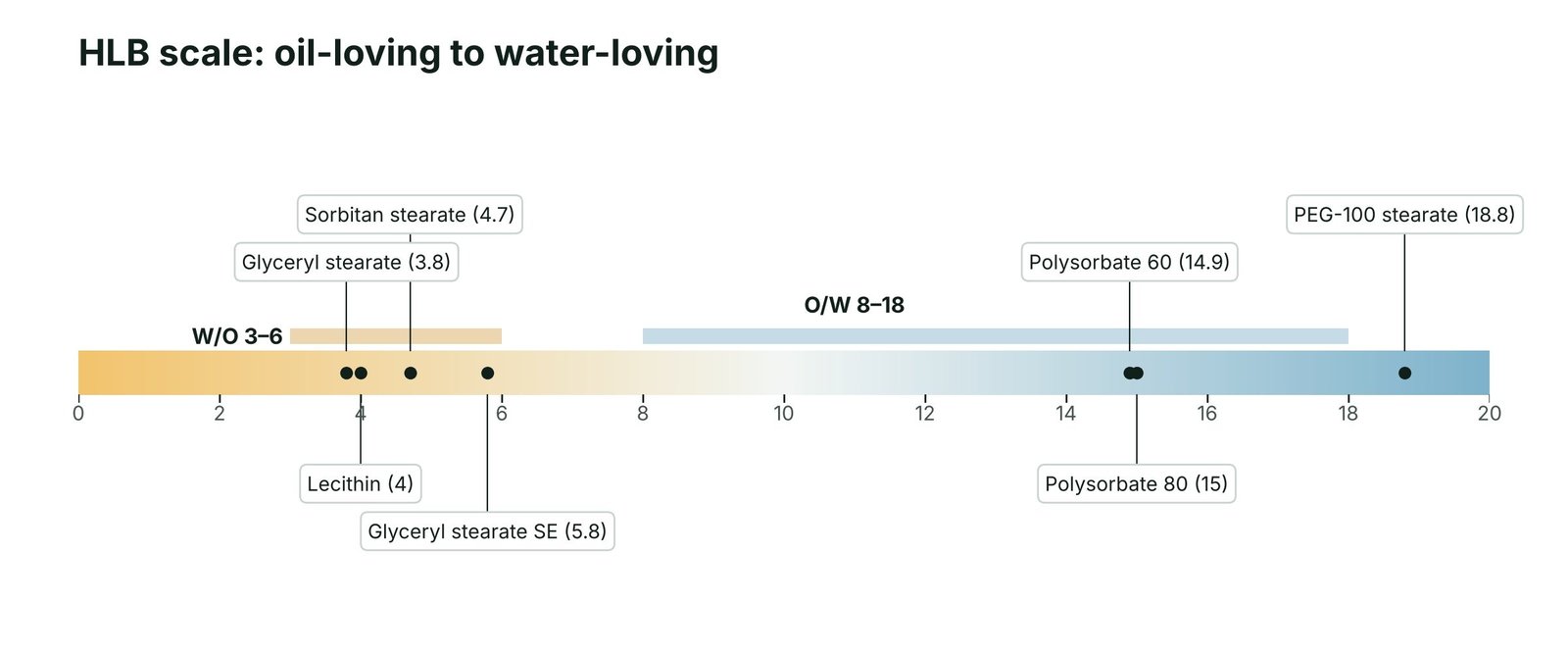
William Griffin introduced the hydrophile-lipophile balance (HLB) scale in 1949 to rank emulsifiers from oil-loving to water-loving [1]. Low-HLB emulsifiers (about 3 to 6) favour water-in-oil systems; high-HLB emulsifiers (about 8 to 18) favour oil-in-water [1], [2].
| Emulsifier (INCI) | HLB | Type | Typical role |
|---|---|---|---|
| Glyceryl stearate | 3.8 | Non-ionic | Co-emulsifier, body |
| Lecithin | 4 | Natural, zwitterionic | W/O or co-emulsifier |
| Sorbitan stearate | 4.7 | Non-ionic | Low-HLB partner |
| Glyceryl stearate SE | 5.8 | Anionic (contains soap) | Self-emulsifying base |
| Polysorbate 60 | 14.9 | Non-ionic, PEG-based | High-HLB partner |
| Polysorbate 80 | 15 | Non-ionic, PEG-based | Solubiliser, high-HLB partner |
| PEG-100 stearate | 18.8 | Non-ionic, PEG-based | High-HLB partner |
Sources: sorbitan stearate and polysorbates from Croda [3]; glyceryl stearate from Griffin [4]; lecithin, glyceryl stearate SE and PEG-100 stearate as listed in US Patent 10,363,216 [5]. Supplier values can differ slightly by grade.
03Emulsifier types: non-ionic, anionic and polymeric
- Non-ionic emulsifiers carry no charge, so they tolerate salts, acids and most actives. Glyceryl stearate and polysorbates are the classic pair.
- Anionic emulsifiers carry a negative charge. Glyceryl stearate SE contains potassium stearate, which makes it self-emulsifying but limits it to roughly pH 5 to 9 [6].
- Polymeric emulsifiers stabilise droplets with a long polymer chain instead of a small surfactant. Acrylates/C10-30 alkyl acrylate crosspolymer works at 0.1–0.3% and needs no HLB calculation; its supplier still recommends a small amount of co-emulsifier for the best stability and feel [7].
04Matching required HLB: a worked example
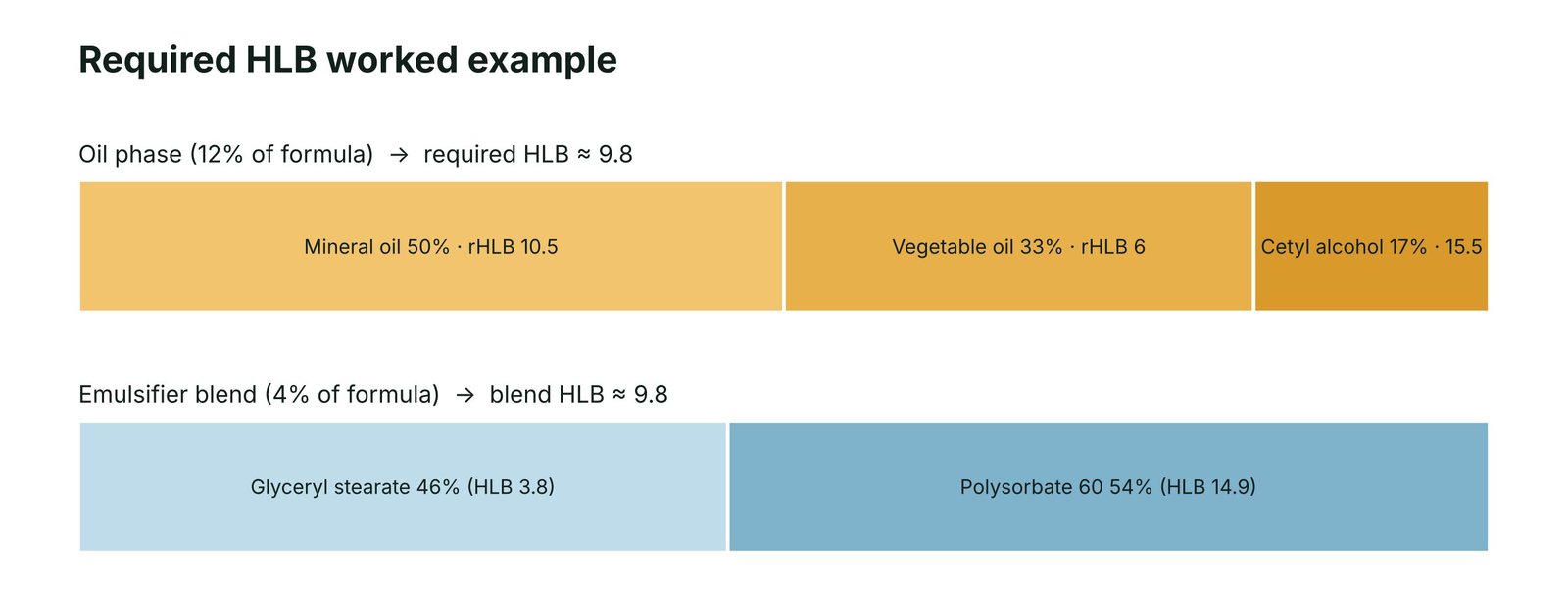
Each oil has a required HLB: the emulsifier HLB at which it emulsifies best. For a blend, take a weighted average by each oil's share of the oil phase, then mix a low- and a high-HLB emulsifier to hit that number [8].
Worked example. A 12% oil phase contains 6% mineral oil (required HLB 10.5), 4% vegetable oil (6) and 2% cetyl alcohol (15.5) [8]:
- Required HLB = (0.50 × 10.5) + (0.33 × 6) + (0.17 × 15.5) ≈ 9.8
- Share of the high-HLB emulsifier = (9.8 − 3.8) ÷ (14.9 − 3.8) ≈ 54%
- At 4% total emulsifier: about 2.2% polysorbate 60 and 1.8% glyceryl stearate
Treat the result as a starting point. Run a small series either side of the calculated value and keep the most stable sample after storage. Polymeric emulsifiers and pre-blended self-emulsifying bases skip this calculation, which is why they are popular for fast development.
05PEG vs PEG-free vs COSMOS-approved emulsifiers
| Option | Examples | Strengths | Trade-offs |
|---|---|---|---|
| PEG-based | Polysorbate 60, PEG-100 stearate, ceteareth-20 | Wide HLB range, robust, low cost | Made by ethoxylation; trace 1,4-dioxane is a concern; not allowed in COSMOS products [9] |
| PEG-free, synthetic | Glyceryl stearate SE, acrylates crosspolymer | No ethoxylation, simple to use | Anionic or synthetic; no natural claim |
| COSMOS-approved natural | Cetearyl olivate, polyglyceryl esters, lecithin | Natural-origin claims, good skin feel | Narrower processing window; often more costly |
Cetearyl olivate with sorbitan olivate is a PEG-free, COSMOS-approved system that its supplier says forms liquid crystal structures mimicking the organisation of the skin's outer layer; it is used at 3–5% as the sole emulsifier [10]. Polyglyceryl esters are made from polyglycerol and plant fatty acids and are marketed as PEG-free, biodegradable alternatives [11]. For the dioxane question behind many PEG-free briefs, see our article on 1,4-dioxane limits and testing.
Natural emulsifiers. "Natural" usually means natural origin, not unprocessed. Most are still made by reacting plant fatty acids with a sugar, a polyol or glycerin: olive-derived esters, polyglyceryl esters, sucrose esters and lecithin from soy or sunflower. They suit brands chasing COSMOS or similar certification, but tend to be less forgiving of high oil loads, salts and fast cooling than PEG-based systems.
06How to choose an emulsifier: five questions
- Which emulsion type?
Oil-in-water lotions need a high-HLB system; water-in-oil balms and barrier creams need a low-HLB one.
- Which claims?
A PEG-free or COSMOS promise rules out polysorbates and other ethoxylated options from day one.
- Which actives and pH?
Acids, salts and cationic ingredients point towards non-ionic systems.
- Which texture?
Glyceryl stearate and fatty alcohols give rich body; polymeric emulsifiers give light, gel-like creams.
- Which process?
Hot-process emulsifiers need heating and cooling capacity; some polymeric and cold-process options do not.
Use two emulsifiers, not one: a low- and high-HLB pair builds a tighter interfacial film. Back up natural emulsifiers with 0.2–0.5% xanthan gum in the water phase. Melt solid emulsifiers fully, typically at 70–80 °C, before the phases meet. Add electrolytes and charged actives after emulsification. An informal rule of thumb sizes total emulsifier at about a quarter of the oil phase weight (the worked example uses a third); treat it as a first guess, not a standard. Prove any switch with heat, cold and freeze-thaw stability testing. Fatty alcohols such as cetearyl alcohol act as co-emulsifiers that add body.
Choosing or switching an emulsifier?
Our formulation team matches emulsifier systems to your actives, claims and format, then proves stability before launch.
07References
- Griffin WC. Classification of surface-active agents by "HLB". J Soc Cosmet Chem. 1949;1(5):311. SCC
- Romanowski P. Choosing the right emulsifier. Chemists Corner; 21 May 2025. Web
- Croda. Span and Tween: sorbitan esters and polysorbates (DI005). Technical brochure; 2009. PDF
- Griffin WC. Calculation of HLB values of non-ionic surfactants. J Soc Cosmet Chem. 1954;5(4). SCC
- US Patent 10,363,216, Table 2. USPTO
- Hallstar. HallStar GMS SE (glyceryl stearate SE) product information. Web
- Lubrizol. Pemulen TR-1 and TR-2 polymeric emulsifiers, technical data sheet TDS-309. PDF
- The HLB system: a time-saving guide to surfactant selection. Presentation to the Midwest Chapter of the Society of Cosmetic Chemists; 9 March 2004. PDF
- COSMOS-standard AISBL. COSMOS-standard cosmetics organic and natural standard, version 4.0, Appendix III (processes not allowed); 2023. PDF
- Hallstar. Olivem 1000 (cetearyl olivate, sorbitan olivate) product information. Web
- Evonik. Polyglyceryl esters. Web
Update log
- Published by Cosmetic Science Lab
This article is general technical information, not legal, regulatory or medical advice. Confirm requirements for your product and market before launch.