EU PFHxA restriction for cosmetics: what UAE and EU brands must reformulate
From 10 October 2026, cosmetics placed on the EU market must meet trace-level limits for PFHxA and related substances. For long-wear make-up and water-resistant sun care, that is a formulation problem, not a label change.
By CSL Regulatory affairs and formulation teams, Cosmetic Science Lab · Reviewed by Dr. Premalatha, Ph.D., Life Science, Regulatory Consultant

Rule at a glance
- Legal act
- Commission Regulation (EU) 2024/2462, adding entry 79 to REACH Annex XVII
- Substances
- PFHxA, its salts and PFHxA-related substances (C5F11– or C6F13– groups)
- Limits
- <25 ppb PFHxA and salts (sum); <1,000 ppb related substances (sum)
- Cosmetics apply from
- 10 October 2026 (products already on the market before then are exempt)
- Legal basis
- REACH, not the Cosmetics Regulation
- Also relevant
- France: national PFAS ban in cosmetics since 1 January 2026
Quick answer
- From 10 October 2026, cosmetics placed on the EU market must contain less than 25 ppb of PFHxA and its salts and less than 1,000 ppb of PFHxA-related substances [1].
- France goes further: its national law has banned intentionally added PFAS in cosmetics since 1 January 2026 [7].
- The risk sits in pigment treatments, film-formers and powders, often inside a supplier's pre-treated material. Relabelling does not establish compliance.
- No single ingredient replaces fluorochemistry. A working route combines a non-fluorinated pigment treatment, a resin–polymer film and oil-absorbing powders, then tests them.
Take-home message for manufacturers
- Audit every pigment and filler surface treatment, not just the formula sheet
- Screen with total fluorine, then confirm with targeted LC-MS/MS
- Re-run stability, wear and SPF tests after any PFAS removal
Take-home message for brand owners
- Treat 10 October 2026 as a placing-on-market date for every EU shipment
- Ask suppliers for PFAS statements that cite Regulation (EU) 2024/2462 and both limits
- Re-substantiate "long-wear", "transfer-proof" and water-resistance claims
01Why PFAS were the hidden backbone of long-wear cosmetics
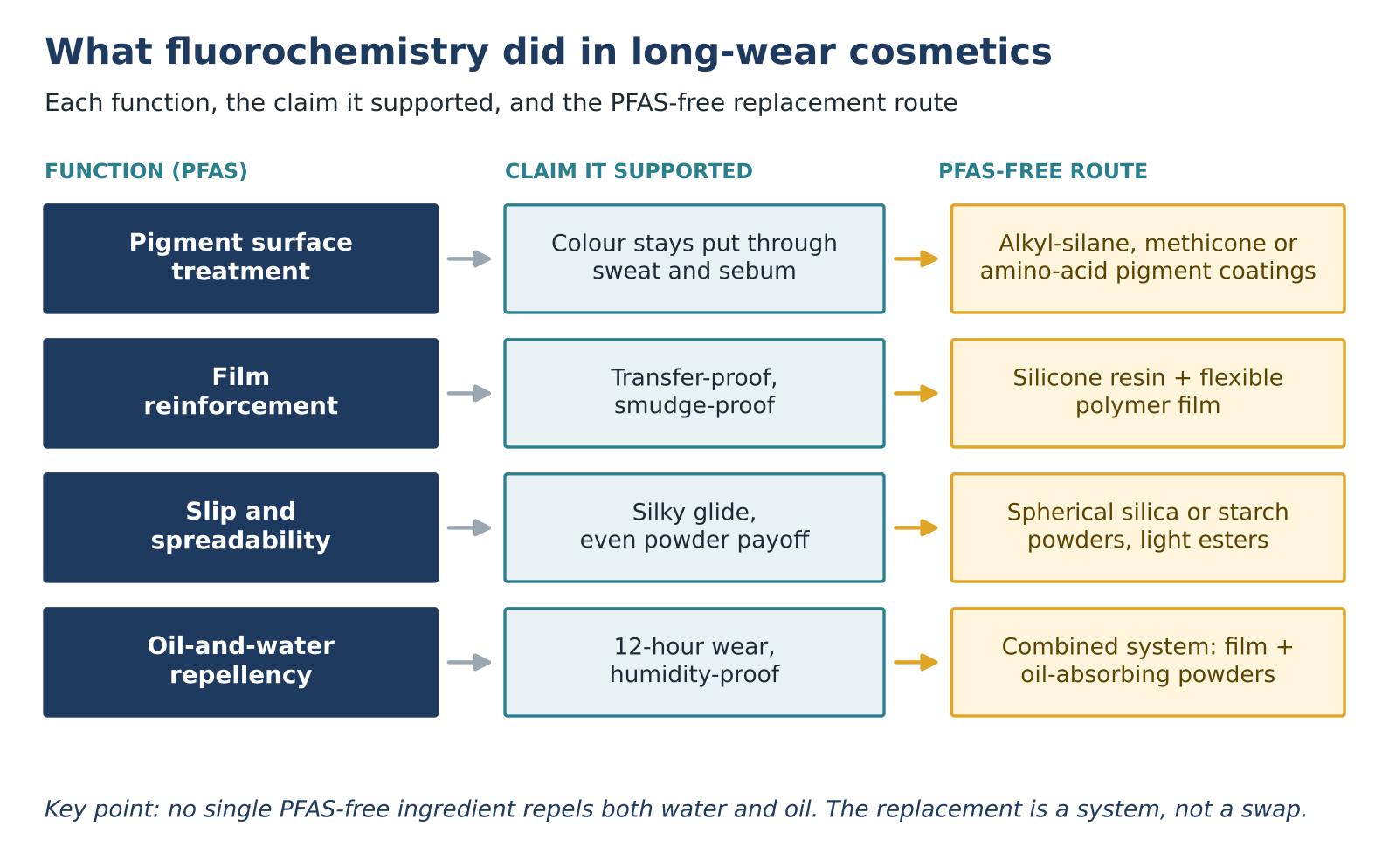
A perfluorinated chain repels both water and oil, a combination no single non-fluorinated ingredient reproduces. Silicones repel water but are wetted by sebum. Waxes resist water but soften with heat and skin oils. In a formula, fluorochemistry typically did four jobs:
- Pigment treatment: kept colour from sliding or patching under sweat and sebum.
- Film reinforcement: made the film harder to rewet, so it resisted transfer for longer.
- Slip: PTFE and fluorinated oils gave powders and bases a silky glide.
- Claims: "12-hour wear" and "sweat-proof" often depended partly on this repellency.
These ingredients often sit inside a supplier's pre-treated pigment, so they never appear on the brand's formula sheet. In a study of 231 North American cosmetics, the ingredient lists of most products tested for specific PFAS did not disclose fluorinated ingredients [3].
02What the EU PFHxA restriction requires
The rule is Commission Regulation (EU) 2024/2462 of 19 September 2024, which adds entry 79 to Annex XVII of REACH [1], [4]. Cosmetic products as defined in the Cosmetics Regulation are one of the consumer uses covered, alongside clothing textiles, food-contact paper and consumer mixtures.
| Requirement | Detail |
|---|---|
| Substances | PFHxA, its salts and related substances with a C5F11– or C6F13– group [2], [4] |
| Limit 1 | Below 25 ppb for the sum of PFHxA and its salts [1] |
| Limit 2 | Below 1,000 ppb for the sum of PFHxA-related substances [1] |
| Applies to cosmetics from | 10 October 2026; one date for rinse-off and leave-on products [1], [5] |
| Existing stock | Products placed on the market before 10 October 2026 are exempt [1] |
| Legal basis | REACH, not Regulation (EC) No 1223/2009 [6] |
The related-substances limit is the one to watch when screening raw materials. Fluorotelomer-based treatments built on C6 chemistry can fall within the definition of PFHxA-related substances. Whether a finished product exceeds a limit depends on the substance identity, its concentration and the restriction's scope, so verify it with supplier information and analytical evidence rather than by INCI name alone.
France's law of 27 February 2025 bans PFAS in cosmetics from 1 January 2026, with residual-concentration thresholds set by implementing decree [7]. A product compliant with the EU PFHxA limits can still fail French law, so check both if France is a target market.
Because the limits are at trace level, the INCI list alone cannot demonstrate compliance. A risk-based analytical testing workflow usually runs in three steps:
- Screen for total organic fluorine
Flags any material or batch that carries fluorinated chemistry, declared or not.
- Quantify PFHxA by targeted LC-MS/MS
Measures the regulated acid and its salts against the 25 ppb limit.
- Check for precursors
An oxidation method such as the total oxidisable precursor (TOP) assay shows related substances that targeted analysis can miss.
03Which products are most exposed
Risk is highest where a product is designed to resist water, sweat or oil. In the North American study, foundations, mascaras and lip products had the highest proportion of high-fluorine samples [3]. Treat that as a pointer to where to look first, not as a prevalence estimate for UAE or EU products.
| Category | Exposure | Hardest claim to keep |
|---|---|---|
| Long-wear foundation | High | 16–24 h wear, sweat-proof |
| Pressed and setting powder | High | Oil control, silky payoff |
| Waterproof mascara and liner | High | Smudge-proof in humidity |
| Long-wear lip | Medium–high | Transfer-proof |
| Water-resistant sunscreen | Medium–high | "Water resistant" or "very water resistant" |
| Skin care | Low | — |
04PFAS-free alternatives: what works
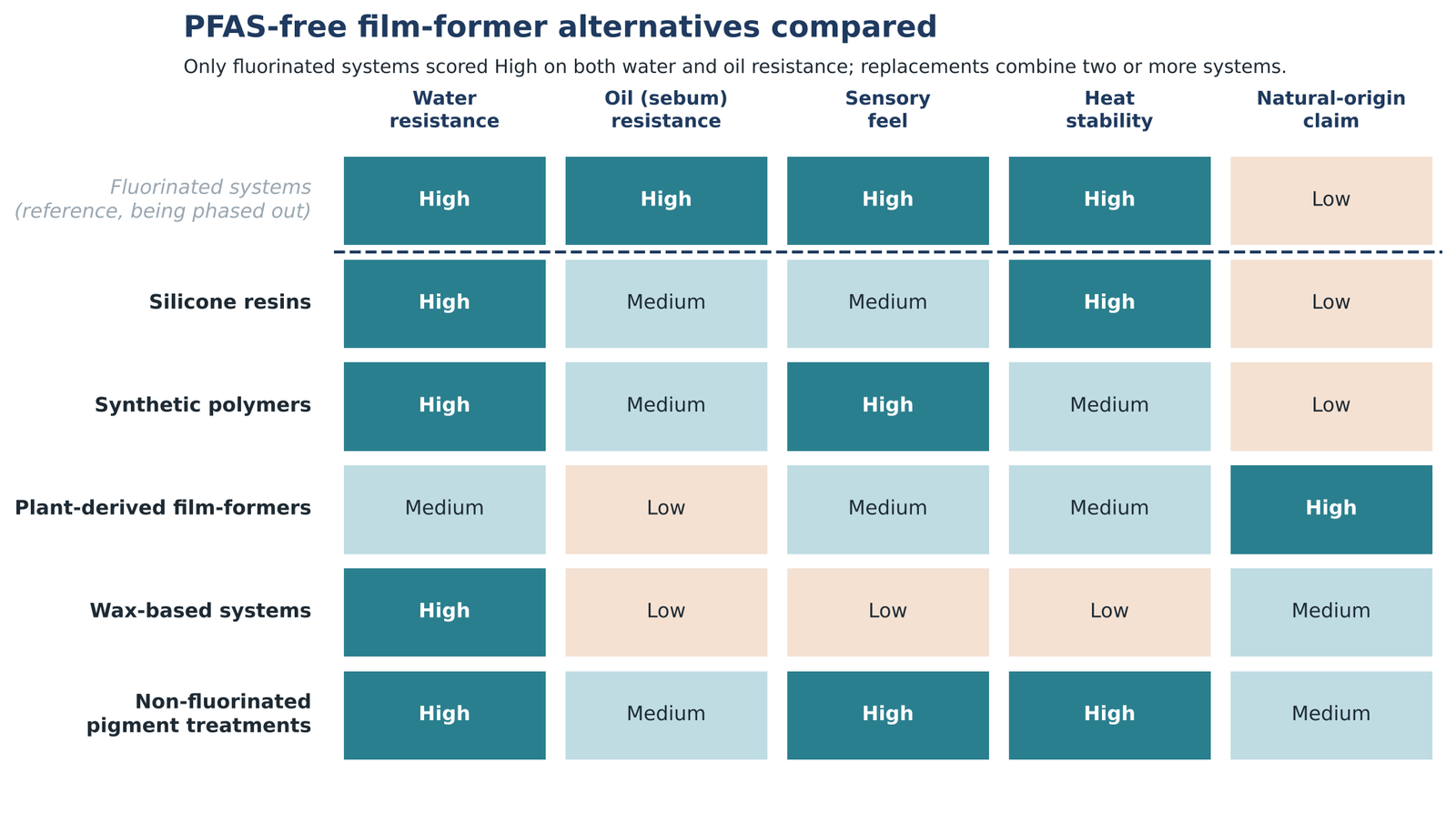
| Alternative | Strength | Weakness |
|---|---|---|
| Silicone resins | Strong water resistance | Weakened by sebum; rules out silicone-free claims |
| Synthetic polymers (acrylates, VP/eicosene) | Flexible, transfer-resistant film | Some lack oil resistance |
| Plant-derived film-formers | Natural-origin claims | Variable water resistance |
| Waxes | Structure, water resistance | Soften in heat |
| Alkyl-silane or amino-acid pigment treatments | Restore water repellency | Lower oil repellency |
Pair a hydrophobic, non-fluorinated pigment treatment with a resin–polymer film. The treatment holds colour; the film carries wear. A straight 1:1 swap to alkyl-silane pigments typically keeps water resistance but loses oil resistance and late-day wear, so close the gap with the film system and oil-absorbing powders, and measure it.
05Water resistance and SPF without fluorochemistry
Three levers recover most of the lost water resistance:
- Inverse emulsions
Water-in-oil and water-in-silicone bases resist rewetting better than oil-in-water systems.
- Film continuity
Plasticise the resin so the film does not crack on mobile areas of the face.
- Low hydrophilic load
Cut back on humectants and high-HLB emulsifiers that pull water into the film.
Oil resistance is handled separately, with sebum-resistant resins and oil-absorbing powders such as silica.
For sunscreens, reassess every claim after reformulation. Removing a fluorinated film enhancer can change film uniformity or filter dispersion, and with it the SPF. In the EU, "water resistant" and "very water resistant" follow the Cosmetics Europe guideline: at least 50% of the SPF must remain after 2 × 20 or 4 × 20 minutes of immersion [8]. Screen candidates in vitro during development, for example with ISO 23675 [11], then confirm the finished product in vivo with ISO 24444 [9] and the water-immersion procedure of ISO 16217 with ISO 18861 [10]. ISO 23675 cannot determine water resistance on its own.
06Sensory design after PFAS removal
Shoppers rarely notice a compliance change, but they notice when a foundation feels different. Typical changes after PFAS removal:
- more drag on application
- a slower, tackier dry-down
- shine breaking through by midday
- a tighter feel on skin
- earlier transfer
The usual corrections are spherical powders, volatile carriers, matte resin grades and flexible co-film-formers. Fix performance first, then tune sensory in a second round with a trained sensory panel. Change both at once and you cannot tell which ingredient caused which effect.
07Why UAE heat makes this harder
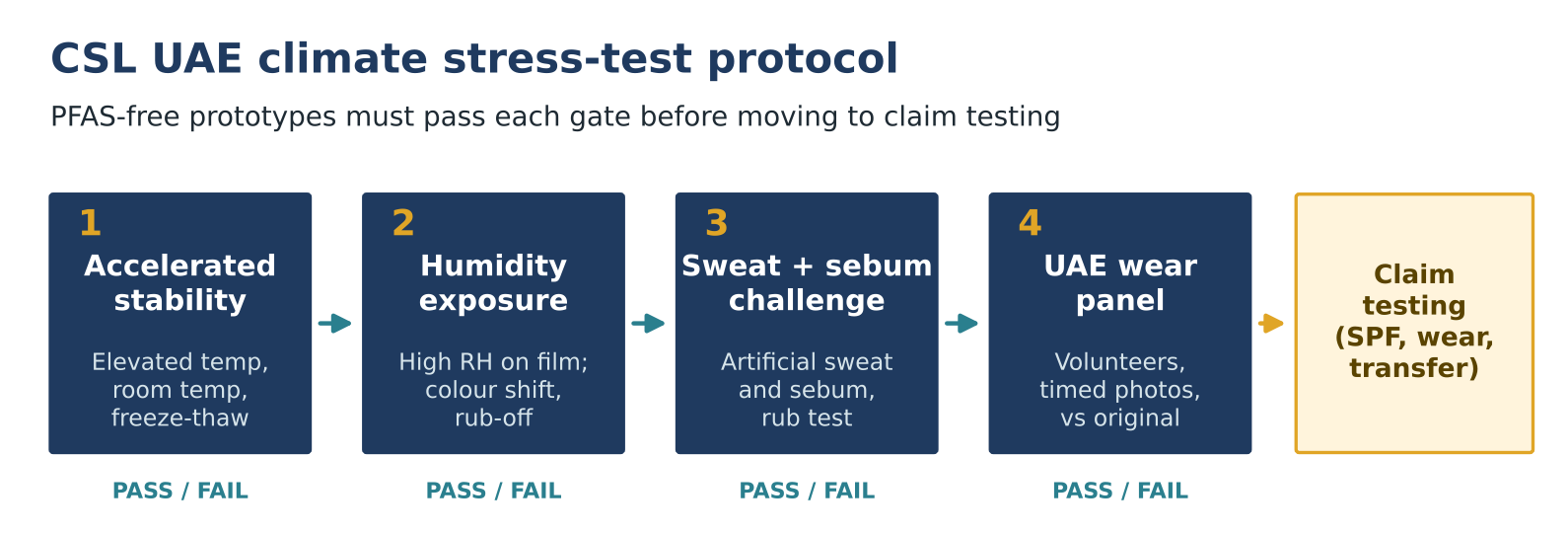
Coastal UAE summers combine temperatures above 40 °C with high humidity. A PFAS-free formula then faces three stresses at once:
- Waxes and resins that hold at 25 °C soften on hot skin.
- Higher sebum output tests exactly the oil resistance fluorochemistry used to provide.
- Products left in cars and warehouses face heat that stresses both the emulsion and the pack.
Build the stress-test plan around the conditions of every target market. A formula validated under European conditions should not be assumed to hold in a GCC summer, and Gulf stress data do not replace market-specific stability, packaging-compatibility or claim testing.
08Verifying PFAS-free raw materials
A PFAS-free formula is only as reliable as its least-documented raw material. Pre-treated pigments and powder blends are the usual blind spots.
- Request supplier PFAS statements that cite Regulation (EU) 2024/2462 and both limits [1]
- Get the full surface-treatment composition for every pigment and filler
- Flag any INCI name containing "fluoro", "perfluoro" or "PTFE"
- Check for cross-contamination on shared manufacturing lines
- Test the finished product before the first EU shipment and file the evidence with your Responsible Person
A "PFAS-free" statement alone is not enough. Review its scope, threshold, analytical method and reporting limits alongside raw-material traceability.
09One formula for the GCC and the EU
Separate formulas for each market multiply stability work, sourcing and batch records, and raise the risk of shipping the wrong batch. One reformulated product can simplify development and documentation, but it does not remove market-specific obligations. The European Chemicals Agency's broader PFAS restriction proposal lists cosmetics among the uses under assessment [6], so a PFAS-free formula also protects you against the next rule. GCC products still need their own UAE and GSO assessment, which our regulatory team can run alongside the EU file.
| Category | PFAS-free route | Trade-off | Must-pass test |
|---|---|---|---|
| Foundation | Treated pigments + silicone resin film | Midday shine | Sebum rub + UAE wear panel |
| Powder | Spherical silica or starch in place of PTFE | Less slip | Payoff + sensory panel |
| Mascara | Wax + polymer film | Harder removal | Humidity smudge test |
| Liquid lip | Silicone resin + acrylate film | Tighter feel | Transfer test |
| Sunscreen | Polymer film + re-treated filters | Possible SPF drop | ISO 24444; ISO 16217 + 18861 |
10How CSL validates the reformulation
- Audit
Find every fluorinated material, including those inside pigments, by document review and total-fluorine screening.
- Feasibility
Map each affected function to a PFAS-free route through our formulation and benchmarking teams.
- Prototype
Build two or three candidates and screen them under Gulf stress conditions.
- Stability and claims
Run full stability on the lead formula, then wear, SPF and water-resistance testing.
- Compliance file
Finished-product PFAS analysis plus documentation for the EU and GCC.
11Questions readers ask
What does the EU PFHxA restriction mean for cosmetics?
From 10 October 2026, cosmetics placed on the EU market must contain less than 25 ppb of PFHxA and its salts and less than 1,000 ppb of PFHxA-related substances under REACH Annex XVII entry 79. Assess each fluorinated ingredient against the defined scope rather than assuming every C6 material is covered.
Does it ban all PFAS in cosmetics?
No. The EU measure covers PFHxA, its salts and related substances, not every PFAS. A broader EU restriction is under assessment, and France has banned PFAS in cosmetics under national law since 1 January 2026.
Are PFAS-free cosmetics less effective?
Not necessarily. Water resistance is usually recoverable. Oil resistance needs a combined system of pigment treatment, film-formers and oil-absorbing powders, confirmed by performance testing.
Do UAE rules ban PFAS in cosmetics?
This article does not identify a blanket UAE ban on PFAS in cosmetics. A UAE product sold in the EU must meet the EU limits, and UAE and GCC requirements must be assessed separately for the intended market.
Reformulating for the PFHxA limits?
Send us your formula or finished product. We audit the raw materials, map PFAS-free routes and test the result for the EU and the Gulf.
12References
- European Commission. Commission Regulation (EU) 2024/2462 of 19 September 2024 amending Annex XVII to Regulation (EC) No 1907/2006 as regards undecafluorohexanoic acid (PFHxA), its salts and PFHxA-related substances. OJ L, 20 September 2024. EUR-Lex
- SGS. EU regulates PFHxA and PFHxA-related substances under REACH. SafeGuardS 145/24, 22 September 2024. SGS
- Whitehead HD, Venier M, Wu Y, et al. Fluorinated compounds in North American cosmetics. Environmental Science & Technology Letters, 2021; 8(7): 538–544. doi:10.1021/acs.estlett.1c00240
- CosmeticOBS. Regulation (EU) 2024/2462: a restriction on certain PFAS applicable to cosmetics. 23 September 2024. CosmeticOBS
- Personal Care Insights. EU limits PFHxA "forever chemical" use in cosmetics under REACH. 24 September 2024. Personal Care Insights
- CosLaw.eu. ECHA publishes updated EU PFAS restriction proposal. 8 September 2025. CosLaw.eu
- King & Spalding. France adopts a law banning PFAS in cosmetics, textiles and waxing products. 19 March 2025. King & Spalding
- Cosmetics Europe (Colipa). CR 16: Water resistance labelling, based on the Colipa Guidelines for evaluating sun product water resistance (2005). Cosmetics Europe PDF
- ISO 24444:2019 Cosmetics — Sun protection test methods — In vivo determination of the sun protection factor (SPF). ISO
- ISO 18861:2020 Cosmetics — Sun protection test methods — Percentage of water resistance; used with ISO 16217:2020 (water immersion procedure). ISO
- CTPA. ISO publishes new SPF test methods (ISO 23675:2024 double plate method and ISO 23698:2024 HDRS). 14 January 2025. CTPA
Update log
- Published by Cosmetic Science Lab
This article is general technical information, not legal or regulatory advice. Confirm requirements for your product and market before launch.