Skin brightening ingredients compared: mechanism, evidence, stability and claim risk
Brightening actives are not interchangeable. Each has a different mechanism, evidence level, regulatory position and stability profile, and the claim you can make depends on all four. A working assessment of the four actives Indian brands ask about most.
By CSL Ingredient and application science team, Cosmetic Science Lab · Reviewed by Dr. Premalatha, Ph.D., Life Science, Regulatory Consultant
Quick answer
Mintel's 2026 India facial skincare research tells brands to "double down on brightening" [1], so formulators are asked to deliver it with the right active, dose and proof. Niacinamide has the most controlled human data of the four; vitamin C depends on the derivative; arbutin depends on form and level; topical tranexamic acid is still emerging and sits closest to drug claims.
Take-home message for manufacturers
- Assess every active on the same eight points before choosing it
- Test stability under heat, humidity and long distribution routes
- Never treat hydroquinone to niacinamide as a simple swap
Take-home message for brand owners
- Choose the claim your evidence can carry: "brightening" and "glow" are not "whitening"
- Ask for endpoint data on your finished formula
- Check each active's classification before you print the pack
01How to assess a brightening active
We evaluate each active on eight points: claim, biological target, evidence level, stability in Indian climate conditions, skin-tone inclusivity, measurement endpoint, regulatory status and claim risk. Regulatory status refers to the Drugs and Cosmetics Act [2] and the Cosmetics Rules 2020 [3]. The table is a working assessment for formulation and regulatory review, not a final regulatory opinion.
| Active | Biological target | Evidence level | Regulatory status (India) | Stability profile | Claim pathway | Claim risk |
|---|---|---|---|---|---|---|
| Niacinamide | Melanosome transfer; barrier support | Moderate | Cosmetic ingredient; confirm listing | Stable across a wide pH range | Tone-evening, glow | Lower |
| Vitamin C derivatives | Tyrosinase pathway; antioxidant | Varies by derivative | Cosmetic ingredient; confirm listing | Heat, light and metal sensitive | Brightening, radiance | Medium |
| Arbutin | Tyrosinase inhibition | Moderate | Check form and level; hydroquinone release | pH and hydrolysis dependent | Visible dark spots | Higher |
| Tranexamic acid | Plasmin; melanocyte signalling | Emerging (topical) | Oral is a drug; topical depends on claim | Water-soluble; test in the system | Tone-evening; avoid melasma wording | Higher |
02Niacinamide: mechanism, evidence and formulation
Active profile
In laboratory work, niacinamide did not change melanin production in cultured melanocytes but inhibited melanosome transfer by 35–68% in a co-culture model [4]. In the clinical studies in the same paper, 5% niacinamide (18 subjects with hyperpigmentation) and 2% niacinamide with sunscreen (120 subjects with facial tanning) gave less hyperpigmentation than vehicle after 4 weeks [4]. The panels were Japanese women, so evidence across Indian skin tones should come from your own study.
For formulation, keep the pH where niacinamide is stable, since hydrolysis to nicotinic acid can cause flushing, and test tolerance at your target level. A higher percentage is not automatically a stronger claim.
In a split-face trial of 27 melasma patients over 8 weeks, 4% niacinamide gave good-to-excellent improvement in 44% of patients against 55% for 4% hydroquinone, with side effects in 18% against 29% [5]. Different efficacy, tolerability and regulatory position make it a reformulation, not a replacement.
03Vitamin C derivatives: stability across Indian climate and distribution
Active profile
L-ascorbic acid is potent but unstable and difficult to deliver into the skin at the optimum dose, which is why research has moved towards stable compounds [6]. Derivatives such as ascorbyl phosphates and glucosides trade some potency for stability, but each converts and performs differently in skin, so evidence cannot be borrowed from one derivative to another. Heat, light, trace metals and oxygen drive colour change and loss of activity.
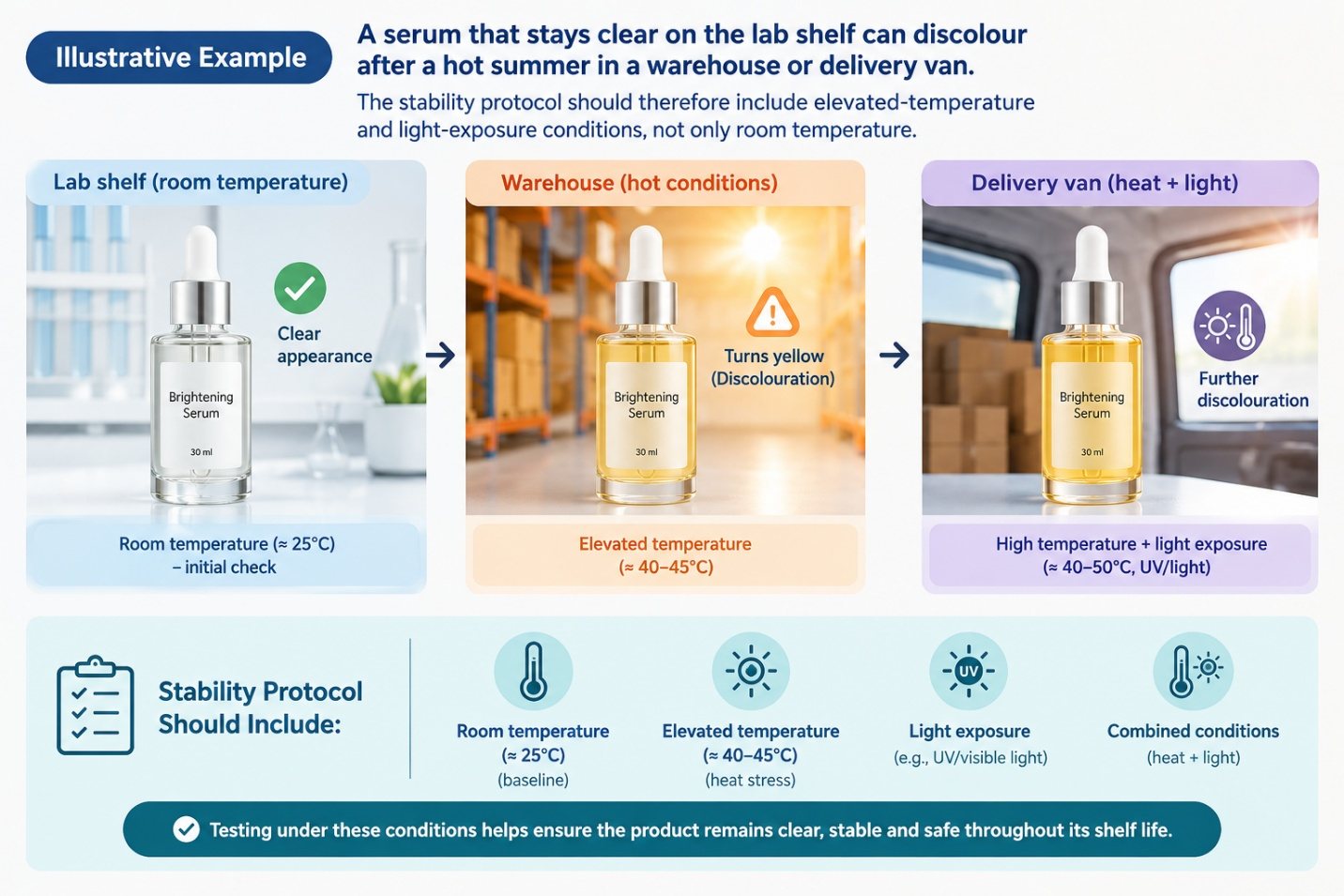
Validate with accelerated and real-time stability studies at conditions that reflect Indian storage and transport, and protect the formula with suitable packaging.
04Arbutin, tranexamic acid and emerging actives
Active profile
A tyrosinase inhibitor. Alpha and beta forms differ, and both can release hydroquinone, which is why the EU's SCCS set conditions for each: alpha-arbutin up to 2% in face cream and 0.5% in body lotion, beta-arbutin up to 7% in face cream, with residual hydroquinone kept as low as possible [7]. That is an EU benchmark, not an Indian limit, but it shows why form and level need a check.
Active profile
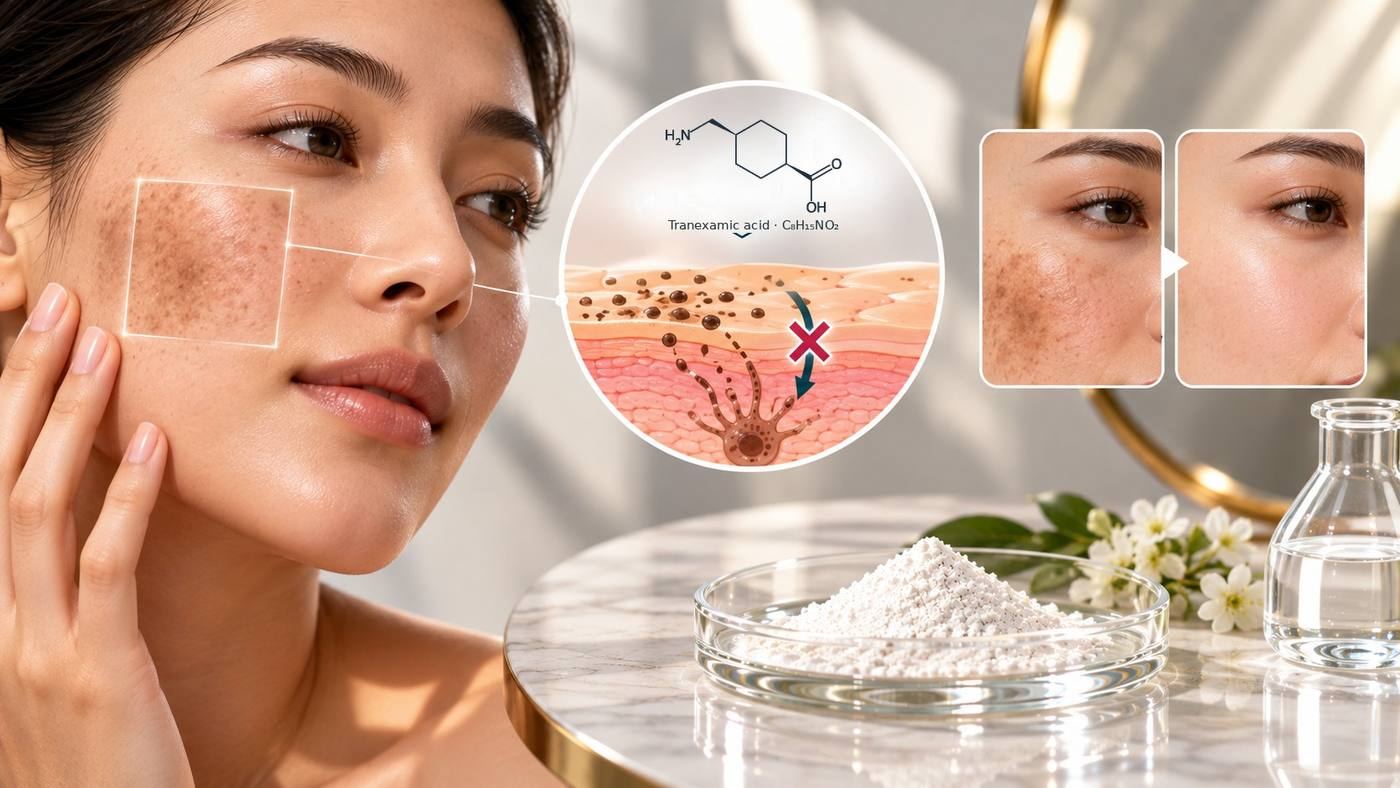
A 2017 meta-analysis of 11 studies and 667 participants found lower melasma severity scores across oral, topical and injected routes [8]. That is evidence in a medical condition. Using it to support a cosmetic tone claim, or naming melasma on pack, moves towards a drug claim.
Others: azelaic acid, kojic acid, 4-butylresorcinol, licorice extract and glutathione each have their own evidence, and some are restricted in other markets, so check them individually.
05Formulating across Indian skin tones and use conditions
- Climate: design for heat, humidity, sweat and sebum, and validate preservation and stability under tropical conditions
- Tolerance: irritation can leave marks, so well-tolerated systems matter for pigmentation claims
- Panels: recruit across the tone range of your consumers and record tone by colorimetry, not self-report alone
- Endpoints: match the measure to the wording, such as melanin index and expert grading for tone-evening, or reflectance and hydration for glow
- Sun protection: UV exposure can undo results, so pair brightening with daily photoprotection
06How CSL takes a brightening active to a claim
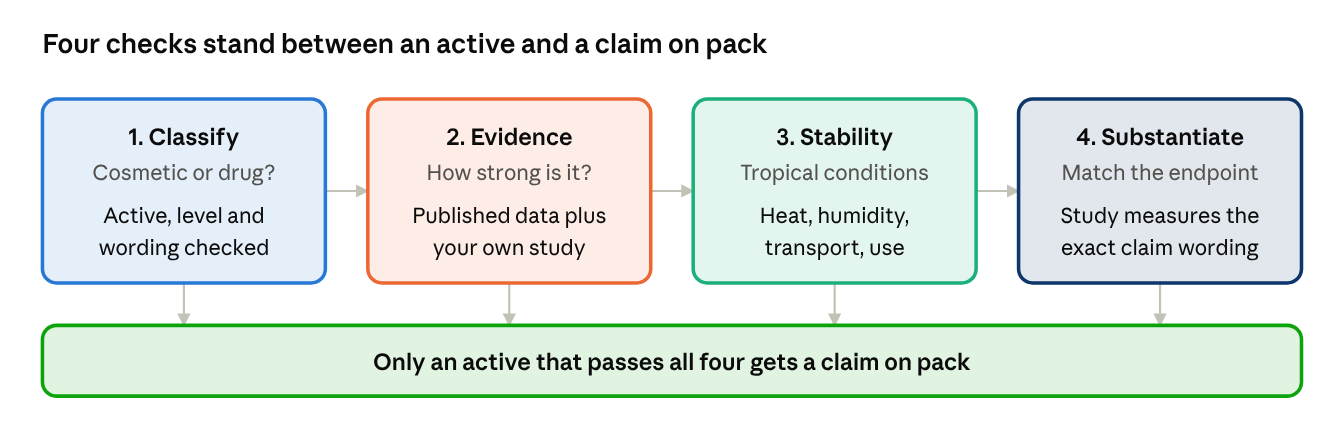
Before a claim is written, each active passes the four checks in Figure 1: regulatory classification, evidence level, stability validation under tropical conditions, and claim substantiation with a matching endpoint. This is how we run formulation, testing and regulatory projects for brightening products.
For the market context behind the shift from "fairness" to "glow", read what India's claim shift means for formulation.
07Questions readers ask
Can I replace hydroquinone with niacinamide and keep the same claim?
No. They have different mechanisms, regulatory positions and evidence, so the claim must be reassessed.
Which brightening ingredient has the strongest evidence?
It depends on the claim and the form. Niacinamide has several controlled studies, while the evidence for topical tranexamic acid as a cosmetic is still emerging.
Is alpha arbutin safe in cosmetics?
The EU SCCS considers alpha-arbutin safe up to 2% in face cream and 0.5% in body lotion, provided residual hydroquinone is kept as low as possible. Check the limits that apply in your own market.
Need a brightening active assessed for your brief?
Bring a brief or a benchmark. We check classification, evidence and tropical stability, then design the claim study.
08References
- Mintel. India Facial Skincare Market Report 2026. Mintel
- The Drugs and Cosmetics Act, 1940, section 3(aaa) and 3(b). Indian Kanoon
- Ministry of Health and Family Welfare, Government of India. The Cosmetics Rules, 2020, G.S.R. 763(E), 15 December 2020. CDSCO
- Hakozaki T, et al. The effect of niacinamide on reducing cutaneous pigmentation and suppression of melanosome transfer. British Journal of Dermatology, 2002; 147(1): 20–31. doi:10.1046/j.1365-2133.2002.04834.x
- Navarrete-Solís J, et al. A double-blind, randomized clinical trial of niacinamide 4% versus hydroquinone 4% in the treatment of melasma. Dermatology Research and Practice, 2011; 2011: 379173. PMC3142702
- Telang PS. Vitamin C in dermatology. Indian Dermatology Online Journal, 2013; 4(2): 143–146. PMC3673383
- Scientific Committee on Consumer Safety (SCCS). Opinion on the safety of alpha-arbutin and beta-arbutin in cosmetic products, SCCS/1642/22, final version 31 January 2023. European Commission
- Kim HJ, Moon SH, Cho SH, Lee JD, Kim HS. Efficacy and safety of tranexamic acid in melasma: a meta-analysis and systematic review. Acta Dermato-Venereologica, 2017; 97(7): 776–781. PubMed
Update log
- Published by Cosmetic Science Lab
This article is general technical information, not legal or regulatory advice. Confirm requirements for your product and market before launch.