Why a lotion separates at 40 °C: a worked emulsion stability example
A worked example of how CSL scientists troubleshoot a body lotion that splits in accelerated stability: reading the clues, measuring droplet size and viscosity, finding the root cause and proving the fix.
By Dr. Premalatha, Ph.D., Life Science, Regulatory Consultant, Cosmetic Science Lab
Quick answer
- Why does a lotion separate at 40 °C? Heat speeds up the processes that pull an emulsion apart. A free oil layer on top means droplets are merging (coalescence), not just rising (creaming).
- Droplet size and viscosity tracked over time show which mechanism is at work and whether a fix really holds.
- Common causes are an emulsifier blend that misses the oil phase's required HLB, too little fatty alcohol to build a gel network, and short homogenisation.
- Fix the cause, then prove it with accelerated, centrifuge and freeze-thaw tests. Extra thickener alone often only delays separation.
This is a teaching example, not a client project. The product, formula and every number in the figures and tables are illustrative, chosen to show how CSL scientists approach an emulsion stability failure. Your own product will give different values.
01The problem: a lotion that splits in the stability oven
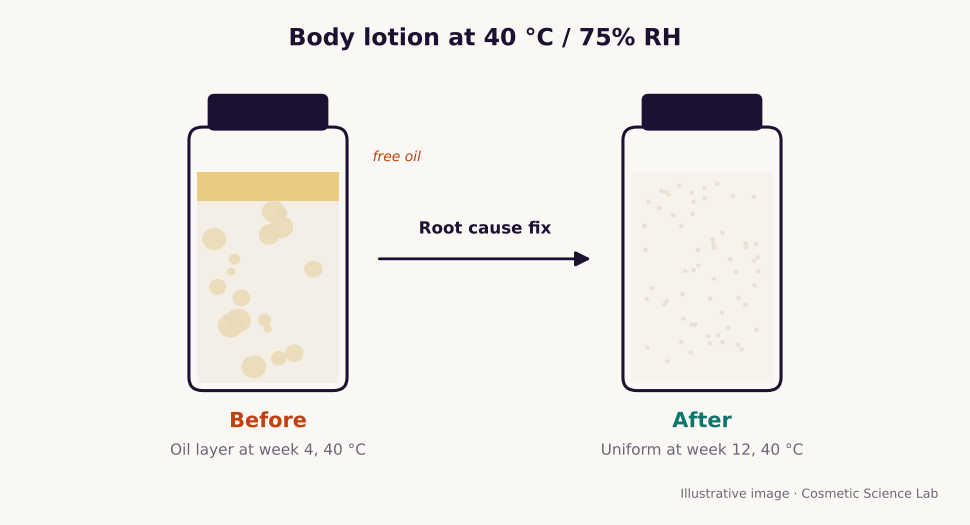
Picture a new oil-in-water (O/W) body lotion with a 22% oil phase and a launch date. Samples kept at room temperature look fine, but samples stored at 40 °C show a thin oil layer on top by week four. The brand needs three things: the reason it separated, a fix that keeps the skin feel, and stability data it can file.
That last point matters. In the EU, the cosmetic product safety report must cover the product's physical and chemical characteristics and its stability [1], so a failed study can hold up launch.
02Reading the clues from the stability test
A lotion is a dispersion of oil droplets held apart in water by emulsifiers, thickeners and fatty alcohols. Emulsions are thermodynamically unstable, so heat and time push them back towards two layers. Our guide What is an emulsion? covers the basics.
- Separation at 40 °C, not at 25 °C. Heat is exposing a weakness that room temperature hides.
- Oil, not cream, on top. A free oil layer points to coalescence, where droplets merge for good. Creaming alone gives a denser cream layer that can be shaken back [2].
- Thinner lotion over time. A falling viscosity lets droplets move and collide faster, which speeds up both creaming and coalescence.
A stability test shows that a product fails, not why. Stokes' law shows the levers: the speed at which droplets rise grows with the square of their radius and falls as the water phase thickens.
v = 2r²(ρc − ρd)g / 9η, where r is droplet radius, ρc and ρd are the water- and oil-phase densities, g is gravity and η is the water-phase viscosity. Doubling droplet size makes droplets rise four times faster.
03A four-step root-cause approach
No single protocol fits every cosmetic, so the manufacturer sets and justifies its own stability methods and limits [3], [4]. A protocol built around this failure would run in four steps.
- Reproduce the failure. Put fresh batches into accelerated storage at 40 °C/75% RH, with 25 °C and 4 °C controls. The 40 °C/75% RH condition comes from the ICH Q1A(R2) pharmaceutical guideline [5] and is widely adapted for cosmetics, and the cosmetics guidelines describe tests at 37, 40 or 45 °C [4]. A centrifuge test speeds up separation further; in the example, 3,000 rpm for 30 minutes gives a 7% creamed layer.
- Measure droplet size and viscosity. In the example, laser diffraction shows a median droplet size (D50) of 6.8 µm on day 0, growing to 18.4 µm by week four at 40 °C, while viscosity falls 58%. Droplets that keep growing are the signature of coalescence.
- Read the formula. Here the emulsifier blend sits about two HLB units below the oil phase's required HLB, cetearyl alcohol is at 1%, too low to build a stabilising gel network, and homogenisation runs for only five minutes. See emulsifiers explained for how required HLB works.
- Fix and prove it. Rebalance the emulsifiers to the required HLB, raise cetearyl alcohol to 3% to form a lamellar gel network, extend homogenisation to 10 minutes at 75 °C and raise xanthan gum to 0.3%. Then repeat the full test set.
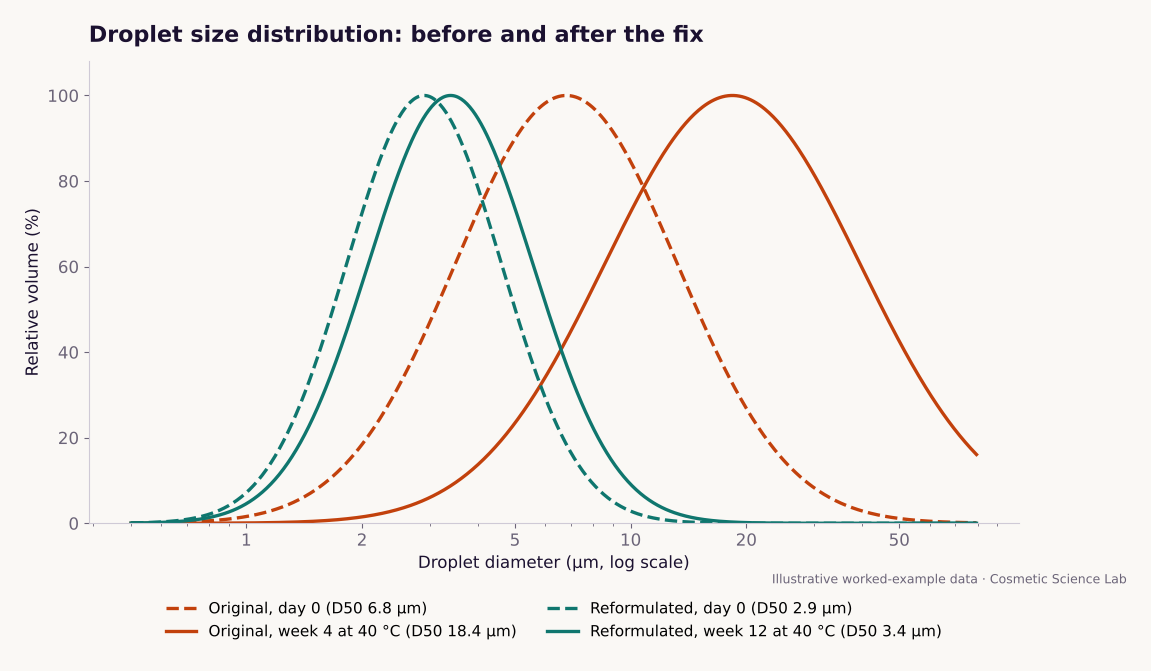
04What a fixed emulsion looks like in the data
In the example, the reformulated lotion holds together through 12 weeks at 40 °C/75% RH with the same skin feel. The point is the pattern, not the exact numbers: droplets stay small, viscosity barely drifts and every stress test passes.
| Measure | Before (original) | After (reformulated) |
|---|---|---|
| Centrifuge test (3,000 rpm, 30 min) | 7% creamed layer | No separation |
| Droplet size D50, day 0 | 6.8 µm | 2.9 µm |
| Droplet size D50 at 40 °C | 18.4 µm (week 4) | 3.4 µm (week 12) |
| Viscosity drift at 40 °C | −58% (week 4) | −8% (week 12) |
| Appearance at 40 °C/75% RH | Oil layer by week 4 | Uniform at week 12 |
| Freeze-thaw (3 cycles) | Grainy texture | Pass |
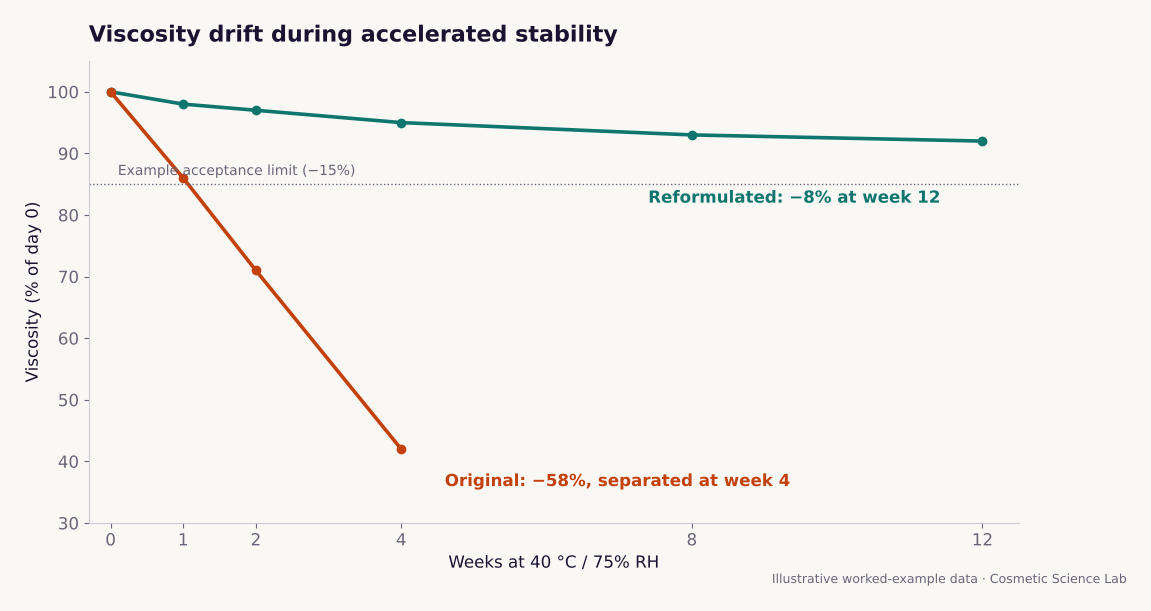
Accelerated data predict shelf life; they do not prove it. A real-time study at 25 °C should run alongside to confirm the shelf-life claim after launch [4].
05Emulsion stability lessons for brands and formulators
| Lesson | Why it matters |
|---|---|
| Find failures early | Centrifuge and 40 °C testing reveal a weak emulsion in days or weeks, before it reaches shelves and becomes returns or complaints. |
| Fix the cause, not the symptom | Extra thickener can hide separation for a while. Droplet size and viscosity data show whether the emulsion is truly stable. |
| Launch with evidence | A documented stability study supports shelf-life claims and the safety file regulators expect [1]. |
06Questions readers ask
Why do creams and lotions separate?
Emulsions are thermodynamically unstable. Over time, and faster with heat, oil droplets rise (creaming) or merge (coalescence) until the product splits into layers.
What is the difference between creaming and coalescence?
Creaming is droplets rising without merging, so the product can often be shaken back together. Coalescence is droplets merging into bigger ones, which ends in a free oil layer and cannot be reversed by shaking.
How long should accelerated stability testing run?
There is no single rule; the manufacturer sets and justifies the protocol. Studies of one to three months at 37–45 °C are common for cosmetics, backed by real-time data at room temperature.
Does adding more thickener fix separation?
It can slow creaming by raising viscosity, but it does not stop droplets from merging. If the emulsifier system or process is the cause, the product may still separate later.
Got a lotion or cream that separates?
Our formulation and testing teams find the root cause with droplet size, viscosity and accelerated stability data, then fix the formula.
07References
- Regulation (EC) No 1223/2009 of the European Parliament and of the Council on cosmetic products, Annex I, Part A, section 2 (physical/chemical characteristics and stability of the cosmetic product). OJ L 342, 22.12.2009, p. 59. EUR-Lex
- Tadros TF. Emulsions: Formation, Stability, Industrial Applications. Berlin: De Gruyter; 2016. DOI
- ISO/TR 18811:2018. Cosmetics — Guidelines on the stability testing of cosmetic products. Geneva: ISO; 2018. ISO
- Cosmetics Europe and CTFA. Guidelines on Stability Testing of Cosmetic Products. Brussels: Cosmetics Europe; March 2004. PDF
- International Council for Harmonisation. ICH Q1A(R2): Stability testing of new drug substances and products (accelerated condition 40 °C ± 2 °C/75% RH ± 5% RH). 2003. EMA
Update log
- Published by Cosmetic Science Lab
This article is general technical information, not legal, regulatory or medical advice. Confirm requirements for your product and market before launch.