What are the different analytical methods used in cosmetic formulation?
Your cream passed its bench checks, then separated in stability storage, and the lab ran rheology afterwards to confirm what everyone could see. Used early, analytical methods are design tools, not post-mortems. This is what each one measures and the decision it should drive.
By CSL Analytical and formulation teams, Cosmetic Science Lab · Reviewed by Dr. Premalatha, Ph.D., Life Science, Regulatory Consultant

- Part 1What each analytical method measures (this article)
- Part 2How to choose the right method at each stage
Quick answer
- Analytical methods in cosmetic formulation fall into five groups: chromatographic, spectroscopic, interfacial, rheological and specialised [1].
- Each method should drive a decision: accept a raw material, pick an emulsifier, rank prototypes or release a batch.
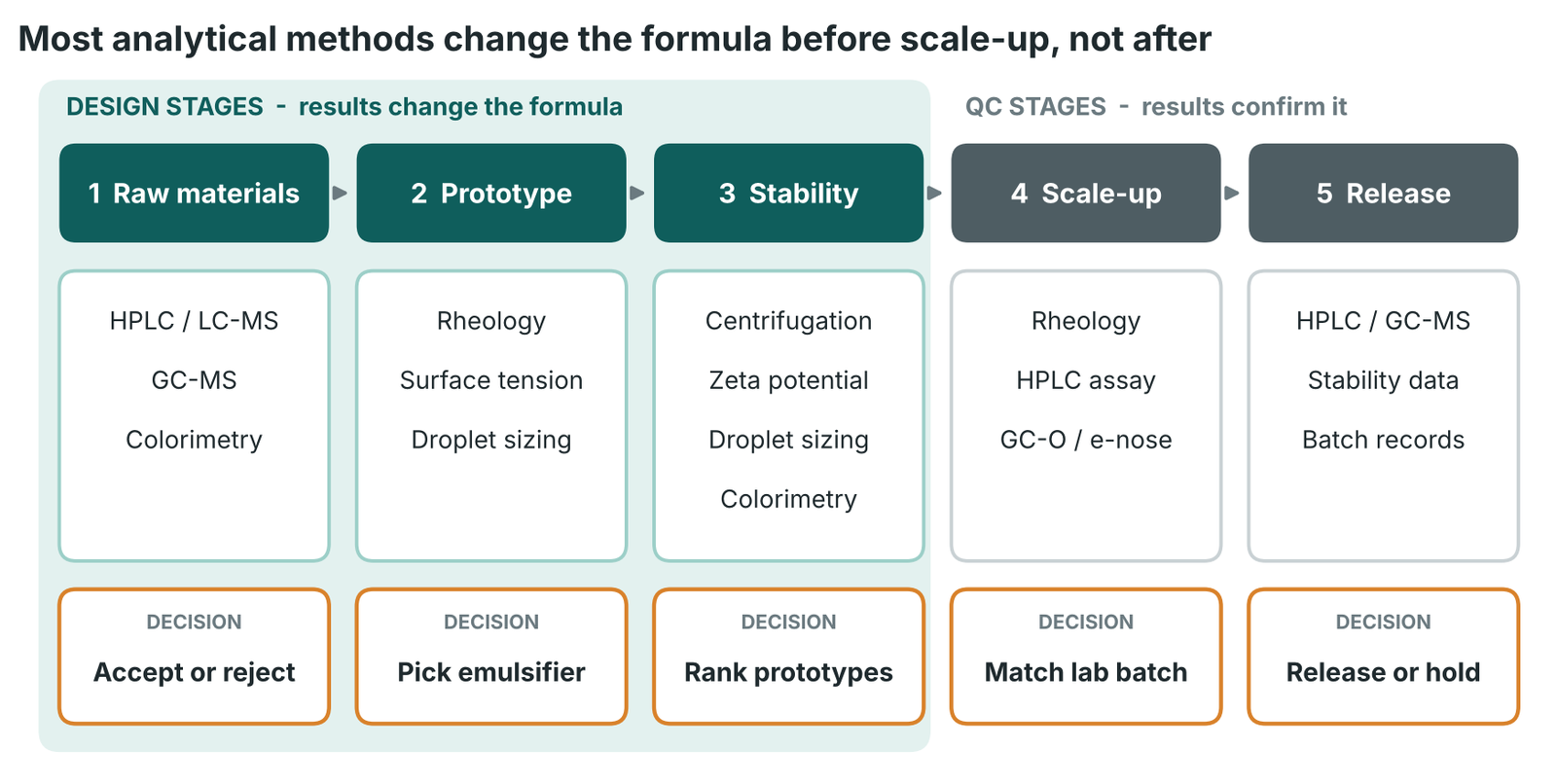
- Three of the five development stages come before scale-up. That is where analytics can still change the formula.
- No single technique characterises a product; nano, micro and macro data are needed together [1].
01The reactive analytics trap: why labs test after failure
Most labs test after something fails: a separated emulsion, a fragrance shift or a regulator's query. By then, testing only confirms the failure. A 2024 review in Cosmetics shows that analytical methods link a formula's microstructure to how it looks, feels and lasts [1]. The same instruments, used during design, flag the risk while the formula can still change. The review groups them into five categories, each answering a different formulation question:
| Category | Example methods | Decision it informs |
|---|---|---|
| Chromatographic | HPLC, LC-MS/MS, GC-MS | Accept or reject raw materials; confirm active content |
| Spectroscopic | Colorimetry, UV-Vis | Set colour specifications; catch colour drift |
| Interfacial | Surface and interfacial tension, contact angle | Choose the emulsifier system and level |
| Rheological | Flow curves, oscillation, temperature sweeps | Select thickener or polymer; tune texture |
| Specialised | Centrifugation, zeta potential, droplet sizing, electronic nose | Predict shelf life; keep fragrance consistent |
02Interfacial methods: choosing the emulsifier
Surface and interfacial tension show how well an emulsifier works at the oil–water boundary [1]. The lowest interfacial tension is not always best: systems right at the optimum formulation form unstable emulsions, and stability improves at a measured distance from it [1]. For particle-stabilised (Pickering) emulsions, contact angle governs whether fine particles can stabilise the interface [1].
Screen emulsifier type and level with interfacial data before building full prototypes. It narrows the candidates early and cuts the number of stability samples you need.
03Chromatography: LC and GC for identity and purity
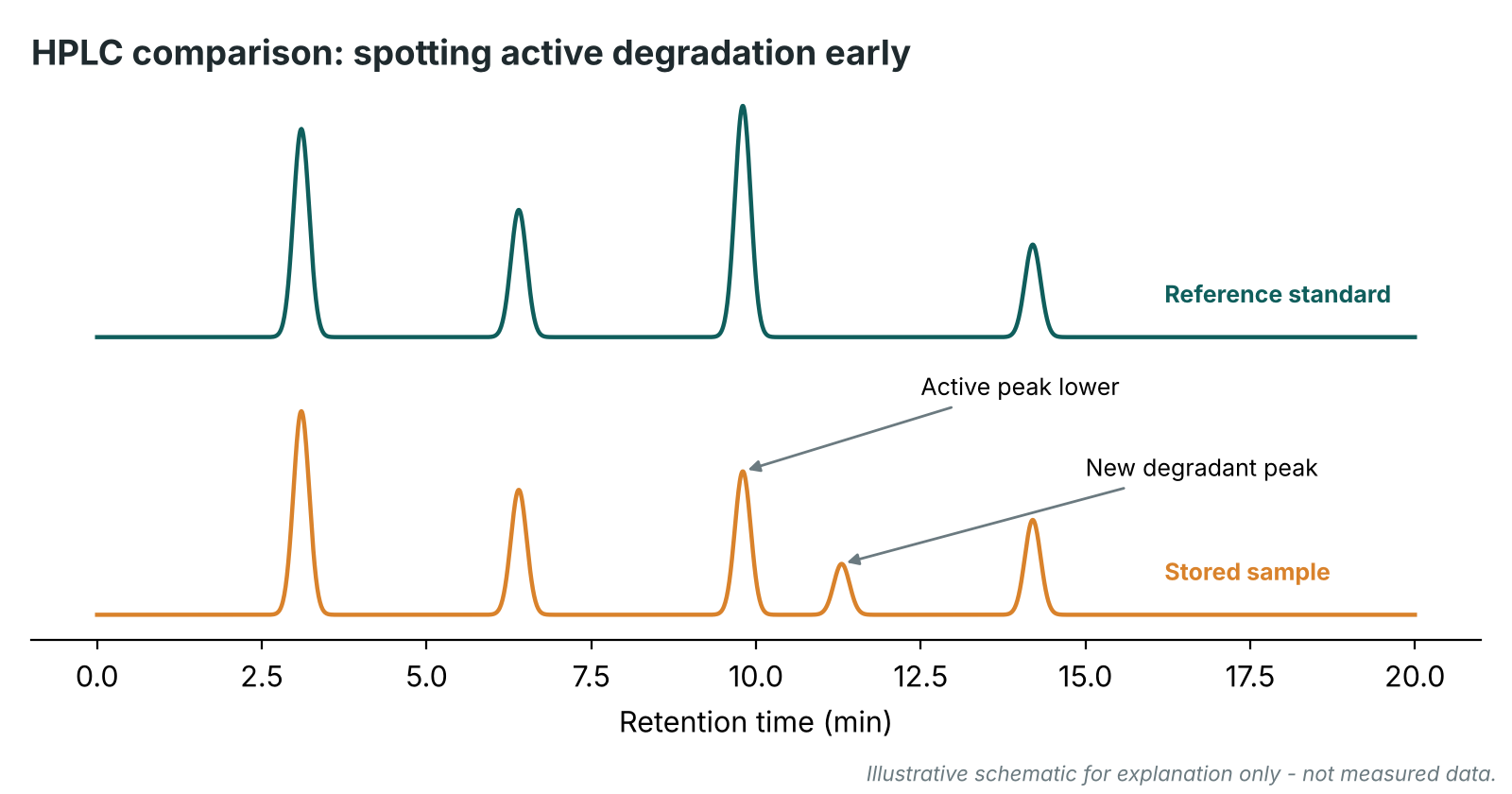
Chromatography separates a mixture so each ingredient can be identified and measured. Liquid chromatography (LC) and gas chromatography (GC) dominate cosmetic labs, paired with UV, diode-array (DAD) or mass spectrometry (MS) detectors [1].
| Liquid chromatography (HPLC, LC-MS/MS) | Gas chromatography (GC-FID, GC-MS) | |
|---|---|---|
| Best suited to | Non-volatile or heat-sensitive compounds | Volatile, low-molecular-weight compounds |
| Typical targets | UV filters, antioxidants, preservatives, colourants | Fragrance components, regulated allergens, solvents |
| When to deploy | Raw-material intake, active stability, batch QC | Fragrance development, allergen checks, batch QC |
Detector choice is a cost choice: UV and DAD suit routine work, while MS is needed for structure or trace levels [1]. Bio-based ingredients can also perform differently from fossil-derived ones [1], and intake chromatography is where you measure that difference before it reaches a prototype.
04Rheology for emulsion stability and texture
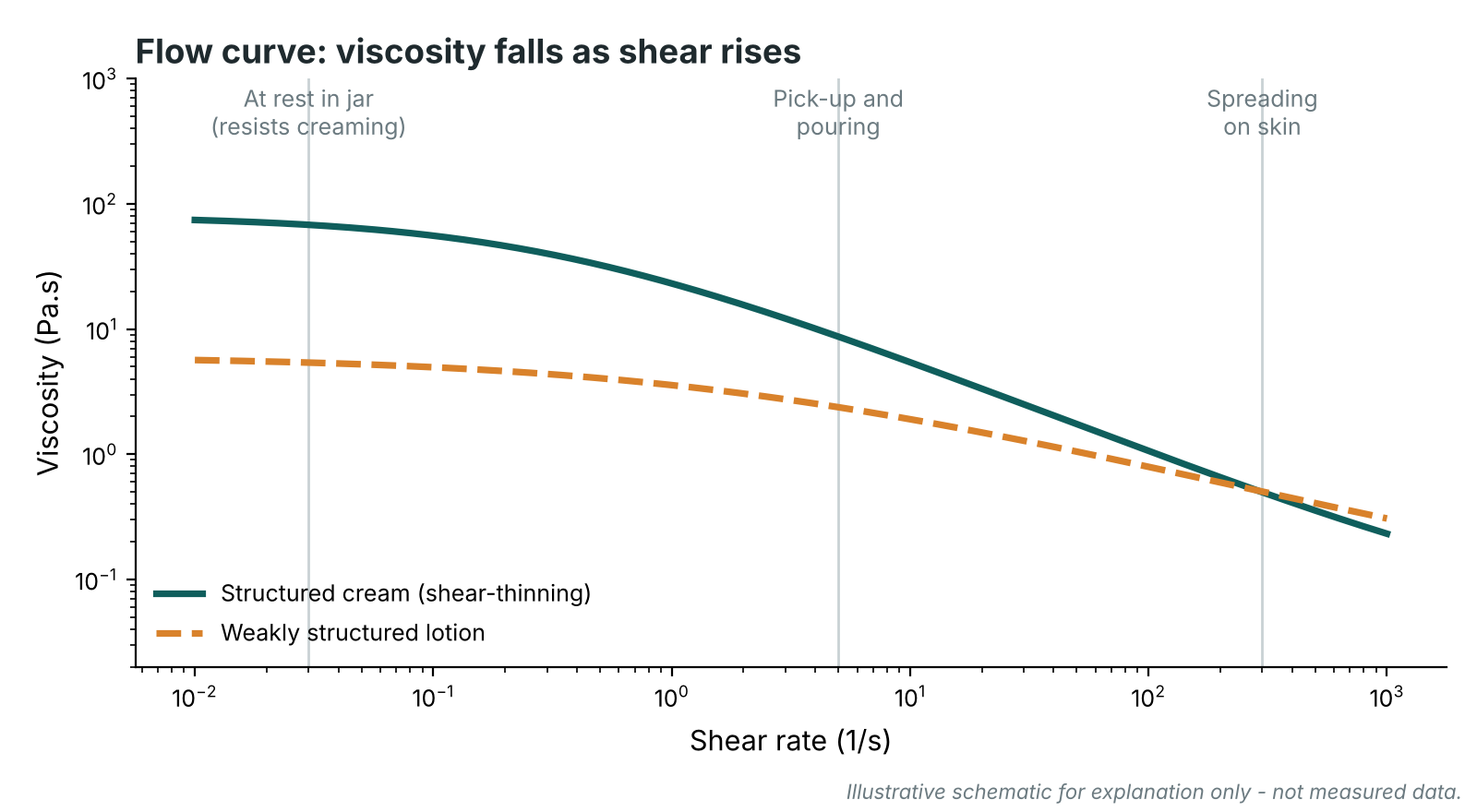
Creams and lotions are dispersions. They hold still in the jar, then thin out on the skin [1], [7]. Rheology measures this, and it works best during design:
- Flow curves: viscosity against shear rate, predicting pick-up, spreading and dispensing.
- Temperature sweeps: whether that structure collapses in heat during shipping or storage.
How to use it: a thicker continuous phase slows creaming, as Stokes' law predicts [1], [6]. Let rheology guide thickener and polymer choice, not just pass or fail a batch. Our case study on plant actives in O/W emulsions shows a temperature sweep predicting a 40 °C failure months ahead.
05Stability prediction: droplet size, zeta potential and centrifugation
Emulsions are thermodynamically unstable and will eventually cream, flocculate and separate [1], [6]. Shelf-life studies take months, so formulators stress prototypes with heat, light and centrifugation, then measure the change [4], [6].
| Method | What it reveals | Design decision |
|---|---|---|
| Droplet size | Larger droplets cream or settle faster | Adjust emulsifier level or homogenisation |
| Zeta potential | Surface charge that keeps droplets apart | Change emulsifier type or ionic content |
| Analytical centrifugation | Accelerated separation and size distribution | Rank prototypes before long-term storage |
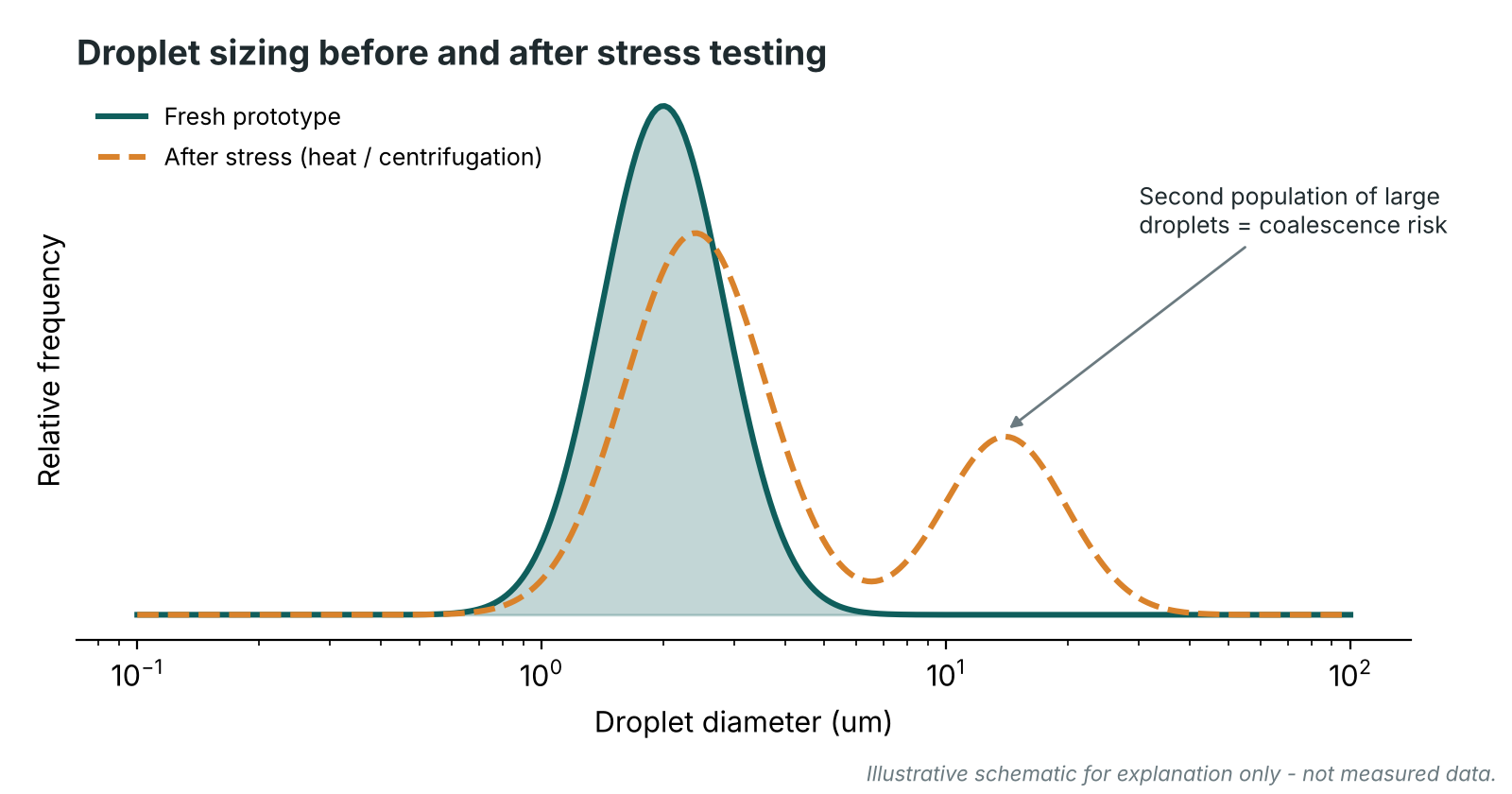
Zeta potential often needs diluted samples, which can change the system being measured [1]. And accelerated results should be confirmed with real-time monitoring, as the stability guidelines advise [4], [5]. Run droplet sizing before and after each stress cycle to see coalescence early.
06Colorimetry, olfactometry and the electronic nose
Colorimetry turns colour into lightness, chroma and hue values, so "slightly darker" becomes a measured shift you can specify and track through stability storage [1].
GC-olfactometry (GC-O) splits the gas chromatograph's output between a detector and a trained assessor, linking each volatile to its odour [1]. Electronic noses use sensor arrays to check a whole scent profile quickly and affordably, which suits batch-to-batch consistency checks [1].
07Inside CSL's multi-scale analytical approach
CSL schedules analytics from raw-material intake, so each result feeds a design decision before scale-up. The same data supports the EU safety file and ISO 22716 GMP records [2], [3]. Cosmetic QC testing still matters, but it should confirm a formula that analytics have already shaped. Our analytical bioscience lab runs the chromatography and characterisation work.
Part 2 gives the decision framework, cost tiers and regulatory checklist: How to choose analytical methods at each stage of development.
08Questions readers ask
Which analytical method should come first in cosmetic formulation?
Chromatography at raw-material intake. It confirms identity and purity before an ingredient reaches a prototype.
Can rheology predict emulsion stability?
Partly. Flow and oscillation data show whether the structure resists separation, but they should be confirmed with stability testing.
Is accelerated stability testing enough?
No. It ranks prototypes quickly, but real-time monitoring is advisable to confirm shelf life.
Do I need every analytical method for every product?
No. Match each method to a formulation question. A simple toner needs far less than a pigmented sunscreen emulsion.
Want analytics that shape the formula?
We plan the method set from raw-material intake to release, so each result changes a decision before scale-up.
09References
- Rico F, Mazabel A, Egurrola G, Pulido J, Barrios N, Marquez R, García J. Meta-analysis and analytical methods in cosmetics formulation: a review. Cosmetics, 2024; 11(1): 1. doi:10.3390/cosmetics11010001
- Regulation (EC) No 1223/2009 of the European Parliament and of the Council of 30 November 2009 on cosmetic products. EUR-Lex
- ISO 22716:2007 Cosmetics — Good Manufacturing Practices (GMP) — Guidelines on Good Manufacturing Practices. ISO
- Colipa (now Cosmetics Europe) and CTFA. Guidelines on stability testing of cosmetic products. March 2004. Cosmetics Europe PDF
- ISO/TR 18811:2018 Cosmetics — Guidelines on the stability testing of cosmetic products. ISO
- McClements DJ. Critical review of techniques and methodologies for characterization of emulsion stability. Critical Reviews in Food Science and Nutrition, 2007; 47(7): 611–649. PubMed
- Tadros TF. Rheology of Dispersions: Principles and Applications. Weinheim: Wiley-VCH, 2010. Wiley-VCH
Update log
- Published by Cosmetic Science Lab
This article is general technical information, not legal or regulatory advice. Confirm requirements for your product and market before launch.